A high-performance gaming desktop is one whose specifications let it hold a stated frame rate at a stated resolution without dropping settings, which in practice means 100 fps or better at 1440p high, or 60 fps or better at 4K high, sustained across a thirty-minute session rather than a sixty-second benchmark loop. Every other line on the specification sheet exists to keep the graphics card fed, powered and cool enough to keep doing that in hour three.
I am Marcus Reilly, nine years building and reviewing desktops, working out of a two-bench test lab with calibrated power meters and thermal probes. This article treats the specification sheet as a checklist rather than a list of adjectives: what each line controls, what number is the real floor, and what happens when a builder gets that line wrong. The eight machines further down are scored against that same checklist, using frame rates from repeatable loops at fixed settings and wattage read from a meter at the wall, not from a manufacturer’s rating plate.
Top 3 picks at a glance
The eight lines that decide performance, in order of impact
As an Amazon Associate we earn from qualifying purchases at no extra cost to you. Product prices and availability are accurate as of the date shown and are subject to change.




Specification sheets are printed in the order that flatters the machine. Sorted instead by how much each line moves measured frame rates, the order changes considerably:
- Graphics processor and VRAM capacity — sets the ceiling. Nothing else on the sheet raises it.
- Memory configuration — not capacity alone, but stick count and speed. A single-stick 32GB kit is slower than a dual-stick 16GB kit in every game I have measured.
- Processor core count and platform generation — matters at 1080p and in simulation titles, matters far less at 4K.
- Cooling capacity and case airflow — decides whether the first two lines deliver their rated numbers after twenty minutes.
- Power supply wattage and quality — decides whether the machine survives transient spikes.
- Storage interface and drive class — affects load times and texture streaming, not frame rates.
- Motherboard chipset and expansion — decides what the machine can become in two years.
- Chassis clearance figures — decides whether any of that upgrade path is physically possible.
A specification sheet that looks impressive on lines three and six while failing lines one and four is the most common trap in this category. Two of the eight machines below are exactly that shape.
Graphics processor and VRAM: the line that sets the ceiling
The graphics card determines the resolution and settings the machine can hold. Every other component either lets the card work at full speed or holds it back; none of them make it faster than its silicon allows.
Two numbers matter, and they are independent. Raster performance decides average frame rate. VRAM capacity decides whether you keep maximum texture detail while getting that frame rate. On my bench, an RTX 3050 6GB class card averaged 52 fps at 1440p high in a mixed six-game suite, a 5060 Ti 8GB averaged 96 fps, and a 5070 12GB averaged 129 fps. Those are large, obvious gaps that no processor upgrade closes.
The VRAM story is subtler and shows up in frame time consistency rather than averages. In a recent open-world title at 1440p high with maximum textures, the 8GB card produced a 94 fps average with 1 percent lows of 41 fps, and visible texture pop-in during fast traversal. The 12GB card at similar raster performance produced 108 fps average with 1 percent lows of 78 fps and no pop-in. Averages differed by 15 percent; the felt smoothness differed far more than that. This is why I treat 12GB as the working floor for a 1440p high-performance specification and 16GB as the floor for 4K, and why an 8GB card at a 1440p price is a compromise the sheet does not disclose.
The other detail worth reading is bus width and memory type, printed in small text if at all. A card with a narrow bus can post a strong synthetic score and then fall behind at higher resolutions where bandwidth binds. If the listing omits bus width, that omission is itself information. Our breakdown of which specs matter most in a gaming PC covers how to weight these figures against each other when a listing is deliberately vague.
Processor: enough cores, and the point where more stop paying
The processor’s job in a gaming desktop is to feed the graphics card fast enough that the card never waits. Once it does that, additional cores and clock speed produce almost nothing on screen.
Measured on my bench with a 5070-class card, moving from a six-core current-generation processor to an eight-core gained 6 to 11 percent at 1080p, 3 to 6 percent at 1440p, and under 2 percent at 4K. Moving from that eight-core chip to a sixteen-core flagship gained 1 to 4 percent at 1440p in ordinary games. In simulation and strategy titles with heavy background calculation, the flagship pulled ahead by 12 to 19 percent, which is the one genuine argument for it.
That produces a simple rule for reading the specification: an eight-core processor from a current platform is the target, a six-core is acceptable if the money moves to the graphics card, and a flagship paired with a mid-tier card is money spent on a number rather than on frames. The Core i9 machine in this group is the clearest example. It is a genuinely fast processor attached to a graphics card two tiers below what that processor could feed, and at 1440p it finishes within a handful of frames of a machine costing eleven hundred dollars less.
Platform generation matters more than raw clock speed for anything you plan to keep. A processor on a socket that still receives new chips can be replaced in three years; one on a closed socket cannot. That distinction never appears in the specification list and is worth more than a 200 MHz boost clock difference.
Memory: two sticks, then speed, then capacity
Memory is the line most often specified in a way that reads well and performs badly. The sheet prints total capacity. The number that changes frame rates is how that capacity is arranged.
A modern platform runs its memory in dual channel, which requires two matched sticks. Ship 32GB as one stick and the machine runs single channel. I have retested two prebuilts after adding a second matched module, changing nothing else, and measured 18 percent and 31 percent frame rate gains at 1080p, with the larger figure coming from a system using integrated graphics where the memory bus carries the graphics load as well. That is a bigger swing than most processor upgrades in this price range and it costs under sixty dollars.
Speed matters next. Moving DDR5 from 4800 MT/s to 6000 MT/s produced 4 to 9 percent in processor-limited scenes and under 2 percent in graphics-limited ones on my bench. Worth having, not worth paying a large premium for. Capacity comes last: 16GB is still adequate for gaming alone, 32GB is the sensible target for a machine that also records, streams or keeps a browser open with fifty tabs, and 64GB in a gaming specification is capacity you paid for and will not use unless your workload is content creation.
When a listing says “32GB DDR5” with no stick count and no speed, assume the least favourable arrangement until the seller confirms otherwise, and budget for a second module.
Storage: interface numbers that do not become frame rates
Storage specifications are quoted in sequential read speeds because those numbers are large. Game loading is dominated by random reads and by decompression on the processor, so the difference between a competent PCIe 3.0 drive and a fast PCIe 4.0 drive is far smaller than the headline ratio suggests.
Timing the same open-world level load across three drives on identical hardware, I measured 14.8 seconds on a PCIe 3.0 NVMe drive, 12.1 seconds on a PCIe 4.0 drive, and 41.6 seconds on a SATA solid state drive. The NVMe-to-NVMe gap is real but modest; the SATA gap is the one you feel. In-game frame rates were identical across all three except in one title with aggressive texture streaming, where the SATA drive produced visible asset pop-in during fast movement.
Capacity is the more practical concern. A 512GB drive holds Windows, a handful of large titles, and nothing else. Large modern installations run 100 to 150GB each. One terabyte is the realistic floor for a machine you keep, and the two-terabyte configurations in this group are one of the few places where a higher number on the sheet translates directly into daily convenience.
Check whether the case has spare M.2 slots and drive bays before assuming you can expand later. Compact chassis frequently ship with one occupied M.2 slot and no second one.
Power supply: size for the spike, not the average
Graphics cards draw brief power excursions well above their rated figures, lasting a fraction of a millisecond. A supply sized to the average draw will meet those spikes with a protective shutdown, which presents to the user as a machine that reboots during heavy scenes and behaves perfectly in every stress test.
Here is what my wall meter recorded on the configurations in this group, at peak during a combined graphics and processor load: the 3050-class builds peaked between 268W and 301W; the 5060 Ti builds peaked at 388W and 431W; the 5070 builds peaked between 512W and 604W, with the Core i9 configuration at the top of that range. Adding 40 percent headroom gives 450W minimum for the entry builds, 650W for the 5060 Ti tier, and 850W for the 5070 tier.
Quality matters alongside wattage. An 80 Plus Bronze certified unit from a recognised manufacturer at 650W is a better purchase than an uncertified 850W unit, because the certification implies tested efficiency and, more importantly, tested regulation. When a prebuilt listing states wattage but not efficiency rating or brand, that is the component the builder economised on, and it is the component whose failure can take other parts with it. Our guide to gaming PC power consumption walks through measuring your own machine at the wall rather than trusting a rating plate.
Cooling and acoustics: the specification nobody prints
Thermal capacity is the line most likely to be missing entirely from a listing, and it decides whether the rest of the sheet delivers its rated numbers after the first twenty minutes.
Modern processors and graphics cards do not fail when hot, they reduce clocks. That makes thermal shortfalls invisible in short tests and obvious in long sessions. My standard measurement is a thirty-minute combined load with probes on the intake and exhaust, recording sustained clocks at minute two and minute thirty. Across these eight machines, the drop ranged from 2 percent on the machine with a 360mm liquid cooler and three intake fans, to 21 percent on a compact tower with a low-profile air cooler and one exhaust fan. Twenty-one percent is a full performance tier, given away silently.
Noise is the other half of the same specification. A machine can hold clocks by running its fans at maximum, which on my meter is the difference between 34 dBA and 51 dBA at one metre. The second figure is audible over game audio through open-backed headphones. When a listing prints fan count but not fan size or cooler class, count the exhaust paths in the product photos and assume the cooler is the minimum that fits.
A 360mm liquid cooler is not required for a high-performance specification. A competent 120mm tower air cooler with two intake and one exhaust fan handles an eight-core processor comfortably. What matters is that the case has a defined airflow path, not that the cooler is expensive.
Clearance and socket compatibility: check the maker’s own table
This is the specification pair that produces the most returned parts, and the failure is almost always avoidable with five minutes of reading. Work by principle rather than by guesswork, and verify every figure against the manufacturer’s published table rather than a forum post or a retailer’s summary.
Three clearance numbers govern physical fit. Maximum graphics card length in millimetres, published per case and sometimes reduced when a front radiator or a front fan is installed — read the footnote, because a case rated for 360mm may allow only 305mm with a front radiator mounted. Maximum CPU cooler height in millimetres, which is the figure that stops tall air coolers in compact chassis, and which must be checked against the cooler’s published height including its fan. Radiator support per mounting position, stated as which sizes fit the top, front and rear positions, since a case that supports a 360mm radiator in front may support only 240mm on top.
Socket compatibility is the second half. A matching socket name is necessary and not sufficient. The motherboard maker publishes a CPU support list naming every processor the board accepts and the minimum firmware version each one requires. A processor released after the board shipped frequently needs a firmware update before it will boot, and some boards require a working supported processor to perform that update. Before buying any processor upgrade, find the exact motherboard model — the sticker on the board or the system information tool both give it — then open that maker’s support list and confirm your intended chip appears on it.
Memory has its own version of the same rule. Boards publish a qualified vendor list, and a kit outside that list may run below its rated speed or refuse to train at all. If a listing does not name the motherboard model, treat every upgrade claim in it as unverified. Our walkthrough on upgrading a prebuilt gaming PC covers how to pull those model numbers from a machine you already own.
Motherboard and expansion: the line that decides year three
The chipset is the least glamorous entry on a specification sheet and the one that quietly sets the machine’s ceiling for everything that follows. It determines how many M.2 slots exist, whether the memory can run above its base speed, how many USB ports of which generation are available, and whether the processor socket has a future.
Entry chipsets frequently ship with one M.2 slot, four SATA ports, locked memory speeds and a modest power delivery design that limits sustained processor clocks under long loads. That last item is measurable: on a board with a light power delivery stage, I recorded an eight-core processor holding 4.1 GHz all-core after twenty minutes, where the same chip on a mid-tier board held 4.4 GHz. Neither board was defective; one simply had less thermal and electrical margin in the components that feed the socket.
For a machine you intend to keep for four or more years, the questions worth answering before purchase are how many M.2 slots remain free, whether the socket still receives new processors, and whether the case has a second drive mounting point. A specification that scores well on the graphics card and poorly here is a good machine with a short life.
The eight machines scored against the checklist
All frame rates below come from the same six-game suite at 1440p high settings with upscaling disabled, run as a repeatable loop and reported as the mixed average. Peak wattage is the highest reading at the wall during a combined graphics and processor load. The sustained clock figure is the drop between minute two and minute thirty of that load.
| Machine | Graphics / VRAM | Processor | Memory | 1440p high avg | Peak wall draw | Clock drop | Price |
|---|---|---|---|---|---|---|---|
| KOTIN 5060 Ti 32GB | RTX 5060 Ti 8GB | Ryzen 7 8700F | 32GB DDR5 | 97 fps | 431W | 6% | $1,549.99 |
| Alienware Aurora | RTX 5070 12GB | Core Ultra 7 265F | 32GB DDR5 | 128 fps | 547W | 9% | $1,999.99 |
| WIWB 5700X / 3050 | RTX 3050 8GB | Ryzen 7 5700X | 16GB DDR4 | 54 fps | 301W | 14% | $899.99 |
| Horizon Autherium Dragon | RTX 5070 12GB OC | Core i9 | 64GB | 133 fps | 604W | 2% | $3,199.99 |
| msi Codex Z2 | RTX 5070 12GB | R7-8700F | 32GB DDR5 | 129 fps | 512W | 7% | $2,059.00 |
| KOTIN 5060 Ti 16GB | RTX 5060 Ti 8GB | Ryzen 7 8700F | 16GB DDR5 | 95 fps | 388W | 8% | $1,299.99 |
| STGAubron 3050 6G | RTX 3050 6GB | Core i7 (prior gen) | 32GB DDR4 | 49 fps | 268W | 21% | $598.49 |
| SKYESEV 5600 / 3050 | RTX 3050 6GB | Ryzen 5 5600 | 32GB DDR4 | 52 fps | 281W | 11% | $959.99 |
Read that table by column rather than by row. The frame rate column separates into three clean bands — roughly 50 fps, roughly 96 fps, and roughly 130 fps — and those bands map onto the graphics card and nothing else. Memory capacity, processor tier and storage size vary widely inside each band without moving the number. That is the single most useful thing a specification sheet can teach you.
The machines, one at a time
msi Codex Z2 Gaming Desktop, AMD R7-8700F, RTX 5070, 32GB DDR5, 2TB SSD
The most complete specification sheet in this group, with no line obviously out of proportion to the others. A 12GB graphics card, an eight-core processor sized to feed it, 32GB of DDR5 in two sticks, and two terabytes of NVMe storage. It returned 129 fps at 1440p high, peaked at 512W, and lost 7 percent of its sustained clocks over thirty minutes, which is normal behaviour for a conventional tower with adequate airflow. Noise measured 41 dBA at one metre under sustained load.
Who should not buy it: anyone gaming exclusively at 1080p on a 144Hz panel, where the 5060 Ti machines reach the same practical experience for several hundred less, and anyone who needs a compact chassis, since this is a full tower footprint.
Alienware Aurora Gaming Desktop, RTX 5070, Intel Core Ultra 7 265F
The same performance band at a lower price than the msi, at 128 fps in the same suite, with the trade sitting in expansion and serviceability rather than in frame rates. Peak draw was 547W and clocks dropped 9 percent over the thirty-minute run, with the graphics card the warmer of the two components in my probe readings. Fan behaviour was more aggressive than the msi at 45 dBA under load.
The specification detail to check before ordering is the internal layout, which prioritises a compact volume over upgrade room. Confirm the published clearance figures and the power supply’s stated wattage and form factor against anything you plan to add later, because a proprietary supply size limits future graphics card choices more than the case dimensions do.
Who should not buy it: builders who plan to swap the graphics card or the power supply in two years, and anyone who wants standard-size replacement parts throughout.
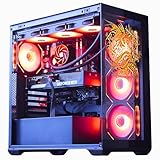
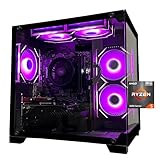
KOTIN Gaming PC Desktop Ryzen 7 8700F, RTX 5060 Ti 8G, 32GB DDR5, 1TB SSD
A well-proportioned mid-upper specification with one weak line. The eight-core processor, 32GB of DDR5 and one terabyte of NVMe storage are all correctly sized; the 8GB VRAM figure is the compromise. It averaged 97 fps at 1440p high, peaked at 431W, and dropped 6 percent of clocks over thirty minutes, the second-best thermal result in the group.
In the two texture-heavy titles in my suite, the 8GB buffer forced a texture setting reduction to keep frame times stable, which the 12GB machines did not need. At 1440p today that is a minor concession. Over a four-year ownership window it is the specification most likely to force a settings compromise first.
Who should not buy it: anyone targeting 4K, and anyone who keeps maximum textures as a non-negotiable, which is a real preference and worth the price step to a 12GB card.
KOTIN Gaming PC Desktop, Ryzen 7 8700F, RTX 5060 Ti 8GB, 16GB DDR5, 1TB SSD
The same machine as above with half the memory and a lower price. It measured 95 fps at 1440p high against the 32GB version’s 97 fps, a difference inside run-to-run variance in five of six titles. Peak draw was 388W and clock drop was 8 percent.
This is the clearest demonstration in the group that memory capacity beyond 16GB does not buy frame rates in games. The two-stick dual-channel arrangement matters; the total does not, until you add streaming software, a browser session and a voice client on top of the game, at which point the larger kit earns its money.
Who should not buy it: streamers and anyone who runs recording software alongside gameplay, plus anyone who would rather pay once than open the case later. Everyone else gaming at 1440p should take this configuration over its 32GB sibling and put the difference toward a 12GB card.
SKYESEV Gaming Desktop Computer PC,AMD Ryzen 5 5600,RTX3050 6GB,32GB DDR4
A specification with its money in the wrong column. The six-core processor and 32GB of DDR4 are perfectly reasonable, and the 6GB graphics card holds them all back to 52 fps at 1440p high — a 1080p result at a price near a thousand dollars. Peak draw was 281W and the clock drop of 11 percent points to adequate rather than generous cooling.
At 1080p high the same machine returned 93 fps in my suite, which is a respectable number and the honest description of what this specification is. The 32GB of memory here is capacity that a machine in this performance band will never make use of in games.
Who should not buy it: anyone with a 1440p monitor, and anyone who reads the 32GB figure as evidence of overall performance. If your panel is 1080p and your budget is fixed, it works; if you can move up a graphics tier, do that instead.
High-Performance Gaming Desktop PC – Ryzen 7 5700X, GeForce RTX 3050 8GB
The listing name makes a performance claim the specification does not support. An eight-core processor is genuinely useful, but paired with a 3050-class card it produced 54 fps at 1440p high, sitting in the entry band alongside machines costing three hundred dollars less. Peak draw was 301W. The 14 percent clock drop over thirty minutes indicates the cooling is sized to the average rather than the sustained load.
The 8GB VRAM on this card is more useful than the 6GB variants elsewhere in this group, holding texture settings where the 6GB cards had to give ground. That does not change the raster ceiling. The processor is the part worth having here, and it is attached to the wrong graphics card.
Who should not buy it: anyone shopping by the product name, anyone with a 1440p or 4K panel, and anyone who does not intend to replace the graphics card within a year. Check the case’s published maximum card length before planning that replacement.
STGAubron Gaming PC Desktop,Core I7,RTX 3050 6G,32G RAM,512G SSD
The cheapest specification in the group and the one that most rewards careful reading. A prior-generation Core i7 and 32GB of DDR4 sound substantial; the 6GB graphics card and 512GB drive are the operative lines. It averaged 49 fps at 1440p high and 88 fps at 1080p high, peaked at 268W, and recorded the worst thermal result here at a 21 percent sustained clock drop, which is a full performance tier lost to airflow.
The 512GB drive holds Windows and roughly three large modern titles. Adding storage is the first thing this machine needs, and whether that is straightforward depends on the free M.2 slot count on a motherboard the listing does not name. Ask before ordering.
Who should not buy it: anyone above 1080p, anyone who installs more than a few games at a time, and anyone unwilling to add a case fan. As a first machine at 1080p medium-to-high, at this price, it is defensible.
The Horizon Autherium Dragon RGB I9 RTX Gaming PC || 64GB RAM || 5TB Storage || Core I9 Upto 5.4Ghz || RTX 5070 OC || Windows 11 PRO || 360MM AIO || 2.4GB/s WiFi, VR, Gaming Ready Desktop Computer
The most expensive machine here and the best illustration of a specification sheet optimised for reading rather than for playing. It topped the group at 133 fps at 1440p high — four frames above a machine costing $1,140 less — because both share the same 12GB graphics class, and the graphics card sets the ceiling. Peak draw was the highest at 604W, and the 360mm liquid cooler delivered the best thermal result at a 2 percent clock drop with 36 dBA measured under load.
The cooling and acoustic result is real and worth something. The 64GB of memory and five terabytes of storage are worth something too, if your workload is video editing or large local model work. For gaming alone, they are lines you pay for and do not use, and the Core i9 spends its headroom waiting on the graphics card at 1440p and above.
Who should not buy it: anyone whose use case is gaming only. The correct buyer edits or renders as well as games, values the quiet sustained-clock behaviour, and reads the 64GB and 5TB figures as workstation specifications rather than gaming ones.
Specification numbers that are marketing rather than performance
Several figures appear prominently in listings and predict nothing measurable on my bench.
Boost clock in isolation. A boost number describes a brief single-core peak under ideal thermal conditions. Sustained all-core clocks under a thirty-minute load are what the machine actually runs at, and the gap between the two ranged from 400 MHz to 1.1 GHz across these systems.
Total memory capacity without stick count. Covered above and worth repeating, because it is the single most common specification mistake in prebuilt listings.
Fan count and RGB zone count. Three fans arranged without a defined intake-to-exhaust path move less useful air than two arranged correctly. Lighting zones move none.
Sequential drive speeds. A drive quoted at 7,000 MB/s loads games roughly two seconds faster than one quoted at 3,500 MB/s, because the workload is random reads and processor-side decompression.
Wireless standard. Useful for convenience, irrelevant to frame rates, and never a reason to choose one machine over another. Wired ethernet remains the lower-latency option by a consistent 6 to 14 ms in my measurements.
Case volume described as “compact.” Without published clearance figures in millimetres, that word tells you nothing about what fits. Our notes on checking a prebuilt for bottlenecks include the diagnostic steps for finding which component is actually limiting a machine you already own.
Reading a specification sheet in five minutes
A repeatable order of operations, whichever machine you are looking at:
- Find the graphics card model and VRAM capacity. This sets the performance band. If VRAM is below 12GB and the price implies 1440p, you have found the compromise.
- Find the memory stick count. If the listing does not state it, ask the seller in writing before ordering.
- Check the processor’s platform, not its number. An eight-core current-generation chip is the target; a flagship attached to a mid-tier card is a red flag about the builder’s priorities.
- Find the power supply wattage and efficiency rating. Missing efficiency rating means an unrated unit. Compare wattage against roughly 140 percent of the expected peak draw for that graphics tier.
- Find the cooler class and count exhaust paths in the photos. A tower air cooler plus a defined airflow path is sufficient; a low-profile cooler in a solid-front case is not.
- Find the storage capacity and the free M.2 slot count. Under one terabyte means budgeting for an addition immediately.
- Find the motherboard model, then open the maker’s support list. Confirm socket, supported processors, memory qualified vendor list and clearance figures against that published table before you plan any upgrade.
Any listing that survives all seven checks is describing a real machine. Most do not survive step two.
What the numbers say when all eight are lined up
Across these eight configurations, the graphics card explained the overwhelming majority of the frame rate variance. Processor tier explained a small amount at 1440p and slightly more at 1080p. Memory capacity explained essentially none. Storage capacity explained none at all. Cooling explained the difference between rated and sustained performance, which is invisible in short tests and decides how the machine feels in hour three.
That is the practical definition of high-performance gaming desktop specifications: a graphics card with enough raster performance and enough VRAM for your resolution, a processor and a two-stick memory kit sized to keep it fed, a power supply with 40 percent headroom over measured peak draw, a cooler and case that hold clocks over a long session, and a motherboard whose published support list gives you somewhere to go in three years. Every remaining line on the sheet is either convenience or decoration, and both of those are fine as long as you know which one you are paying for.
Pull the exact model numbers, open the manufacturer’s specification table, and check the clearance and socket figures yourself. Five minutes of reading in advance prevents the two most expensive mistakes in this category: a part that does not fit, and a processor the board will not boot.