The best IEM under $500 for both gaming and audiophile listening is the Thieaudio Hype 4 MKII if you want a studio-neutral, modular-cable hybrid that stays easy to drive from a dongle, and the Kiwi Ears Astral if you want a seven-driver hybrid at a lower tier. Both use a detachable 2-pin cable, which matters here because the best way to game on an audiophile IEM is to keep two cables: a music cable and a mic cable.
The runner-up for players who prefer planar sound is the Tangzu Zetian Wu Legend, which pairs a 14.2mm planar with a 6mm planar and ships with a 4.4mm plug. This guide is for people who already know they want to spend real money on in-ear monitors and want to know which of them hold up in a competitive match, not just on a music track.
Our Top Picks

Top 3 picks at a glance
Top Picks at a Glance
| Product | Best for | Key specs from the listing | Watch for | Price tier |
|---|---|---|---|---|
| Thieaudio Hype 4 MKII | All-round neutral hybrid | 2 dynamic + 4 BA, 2-pin, modular 3.5/4.4mm cable, 18 ohm, 101 dB per the maker | Sensitivity reference not stated in the sources we found | Premium |
| Kiwi Ears Astral | Detail at a lower tier | 1 dynamic + 6 BA, 16 ohm, 112 dB per a published review | All-armature upper range can be bright | Upper mid-range |
| Moondrop Blessing 3 | Tonal balance across genres | 2 dynamic + 4 BA, triple-range frequency division, 0.78mm 2-pin | Electrical specs not listed | Premium |
| Dunu DN142 | Planar plus hybrid detail | 1 dynamic + 4 BA + 2 planar, silver-plated OCC cable | Specs not listed; complex tuning | Premium |
| Tangzu Zetian Wu Legend | Planar sound with 4.4mm | 14.2mm + 6mm planar drivers, 2-pin, 4.4mm plug | Needs a 4.4mm source or adapter | Upper mid-range |
| Letshuoer Cadenza4 | Dynamic body plus armature detail | 10mm beryllium-coated dynamic + 3 Knowles BA | Specs not listed | Upper mid-range |
| Softears Studio4 | Studio-style all-armature | 4 BA, 0.78mm 2-pin | No dynamic driver, so lighter bass impact | Premium |
What “Audiophile” Means for a Gamer
Audiophile IEMs are tuned and built for accuracy in tone, detail and imaging. Gamers want the same traits for a different reason: a footstep, a reload or a voice line is a signal, and the more cleanly the IEM renders it, the easier it is to read. The overlap is real, but there are two places where the audiophile priority can mislead a gamer.
- Tonal flavor. A warm, bass-rich audiophile tuning can be excellent for music and still mask quiet footsteps. A neutral or lightly bright tuning is often better for competitive play.
- Soundstage. Width is valuable for immersion and open-world games, but positional accuracy depends on how consistently the IEM places a sound, not how large the stage is.
The picks below are chosen because reviewers describe them as balanced or neutral rather than bass-heavy, and because each can serve a competitive session and an evening of music without a change of IEM. The trade-off is the usual one: nothing in this tier ships with a microphone, so the setup includes a plan for a mic cable.
What the extra money buys over mid-range
- Better driver matching: pairs of IEMs with more consistent left-right balance, which helps imaging.
- Modular or better cables: a swappable 3.5mm or 4.4mm plug on the Hype 4 MKII, for instance, lets you move between sources without an adapter.
- Higher resolution: more detail at low volume, valuable in quiet scenes.
- Build: CNC aluminum, resin or metal shells that survive daily use.
What it does not buy is certainty that a higher price sounds better to your ears. Fit and tips matter as much as the driver count, so budget a little time for tip selection.
1. Thieaudio Hype 4 MKII: Best All-Round Neutral Hybrid
- Driver layout: 2 dynamic + 4 balanced armature
- Impedance: 18 ohm (plus or minus 1), per the maker
- Sensitivity: 101 dB at 1kHz, per the maker
- Housing: CNC aluminum shell
- Cable: modular 3.5mm and 4.4mm plugs on a 2-pin cable
Best for: players who want a studio-neutral tuning with a wide source compatibility. Skip if: you want a bass-led, fun tuning.
The Hype 4 MKII is the closest thing in this list to a do-everything pick. The listing describes an engaging yet studio-neutral tuning, and reviewers note that it is easy to drive from low-power sources such as dongles and phones. The modular cable is a practical highlight for gamers who move between a PC with a 3.5mm dongle and a handheld or DAC with a 4.4mm output.
The sensitivity figure of 101 dB is lower than the figures of most IEMs in this guide, but the sources we found do not state the reference (per milliwatt or per volt). We work through both readings in the power section below. Either way, the 18 ohm load is easy for a modern dongle.
Pros: verified 18 ohm impedance; modular 3.5 and 4.4mm cable; studio-neutral tuning described by the listing; strong build.
Cons: sensitivity reference unclear; no mic; sits at the top of the tier.
As an Amazon Associate we earn from qualifying purchases at no extra cost to you.

2. Kiwi Ears Astral: Best Detail at a Lower Tier
- Driver layout: 1 dynamic + 6 balanced armature
- Impedance: 16 ohm, per a published review
- Sensitivity: 112 dB, per the same review
- Positioning: studio recording and mixing, per the listing
- Mic: none
Best for: players who want analytical detail at a lower tier than the Hype 4 MKII. Skip if: you are sensitive to treble.
The listing positions the Astral for studio mixing, which usually means a flatter, more analytical balance. In a game, that reads as clear separation between effects and dialogue. Armature-heavy designs can sound lean in the bass and bright in the treble, so tip choice matters: a deeper seal often adds body.
The 16 ohm and 112 dB figures put the Astral firmly in the easy-to-drive category, so a low-noise dongle is the right source. The caution is hiss: at high sensitivity, noisy outputs become audible during quiet scenes.
Pros: seven-driver detail; easy to drive; studio-style tuning; lower tier than other premium hybrids.
Cons: may sound lean or bright; no mic; hiss-sensitive.

3. Moondrop Blessing 3: Best Tonal Balance Across Genres
- Driver layout: 2 dynamic + 4 balanced armature
- Design: triple-range frequency division per the listing
- Connector: 0.78mm 2-pin
- Mic: none
- Impedance and sensitivity: not listed
Best for: listeners who play many genres of game and music and want a balanced tuning. Skip if: you need confirmed electrical specs before buying.
The listing for the Blessing 3 describes a triple-range frequency division design with two dynamic drivers handling the lows and four armatures above; we found no verified measurements, so treat any tonal claim as a reviewer opinion. A design like this is generally aimed at broad music use, which suits mixed use. In gaming, a balanced curve avoids two common problems: bass that masks quiet cues and treble that fatigues. It is a safe pick for someone who wants one premium IEM for everything.
Pros: balanced tuning intent; hybrid with two dynamic drivers; detachable 2-pin cable.
Cons: electrical specs not listed; no mic; premium tier.

4. Dunu DN142: Best Planar Plus Hybrid Detail
- Driver layout: 1 dynamic + 4 balanced armature + 2 planar
- Cable: silver-plated OCC copper
- Positioning: listed for music, with gaming mentioned in related models
- Mic: none
- Impedance and sensitivity: not listed
Best for: detail-oriented players who enjoy technical presentation. Skip if: you prefer a simple, cohesive single-driver sound.
Seven drivers across three driver types is a complex design. The point is to give each part of the range to the technology best suited to it. For gaming, a complex multi-driver IEM can deliver a rich picture of ambient detail, but the complexity makes source and tip matching more important. A better seal often does more for such a design than any cable change.
Pros: three driver types; high detail ceiling; detachable cable; premium build.
Cons: specs not listed; complex tuning; premium tier.

5. Tangzu Zetian Wu Legend: Best Planar Sound With a 4.4mm Plug
- Driver layout: 14.2mm planar plus 6mm planar
- Connector: 2-pin cable
- Plug: 4.4mm in the listing
- Mic: none
- Impedance and sensitivity: not listed
Best for: players with a balanced 4.4mm source who prefer a planar flavor. Skip if: you use only 3.5mm outputs.
Using planar drivers for both the main and the supporting range gives this IEM a distinctive character, usually described as smooth and fast. The 4.4mm termination suits modern dongles and players with a balanced output, and the 2-pin socket allows a 3.5mm cable swap if your source requires it. For gaming, a smooth planar presentation can reduce fatigue over long sessions.
Pros: dual planar design; 4.4mm balanced termination; detachable 2-pin cable.
Cons: needs a compatible source or cable; specs not listed; no mic.
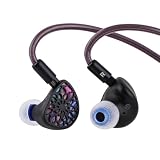
6. Letshuoer Cadenza4: Best Dynamic Body Plus Armature Detail
- Driver layout: 10mm beryllium-coated dynamic + 3 Knowles balanced armature
- Positioning: hi-fi in-ear monitors for wired use
- Mic: none
- Impedance and sensitivity: not listed
- Cable: detachable
Best for: players who want some low-end weight with a detailed top end. Skip if: you want the most neutral tuning.
A beryllium-coated dynamic driver for the low end and Knowles armatures for the rest is a recipe for impact and detail. In games, that combination suits action and cinematic titles where weight and clarity both matter.
Pros: dynamic body with armature detail; recognized armature supplier; detachable cable.
Cons: specs not listed; not strictly neutral; no mic.

7. Softears Studio4: Best Studio-Style All-Armature
- Driver layout: 4 balanced armature
- Connector: 0.78mm 2-pin
- Positioning: professional in-ear monitor from the maker’s Studio series
- Mic: none
- Impedance and sensitivity: not listed
Best for: those who prefer an analytical, monitor-style sound. Skip if: you want deep bass impact.
An all-armature IEM aims for speed and precision. For competitive play, a clean, monitor-like presentation makes reloads and footfalls easy to separate. The trade-off is less low-end weight, which can feel thin in cinematic games and music with heavy bass.
Pros: monitor-style sound; fast transient response; detachable cable.
Cons: lighter bass; specs not listed; premium tier.

Also Consider
Kiwi Ears KE4
A 2 dynamic + 2 balanced armature isobaric hybrid with a resin and alloy shell and a 3-way passive crossover, at a lower tier than the main picks.

Aful Performer 8S
An eight-driver IEM that the listing describes as having tunable bass and impedance, suited to people who like to experiment.
EPZ P40
A 2 dynamic + 1 planar + 1 piezo ceramic hybrid with a replaceable 3.5mm or 4.4mm plug.
Dunu DN242
A step-up from the DN142 with 2 dynamic + 4 balanced armature + 2 planar drivers, at the top of the tier.
Power and Source: A Worked Example
Take the Thieaudio Hype 4 MKII at 18 ohm and a listed sensitivity of 101 dB. The reference is not stated, so consider both readings and aim for an average level of about 85 dB.
- If 101 dB is per milliwatt: you need 16 dB less than 1 mW, which is about 0.025 mW. At 18 ohm that is a voltage of about 0.02 V.
- If 101 dB is per volt: the required voltage is 10 to the power of (85 minus 101) over 20, or about 0.16 V. The power is 0.16 squared divided by 18, which is about 1.4 mW.
Gaming has loud peaks. If you allow 20 dB of headroom above the average, the second reading needs 100 times the power, or about 140 mW, which is a sizeable fraction of a small dongle’s output. The TRN Black Pearl lists 320 mW at 32 ohm, which suggests it should have headroom, but power ratings vary with load, so check the dongle’s rating at low impedance.
For the Kiwi Ears Astral at 16 ohm and 112 dB, the same arithmetic gives a much lower requirement, which is why it works from nearly anything. The conclusion is practical: for the Hype 4 MKII, use a competent dongle rather than a laptop jack; for the Astral, any clean source works.
Keep Two Cables: One for Music, One for Gaming
An audiophile IEM deserves a good cable, but a good cable rarely includes a mic. The solution is a two-cable plan, which all the picks above support through their detachable connectors.
| Cable | Use | Example | Note |
|---|---|---|---|
| Music cable | Home listening, 4.4mm balanced where available | Supplied cable, Thieaudio Midnix single-crystal copper cable | Match the connector and the plug |
| Gaming cable with boom mic | Team chat in competitive play | Antlion Kimura 2-pin boom-mic cable | Professional boom mic on a standard 2-pin |
| Gaming cable with inline mic | Casual chat, travel | Moondrop MC2 or Tripowin Zonie with omni mic | Lighter and cheaper |
Swapping a 2-pin cable takes seconds. Pull straight along the connector axis rather than twisting, and store the unused cable in a small case.
Dongle and DAC Choices
| Source | Outputs | Best for | Note |
|---|---|---|---|
| Moondrop Dawn Pro 2 | 3.5mm and 4.4mm | Balanced setups | Dual CS43198 chips per the listing |
| TRN Black Pearl | 3.5mm and 4.4mm | Power headroom | 320 mW at 32 ohm per the listing |
| Kiwi Ears Allegro Mini | 3.5mm and 4.4mm | Compact use | USB-C input |
| FiiO KA11 | 3.5mm | Simple phone or PC use | USB-C adapter-style DAC |
| EPZ TP35 PRO | 3.5mm and 4.4mm | Mini balanced dongle | Dual CS43198 per the listing |
Matching Each Pick to Your Games
| Play style | Priority | Strongest fit | Reason |
|---|---|---|---|
| Ranked tactical shooters | Neutral mids, precise imaging | Hype 4 MKII, Studio4, Astral | Monitor-style balance keeps cues readable |
| Battle royale and open maps | Distance cues, ambient detail | Dunu DN142, Hype 4 MKII | Multi-driver detail helps with far-off sounds |
| Single-player epics | Immersion, wide staging | Zetian Wu Legend, Blessing 3 | Smooth planar or broadly balanced tuning |
| Racing, action, cinematic titles | Impact and body | Letshuoer Cadenza4 | Beryllium dynamic driver for low-end weight |
| Music-first with some gaming | Tonal balance, long-session comfort | Blessing 3, Hype 4 MKII | Balanced intent, easy cable options |
Cable Myths and What Actually Matters
Premium cable listings promise improved sound from silver plating or high-purity copper. In practice, the differences you can hear in a blind comparison are small, and the real value of a better cable is mechanical: it tangles less, produces less microphonic noise, resists kinks and uses a connector that seats firmly. For a gamer, microphonic noise is a real issue because cable rub on a collar can be mistaken for a sound in the game. A softer, braided cable worn over the ear is the cheapest fix.
The other cable issue is the connector standard. Some IEMs use a recessed 2-pin socket, some use a flush one, and boom-mic cables sometimes use a different connector such as QDC. Before buying a mic cable for a premium IEM, confirm the connector in the listing, because a mismatch wastes the order.
Fit and Tips at This Tier
Premium IEMs often have larger shells to house more drivers, and fit becomes the deciding factor. Spend your first week with the supplied tips, then try a second family of tips, for example a wide-bore set for a brighter feel or a foam set for isolation. A stable seal can shift the bass by several decibels, which changes how the IEM sounds more than most cable swaps.
If your ears are small, favor smaller resin shells and plan on a shallow insertion. If you wear glasses, choose an over-ear cable routing that keeps the cable clear of the arms. If you game for hours, schedule breaks, because sealed ears get warm and fatigue is more likely than with open headphones.
Common Mistakes When Spending This Much
- Buying on driver count. Seven drivers do not beat four if the tuning is wrong for you. Read descriptions of the tuning, not just the spec line.
- Ignoring the source. A premium IEM on a noisy jack shows hiss and loses detail. A clean dongle is part of the purchase.
- Forgetting the mic. The most common regret at this tier is realizing in the first match that the IEM has no mic. Order the cable at the same time.
- Using the music cable for chat. A premium cable with no mic is not a gaming cable. Keep two cables.
- Over-driving the volume. Highly resolving IEMs sound clear at low volume. If you find yourself raising the level to hear detail, check the seal first.
How We Chose
This guide is research-based. We did not personally use these products. We read product listings, manufacturer figures and published reviews, and we marked any figure we could not confirm as not listed. We chose models with detachable cables, tunings that reviewers describe as balanced or neutral, and a mix of driver types. We limited the main list to one model per brand where possible and no more than two, and we avoid exact prices, using tier words instead.
Buying Guide
Set your tonal priority
If you play competitive shooters, favor neutral or lightly bright tunings (Hype 4 MKII, Astral, Studio4). If you play cinematic and open-world games, consider a warmer or planar option (Cadenza4, Zetian Wu Legend).
Check the electrical figures
Prefer impedance under 40 ohm and a known sensitivity. Where figures are not listed, treat the IEM as an unknown and start at low volume.
Plan the connector and plug
Choose a modular cable if you use multiple sources. A 4.4mm plug suits balanced sources, and 3.5mm suits almost everything else.
Fit and comfort
Premium IEMs often have larger shells. If you wear glasses or have small ears, check the shell size and plan to try several tip types.
Warranty and support
Check the seller’s return policy before spending at this tier, because fit is personal and returns are the safety net.
Volume safety
Keep listening levels moderate, take breaks during long sessions and lower the volume if you notice ringing or discomfort. If you have concerns about your hearing, consult a qualified professional.
Frequently Asked Questions
What is the best IEM under 500 for gaming?
The Thieaudio Hype 4 MKII is the best all-round pick because of its neutral tuning, easy electrical load and modular cable, while the Kiwi Ears Astral offers similar detail at a lower tier.
Are audiophile IEMs good for competitive gaming?
Yes, if the tuning is neutral or lightly bright. A bass-heavy audiophile tuning can mask quiet cues, so check the tuning description before buying.
Do premium IEMs come with a mic?
Almost never. Plan to buy a detachable cable with a mic or boom mic, such as the Antlion Kimura or the Moondrop MC2.
Do I need a DAC or amp?
A good USB-C dongle is recommended. Premium IEMs reveal source noise, and a clean dongle gives better volume control than a motherboard jack.
Are planar IEMs better than hybrids for gaming?
Not automatically. Planar IEMs can sound smooth and fast, but positional accuracy depends on tuning and fit. Choose by listener descriptions, not driver type.
What does 4.4mm balanced mean?
It is a five-pole plug standard for balanced outputs found on many dongles and players. It can offer more power and lower noise, but it needs a matching source or cable.
Can I use premium IEMs on a console?
Yes, through the controller’s 3.5mm jack with a suitable cable. Mic support depends on the cable and the controller, and a PC with a dongle usually gives better results.
Which One Should You Buy?
Choose the Thieaudio Hype 4 MKII for the safest all-round pick, the Kiwi Ears Astral for the same neutral lean at a lower tier, the Moondrop Blessing 3 for balance across genres, and the Tangzu Zetian Wu Legend if you want a planar sound and have a 4.4mm source. Whatever you pick, buy a boom-mic cable and a clean dongle at the same time.
Sources
- Thieaudio and Linsoul product pages
- Headfonia and Headfonics reviews of the Hype 4 MKII and Astral
- Head-Fi product showcases
- Manufacturer listings for Moondrop, Dunu, Tangzu, Letshuoer and Softears
Last updated: October 2026