Choosing the right atx power supply is the least glamorous decision in a gaming PC build, and that is exactly why so many people get it wrong. A PSU that cannot deliver stable voltage under load will throttle components, cause crashes at the worst moment, or in the worst case take other parts with it when it fails. The problem is not picking a unit with enough watts on the label; it is matching efficiency rating, connector availability, build quality, and warranty length to the actual system you intend to run.
What separates a good atx power supply from a mediocre one in 2026 comes down to a handful of concrete factors. Modern graphics cards demand high peak power and specific connector types, so ATX 3.1 compliance and native PCIe 5.1 support are no longer optional for serious builds. For entry-level systems, a basic unit from a reputable manufacturer still works perfectly well, but cheap capacitors and poor voltage regulation are real risks on unbranded alternatives. We compared published specifications, list prices, and recurring owner feedback across all eight units below to identify where each one genuinely fits.
As an Amazon Associate we earn from qualifying purchases at no extra cost to you. Product prices and availability are accurate as of the date shown and are subject to change.




Top 3 picks at a glance
Quick Picks
| Product | Best For | Price |
|---|---|---|
| Thermaltake Smart 500W | Budget office or basic gaming builds | $39.99 |
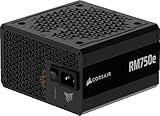
| CORSAIR RM750e | Mid-range gaming with modern GPU | $89.99 |
| MSI MAG A750GL | Compact builds needing modular cables and long warranty | $94.99 |
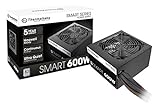
| Thermaltake SMART 600W | Entry-level systems with slightly more headroom | $42.99 |
| Thermaltake GF1 850W | Quiet high-end builds without ATX 3.1 requirements | $79.95 |
| Thermaltake Toughpower GT 850W | Modern GPU builds needing native 450W connector | $79.99 |
| CORSAIR RM850e | Premium mid-range builds with CORSAIR ecosystem | $119 |
| ASRock PRO 750G | Value-focused ATX 3.1 builds | $54.99 |
How We Picked
We evaluated every unit on four criteria that directly affect real-world use in a gaming system. First, ATX 3.1 and PCIe 5.1 compliance determine whether the PSU can natively handle the transient power spikes and connector requirements of current-generation graphics cards without adapter cables. Second, efficiency certification affects both your electricity bill and the thermal load inside your case. Third, warranty length reflects the manufacturer’s confidence in component quality. Fourth, we reviewed owner feedback for recurring complaints about noise, coil whine, or voltage instability that spec sheets never reveal.
The 8 Best Atx Power Supply in 2026
Thermaltake Smart 500W 80+ White
This unit serves people assembling their first PC or powering an office system that occasionally runs light games. The 500W rating and ATX 12V V2.3 compliance cover integrated graphics or older discrete cards comfortably, and the 120mm fan keeps things quiet during typical workloads. Active PFC is a positive sign at this price point, filtering out truly bottom-of-the-barrel alternatives.
- Pro: Exceptionally low price for a branded unit with active PFC
- Pro: Quiet 120mm fan suitable for noise-sensitive environments
- Con: 80+ White certification means noticeable power waste under sustained load
Skip this if your GPU requires a PCIe 5.1 connector or if you plan to upgrade to a modern mid-range card; the wattage and connector set will leave you stranded.
CORSAIR RM750e ATX 3.1
The RM750e targets builders pairing a 750W Gold-rated supply with a contemporary mid-to-upper-range GPU. ATX 3.1 and PCIe 5.1 compliance mean it handles transient spikes natively, and the CORSAIR ecosystem of software and warranty support reduces friction if you already own other CORSAIR components. Owner feedback consistently highlights stable voltage regulation across varied loads.
- Pro: Fully compliant with current connector standards, no adapters needed
- Pro: Strong reputation for reliable long-term operation
- Con: Higher price than several competing 750W ATX 3.1 options
Skip this if budget is your primary constraint; the ASRock PRO 750G delivers similar modern specs for significantly less money.
MSI MAG A750GL PCIE5
MSI built this for compact builds where cable management matters. Full modularity means you only connect what you need, the native dual-color 12V-2×6 cable provides visual confirmation of proper seating, and the 10-year warranty is the longest in this group by a wide margin. The 80+ Gold rating keeps efficiency competitive with pricier options.
- Pro: 10-year warranty signals exceptional component quality confidence
- Pro: Compact form factor fits tighter cases without compromise
- Con: Fewer owner reviews available compared to established CORSAIR or Thermaltake lines
Skip this if you prefer a proven track record backed by thousands of community reports; the RM750e has a longer history of user validation.
Thermaltake SMART 600W 80 Plus
A direct step up from the Smart 500W, this unit gives you 100W more headroom for systems with a modest discrete GPU. The 80 Plus certification and active PFC match its sibling, and the ATX 12V V2.3 compliance suits older platforms well. It fills a gap for people who know 500W might be tight but do not need modern ATX 3.1 features.
- Pro: Meaningful wattage increase over the 500W model for only three dollars more
- Pro: Proven Thermaltake design with widespread availability
- Con: No ATX 3.1 support and no native PCIe 5.1 connector
Skip this if your build includes any current-generation graphics card; you will need a modern unit with proper transient handling.
Thermaltake GF1 850W Fully Modular
The GF1 suits enthusiasts who want an 850W Gold-rated supply with zero-RPM fan operation and full modularity but do not need ATX 3.1 compliance. It appeals to builders running older high-end GPUs or those prioritizing silence over future-proofing. Owner feedback frequently praises its near-silent operation under light loads.
- Pro: Zero RPM mode delivers complete silence at idle and low load
- Pro: 850W Gold-rated capacity at a competitive price point
- Con: Lacks ATX 3.1 and native PCIe 5.1 support
Skip this if you are buying a new GPU that requires a 12V-2×6 connector; the adapter cable solution introduces an additional failure point.
Thermaltake Toughpower GT 850W ATX 3.1
This unit combines the GF1’s wattage and Gold efficiency with full ATX 3.1 and PCIe 5.1 readiness, including a native 450W connector. The Smart Zero Fan keeps noise down when idle, and the five-year warranty matches what you expect from a premium line. It represents the best value in this list for a modern high-end build.
- Pro: Native 450W PCIe 5.1 connector handles the most power-hungry GPUs directly
- Pro: Excellent price-to-spec ratio among ATX 3.1 Gold units
- Con: Five-year warranty is shorter than the MSI MAG A750GL’s ten
Skip this only if your case cannot accommodate its physical dimensions; otherwise it is hard to argue against at this price.
CORSAIR RM850e ATX 3.1
The premium choice in this roundup, the RM850e delivers 850W of Gold-rated power with full ATX 3.1 and PCIe 5.1 compliance. CORSAIR’s reputation for voltage regulation quality is well-established, and the company’s software integration through iCUE appeals to people who want monitoring. The price reflects brand positioning rather than a fundamental spec advantage over competitors.
- Pro: Industry-leading voltage stability reputation backed by extensive community data
- Pro: Native modern connector support with no adapter compromises
- Con: Costs significantly more than the Toughpower GT with nearly identical specifications
Skip this if you do not already own CORSAIR peripherals or software; you are paying a brand premium for the same underlying capability.
ASRock PRO 750G 80 Plus Gold
The ASRock PRO 750G is the standout value proposition here. It packs 750W of Gold-rated efficiency, full ATX 3.1 and PCIe 5.1 compliance, a native 12V-2×6 connector, and a 120mm low-noise fan into a sub-$55 package. No other unit in this list matches this combination of modern features at this price.
- Pro: Unmatched price for a full ATX 3.1 Gold-certified unit with native connector
- Pro: 120mm low-noise fan keeps acoustics in check
- Con: Only a three-year warranty, the shortest in this group
Skip this if warranty length is your top priority; the MSI MAG A750GL offers three times the coverage for a modest premium.
Buying Guide
ATX Version and PCIe 5.1 Compliance
ATX 3.1 is the current power delivery specification that mandates handling power excursions up to 235 percent of rated wattage for brief periods. Older ATX 2.x units cannot guarantee this without a separate GPU-side capacitor. If your graphics card uses a 12V-2×6 connector, a native ATX 3.1 supply eliminates the adapter and its associated thermal and reliability concerns.
Wattage Sizing for Modern GPUs
A 750W supply comfortably covers current mid-range cards while leaving headroom for the CPU and peripherals. For top-tier GPUs with high transient demands, 850W provides a safety margin that prevents shutdowns during peak spikes. Going beyond 850W only makes sense in multi-GPU or workstation-class builds; for a single-card gaming system, it adds cost without practical benefit.
Modularity and Warranty as Quality Indicators
Fully modular units require better internal engineering and typically use higher-grade capacitors, making modularity a rough proxy for build quality. Warranty length is a direct expression of the manufacturer’s confidence: a ten-year warranty means the company expects the unit to survive two full PC upgrade cycles. Treat anything under three years as a signal that component quality may not support long-term use.
Our Verdict
The top pick is the Thermaltake Toughpower GT 850W. It delivers full ATX 3.1 and PCIe 5.1 compliance, a native 450W connector, 80 Plus Gold efficiency, and Smart Zero Fan operation at a price that undercuts every similarly equipped competitor. For most people building a modern gaming PC, it is the most complete answer to the question of what to buy.
The budget pick is the ASRock PRO 750G. At $54.99 it provides every critical modern feature that budget buyers actually need, and the three-year warranty is acceptable for the price.
One condition changes the recommendation: if you are building in a compact case and value cable management above all else, the MSI MAG A750GL wins with its small footprint, full modularity, dual-color connector for visual confirmation, and an industry-leading ten-year warranty.
FAQ
Can I use an adapter cable with a non-ATX 3.1 supply for a 12V-2×6 GPU?
Yes, most modern GPUs ship with or support adapter cables that convert traditional PCIe connectors to the 12V-2×6 format. However, the adapter adds a potential failure point and may not handle the highest transient loads as gracefully as a native connector on an ATX 3.1 unit.
Is 80 Plus White certification acceptable for a gaming PC?
For a system drawing 200-300W under load, the difference between White and Gold efficiency translates to a small amount of wasted energy converted to heat. It is acceptable for very tight budgets, but the price gap to Gold-certified units has narrowed enough that Gold is almost always the better choice.
What happens if my power supply fails?
A quality atx power supply should protect your other components through built-in overcurrent, overvoltage, and short-circuit protection circuits. A cheap unit lacking these safeguards can send excessive current to the motherboard or GPU. This is the primary reason to stick with known brands and avoid unbranded units regardless of their listed wattage.
Do I need a fully modular supply for a gaming build?
No. Non-modular and semi-modular units function identically in terms of power delivery. Full modularity improves cable management and airflow inside the case, which is meaningful in compact builds but less critical in a mid-tower with room for excess cables behind the motherboard tray.