A bench power supply is the one tool that separates a hobbyist who guesses at voltage from one who dials it in and moves on. Whether you are troubleshooting a motherboard, running LEDs at a specific current, or charging a lithium pack for a custom build, the right DC power supply removes the risk of frying components with an adapter that drifts or lacks protection. The wrong one, however, is a false economy: vague readouts, no overcurrent safety, and coarse knobs that make fine adjustment impossible.
The eight units in this roundup span entry-level fixed-wattage supplies to higher-voltage variable bench models, all targeting the 0-30V 0-10A sweet spot most makers and technicians need. What separates a good purchase from a mediocre one comes down to display precision, adjustment resolution, protective circuitry, and whether the auxiliary USB charging is genuinely fast enough to justify leaving your wall charger behind. Below, we rank each by published specs, street price, and recurring themes from owner feedback.
As an Amazon Associate we earn from qualifying purchases at no extra cost to you. Product prices and availability are accurate as of the date shown and are subject to change.


Top 3 picks at a glance
Quick Picks
| Product | Best for | Price |
|---|---|---|
| Jesverty SPS-3010 | Precision bench work on a mid-range budget | $42.74 |
| DC Power Supply Variable (Encoder/Type-C) | Daily-driver bench supply with modern fast charging | $44.98 |
| NICE-POWER 150W | Electroplating and DIY projects on a tight budget | $29.22 |
| DC Power Supply Variable (Black, Alarm) | Safety-conscious users who need output switching | $49.99 |
| Wefomey Universal | Single-voltage replacement for consumer devices | $19.99 |
| DC Power Supply Variable (Charging Mode) | Battery charging workflows | $59.99 |
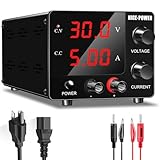
| Jesverty SPS-6005V | Higher-voltage projects beyond 30V | $71.24 |
| NICE-POWER 30V 5A | LED testing and low-current electroplating | $30.85 |
How We Picked
We evaluated these eight units against four criteria that consistently appear in negative owner reviews across this category: display resolution and accuracy, adjustment granularity (encoder knobs versus basic potentiometers), built-in protection features such as overcurrent and short-circuit alarm, and the usefulness of auxiliary outputs like USB Type-C. Price-to-wattage ratio also factored in, because a supply that costs more per watt than its capabilities justify is hard to recommend. In the 2026 market, sub-$50 variable bench supplies have become genuinely capable, which raises the bar for anything priced above that.
The 8 Best Dc Power Supply in 2026
Jesverty SPS-3010 (0-30V 0-10A)
This is the supply to recommend when someone asks for a first bench unit that will not embarrass them at a trade-show demo table. The four-digit LED display gives both voltage and current at a resolution that makes dialing in 12.36V at 2.45A practical rather than aspirational. Coarse and fine adjustment knobs work in tandem so you can sweep to roughly the right range quickly, then nail the exact value without overshooting. The built-in 5V/2A USB port is a small convenience but saves a cable on a crowded workbench.
- Four-digit display with both voltage and current readout simultaneously
- Coarse/fine dual-knob system for repeatable setting
- USB port is limited to 5V/2A, so it will not fast-charge modern phones
Skip this if you need more than 30V output or plan to run it unattended, as the unit lacks a dedicated output enable/disable button.
DC Power Supply Variable with Encoder and Type-C Quick-Charge (0-30V 0-10A)
Owner feedback highlights the encoder knob as the standout feature here: it clicks through values in defined increments, eliminating the drift that plagues cheaper potentiometer-based designs. The 3.6A USB and Type-C quick-charge output is genuinely useful, letting you top off a tablet or phone from the same box you are using for bench work. Overcurrent protection triggers reliably, which is critical when probing boards where a short can appear without warning.
- Encoder knob provides tactile, drift-free adjustment
- Type-C quick-charge output handles modern device protocols
- Display refresh rate feels sluggish compared to the Jesverty four-digit unit
Skip this if your primary use case is constant-voltage electroplating where you need sustained maximum current without any protection intervention.
NICE-POWER 150W Fixed Power (0-30V 0-10A)
At just under $30, this is the cheapest variable bench supply with a meaningful power rating that still delivers usable performance. The 150W fixed ceiling means you get either 15V at 10A or 30V at 5A, so plan your project accordingly. It earns its reputation in electroplating circles because the current regulation holds steady for long runs, and the encoder knob gives enough resolution for setting plating bath parameters. The three-digit display is a compromise, but at this price it is forgivable.
- Lowest per-watt cost in the group
- Encoder knob provides more control than basic dial supplies
- Three-digit display limits precision on voltage and current readouts
Skip this if you need true constant-voltage and constant-current simultaneously across the full 0-30V range, or if display precision matters for your workflow.
DC Power Supply Variable with Output Switch and Short-Circuit Alarm (30V 10A)
The dedicated output enable/disable button is the feature that earns this unit its place on the list. Being able to cut the output without touching the adjustment knobs means you can safely probe a circuit, pause it, and resume at the exact same setting. The short-circuit alarm provides an audible warning that is louder than most budget units, which owners note is invaluable when you are not staring directly at the display. USB quick-charge rounds out the feature set.
- Output enable/disable preserves your set point between connections
- Audible short-circuit alarm is noticeably effective
- Priced at the top of the 0-30V group without a clear spec advantage over cheaper rivals
Skip this if budget is your primary constraint; the NICE-POWER or Jesverty SPS-3010 deliver similar core performance for less.
Wefomey Universal Power Supply (3V-24V 3A 72W)
This is not a bench supply in the traditional sense but rather a multi-voltage replacement adapter for consumer electronics, routers, and LED strips. If you have a shelf full of single-use AC adapters and want to consolidate, this does the job at a fraction of the cost of a dedicated bench unit. The adjustment range caps at 24V and 3A, so it will not serve electronics work that demands higher current or wider voltage swings.
- Lowest price point makes it a no-brainer as an adapter replacement
- Compact and portable, suitable for field use
- 3A ceiling and narrow voltage range disqualify it as a true bench tool
Skip this if your work requires more than 24V or more than 3A, or if you need a regulated display with current limiting for circuit development.
DC Power Supply Variable with Intelligent Charging Mode (30V 10A)
The intelligent charging mode is what sets this apart for anyone who regularly cycles lithium or NiMH packs. It automates the constant-current-to-constant-voltage transition that manual bench supplies force you to manage by hand, reducing the risk of overcharging. The 18W USB interface is the most powerful auxiliary output in the group, making it a practical charging hub alongside its bench duties. Precision encoder knob handles fine adjustment well.
- Intelligent charging mode removes guesswork from battery cycling
- 18W USB is the highest auxiliary output power in the roundup
- Premium price with no spec advantage in core voltage or current range
Skip this if you only need it for general bench work and do not regularly charge batteries; the savings from the NICE-POWER or Jesverty would fund other tools.
Jesverty SPS-6005V (0-60V 0-5A)
When 30V is not enough, this is the entry-level answer. The 0-60V range opens up work on higher-voltage LED arrays, certain motor controllers, and vacuum tube projects that a standard bench supply cannot handle. The four-digit display, coarse/fine encoder system, and 20W USB with Type-C quick-charge make it feature-complete in its own right. The trade-off is lower current headroom at 5A, so heavy-draw projects at mid-range voltage may hit the ceiling sooner than expected.
- 60V ceiling covers applications beyond the standard 30V class
- 20W USB and Type-C quick-charge provide genuinely useful auxiliary power
- Five-amp limit means high-current work at mid-range voltage is restricted
Skip this if all your projects stay within 0-30V; the Jesverty SPS-3010 or the encoder Type-C model delivers more current capacity for less money.
NICE-POWER 30V 5A
A stripped-down bench supply aimed squarely at LED testing, small-scale electroplating, and hobby electronics where 5A is all you need. The upgraded three-digit display is an improvement over older NICE-POWER models, and the encoder knob gives repeatable adjustment without the cost of a four-digit panel. At roughly $31, it is competitive with the Wefomey in price but offers regulated bench-grade output that a multi-voltage adapter cannot match.
- Low price with encoder-controlled adjustment, rare at this tier
- Well-suited to low-current electroplating and LED characterization
- 5A ceiling means it cannot serve general-purpose bench work requiring higher current
Skip this if you anticipate needing more than 5A; stepping up to the NICE-POWER 150W or Jesverty SPS-3010 adds current headroom for only a few dollars more.
Buying Guide
Display Precision and Readout Resolution
A four-digit display resolves hundredths of a volt and hundredths of an amp, which matters when you are matching a datasheet spec or logging test conditions. Three-digit displays round to tenths, introducing ambiguity that can compound over long runs. If your work involves setting precise bias points or measuring small current draws, the jump from three to four digits is the single most impactful spec difference in this price tier.
Adjustment Mechanism: Encoder vs. Potentiometer
Encoder knobs click through defined steps and retain their value without drift, while potentiometers rely on continuous resistance tracks that wear over time and creep with vibration. For anyone who sets a supply once and walks away, or who needs to return to a precise value after power cycling, an encoder is not a luxury but a practical necessity for repeatability.
Protection Circuitry and Output Control
Overcurrent protection, short-circuit alarm, and a dedicated output enable/disable button each address a different failure mode. OCP prevents damage when a probe slips across adjacent pads. An audible alarm catches faults you are not watching for. An output switch preserves your set point while you re-probe a connection. The best supplies in this list combine all three; if a unit lacks even one, weigh that gap against your actual risk tolerance.
Our Verdict
The Jesverty SPS-3010 is the top pick for most buyers: its four-digit display and dual-knob system deliver precision that rivals cost significantly more, and at $42.74 it sits in the sweet spot of the market. The NICE-POWER 150W is the budget pick, offering encoder control and meaningful wattage for under $30, making it ideal for electroplating or projects where absolute display precision is less critical.
However, if your workflow centers on battery charging, the Intelligent Charging Mode unit at $59.99 justifies its premium by automating the CC-CV transition, a task that demands manual attention and carries real risk of cell damage when done by hand on a standard supply.
FAQ
Can a variable DC power supply replace a fixed-voltage adapter for a router or LED strip?
Yes, as long as you match the voltage exactly and confirm the supply can deliver equal or greater current than the device draws. Set the output before connecting the load, and use the current limit to prevent inrush damage.
What is the difference between constant voltage and constant current mode?
In constant voltage mode, the supply holds the set voltage and lets current draw itself to whatever the load demands. In constant current mode, the supply holds the set current and drops voltage to whatever the load requires, up to the maximum set value.
Do I need Type-C quick-charge on a bench power supply?
Not strictly, but if your workbench already doubles as a charging station, a 20W or higher Type-C output eliminates the need for a separate wall adapter and keeps cabling tidy.
Is a three-digit display acceptable for electronics prototyping?
For general prototyping and hobby work, three digits are sufficient. Where it falls short is precision analog work, sensor calibration, or any scenario where you need to confirm a bias point to within a few millivolts.