If you have an IP camera, a VoIP desk phone, or a wireless access point sitting on a desk far from any power outlet, a PoE injector is the cheapest way to keep that single Ethernet cable doing double duty — carrying data and electricity together. The problem is that not all injectors are created equal. A unit that nominally says “48V” but lacks proper IEEE 802.3af or 802.3at compliance can under-power a demanding access point, flicker a camera feed, or simply fail to handshake with the powered device at all. Owners of cheap, uncertified injectors frequently report intermittent disconnects after a few weeks, which is exactly the failure mode that ruins a security camera’s coverage window at 2 a.m.
What separates a worthwhile PoE injector from a frustrating one comes down to three things: verified standards compliance, adequate wattage headroom for your actual device, and construction that won’t overheat inside a cable-management tray. This roundup compares eight options across those dimensions using published specifications, street prices, and recurring patterns in owner feedback, so you can match the right injector to the right device without overpaying or gambling on an unbranded unit. Every product here is positioned in 2026 at a specific price point, and the gaps between them are narrower than you might expect once you factor in what each one actually delivers.
As an Amazon Associate we earn from qualifying purchases at no extra cost to you. Product prices and availability are accurate as of the date shown and are subject to change.




Top 3 picks at a glance
Quick Picks
| Product | Best for | Price |
|---|---|---|
| Omada PoE+ Injector (POE160S) | Gigabit PoE+ devices needing UL certification | $19.99 |
| TRENDnet TPE-115GI | Business-grade gigabit PoE+ with brand reliability | $24.99 |
| Generic Gigabit PoE Injector (48V) | Budget setups that need a cable included | $8.97 |
| ThePoEstore Gigabit PoE+ Injector | Mid-range PoE+ without paying a premium brand tax | $17.99 |
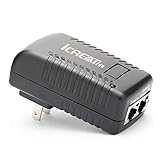
| iCreatin Wall Plug PoE Injector | Cisco, Polycom, and Aastra phones on a tight budget | $8.98 |
| Omada 48V PoE Injector (POE4824G) | Low-power 802.3af devices at minimal cost | $13.99 |
| Bawofu 48V 24W PoE Adapter (2-Pack) | Two PoE devices at once for under ten dollars | $9.99 |
| Omada 2.5G PoE+ Injector (POE260S) | Wi-Fi 6E/7 access points with 2.5G uplinks | $31.14 |
How We Picked
Four criteria drove this selection. First, standards compliance: every injector here lists IEEE 802.3af or 802.3at (PoE+) support, which guarantees proper voltage negotiation with the powered device. Second, power rating relevance: we grouped units by whether they serve low-draw phones and sensors or high-draw cameras and access points. Third, build reputation: Omada, TRENDnet, and ThePoEstore carry consistent owner feedback across multiple listings, while the generic and Bawofu options earn value through price rather than longevity claims. Fourth, price-to-feature ratio: a $9 injector that includes a Cat 6 cable and a $25 injector that does not are different value propositions, and we scored them accordingly.
The 8 Best Poe Power Supply in 2026
Omada PoE+ Injector (POE160S)
This is the go-to choice for anyone powering a PoE+ access point or PTZ camera on a gigabit link who also wants the peace of mind of UL certification. Owners consistently note the compact brick form factor fits behind furniture without cable strain. The 30W ceiling handles the most demanding 802.3at devices without negotiation. The primary limitation is that at $19.99 you are paying more than generic alternatives offer for comparable wattage, and the non-gigabit data path is not an issue but the lack of included Ethernet cable means a separate purchase if your run is short. Skip this if your device draws under 13W and the extra headroom is unnecessary.
- Pro: UL Certified construction for safe continuous operation in enclosed spaces.
- Pro: Gigabit throughput with no negotiation lag on PoE+ handshake.
- Con: No included Ethernet cable at this price point.
TRENDnet TPE-115GI
TRENDnet built this for IT departments that standardize on known brands, and it shows in the uniform owner feedback praising reliability over multi-year deployments. The gigabit pass-through and PoE+ 30W rating match the Omada POE160S in raw capability, but the $24.99 price makes it the most expensive single-port injector on this list. For enterprise buyers who need vendor consistency it is a sensible pick. For a home office with one camera, the premium over the Omada equivalent is hard to justify. Skip if you do not need brand-name procurement and can accept Omada’s comparable spec at five dollars less.
- Pro: Proven reliability track record in business networking environments.
- Pro: Full gigabit data path with no throughput penalty.
- Con: Highest per-unit price among comparable PoE+ injectors here.
Generic Gigabit PoE Injector (48V)
At $8.97 this is the lowest-cost gigabit PoE option in the roundup, and it ships with a 3-foot Cat 6 cable included. For a one-off install on a desk where you need to reach a PoE phone or a low-watt camera without hunting for a cable, the value is immediate. The tradeoff is that the listing carries no brand name and no third-party safety certification beyond the IEEE 802.3at/af compliance claim. Owner reviews are sparse and mixed on long-term durability. Skip this for any always-on security camera or access point where a failure means blind spots; reserve it for temporary or easily-swap setups.
- Pro: Lowest price with a Gigabit Ethernet cable included in the box.
- Pro: Full 802.3af/at compliance for broad device compatibility.
- Con: No brand backing or safety certification; owner feedback is thin.
ThePoEstore Gigabit PoE+ Injector
ThePoEstore occupies a middle ground between the brand-certified Omada units and the no-name options, offering IEEE 802.3af/at compliance at $17.99. Owners report solid handshake reliability with Ubiquiti and TP-Link access points, and the compact housing works well in patch-panel areas. It does not carry a UL mark, which may matter in commercial installations with inspection requirements. At its price, it undercuts TRENDnet by seven dollars while matching the gigabit and PoE+ specification. Skip if your facility requires UL-listed hardware or if the Omada POE160S at two dollars more offers the certification you need.
- Pro: Competitive PoE+ pricing without sacrificing gigabit throughput.
- Pro: Consistent owner reports of reliable handshake with major AP brands.
- Con: No UL or third-party safety certification listed.
iCreatin Wall Plug PoE Injector
This is a wall-plug form factor at $8.98, designed specifically for desk-side VoIP phones from Cisco, Polycom, and Aastra that need 48V PoE and a nearby outlet but no extra brick on the floor. The integrated plug eliminates the AC cord and brick clutter entirely. It is limited to 802.3af (15.4W), so it will not power PoE+ access points or PTZ cameras. Owners who need a clean desk setup for one or two IP phones call it a no-brainer at this price. Skip if your powered device requires more than 15W or if your outlet is behind a piece of furniture that blocks a wall plug.
- Pro: Wall-plug design saves desk and cable-management space.
- Pro: Compatible with the widest range of business VoIP handsets.
- Con: 802.3af only; cannot power PoE+ devices.
Omada 48V PoE Injector (POE4824G)
At $13.99 this Omada model covers the most common middle tier: gigabit data plus 24W output, which handles fixed cameras, most wireless access points, and PoE-powered switches with one or two ports. It is not a PoE+ unit, so the 24W ceiling is the constraint. Owner feedback highlights quiet operation and reliable long-term performance in TP-Link-centric networks. For anyone already in the Omada ecosystem with its management software, this integrates cleanly. Skip if you run a single PoE+ device that draws over 24W; the POE160S above is only six dollars more and doubles the headroom.
- Pro: Balanced 24W output covers the majority of fixed cameras and APs.
- Pro: Trusted Omada reliability at a sub-$14 price.
- Con: Not PoE+; will not handshake with devices requiring over 24W.
Bawofu 48V 24W PoE Adapter (2-Pack)
Two 802.3af-compliant injectors for $9.99 works out to under five dollars per unit, making this the cheapest way to power two low-draw devices simultaneously — two IP phones, two small cameras, or a phone and a sensor. The 10/100Mbps data path is the critical limitation: any gigabit-requiring device will be bottlenecked. Owner reports confirm reliable operation for non-gigabit endpoints but note the lack of certification. Skip for access points or cameras with gigabit uplinks, or for any deployment where uptime matters more than cost.
- Pro: Under $5 per injector makes multi-device setups extremely affordable.
- Pro: US wall plug included; no adapter hunting.
- Con: 10/100Mbps only; unusable for gigabit PoE devices.
Omada 2.5G PoE+ Injector (POE260S)
The $31.14 price buys something none of the others offer: a 2.5 Gigabit pass-through port paired with 30W PoE+ output and UL certification. This is the correct choice for Wi-Fi 6E and Wi-Fi 7 access points with 2.5G uplinks, where gigabit injectors throttle the radio’s real throughput. Owner feedback from homelab enthusiasts consistently notes the visible speed improvement over gigabit-limited injectors on multi-gig networks. If you run a single 2.5G AP it is a direct upgrade path. Skip if all your devices speak 1Gbps; the POE160S covers them at roughly two-thirds the cost.
- Pro: 2.5G throughput unlocks full bandwidth of multi-gig access points.
- Pro: UL Certified with 30W PoE+ for high-demand devices.
- Con: Most expensive single-port option; unjustifiable on 1G networks.
Buying Guide
Match Wattage to Your Device’s Peak Draw
PoE injectors advertise a maximum output, but the powered device determines actual consumption. A fixed IP camera might draw 4-6W while a PTZ with a heating element peaks at 20W or more. Check your device’s datasheet for maximum draw, not average, then add at least 20% headroom. An 802.3af injector rated 15.4W will refuse to power anything requesting more than that during handshake, even if average draw is lower. The POE160S and POE260S at 30W cover the full 802.3at range; the POE4824G at 24W covers most fixed devices but leaves little margin for heated cameras.
Gigabit Pass-Through Matters More Than You Think
A 10/100Mbps injector caps your device’s network speed regardless of what the device itself supports. The Bawofu 2-Pack is fine for VoIP phones that barely use 1Mbps, but it will bottleneck a 4K camera stream or a Wi-Fi access point serving multiple clients. Every other product on this list provides at least gigabit throughput, and the POE260S goes to 2.5G specifically for next-generation access points. Unless you are powering phones or low-bandwidth sensors only, avoid 10/100 units.
Form Factor Determines Installation Feasibility
Standard brick-style injectors sit inline on a shelf or in a rack, requiring both an AC outlet and Ethernet runs on each side. Wall-plug designs like the iCreatin eliminate the brick and shorten the cable footprint to the device-to-wall distance. For ceiling-mounted cameras and access points, the smaller and lighter the brick, the easier it is to tuck inside a junction box or above a drop ceiling panel. Consider physical clearance before assuming any injector will fit the space you have.
Our Verdict
For most readers in 2026, the Omada POE160S is the top pick: UL certified, gigabit, 30W PoE+, and priced two dollars under ThePoEstore’s uncertified equivalent while matching TRENDnet’s spec at five dollars less. The budget pick is the iCreatin wall plug at $8.98 if your target device is a VoIP phone, or the Omada POE4824G at $13.99 for the most affordable reliable gigabit injector that handles fixed cameras and standard access points. The POE260S wins outright for anyone running a Wi-Fi 6E or 7 access point with a 2.5G uplink — no other option on this list preserves that bandwidth.
FAQ
Will any PoE injector damage my device?
A standards-compliant 802.3af/at injector will not over-volt a device because the handshake negotiates power before delivering it. The risk comes from non-compliant passive PoE adapters that force 48V onto the data lines regardless of what the endpoint expects; none of the products in this roundup are passive injectors.
Do I need PoE+ or is standard PoE enough?
If your device’s datasheet lists maximum power draw under 15W, standard 802.3af is sufficient. Access points with multiple radios, PTZ cameras with heaters, and PoE-powered mini-switches commonly exceed 15W and require the 30W PoE+ headroom that the POE160S, TPE-115GI, or POE260S provide.
Can I use a PoE injector with a PoE switch?
Yes, and this is a common mixed-network scenario. A switch with PoE on some ports and non-PoE on others lets you add a single injector on the non-PoE port to bring that segment up to standard without replacing the entire switch or running a separate power cable to the device location.
Does cable length affect PoE power delivery?
PoE standards specify delivery over a single 100-meter Ethernet run, and voltage drop over that distance is accounted for in the negotiated handshake. Beyond 100 meters the injector cannot reliably sense the endpoint’s power request, so either shorten the run or relocate the injector closer to the powered device.