A gaming PC build rarely stops at the ATX power supply anymore. Custom water loops with external pumps, addressable RGB ecosystems, CNC-milled faceplates, 3D-printed chassis components, and high-draw peripheral arrays all demand stable DC rails that a standard PSU cannot easily extend. That is where a dedicated AC-DC switching supply earns its place on the bench. Mean Well occupies a specific niche in this space: industrial-grade conversion modules at prices that undercut specialty gaming-branded units by a wide margin, yet with voltage regulation and ripple performance that many enthusiast reviewers consider competitive.
What separates a worthwhile Mean Well from a mediocre one is not brand prestige but the match between output characteristics and the load profile it serves. A unit rated for continuous 12V operation with wide input tolerance and robust over-temperature protection will outlast a consumer adapter pushing near its ceiling, even if both advertise the same wattage. Owner reports consistently flag thermal headroom, mounting flexibility, and build quality as the differentiators. The eight models below represent the range of use cases a custom gaming or maker-focused builder encounters, from low-wattage LED accents to high-current rails for external hardware.
As an Amazon Associate we earn from qualifying purchases at no extra cost to you. Product prices and availability are accurate as of the date shown and are subject to change.



Top 3 picks at a glance
Quick Picks
| Product | Best for | Price |
|---|---|---|
| Mean Well LRS-350-12 | High-current 12V LED and peripheral rails | $29.99 |
| Mean Well LRS-350-24 | 24V CNC and automation add-ons | $31.47 |
| Mean Well LRS-350-12 (Multi-Use Listing) | CCTV and mixed-load project builds | $32.80 |
| Mean Well EDR-120-12 | Compact DIN-rail enclosures | $31.90 |
| Mean Well LRS-350-5 | 5V logic and USB hub arrays | $38.99 |
| Mean Well LPV-60-12 | Sealed outdoor LED accents | $15.13 |
| Mean Well NDR-240-24 | Industrial 24V with DIN rail | $59.00 |
| Mean Well LRS-350-24 (SMPS Listing) | Best-value 24V bulk supply | $30.48 |
How We Picked
We narrowed this group by weighting three criteria most relevant to enthusiast builders who supplement a primary PSU with external DC rails. First, published output specifications including wattage, voltage, and current rating, because under-specifying a rail leads to brownouts or premature failure. Second, thermal and protection features reported by owners over months of continuous operation, since a unit that throttles or triggers over-current shutdowns in a warm case is a poor fit. Third, form-factor versatility, including whether the unit fits open-frame builds, DIN-rail panels, or sealed environments, because the mounting method often determines whether the supply is practical in a given setup.
The 8 Best Meanwell Power Supply in 2026
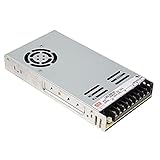
Mean Well LRS-350-12 (348W, 12V, 29A)
This is the go-to option for builders who need a single, fat 12V rail to feed addressable LED strips, external pump controllers, or high-draw peripherals that would overload a PSU auxiliary rail. Owners appreciate the near-350W continuous rating and the wide input range that handles unconditioned wall power without complaint. The open-frame design mounts easily on a bench or inside a custom chassis.
- Pro: 29 amps of 12V output provides generous headroom for multiple peripherals simultaneously.
- Pro: Lowest price in the 350W class, making it easy to deploy as a dedicated rail.
- Con: Open frame offers no dust protection, limiting use in environments with pet hair or workshop particulate.
Skip this unit if your build case is small or poorly ventilated, as the lack of enclosure can compound existing thermal challenges inside a cramped chassis.
Mean Well LRS-350-24 (350.4W, 24V, 14.6A)
For builders integrating CNC routers, laser modules, or automation hardware alongside their gaming rig, this 24V variant delivers the voltage most industrial peripherals expect. The 14.6-amp rating is sufficient for multiple stepper drivers or a spindle controller without a separate supply. It shares the same platform reliability as its 12V sibling.
- Pro: 24V output aligns with the majority of CNC and automation accessories, reducing the need for converters.
- Pro: Published specs show 350.4W continuous, a marginally higher ceiling than the 12V model.
- Con: Not suitable for gaming peripherals that expect 12V or 5V rails; requires a buck converter for mixed loads.
Skip it if your add-ons are all consumer-grade 12V devices, because you would end up adding a conversion stage that introduces its own inefficiency.
Mean Well LRS-350-12 (Multi-Use, 350W, 12V, 29A)
Nearly identical in electrical specification to the first LRS-350-12 but listed with broader compatibility claims covering CCTV, 3D printers, routers, and computer projects. The practical difference for a builder is minimal; the listing emphasizes multi-application versatility, and the price sits slightly higher, likely reflecting different distribution channels. Owner feedback mirrors the base model: reliable, cool-running under load, and straightforward to wire.
- Pro: Same proven 12V platform with slightly more documented cross-application use cases in community threads.
- Pro: Wide acceptance for mixed loads, making it a safe general-purpose choice.
- Con: A few dollars more than the first listing for functionally the same output.
Skip it if you are already buying the $29.99 version and have no need for the specific documentation or seller support that accompanies this listing.
Mean Well EDR-120-12 (12V, 10A, 120W)
This is the pick for compact enclosures, DIN-rail panels, or tight builds where a full-size LRS unit simply will not fit. The 120W ceiling is enough for moderate LED arrays, small pumps, or router-class devices. Its DIN-rail form factor is the key selling point for builders who mount hardware on backplates or in rack-style frames.
- Pro: DIN-rail mounting makes it ideal for panel builds and organized cable management.
- Pro: Sealed enough for dust-prone environments while remaining compact.
- Con: 120W is limiting for high-draw setups; pushing near capacity reduces longevity.
Skip it if your peripheral load exceeds 10 amps of 12V draw, as this unit will struggle and potentially enter over-current protection.
Mean Well LRS-350-5 (300W, 5V)
A 5V rail at 300W is unusual and extremely useful for builders who feed large USB hub arrays, logic-level peripherals, or legacy 5V-only devices. Gaming peripherals that require 5V auxiliary power benefit from having a dedicated, well-regulated source rather than sharing the PSU rail. Owner reports highlight stable voltage under varying load steps.
- Pro: 300W of clean 5V output is rare in this price tier and solves a specific rail-supply problem.
- Pro: Industrial regulation quality means minimal ripple on sensitive logic loads.
- Con: Higher price than 12V siblings despite slightly lower total wattage.
Skip it if your peripherals all run on 12V, because a 5V rail would require a boost stage that adds complexity.
Mean Well LPV-60-12 (12V, 5A, Sealed Panel Mount)
The most affordable unit in this group and the only one rated for sealed, potentially outdoor or damp environments. For builders adding ambient LED accents around a case window, desk edge, or external signage, the IP-rated construction and integrated LED driver function make it a purpose-built solution. Its 60W budget is appropriate for a single strip or a small cluster.
- Pro: Lowest price and sealed panel-mount form factor for moisture or dust exposure.
- Pro: Built-in LED driver simplifies wiring for strip-light applications.
- Con: 5 amps of 12V output limits it to small loads; no headroom for expansion.
Skip it if you plan to grow the LED array or add non-LED peripherals to the same rail.
Mean Well NDR-240-24 (240W, 24V, 10A, DIN Rail)
The premium option here, combining the 24V industrial standard with a DIN-rail form factor and 240W continuous output. Builders running multiple CNC axes, industrial-grade actuators, or high-draw automation alongside their PC will find this the most robust single-supply solution. The price reflects the combination of power density, mounting style, and build quality.
- Pro: DIN-rail 24V at 240W is a rare combination that eliminates the need for separate mounting hardware and converters.
- Pro: Owners report quiet operation and stable output even after extended sessions.
- Con: At $59, it costs nearly double the LRS-350 series while providing fewer total watts.
Skip it if your budget is tight and your 24V load stays below 120W, where the EDR or LRS-350-24 would serve at lower cost.
Mean Well LRS-350-24 (SMPS Listing, 350.4W, 24V, 14.6A)
Electrically equivalent to the second LRS-350-24 but listed at the lowest 24V price in this group. For builders who already own the 12V LRS unit and need a second rail for 24V hardware, this represents the best value per watt. The SMPS designation in the listing simply reiterates the switching topology that all these units share.
- Pro: Best price among 24V options for the full 350W class.
- Pro: Identical thermal and regulation performance to the more expensive 24V listing.
- Con: Same open-frame dust exposure as all LRS variants.
Skip it if you need sealed or DIN-rail mounting, in which case the EDR or NDR form factors justify their premiums.
Buying Guide
Match Voltage to Load, Not the Other Way Around
The single most common mistake in auxiliary-rail selection is buying a unit with excess wattage but the wrong output voltage. A 350W supply at 24V cannot power a 12V LED strip without a buck converter, which adds heat, cost, and a failure point. Map every peripheral you intend to attach, note its required voltage, and select a Mean Well whose nominal output matches the dominant load. Mixed loads are only practical when all devices share the same rail voltage.
Respect Thermal Headroom Over Peak Wattage
Publishing a continuous rating does not mean the unit runs cool at that number in a warm room inside an enclosed case. Owner feedback consistently shows that LRS-series units run noticeably warmer above 80 percent of rated load. If your build sits in a small-form-factor chassis or your ambient temperature exceeds thirty degrees Celsius, select a supply rated roughly 30 percent above your calculated peak draw. This is not padding; it is the difference between five years of service and two.
Form Factor Determines Mounting Viability
Open-frame units like the LRS series require either a DIN-rail adapter or custom bracket work to mount cleanly. If your build already uses a backplate or modular panel system, spending a few dollars more on an EDR or NDR model saves fabrication time and reduces vibration transfer. For bench-top or open-frame test setups, the LRS line remains the most flexible and lowest-cost option.
Our Verdict
The top pick for most custom gaming and peripheral builds is the Mean Well LRS-350-12 at $29.99. It offers the best price-to-amp ratio in the group, serves the most common auxiliary voltage, and has the widest community validation. For budget-conscious builders who only need a small LED rail or a single low-draw device, the LPV-60-12 at $15.13 is an easy recommendation with sealed protection as a bonus. If your setup is strictly 24V industrial, the NDR-240-24 wins despite its premium price, because its combination of DIN-rail mounting and 240W output eliminates two separate purchases that an LRS-based solution would require.
FAQ
Can a Mean Well supply replace my ATX power supply?
No. Mean Well switching supplies provide a single DC output voltage and lack the multi-rail architecture, signal lines, and connector standards that motherboards and GPUs require. They supplement an ATX PSU by extending dedicated power to peripherals, LEDs, or external hardware.
Do LRS-series units need cooling fans from the case?
Most are designed for natural convection at loads well below maximum, but sustained operation near rated wattage benefits from some airflow. Owners in ventilated cases report comfortable temperatures, while sealed-enclosure users sometimes add a small blower to prevent throttling.
Are these supplies safe to wire directly to a wall outlet?
The input side is designed for mains connection with appropriate earth and overcurrent protection upstream. Always connect through a fused, grounded circuit and follow local electrical codes. Never open the enclosure while energized.
How long do these units typically last under continuous load?
Mean Well publishes MTBF figures in the hundreds of thousands of hours for the LRS and NDR lines, and owner reports on gaming and automation forums commonly reference years of 24/7 operation without failure, provided thermal headroom is respected.