A programmable DC power supply sits at the center of any electronics workbench that goes beyond hobbyist soldering. Whether you are diagnosing a failed GPU VRM on a gaming rig, stress-testing a custom cooling loop controller, or replacing a wall wart with something you can dial to an exact voltage, the gap between a forty-five-dollar bench unit and a three-hundred-dollar instrument comes down to output resolution, protection logic, and whether you can control it from software or are stuck turning a knob with oily fingers.
The eight supplies below span that entire range. We compared published specifications, listed prices, and aggregated owner feedback from verified buyers on major retail platforms. What separates a good pick from a mediocre one in 2026 is no longer just voltage and current headroom. It is whether the unit offers fine-grained adjustment, a reliable overcurrent cutoff, and a communication path that lets you log or automate a test sequence instead of repeating manual dial-ins for the fiftieth time.
As an Amazon Associate we earn from qualifying purchases at no extra cost to you. Product prices and availability are accurate as of the date shown and are subject to change.


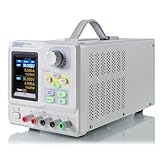
Top 3 picks at a glance
Quick Picks
| Product | Best for | Price |
|---|---|---|
| DC Power Supply Variable (30V 10A Black) | First bench supply | $49.99 |
| Jesverty SPS-3010 | Best value with 4-digit display | $42.74 |
| Kiprim 0-60V 0-5A | Higher voltage headroom | $115.99 |
| HM310T | PC software control on a budget | $99.99 |
| Jesverty SPS-3010V | USB-C quick-charge | $49.99 |
| DC Power Supply Variable (3.6A USB) | High USB current | $44.98 |
| SKY TOPPOWER 32V 10A | PC control under $50 | $46.54 |
| Siglent SPD1305X | Professional reliability | $328 |
How We Picked
We prioritized four criteria in order of importance for this category. First, output range and whether the stated voltage and current ceilings match common repair scenarios on consumer electronics. Second, adjustment precision: a coarse-plus-fine encoder or a 4-digit display makes reproducible settings realistic. Third, protection behavior, specifically overcurrent cutoff and short-circuit handling, because a supply that lets current spike can destroy the board you are trying to save. Fourth, connectivity: USB serial, included PC software, or a Type-C port that supports data commands separates a true programmable unit from a variable one with a misleading title.
The 8 Best Programmable Dc Power Supply in 2026
DC Power Supply Variable (30V 10A Black)
This is the simplest entry point here, aimed at hobbyists and IT techs who need an adjustable DC source for board-level diagnostics without learning software commands. At under fifty dollars it packs a short-circuit alarm that higher-priced units sometimes omit.
- Encoder knob provides tactile fine control and the output enable/disable button prevents accidental live probes
- Built-in USB quick-charge port doubles as a convenience charger during extended repairs
- No programmable presets or PC interface means you cannot save or recall test profiles
Skip this if your workflow involves repeated measurements at identical set points; a software-controlled unit will save you time and reduce dial-in error.
Jesverty SPS-3010
At $42.74 the Jesverty SPS-3010 is the cheapest unit on this list that still offers a high-precision 4-digit LED display and separate coarse and fine adjustment, a combination that eliminates the guesswork found on single-knob designs. It is a natural fit for anyone who wants readout accuracy without touching a computer.
- 4-digit display plus dual-speed adjustment yields repeatable settings in the sub-tenth-volt range
- 5V/2A USB port handles phone charging alongside bench work
- USB current ceiling of 2A is lower than competitors offering 3.6A or 20W
Skip if you rely on high-current USB charging for multiple devices at once or want data-logging capability.
Kiprim 0-60V 0-5A
The Kiprim targets a specific niche: technicians who regularly need more than thirty volts. With a 0-60V range it covers op-amp rails, certain audio amplifier biases, and automotive electronics that sit above the common thirty-volt ceiling. The 4-digit display supports fine resolution, and the unit is programmable, so you can store profiles for repeated tasks.
- Sixty-volt ceiling opens test scenarios that every 30V or 32V unit on this list cannot reach
- Programmable operation with 4-digit readout supports preset recall
- Current caps at 5A, half the output of the 30V/10A units, and input is 110V only
Skip this if your work centers on five-volt and twelve-volt logic rails and you need higher current, or if you operate on a 220V mains supply without a transformer.
HM310T
The HM310T is a programmable DC power supply that bundles PC software and a USB interface at under a hundred dollars, a combination that was exclusive to instruments costing three times as much just a few years ago. The four-digit display cycles through voltage, current, power, and elapsed time, giving you a compact readout panel. For anyone automating burn-in tests or ramping voltage in controlled steps, this unit bridges the hobby and professional gap.
- Included PC software with USB serial control enables scripted voltage and current sweeps
- Voltage, current, power, and time display supports detailed logging without external instrumentation
- Output ceiling is 30V rather than the 32V some rivals offer, marginally reducing headroom
Skip if you never plan to connect a computer and want to keep your bench uncluttered; a knob-only unit is cheaper.
Jesverty SPS-3010V
Jesverty refreshed its popular bench supply with the SPS-3010V, adding a 20W USB and Type-C quick-charge port alongside the encoder-driven coarse and fine adjustment that made the original a bestseller. The 4-digit LED display retains high-precision readout. If you charge phones, tablets, or handheld consoles from your bench while doing repair work, the 20W Type-C output covers most modern devices without a separate adapter.
- 20W USB plus Type-C quick-charge handles the vast majority of consumer device charging scenarios
- Encoder coarse and fine knob combined with 4-digit LED yields precise manual settings
- No PC interface or programmable presets limits use to single-session manual adjustments
Skip this if you need to automate a sequence of voltage steps or store test profiles between sessions.
DC Power Supply Variable (3.6A USB)
At $44.98 this unit offers the highest dedicated USB output current on the list, rated at 3.6A with both a standard USB-A and a Type-C port. The encoder knob provides coarse and fine adjustment, and an OCP overcurrent protection circuit shuts the output down if a fault draws the supply past its safe limit. It is a practical bench companion for phone-repair technicians who need reliable charging power next to their adjustable rail.
- 3.6A USB output supports fast-charging protocols that 2A ports cannot deliver
- OCP protection cuts output before a shorted capacitor or trace can draw damaging current
- Lacks PC programmability and the display resolution is not specified as 4-digit
Skip if you require logged data, scripted ramps, or a documented high-resolution display for fine-voltage work.
SKY TOPPOWER 32V 10A
The SKY TOPPOWER is the least expensive unit here that combines USB-C connectivity with PC control and genuine programmable operation. At $46.54 it undercuts the HM310T by more than fifty dollars while still providing a thirty-two-volt, ten-amp output range. Owner feedback highlights the convenience of USB-C for modern laptops, removing the need for a legacy adapter. If you want software control on the cheapest possible budget, this is the starting point.
- USB-C PC control eliminates the dongle or adapter that older USB-A units require
- 32V/10A range matches mid-tier supplies at a fraction of the cost
- Published documentation and software polish trail Siglent and HM310T offerings
Skip if your lab requires SCPI-compliant commands or you need verified software stability for production burn-in.
Siglent SPD1305X
Siglent built its reputation on oscilloscopes and function generators, and the SPD1305X carries that engineering pedigree into a single-channel programmable DC power supply rated at 30V, 5A, and 150W. The price of $328 reflects a documented, firmware-updatable instrument with known output ripple figures, reliable overcurrent logic, and a communication stack that plays well with lab automation software. For anyone whose income depends on the supply not lying about what it delivers, this is the floor you want.
- Brand-level documentation, firmware support, and consistent performance reduce uncertainty in professional workflows
- 150W output with programmable sequencing supports multi-stage power-up tests without external timers
- Five-amp current ceiling and high price make it overkill for low-current digital board repair
Skip if every project you touch draws under three amps; a forty-dollar unit will do the same job at a quarter the cost.
Buying Guide
Output Range and Resolution
Match the voltage and current ceilings to the devices you repair most often. Consumer gaming hardware rarely exceeds twenty-four volts on any rail, and currents above five amps are uncommon outside CPU VRMs under load. A thirty-volt, ten-amp unit covers virtually all laptop and desktop board work. If you touch automotive or audio electronics, look for sixty-volt headroom like the Kiprim. Resolution matters as much as range: a 4-digit display with a one-hundredth-volt step lets you set 12.00V instead of eyeballing 12 on a two-digit readout. A dual-speed encoder (coarse for big jumps, fine for trimming) is the mechanical equivalent and should not be treated as optional.
Protection Logic
Every unit here lists some form of short-circuit or overcurrent protection, but the quality of that protection varies. A fast-acting OCP circuit reduces output within milliseconds when a fault draws current past the set limit, protecting both the board under test and the supply itself. The cheaper units rely on basic current limiting without a defined cutoff speed, which is acceptable for hobbyist use but risky when probing a component you suspect is already failing. If you routinely work on boards with visible scorch marks or bulging capacitors, prioritize a unit with documented OCP behavior or an independent fuse.
Connectivity and Automation
The word “programmable” in a product title can mean anything from full SCPI remote control to a single preset slot. Before buying, confirm which interface the unit exposes. USB-A serial, USB-C data, included Windows software, and SCPI-over-serial support are four different tiers of capability. If you need to sweep voltage linearly over time or repeat a sequence of set points across multiple boards, anything without PC control will cost you hours of manual dial-in. If your work is one-off troubleshooting, a tactile encoder and a clear display are genuinely sufficient.
Our Verdict
Top pick: the Siglent SPD1305X. When accuracy, protection reliability, and long-term firmware support matter to your livelihood, it earns its price through documented performance that no budget unit can guarantee.
Budget pick: the Jesverty SPS-3010. At $42.74 it delivers a 4-digit display, dual-speed encoder, and a USB charging port in a single unit, which is the best spec-per-dollar ratio on this list.
The HM310T wins outright if you need PC software control but your budget stops below $120, because its included USB interface and scripted ramp capability replace manual repetition in a way that the knob-only units cannot.
FAQ
Can a programmable DC power supply replace a multimeter for diagnostics?
No. A power supply sources current; it does not measure resistance, continuity, or voltage across a component. You need both on the bench. Some high-end supplies include a built-in DMM or a monitoring readout, but none on this list does.
Is switching topology a problem for sensitive analog work?
Switching supplies introduce more output ripple than linear designs, which can mask small-signal behavior in RF or precision analog circuits. For digital board repair, the difference is negligible and switching units are lighter and more efficient.
Do I need 10A output for gaming PC repair?
Rarely. A CPU VRM draws five to seven amps on a single 12V rail under synthetic load, and no other component exceeds three amps independently. A 5A unit covers every scenario you will encounter unless you are powering multiple rails simultaneously.
What does OCP protect against specifically?
Overcurrent protection shuts the output when the load draws more current than your set limit, preventing a shorted capacitor, solder bridge, or failed MOSFET from pulling the supply into thermal shutdown or, worse, damaging the component you are trying to test.