The best handheld gaming PC for most people in October 2026 is the ASUS ROG Xbox Ally X. It pairs AMD’s Ryzen AI Z2 Extreme chip with 24GB of fast memory, a 1TB SSD and a large 80Wh battery in a body that still weighs well under a kilogram. The runner-up is the Steam Deck OLED, which is slower on paper but runs SteamOS, the smoothest console-style software on any handheld PC, and has a gorgeous HDR OLED screen.
The handheld market changed a lot this year. Memory shortages pushed prices up across the board, Valve raised Steam Deck OLED prices in late May 2026, and Intel’s new Arc G3 Extreme chip arrived in June inside the MSI Claw 8 EX AI+. This guide sorts through all of it so you can match a device to your library, your budget and how long you want to play away from a charger.
Disclosure: We may earn a commission from qualifying purchases made through links on this page, at no extra cost to you.
Our Top Picks
 ASUS ROG Xbox Ally Gaming Handheld 7" 120Hz16GB RAM|512GB SSD11 x 4.5 x 1.5 inches2 PoundsCheck on Amazon
 msi Claw A8 PC Gaming Handheld: AMD Ryzen0.9" x 11.8" x 5"11.79 x 0.94 x 4.99 inches1.69 PoundsCheck on Amazon

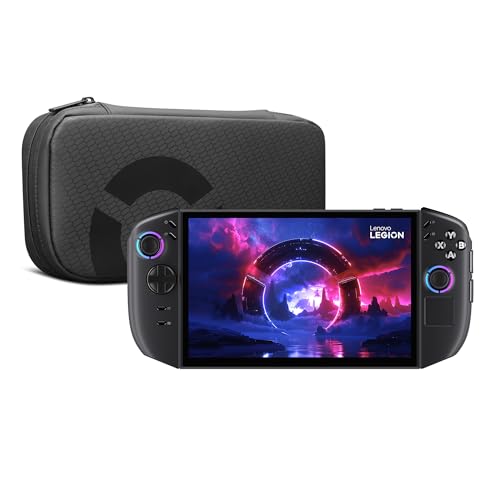

Top 3 picks at a glance

Top Picks at a Glance
- Best Overall: ASUS ROG Xbox Ally X, the strongest all-round mix of speed, battery and comfort.
- Best for Ease of Use: Steam Deck OLED, the most console-like software and an excellent HDR screen.
- Best Value: ASUS ROG Xbox Ally, the same shell and screen as the X for a much lower price tier.
- Best Big Screen: Lenovo Legion Go 2, an 8.8-inch 144Hz OLED with detachable controllers.
- Best Premium Performance: MSI Claw 8 EX AI+, the first handheld with Intel’s Arc G3 Extreme.
- Best 8-Inch AMD Option: MSI Claw A8, Z2 Extreme power and an 80Wh battery behind a roomier screen.
- Best Budget 8-Inch: Lenovo Legion Go S, a lighter, simpler handheld built around the Ryzen Z2 Go.
Best Handheld Gaming PC Comparison Table
| Handheld | Best For | Chip | Screen | Battery / Weight | Watch For | Price Tier |
|---|---|---|---|---|---|---|
| ASUS ROG Xbox Ally X | Most players | Ryzen AI Z2 Extreme, 24GB | 7″ 1080p IPS, 120Hz | 80Wh / 715g | Smaller screen than 8-inch rivals | Premium |
| Steam Deck OLED | Steam libraries, simplicity | Custom Zen 2 APU, 16GB | 7.4″ 800p HDR OLED, 90Hz | 50Wh / 640g | Lowest raw performance here | Upper-mid |
| ASUS ROG Xbox Ally | Value | Ryzen Z2 A, 16GB | 7″ 1080p IPS, 120Hz | 60Wh / 670g | Older Zen 2 CPU cores | Mid-range |
| Lenovo Legion Go 2 | Big screen, couch play | Ryzen Z2 Extreme, up to 32GB | 8.8″ 1200p OLED, 144Hz | 74Wh / 920g | Heaviest pick | Premium |
| MSI Claw 8 EX AI+ | Top-end performance | Intel Arc G3 Extreme, 32GB | 8″ 1200p IPS-level, 120Hz VRR | 80Wh / 785g | Flagship price | Flagship |
| MSI Claw A8 | 8-inch AMD power | Ryzen Z2 Extreme, 24GB | 8″ 1200p, 120Hz VRR | 80Wh / 765g | Wide, heavy body | Premium |
| Lenovo Legion Go S | Budget 8-inch | Ryzen Z2 Go, 16GB | 8″ 1200p IPS, 120Hz | 55.5Wh / 730g | Modest GPU for new AAA games | Mid-range |
1. ASUS ROG Xbox Ally X: Best Handheld Gaming PC Overall
As an Amazon Associate we earn from qualifying purchases at no extra cost to you.
- Chip: AMD Ryzen AI Z2 Extreme, 8 cores / 16 threads (Zen 5 + Zen 5c), Radeon RDNA 3.5 graphics
- Memory / storage: 24GB LPDDR5X-8000, 1TB M.2 2280 SSD
- Screen: 7-inch 1920 x 1080 IPS, 120Hz, FreeSync Premium, 500 nits
- Battery / weight: 80Wh, 715g
- Ports: 1x USB4 (Thunderbolt 4 compatible), 1x USB-C 3.2 Gen 2, microSD, Wi-Fi 6E
- Software: Windows 11 with the Xbox full-screen experience
Best for: anyone who wants to play a big Windows library, including Xbox PC Game Pass, Steam, Epic and Battle.net, on one device. Skip if: you mostly play Steam games and want the simplest possible software.
Why we picked it: The Ally X is the most balanced handheld you can buy right now. The Z2 Extreme is the same class of silicon that powers the MSI Claw A8 and Legion Go 2, but ASUS fits it into a lighter 715g shell with grips that reviewers consistently describe as some of the most comfortable in the category. The 24GB of LPDDR5X-8000 matters more than it sounds: integrated graphics borrow system memory as video memory, so faster and larger RAM gives the GPU more room for textures in modern games.
The 80Wh battery is as large as anything in this list, which means you can either play lighter titles for a long stretch at low power or push the chip harder in demanding games and still get a reasonable session. Based on the spec tier, expect recent AAA games to run at 720p to 800p with upscaling at medium settings, and older or indie games to run at the full 1080p. The USB4 port is a meaningful upgrade over the cheaper Ally: it opens the door to faster docks and external storage.
For longevity, ASUS uses a full-size M.2 2280 SSD slot, so a larger drive is a simple swap later. The main trade-off is the 7-inch screen. If you want more screen area, the 8-inch Claw A8 and 8.8-inch Legion Go 2 use the same chip in bigger bodies.
Pros
- Fast Z2 Extreme chip with 24GB of high-speed memory
- Large 80Wh battery in a comparatively light body
- Comfortable controller-style grips
- USB4 port for docks and fast accessories
- Easy-to-upgrade 2280 SSD
Cons
- Sits in the premium price tier
- 7-inch 1080p screen is smaller than 8-inch rivals
- Windows still needs occasional desktop-mode fiddling
2. Steam Deck OLED: Best for Ease of Use
As an Amazon Associate we earn from qualifying purchases at no extra cost to you.
- Chip: Custom 6nm AMD APU, 4-core / 8-thread Zen 2 CPU, 8 CU RDNA 2 GPU
- Memory / storage: 16GB LPDDR5 at 6400 MT/s, 512GB or 1TB SSD
- Screen: 7.4-inch 1280 x 800 HDR OLED, up to 90Hz, 1,000 nits peak HDR
- Battery / weight: 50Wh, about 640g
- Connectivity: USB-C with DisplayPort 1.4, Wi-Fi 6E, Bluetooth 5.3
- Software: SteamOS
Best for: Steam players who want a pick-up-and-play device with sleep and resume that just works. Skip if: you rely on Game Pass, anti-cheat-heavy multiplayer games that do not support Linux, or you want the fastest frame rates.
Why we picked it: The Steam Deck OLED is the handheld that feels most like a console. SteamOS boots straight into a controller-first interface, suspend and resume is nearly instant, and Valve’s Deck Verified program tells you up front how well a game will run. None of the Windows handhelds match that polish out of the box, even with their improved Xbox-style shells.
Its screen is a highlight. The OLED panel has true blacks, HDR support and a 90Hz mode, and the lower 1280 x 800 resolution is actually a good match for the chip. Because the GPU only has to drive about half as many pixels as a 1080p screen, games often hold steadier frame rates than you might expect from older Zen 2 hardware. That said, it is the slowest chip on this list. Estimate lower settings in the newest AAA releases and plan to cap at 30 to 40fps in the heaviest titles.
Price is the catch in 2026. Valve raised Steam Deck OLED prices on May 27, 2026, citing memory and storage costs, so it now lands in the upper-mid tier rather than the bargain bracket. Even so, the combination of OLED, battery efficiency at low wattage and software polish keeps it near the top. Valve has not announced a Steam Deck 2 as of this update.
Pros
- SteamOS is the simplest, most console-like handheld software
- Excellent HDR OLED screen
- Light at about 640g
- Deck Verified ratings take the guesswork out of compatibility
Cons
- Oldest and slowest chip in this guide
- No native Game Pass app; some multiplayer games will not run
- 2026 price increase reduces its value edge
3. ASUS ROG Xbox Ally: Best Value Handheld PC
As an Amazon Associate we earn from qualifying purchases at no extra cost to you.
- Chip: AMD Ryzen Z2 A, 4 cores / 8 threads (Zen 2)
- Memory / storage: 16GB LPDDR5X-6400, 512GB M.2 2280 SSD
- Screen: 7-inch 1920 x 1080 IPS, 120Hz, FreeSync Premium, 500 nits
- Battery / weight: 60Wh, 670g
- Ports: 2x USB-C 3.2 Gen 2, microSD, Wi-Fi 6E
Best for: players who want a Windows handheld for Game Pass, indies and older AAA titles without paying flagship money. Skip if: you want to run the newest demanding releases at decent settings.
Why we picked it: The standard ROG Xbox Ally shares its shell, grips and 7-inch 120Hz screen with the Ally X, so it looks and feels like the more expensive model. The difference is inside. The Ryzen Z2 A uses older Zen 2 cores and a smaller GPU, closer in class to the Steam Deck’s chip than to the Z2 Extreme, and it pairs that with 16GB of slower memory and a 512GB drive.
That makes it a smart buy for a specific kind of player. Game Pass titles, indies, emulation and games a few years old are well within its range, and the 60Wh battery is larger than the Steam Deck’s 50Wh, which helps at low wattages. Expect the newest AAA games to need low settings and aggressive upscaling. Compared with the Legion Go S, the Ally trades a smaller screen for a lighter body and the comfortable ASUS grips.
A practical upgrade note: like the Ally X, it uses a full-size M.2 2280 slot, so you can fit a bigger SSD later instead of relying on microSD for large game installs.
Pros
- Same comfortable shell and 120Hz screen as the Ally X
- Mid-range price tier
- 60Wh battery and efficient low-power chip
- Upgradeable 2280 SSD
Cons
- Zen 2 chip struggles with the newest AAA games
- Only 512GB of storage in the base configuration
- No USB4 port
4. Lenovo Legion Go 2: Best Big-Screen Handheld
As an Amazon Associate we earn from qualifying purchases at no extra cost to you.
- Chip: AMD Ryzen Z2 Extreme (Ryzen Z2 on lower configurations), Radeon 890M-class graphics
- Memory / storage: up to 32GB LPDDR5X-8000, up to 2TB M.2 2242 SSD, microSD
- Screen: 8.8-inch 1920 x 1200 OLED, 144Hz VRR, 500 nits typical, 1,000 nits HDR peak
- Battery / weight: 74Wh, 920g
- Ports: 2x USB4, microSD, 3.5mm jack
- Controls: detachable controllers with Hall effect sticks, trackpad, FPS mode
Best for: couch and tabletop players who want the largest, most vivid screen on a handheld. Skip if: you play mostly in your hands for long sessions or travel light.
Why we picked it: The Legion Go 2 is the handheld that most resembles a small gaming tablet. Its 8.8-inch OLED is the biggest screen in this list, with a 144Hz variable refresh rate and HDR peaks around 1,000 nits. Lenovo kept the detachable controllers from the original Legion Go, so you can prop it on a table with its kickstand and play with the controllers in your hands, or use the right controller as a vertical mouse in FPS mode.
Inside, the Z2 Extreme puts it in the same performance class as the Ally X and Claw A8, and Lenovo offers it with up to 32GB of memory. The battery grew from 49Wh on the first Legion Go to 74Wh here, a roughly 50 percent increase. With two USB4 ports, docking and charging while using an accessory is easy.
The downside is weight. At 920g it is the heaviest device in this guide by a clear margin, and it is noticeably thicker than the original. Treat it as a big-screen handheld you will often set down, not one you will hold up for three hours on a train. Its SSD is the shorter M.2 2242 size, which is still replaceable but has fewer high-capacity options than 2280 drives.
Pros
- Largest and best-looking screen here: 8.8-inch 144Hz OLED
- Detachable controllers and kickstand for tabletop play
- Z2 Extreme with up to 32GB of RAM
- Two USB4 ports
Cons
- Heaviest pick at 920g
- Premium price, inflated further by the RAM shortage
- Bulky for travel
5. MSI Claw 8 EX AI+: Best Premium Performance
As an Amazon Associate we earn from qualifying purchases at no extra cost to you.
- Chip: Intel Arc G3 Extreme (Panther Lake), 14 cores, Arc B390 graphics with 12 Xe3 cores
- Memory / storage: 32GB LPDDR5X-8533, 1TB M.2 2280 PCIe 4.0 SSD
- Screen: 8-inch 1920 x 1200 touchscreen, 48 to 120Hz VRR, 500 nits
- Battery / weight: 80Wh, 785g
- Ports: 2x Thunderbolt 4, microSD, Wi-Fi 7, Bluetooth 6.0
Best for: enthusiasts who want the newest handheld silicon and are willing to pay for it. Skip if: price matters, or you want proven, settled driver support across older games.
Why we picked it: The Claw 8 EX AI+ is the first shipping handheld built on Intel’s Arc G3 Extreme, a chip Intel designed specifically for gaming handhelds. It went on sale on June 23, 2026. The GPU is the headline: 12 Xe3 cores with dedicated ray tracing units and XMX AI engines for Intel’s XeSS upscaling. Early reviews have been strongly positive about its frame rates, and on paper it is the most capable chip in this guide.
MSI pairs it with 32GB of LPDDR5X-8533, the fastest memory here, plus an 80Wh battery, Hall effect sticks and triggers, Wi-Fi 7 and two Thunderbolt 4 ports. The Cooler Boost HyperFlow system uses dual fans and heat pipes, which matters because the chip can draw far more power when docked than on battery. MSI also moved to a full-size M.2 2280 SSD, a welcome change from the shorter drives in earlier Claws.
The trade-offs are cost and maturity. This is flagship-tier pricing, and a cheaper Arc G3 (non-Extreme) version has been reported for late October 2026. Intel’s handheld drivers have improved a great deal, but AMD-based devices still have the longer track record with older titles. If you want the best of everything today and accept a premium, this is it.
Pros
- Most powerful handheld chip available in 2026
- 32GB of fast memory and an 80Wh battery
- Two Thunderbolt 4 ports, Wi-Fi 7
- Full-size 2280 SSD
Cons
- Flagship price tier
- Newer platform with a shorter driver track record
- Heavier than the Ally X
6. MSI Claw A8: Best 8-Inch AMD Handheld
As an Amazon Associate we earn from qualifying purchases at no extra cost to you.
- Chip: AMD Ryzen Z2 Extreme, 8 cores / 16 threads, 16 CU RDNA 3.5 graphics
- Memory / storage: 24GB LPDDR5X-8000, 1TB M.2 2280 PCIe 4.0 SSD
- Screen: 8-inch 1920 x 1200 touchscreen, 120Hz VRR, up to 500 nits
- Battery / weight: 80Wh, 765g
- Ports: 2x 40Gbps USB-C with DisplayPort and charging, microSD, Wi-Fi 7
Best for: players who want Z2 Extreme performance with a larger 16:10 screen than the Ally X. Skip if: you have small hands or care most about weight.
Why we picked it: The Claw A8 is MSI’s AMD answer to its Intel Claws. It uses the same Ryzen Z2 Extreme as the Ally X and Legion Go 2, with 24GB of LPDDR5X-8000 and an 80Wh battery, but puts it behind an 8-inch 1920 x 1200 screen. The taller 16:10 shape gives you more room for strategy games, menus and desktop apps than the 7-inch 16:9 screens on the ASUS models.
It sits neatly between the Ally X and Legion Go 2 in this list. It is about 50g heavier than the Ally X, but much lighter than the 920g Legion Go 2. Hall effect sticks and triggers help with long-term drift resistance, Wi-Fi 7 future-proofs wireless streaming, and two 40Gbps USB-C ports make docking straightforward. MSI’s own claims put video playback at 19-plus hours, while independent reviews suggest a heavy AAA session is closer to the typical two to three hours you see across this class.
Like the Ally X, the full-size 2280 SSD slot is an easy long-term upgrade path. The main reason to choose the Ally X instead is comfort and weight; the main reason to choose the Claw A8 is the bigger screen.
Pros
- Z2 Extreme in an 8-inch 16:10 screen
- 80Wh battery and 24GB of fast RAM
- Hall effect sticks and triggers
- Wi-Fi 7 and two 40Gbps USB-C ports
Cons
- Wide, heavy body at about 765g
- Premium price tier
- Performance similar to the cheaper-to-carry Ally X
7. Lenovo Legion Go S: Best Budget 8-Inch Handheld
As an Amazon Associate we earn from qualifying purchases at no extra cost to you.

- Chip: AMD Ryzen Z2 Go, 4 Zen 3 cores / 8 threads, 12 CU RDNA 2 graphics
- Memory / storage: 16GB LPDDR5X-6400 (32GB options), 512GB or 1TB SSD, microSD
- Screen: 8-inch 1920 x 1200 IPS, 120Hz VRR, 500 nits
- Battery / weight: 55.5Wh, about 730g
- Ports: 2x USB4, microSD, Wi-Fi 6E
- Software: Windows 11 (white) or SteamOS (blue) versions
Best for: budget buyers who want a bigger 8-inch screen and the option of SteamOS from a third-party maker. Skip if: you expect strong performance in brand-new AAA games.
Why we picked it: The Legion Go S is a simpler, lighter sibling to the Legion Go 2. It drops the detachable controllers for a one-piece design and uses the Ryzen Z2 Go, a chip Lenovo co-developed with AMD. That chip sits a step above the Steam Deck in CPU terms thanks to Zen 3 cores, with a 12 CU RDNA 2 GPU that handles indies, older AAA games and Game Pass titles comfortably at reduced settings.
What makes it notable is choice. It was the first third-party handheld sold with SteamOS installed, so you can get Valve’s console-style software on an 8-inch 120Hz screen, or pick the Windows version if you need other launchers. Rapid charging reaches about 50 percent in 30 minutes with the 65W adapter, and two USB4 ports are generous at this tier.
The trade-off is efficiency. Despite a larger 55.5Wh battery than the Steam Deck OLED, reviews found it usually runs out sooner, and it weighs roughly 90g more. Make sure you buy the Z2 Go version shown here; some configurations ship with the older Z1 Extreme instead.
Pros
- 8-inch 1200p 120Hz screen at a mid-range price tier
- Available with SteamOS or Windows
- Two USB4 ports and fast charging
Cons
- Modest GPU for the newest games
- Shorter battery life than the Steam Deck OLED
- Configurations vary, so check the chip before buying
Also Consider
MSI Claw 8 AI+
As an Amazon Associate we earn from qualifying purchases at no extra cost to you.

Best for: buyers who want an 8-inch Intel handheld without paying for the newest Arc G3 model. It uses the Intel Core Ultra 7 258V (Lunar Lake) with 32GB of LPDDR5X and an 80Wh battery behind an 8-inch 1200p 120Hz screen. Its Arc 140V graphics were a big step up for Intel in 2025. Trade-off: the Claw 8 EX AI+ above is clearly faster, and AMD’s Z2 Extreme models are better proven across older games.
Lenovo Legion Go (first generation)
As an Amazon Associate we earn from qualifying purchases at no extra cost to you.

Best for: players who want detachable controllers and a big 8.8-inch screen at a lower price tier than the Legion Go 2. It runs the Ryzen Z1 Extreme with 16GB of RAM and an 8.8-inch 2560 x 1600 IPS screen at 144Hz. Trade-off: its 49Wh battery is much smaller than the Legion Go 2’s 74Wh, and the high-resolution screen often needs to be run below native resolution for smooth frame rates.
ASUS ROG Ally (2023, Z1)
As an Amazon Associate we earn from qualifying purchases at no extra cost to you.

Best for: a budget floor if you only play indies, emulators and cloud games. The original ROG Ally with the standard Z1 chip has a 7-inch 1080p 120Hz screen and weighs about 608g. Trade-off: its 40Wh battery is half the size of the Ally X’s, and it is a previous-generation device, so treat it as an entry point rather than a long-term machine.
JSAUX 6-in-1 Docking Station
As an Amazon Associate we earn from qualifying purchases at no extra cost to you.
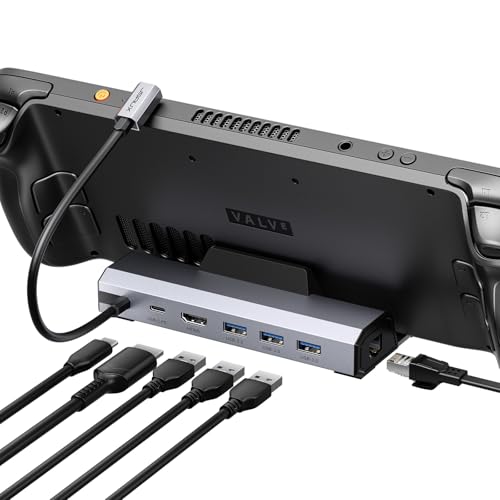
Best for: turning any of these handhelds into a living-room or desk console. The JSAUX dock supports the Steam Deck, ROG Ally X and Legion Go S and adds HDMI output and extra ports in a stand that holds the device upright while it charges. Trade-off: a basic dock will not add GPU power; your handheld still renders every frame.
How We Chose
These picks are based on research, not physical evaluation of each unit. We started with every handheld gaming PC currently sold new in the US and narrowed the list using these criteria:
- Chip class: current-generation handheld silicon (AMD Ryzen Z2 family, Intel Arc G3 and Lunar Lake, Valve’s custom APU) ranked by GPU core count, architecture and memory speed.
- Battery and weight: watt-hour capacity relative to weight, since this decides how long and how comfortably you can play unplugged.
- Screen: size, resolution, refresh rate, VRR and panel type, weighed against how hard the chip has to work to drive it.
- Software: Windows versus SteamOS and how each handles controller-first navigation.
- Upgrade path: SSD size format, USB4 or Thunderbolt ports and RAM capacity.
- Price tier: at least one pick per budget band.
Specifications come from manufacturer spec sheets (ASUS, Valve, Lenovo, MSI, Intel and AMD) and were cross-checked against independent reviews from established hardware publications. Performance notes are estimates based on each chip’s tier, not measurements.
Handheld Gaming PC Buying Guide
Which chip do you need?
The chip decides almost everything. In 2026 the practical tiers are:
- Entry: Steam Deck APU, Ryzen Z2 A and Ryzen Z2 Go. Fine for indies, older AAA games, emulation and Game Pass at modest settings.
- High-end: Ryzen Z2 Extreme and Intel Core Ultra 7 258V. The sweet spot for recent AAA games at 720p to 1080p with upscaling.
- Flagship: Intel Arc G3 Extreme. The strongest integrated graphics in a mainstream handheld right now.
If most of what you play came out in the last two years, aim for the high-end tier or above. If you mostly play older or lighter games, entry chips save a lot of money and often last longer per charge.
Screen size, resolution and refresh rate
A 7-inch 1080p screen is sharp enough for handheld viewing distances, while 8-inch and 8.8-inch 16:10 panels add room for menus and strategy games. Higher resolution is not always better: the Steam Deck’s 800p screen lets a slower chip reach smoother frame rates. Look for 120Hz with VRR (variable refresh rate); VRR keeps motion smooth when frame rates dip below the maximum, which happens often on handhelds. OLED gives deeper blacks and better HDR than IPS but costs more.
Battery capacity and real playtime
Battery size ranges from 50Wh to 80Wh in this guide. As a rule of thumb, demanding games at 20 to 25W drain any handheld in roughly two to three hours, regardless of brand. Bigger batteries help most at low wattages for indies and older games, where an 80Wh device can run far longer. If long flights matter, favor 74Wh to 80Wh and carry a 65W USB-C power bank.
Memory and storage
Integrated graphics share system memory, so 16GB is the minimum and 24GB to 32GB is better for the newest games. Faster LPDDR5X (8000 MT/s and up) also lifts GPU performance. For storage, 1TB is a comfortable baseline because modern games can exceed 100GB each. Check the SSD format: full-size M.2 2280 slots (Ally, Ally X, Claw A8, Claw 8 EX) have the widest choice of affordable high-capacity drives.
Windows or SteamOS?
Windows runs everything, including Game Pass, Epic, Battle.net, EA and most anti-cheat multiplayer games. The Xbox full-screen experience on newer handhelds makes it feel more like a console, but it still needs occasional desktop-mode work. SteamOS is simpler, sleeps and wakes faster, and is very efficient, but some multiplayer titles with kernel anti-cheat will not run. Choose based on where your library lives.
Weight, ergonomics and ports
Under 700g feels comfortable for long sessions in your hands; above 850g you will want to rest the device on something. Hall effect sticks resist drift over time. For ports, USB4 or Thunderbolt allows faster docks and external drives, and two USB-C ports let you charge and use an accessory at the same time.
Mistakes to Avoid
- Buying the wrong configuration. Several handhelds share names across very different chips. The ROG Xbox Ally uses the Z2 A while the Ally X uses the Z2 Extreme, and the Legion Go S ships with either the Z2 Go or the older Z1 Extreme. Always check the chip in the listing.
- Chasing resolution over frame rate. A high-resolution screen on a mid-range chip often means running games below native resolution anyway. Balance screen and chip.
- Ignoring your library. If you play Game Pass or anti-cheat multiplayer games, SteamOS devices can be frustrating. If you only play Steam, Windows adds complexity you may not need.
- Expecting all-day AAA gaming. No handheld runs demanding games for more than a few hours at full power. Plan on a charger or power bank for long trips.
- Skimping on storage. A 512GB drive fills quickly. Budget for 1TB or a high-speed microSD card from the start.
- Forgetting comfort. A heavier, faster handheld is not better if you stop using it after 30 minutes. Weight and grip shape matter as much as specs.
FAQ
What is the best handheld gaming PC in 2026?
The ASUS ROG Xbox Ally X is the best handheld gaming PC for most people in 2026. It combines the Ryzen AI Z2 Extreme, 24GB of fast memory, a 1TB SSD and an 80Wh battery in a 715g body. The Steam Deck OLED is the best alternative if you want simpler software.
What is the most powerful handheld gaming PC?
The MSI Claw 8 EX AI+ with Intel’s Arc G3 Extreme is the most powerful mainstream handheld available right now. Its Arc B390 GPU has 12 Xe3 cores, and it pairs that with 32GB of LPDDR5X-8533. Z2 Extreme devices such as the Ally X and Legion Go 2 form the next tier.
Is the Steam Deck OLED still worth buying in 2026?
Yes, if you mainly play Steam games and value ease of use. Its OLED screen, SteamOS polish and light weight are still class-leading. However, Valve’s May 2026 price increase means it no longer has a big price advantage, so Windows handhelds like the ROG Xbox Ally deserve a look.
Can handheld gaming PCs run AAA games?
Yes, most can run modern AAA games, but usually at 720p to 1080p with upscaling and medium or low settings. High-end chips like the Z2 Extreme and Arc G3 Extreme handle recent releases best. Entry chips like the Steam Deck APU may need the lowest settings in the most demanding titles.
How long does a handheld gaming PC battery last?
Expect roughly two to three hours in demanding games at 20 to 25W on most handhelds. Lighter games at low wattage can run five hours or more on 80Wh models. Screen brightness, refresh rate and frame-rate caps all have a big effect on playtime.
Should I get a handheld gaming PC or a gaming laptop?
Get a handheld if portability and couch play matter most and you are happy with handheld-class performance. Get a gaming laptop if you want much higher frame rates, a bigger screen and a full keyboard for work. Many handhelds can also dock to a monitor for desk use.
Can I connect a handheld gaming PC to a TV or monitor?
Yes. Every handheld in this guide can output video over USB-C, either directly to a USB-C monitor or through a dock with HDMI. Models with USB4 or Thunderbolt 4 support faster docks and, on some, external GPU enclosures.
Is 16GB of RAM enough for a handheld gaming PC?
16GB is enough for indies, older games and many current titles, but 24GB to 32GB is better for the newest AAA games. Integrated graphics use part of system memory as video memory, so more RAM leaves more room for textures and helps avoid stutter.
Which Handheld Gaming PC Should You Buy?
- You want one handheld that does everything well: ASUS ROG Xbox Ally X.
- You live in Steam and want console simplicity: Steam Deck OLED.
- You want Windows and Game Pass on a budget: ASUS ROG Xbox Ally.
- You play at a table or on the couch and want the best screen: Lenovo Legion Go 2.
- You want the fastest handheld money can buy: MSI Claw 8 EX AI+.
- You want Z2 Extreme power with an 8-inch screen: MSI Claw A8.
- You want an 8-inch screen and SteamOS option at a lower tier: Lenovo Legion Go S.
If you are still unsure, decide on software first (Windows or SteamOS), then pick the highest chip tier your budget allows. That single choice will shape your experience more than any other spec.
Sources
- ASUS ROG Xbox Ally and Ally X official specifications
- Valve Steam Deck OLED tech specs page
- Lenovo Legion Go 2 and Legion Go S product specifications
- MSI Claw 8 EX AI+ and Claw A8 product pages and Computex 2026 announcement
- Intel Arc G3 series processor briefs
Last updated: October 10, 2026