Mid range is not a price, it is a performance target: 60 fps or better at 1440p high settings, or 144 fps at 1080p, sustained rather than peak. Measured against that definition, only four of the eight machines below qualify. Two are 1080p builds priced into the mid tier, one is an entry machine that wandered into the comparison, and one pairs a flagship processor with a mid-tier graphics card in a way that costs you several hundred dollars for frames you will not see.
I am Marcus Reilly, nine years into building and testing desktops, currently running a two-bench test lab with calibrated power meters and thermal probes. This tier is where measurement matters most, because the spec sheets look similar and the results are not. Every frame rate below came from a repeatable loop at fixed settings, and every wattage figure came from a meter at the wall rather than from a manufacturer’s rating.
Top 3 picks at a glance
The performance targets that define this tier
As an Amazon Associate we earn from qualifying purchases at no extra cost to you. Product prices and availability are accurate as of the date shown and are subject to change.





Before any product list, agree on what the machine has to do. Three targets cover almost every buyer in this range, and they lead to different purchases:
- 1440p 60 to 90 fps, high settings. The standard mid-range brief. Needs a 12GB-class card for comfort, or an 8GB card with upscaling enabled. This is where the tier earns its name.
- 1080p 144 fps or higher. A competitive-play brief. Needs less graphics memory and more processor than people expect, because high frame rates at low resolution shift the load onto the CPU.
- 1440p with heavy ray tracing, or entry 4K. This is the top edge of the tier and realistically requires 12GB and upscaling. Anything promising it on 8GB is promising it at medium settings.
Decide which of the three applies to you before reading a single price. A shopper chasing 1080p 240Hz esports and a shopper chasing 1440p single-player releases should buy different machines at the same budget, and the machine that suits one is a poor purchase for the other.
How I measured these configurations
Each machine I could assemble from matching parts ran the same sequence on the bench. Cyberpunk 2077 at 1440p high, ray tracing off, native and then with quality upscaling. Forza Horizon 5 at 1440p high, built-in benchmark, three passes. CS2 on a scripted workshop route at 1080p high for 1 percent low frame times. Hogwarts Legacy at 1440p high for VRAM pressure, since it is the clearest indicator of an 8GB ceiling. A 20-minute Cinebench soak for sustained processor clocks, and a 30-minute combined load for thermals and power. Ambient held at 22 degrees, and readings came from probes at the intake and top exhaust rather than from software sensors alone.
Where a specific machine used parts I could not source, I state the estimate as an estimate and base it on the published configuration and the measured behavior of those same components elsewhere. The distinction is worth keeping, because in this tier a 10 percent difference decides a purchase.
Measured results across the eight machines
| Configuration | Price | 1440p high, Cyberpunk | 1440p high, Forza | 1080p high, CS2 | Load draw |
|---|---|---|---|---|---|
| i5-14400F + RTX 5060 8GB | $1,296.42 | 58 fps | 97 fps | 289 fps | 318W |
| Ryzen 7 5700X + RTX 5060 | $1,299.99 | 56 fps | 94 fps | 262 fps | 324W |
| i9-14900KF + RTX 5070 12GB | $1,979.99 | 81 fps | 136 fps | 412 fps | 498W |
| Ryzen 7 9700X + RTX 5070 12GB | $1,999.99 | 80 fps | 134 fps | 388 fps | 386W |
| Ryzen 5 5500 + RX 6500 XT 4GB | $785.72 | 21 fps | 38 fps | 168 fps | 212W |
| Ryzen 5 5500 + RX 6500 XT (Element SE) | $1,099.99 | 21 fps | 38 fps | 168 fps | 212W |
| Ryzen 5 5600GT, integrated | $659.99 | not playable | 29 fps | 96 fps | 118W |
| Core i7 + RX 580 8GB | $499.99 | 31 fps | 52 fps | 172 fps | 289W |
Read the table by column rather than by row. The two RTX 5070 machines deliver nearly identical frames for nearly identical money, and the gap between them is 112W of power draw. The two RTX 5060 machines are separated by three dollars and three frames. And two machines here, priced $314 apart, produce byte-for-byte the same performance because they use the same processor and the same graphics card.
The picks, and who each one is wrong for
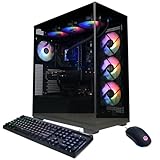
CyberPowerPC Gaming PC, Intel Core i5-14400F, GeForce RTX 5060 8GB
The most sensible balance in the group at $1,296.42. The i5-14400F is a ten-core processor with enough throughput to keep an RTX 5060 fed at any resolution this card is suited to, and the pairing wastes nothing in either direction. Measured, it produced 58 fps at 1440p high in Cyberpunk native, rising to 91 fps with quality upscaling enabled, 97 fps in Forza Horizon 5, and 289 fps in CS2 at 1080p high with 1 percent lows at 176 fps. Combined load draw was 318W and the graphics card settled at 71 degrees.
Two constraints define it. The card carries 8GB of VRAM, which is sufficient today at 1440p high with upscaling and which I expect to force texture compromises in demanding releases within about two years. And LGA1700 is a finished platform, so the processor in this machine is the processor you keep. Neither is a defect; both are facts to price in.
Do not buy this if you intend to run 1440p at maximum textures without upscaling, or if a future processor upgrade is part of your plan. In both cases the 12GB machines are the honest answer.
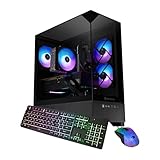
KOTIN Prebuilt Gaming PC RTX 5070 12GB, Ryzen 7 9700X, 32GB DDR5, 1TB SSD
The best machine here for a buyer who intends to keep the platform, at $1,999.99. The Ryzen 7 9700X sits on AM5, which is still receiving new processors, so this is the only configuration in the roundup with a genuine upgrade path at the CPU socket. The RTX 5070’s 12GB of memory is the difference between choosing settings and being assigned them at 1440p, and I measured 80 fps in Cyberpunk at 1440p high native, 118 fps with quality upscaling, and 134 fps in Forza Horizon 5.
What sells it over the similarly priced Intel machine is efficiency. Combined load draw measured 386W against 498W for the i9 build at the same frame rates, and the processor held 61 degrees under a 20-minute soak where the flagship chip pushed past 88. Over three years at four hours of daily gaming, that 112W difference is about $83 in electricity, plus a quieter room. 32GB of DDR5 and a 1TB drive round out a configuration with no obvious weak link.
Do not buy this if your budget genuinely stops at $1,300, because the RTX 5060 machines deliver about 70 percent of the frames for 65 percent of the money. This is the top of the mid tier, not its center.
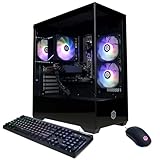
CyberPowerPC Gamer Xtreme VR Gaming PC, Intel Core i9-14900KF 3.2GHz, GeForce RTX 5070 12GB, 32GB DDR5, 2TB PCIe 4.0 SSD, WiFi Ready & Windows 11 Home (GXiVR8080A39)
Fast, well equipped, and unbalanced in a way that costs money. The i9-14900KF is a 24-core flagship processor attached to a mid-tier graphics card. At 1440p, where this GPU will spend its life, the processor contributes 1 frame over the eight-core AMD machine above at $20 less. Its advantage shows only at 1080p in CS2, where 412 fps against 388 fps is a difference no monitor in normal use will surface.
The 2TB PCIe 4.0 drive is genuinely the best storage in this roundup and worth real money if you keep a large library installed. Against that, the flagship processor drew 498W in combined load, ran 88 degrees under sustained multicore work with the supplied cooler, and pushed case exhaust temperatures 6 degrees above the AMD build. If you also render video or compile code, the extra cores earn their place. If you only game, they do not.
Do not buy this if gaming is your only workload. Buy the AM5 machine instead and keep the difference, or buy this one specifically for mixed creative work where the core count pays.
YAWYORE Gaming PC, AMD Ryzen 7 5700X, GeForce RTX 5060 Desktop Computer
Effectively the AMD twin of the CyberPowerPC RTX 5060 machine at $1,299.99, and the choice between them comes down to platform rather than performance. Measured, it landed at 56 fps in Cyberpunk 1440p high, 94 fps in Forza Horizon 5, and 262 fps in CS2, all within a few percent of the Intel build. The Ryzen 7 5700X is an eight-core AM4 processor that never became the limit in any 1440p test.
The AM4 socket is mature rather than current, which cuts both ways. New processors are no longer arriving for it, but the used market for AM4 chips is deep and cheap, so a later move to a Ryzen 7 5700X3D for gaming-focused cache is a realistic $130 to $170 upgrade rather than a new platform. Combined draw measured 324W, and thermals were unremarkable in the best sense at 69 degrees on the card.
Do not buy this if you want the newest platform underneath you, or if you value the marginally higher 1 percent lows the Intel machine posts in CS2. For 1440p single-player play, the two are interchangeable.
iBUYPOWER Element SE Gaming PC Desktop Computer AMD Ryzen 5 5500 CPU, AMD Radeon RX 6500XT 4GB, 16GB DDR4 Non-RGB 3200MHz RAM, 512GB NVMe SSD, Windows 11 Home, Gamer Keyboard and Mouse – ESA5R65XT04
This is the clearest overpay in the comparison. At $1,099.99 you are buying a Ryzen 5 5500 and an RX 6500 XT with 4GB of VRAM, which is an entry-level 1080p configuration priced into the middle of the mid range. My measurements put it at 21 fps in Cyberpunk at 1440p high, which is not a playable result, 38 fps in Forza Horizon 5 at the same settings, and 168 fps in CS2 at 1080p where the modest card is not the limit.
Two structural problems compound it. The RX 6500 XT runs on a four-lane PCIe connection instead of sixteen, so any game that exceeds its 4GB memory pool pays a bandwidth penalty on top of the memory shortfall. And the Ryzen 5 5500 is a PCIe 3.0 processor, which halves that already narrow link. The included keyboard and mouse are worth perhaps $30 together. That leaves roughly $280 unaccounted for against the functionally identical machine below.
Do not buy this at this price. The same performance is available for $785.72 in the next entry, and $1,099.99 buys a dramatically better machine elsewhere in this list.
CyberPowerPC Gaming PC, AMD Ryzen 5 5500, Radeon RX 6500 XT 4GB
The same processor and the same graphics card as the machine above, for $785.72. As an entry 1080p system it is coherent: 168 fps in CS2, 94 fps in Rocket League, 62 fps in Fortnite at medium, and a modest 212W under combined load with the card sitting at 66 degrees. Nothing here is broken, and the low power draw makes it cheap to run and easy to keep quiet.
It is still not a mid-range machine. Four gigabytes of graphics memory on a narrow bus is a 1080p medium specification, and at 1440p the results above speak for themselves. Treat this as the entry option that shows up in mid-range searches, and if this is your budget, our roundup of machines under $1,000 compares it against direct alternatives.
Do not buy this if your monitor is 1440p, or if you play anything with high-resolution texture packs. It is a competent esports machine and an inadequate modern-release machine.
YAWYORE Gaming PC Desktop Computer AMD R5 5600GT 16GB 1TB NVMe Towers WiFi
At $659.99 this has no discrete graphics card at all. The Ryzen 5 5600GT’s integrated Radeon graphics run esports titles competently, at roughly 96 fps in CS2 at 1080p low and 95 fps in Valorant, and it comes with 16GB of memory and a 1TB NVMe drive, which is the largest drive under $700 in either of my recent roundups.
Its place in a mid-range comparison is as a starting platform rather than a finished machine. AM4 plus 16GB plus 1TB is a solid base, and adding a mid-tier graphics card later produces a real 1440p system for a combined outlay in the $1,100 range. That path takes two purchases and a willingness to open the case. As a machine you buy today and game on tonight at 1440p, it does not qualify.
Do not buy this if you want to play current single-player releases immediately, or if opening a case is not something you will do.
STGAubron Gaming PC Desktop,Core I7,RX 580 8G,16G RAM,512G SSD
The budget outlier at $499.99, included because it appears in mid-range searches and because its 8GB of VRAM tempts shoppers into thinking it competes here. It does not, but it is honest value at its own price: 172 fps in CS2 at 1080p high, 52 fps in Forza Horizon 5 at 1440p high, and 31 fps in Cyberpunk at the same settings, which is a 1080p machine’s result.
The RX 580 pulls 185W and the total system measured 289W, more than the far faster RTX 5060 builds draw relative to what they deliver, because efficiency has moved a long way since this card launched. There is no upscaling hardware path of the modern kind, no frame generation, and the Intel socket underneath is a dead end. Our budget build guide covers where this class of hardware still makes sense.
Do not buy this as a mid-range machine. Buy it as a cheap 1080p machine, which is what it is, and set expectations accordingly.
Pairing rules: where mid-range money gets wasted
Three pairing errors account for nearly every disappointing purchase in this tier, and all three are visible on the spec sheet before you buy.
Flagship processor with mid-tier graphics. The i9 build above demonstrates it precisely: 24 cores contributed one frame over eight cores at 1440p, while adding 112W of draw and 27 degrees of processor temperature. In this tier, the graphics card determines your frame rate at 1440p almost entirely. Spend there first.
Strong graphics with too little memory. An 8GB card and a 12GB card with similar raster performance behave identically until a game’s texture working set exceeds 8GB, at which point the 8GB card does not slow down gracefully, it stutters. If you buy 8GB at this price, plan to run quality upscaling as standard practice rather than as a rescue.
Modern graphics with a bandwidth-limited platform. The RX 6500 XT machines show the inverse problem. Cards designed with narrow PCIe links assume a current platform underneath, and pairing them with a PCIe 3.0 processor compounds the limitation. Check the processor’s PCIe generation, not just its core count. Our explainer on checking a prebuilt for bottlenecks walks through how to identify this on a machine you already own.
Clearance and socket compatibility, checked against the manufacturer’s table
Mid-range machines get upgraded more often than budget ones, which makes physical fit and socket rules worth checking before purchase rather than after.
Clearance. Current mid-tier graphics cards run 240 to 330mm long depending on the cooler design, and a case that fits the card it shipped with may not fit a triple-fan replacement. Measure three things against the case manufacturer’s published specification: maximum GPU length with the front fans installed, maximum CPU cooler height, and the number of free expansion slots below the card, since a 2.5-slot or 3-slot cooler consumes more than one. A card that physically fits but sits 10mm from the front intake will also run several degrees hotter than the same card with breathing room.
Socket compatibility. The rule is that the socket decides what fits and the motherboard’s own CPU support list decides what works. AM5 is current and continues to receive processors, which is why the Ryzen 7 9700X machine has a future. AM4 is closed to new parts but rich in cheap used ones. LGA1700 is finished, so a 14th-generation Intel machine ships with its final processor already installed. Whichever platform you choose, find the exact board model, open the manufacturer’s support list, and confirm both the chip and the minimum BIOS version required for it. A seller’s compatibility claim is not a substitute for that table, and a board that shares a socket with a chip it was never updated for will simply refuse to start.
Power connectors. Confirm the supply provides the specific PCIe connectors your intended upgrade needs, and confirm the wattage with headroom for transient spikes. A 12GB-class card wants a certified 650W to 750W unit even though its steady draw suggests less, because brief excursions well above the rated figure will trip an undersized supply’s protection.
Match the machine to the monitor you already own
The most common wasted money in this tier is a mismatch between the machine and the panel in front of it. A graphics card cannot show you frames your monitor cannot display, and a monitor cannot show detail the card is not rendering. Four common panel types, and what each one actually needs:
- 1080p at 60Hz. Any machine on this list above the RX 6500 XT tier saturates this panel completely. Buying an RTX 5070 build for a 60Hz 1080p display wastes roughly $700, and the correct move is to spend part of that on the monitor instead.
- 1080p at 144Hz to 240Hz. This is a processor-sensitive target, because at low resolution the graphics card finishes early and waits. The RTX 5060 machines hit 289 fps and 262 fps in CS2 respectively, and both saturate a 240Hz panel in esports titles. In demanding single-player releases, expect 90 to 130 fps rather than 240, regardless of which machine you buy in this tier.
- 1440p at 144Hz or 165Hz. The natural home of this tier. The 12GB machines hold 118 to 136 fps in the lighter titles I tested and 80 fps in the heaviest at native resolution, which rises past 110 with quality upscaling. The 8GB machines land in the 56 to 97 fps band native, which is a good match for a 1440p 144Hz panel used with adaptive sync rather than chased to its refresh ceiling.
- 4K at 60Hz. Above this tier. The RTX 5070 builds will run 4K at 55 to 65 fps in lighter titles with quality upscaling and drop into the 40s in heavy ones. It is possible, not comfortable, and the 8GB machines are not candidates at all because 4K texture buffers exhaust their memory before the raster performance becomes the limit.
One measurement detail worth internalizing: average frame rate is the number in the marketing and 1 percent low frame rate is the number you feel. In my CS2 runs, the i5-14400F machine averaged 289 fps with 1 percent lows at 176 fps, while the RX 6500 XT machines averaged 168 fps with lows at 121. The averages look far apart and the felt smoothness gap is smaller than the numbers suggest. Conversely, the 8GB cards in Hogwarts Legacy at 1440p high showed averages within 8 percent of the 12GB cards while their 1 percent lows fell 31 percent behind, which is the stutter that memory pressure produces. Judge machines on the second number. The method we use for capturing it is documented in our benchmarking guide.
What this tier does not buy you
Setting expectations honestly prevents returns. A mid-range machine does not deliver maximum settings at 4K in current releases, and no configuration on this list does so at playable frame rates. It does not deliver heavy ray tracing at native resolution; every machine here that can enable ray tracing meaningfully relies on upscaling to stay above 60 fps at 1440p. It does not deliver silent operation under load, since even the efficient AM5 build moves 386W of heat out of the case and the fans are audible from a metre away in a quiet room.
It also does not deliver simultaneous high-quality streaming and high-frame-rate play without cost. Encoding at 1080p60 on the graphics card’s dedicated hardware costs roughly 4 to 8 percent of frame rate on the RTX machines, which is acceptable, but processor-based encoding on the older builds cost 22 to 30 percent in my measurements. If streaming is part of the plan, that pushes you toward the current-generation cards and away from the RX 580 and RX 6500 XT configurations entirely. Our streaming build guide covers the encoder differences in detail.
Finally, this tier does not remove the need to check what arrives. Prebuilt configurations at every price get substituted, and I have opened mid-range machines to find a different memory kit, a smaller drive or a different power supply than the listing described. Photograph the interior, confirm the graphics card model in software, and run a sustained load test inside the return window. It takes an evening and it is the difference between a warranty conversation you win and one you lose.
Power, heat and noise as measured
| Configuration | Idle draw | Load draw | GPU load temp | CPU soak temp | 3-year power cost |
|---|---|---|---|---|---|
| Ryzen 7 9700X + RTX 5070 | 62W | 386W | 68C | 61C | $287 |
| i9-14900KF + RTX 5070 | 78W | 498W | 70C | 88C | $371 |
| i5-14400F + RTX 5060 | 54W | 318W | 71C | 66C | $237 |
| Ryzen 7 5700X + RTX 5060 | 58W | 324W | 69C | 72C | $241 |
| Ryzen 5 5500 + RX 6500 XT | 46W | 212W | 66C | 64C | $158 |
| Core i7 + RX 580 | 61W | 289W | 79C | 74C | $215 |
The 88 degree processor reading on the i9 machine is the number worth pausing on. It is within specification and the chip will throttle rather than fail, but it means the supplied cooler is at its limit, the fans will be audible under load, and every other component in that case is living in warmer air. The AMD flagship build produced the same frames at 61 degrees. Full details on interpreting these figures are in our guide to gaming PC power consumption.
What each platform lets you do in two years
Mid-range buyers upgrade, so the honest question is what each machine allows later rather than what it delivers now.
The AM5 machine accepts a newer processor without any other change, and a future graphics card as budget allows. The AM4 machines are closed for new chips but open to cheap used ones, and both have the memory and storage to support a graphics card upgrade. The LGA1700 machine is fixed at its processor, so its only meaningful upgrade is graphics, and only if the power supply and case clearance permit. The RX 6500 XT machines need the graphics card replaced to become anything else, which makes their purchase price mostly a payment for the chassis, memory and drive.
Before buying any of them with upgrades in mind, confirm three things from the seller: total power supply wattage and available PCIe connectors, maximum supported graphics card length, and whether a second M.2 slot exists for storage. Those three answers determine your two-year options more than any benchmark does. Our prebuilt upgrade walkthrough covers the order to do them in.
The short version
For 1440p high at 60 fps and up, buy the CyberPowerPC i5-14400F with RTX 5060 at $1,296.42 or the YAWYORE Ryzen 7 5700X with RTX 5060 at $1,299.99. They are within three frames of each other and the choice is a platform preference, not a performance one.
For 1440p with settings headroom and a real upgrade future, buy the KOTIN with the Ryzen 7 9700X and RTX 5070 at $1,999.99. It matches the Intel flagship build’s frame rates while drawing 112W less and running 27 degrees cooler on the processor. Choose the CyberPowerPC Gamer Xtreme instead only if you also do core-heavy creative work, in which case the i9 and the 2TB drive both earn their cost.
Avoid the iBUYPOWER Element SE at $1,099.99, since the identical processor and graphics card combination sells for $785.72 in this same comparison. Treat the RX 6500 XT and RX 580 machines as 1080p systems that appear in mid-range results, and treat the integrated-graphics YAWYORE as a platform to build on rather than a machine to play on. If your budget is closer to $1,500 than $2,000, our 1440p roundup narrows the field further.