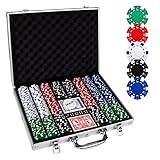
The best poker chip sets for most home games are 500-chip composite sets with clear denominations, a sturdy aluminum or hard-shell case, and chips weighing about 11.5–14 grams; choose a 300-chip set for four to six players, 500 chips for up to ten, or 1,000 chips for a large tournament table.
As an Amazon Associate we earn from qualifying purchases at no extra cost to you.



Our Top Picks


Top 3 picks at a glance
Quick recommendations by home-game setup
| Your situation | Best chip specification | Recommended quantity | Why it fits |
|---|---|---|---|
| Occasional family or friends’ games | 11.5–14 g composite chips with printed denominations | 300 chips | Affordable, easy to sort, and sufficient for four to six players |
| Regular 6–10 player home games | 13.5–14 g ceramic or high-quality composite chips | 500 chips | More durable and flexible for different starting stacks |
| Tournament-style games | 14 g chips or ceramic chips with several denominations | 500–1,000 chips | Supports larger stacks, color-ups, and multiple tables |
| Quiet, premium-feeling table | Clay-composite or ceramic chips | 500 chips | Better edge feel, sound, and handling than basic plastic chips |
| Travel or storage is the priority | Lightweight 9–11.5 g plastic or composite chips | 300–500 chips | Reduces case weight while retaining a useful set size |
What makes the best poker chip sets?
A good set is not simply the heaviest or most expensive option. The useful combination is a readable denomination system, enough chips in the colors you actually need, consistent dimensions, and a case that protects the contents. A 1,000-chip set with poor markings can be less practical than a well-organized 500-chip set.
For most households, look for chips close to 39 mm in diameter. This is the common size used by many home sets and works well with standard racks, trays, and automatic or manual shufflers designed for regular poker chips. Chips that are unusually large may feel impressive but can be harder to stack and store.
Chip materials compared
Plastic
Plastic chips are the cheapest and lightest option, commonly weighing about 7–11.5 grams. They resist spills and are easy to clean, making them suitable for children’s games, travel, or occasional use. Their drawbacks are a less substantial feel, louder sliding noise, and printed markings that may wear sooner.
Choose plastic when price, portability, and easy maintenance matter more than a premium tactile experience. Avoid very thin chips if players will shuffle, stack, and handle them frequently.
Composite and ABS chips
Composite chips are usually plastic-based but denser and more substantial than basic injection-molded chips. Many home sets weigh 11.5–14 grams and include a metal insert or layered construction. They are the safest all-purpose choice because they combine reasonable durability, readable designs, and broad availability.
Weight alone does not prove quality. A heavier chip may contain a metal slug, while a lighter chip may have a better surface and more durable graphics. Check whether the denomination is molded into the chip, printed under a protective coating, or applied as a surface label.
Clay-composite chips
Clay-composite chips imitate the feel and muted sound associated with casino-style playing pieces while remaining more affordable than fully custom professional chips. They are often around 13.5–14 grams. The textured surface provides grip, and the edge spots make denominations easier to identify at a glance.
These chips are a strong choice for regular home games. They can chip, however, if repeatedly dropped onto hard flooring, and their textured finish may require more careful cleaning than smooth plastic.
Ceramic chips
Ceramic chips have a smooth, dense surface with graphics printed across the face and edges. They are often about 10–10.5 grams, although weight varies by design. Their main advantage is durability of the artwork: the design is part of the surface rather than a thin sticker.
Ceramic sets are especially appealing for tournament-style games or custom themes. Their smoothness can make stacks slide more easily, so players who prefer a grippy clay feel may favor clay-composite chips instead.
How many chips do you need?
Set quantity should be calculated from starting stacks, not player count alone. For a simple home tournament, assume each player receives 40–60 chips. A 500-chip set therefore has enough physical pieces for eight to ten players, with a reserve for the table bank and replacement chips.
Here is a practical example. Suppose eight players receive 5,000 points each, using these denominations:
- 10 × 25-point chips = 250 points
- 10 × 100-point chips = 1,000 points
- 7 × 500-point chips = 3,500 points
- 1 × 1,000-point chip = 1,000 points
That is 28 chips per player, or 224 chips for eight players. Add roughly 25% for the central bank, color-ups, replacements, and players who prefer larger stacks: 224 × 1.25 = 280 chips. A 300-chip set works mathematically, but a 500-chip set gives more room for alternate structures and a more comfortable supply of low denominations.
| Set size | Comfortable player capacity | Typical use | Useful denomination mix |
|---|---|---|---|
| 200 chips | 2–4 players | Short casual games | Two or three denominations |
| 300 chips | 4–6 players | Compact home tournaments | Three or four denominations |
| 500 chips | 6–10 players | Most regular home games | Four or five denominations |
| 750 chips | 8–12 players | Large groups or two tables | Five or six denominations |
| 1,000 chips | 10–20 players | Large tournaments and multiple tables | Five or more denominations |
Denomination markings: printed, labeled, or blank?
Printed denominations are the best default for casual players because nobody has to remember which color means which value. Select sets with strong contrast and numbers large enough to read from across the table. Avoid designs where decorative edge spots overpower the central denomination.
Blank chips offer flexibility, but they require a separate chip-value system and are less convenient when guests play infrequently. They can make sense for experienced groups that want to change the structure between games.
For tournament play, do not buy a set with only three denominations unless you intend to keep starting stacks small. Four or five values make it easier to increase levels, remove low chips from play, and avoid giving every player an oversized pile of the smallest denomination.
Case quality matters more than the included accessories
Many sets advertise dealer buttons, playing cards, dice, and chip racks, but these extras should not decide the purchase. Inspect the case first. A good case has reinforced corners, secure latches, a handle that does not flex excessively, and interior padding that prevents chips from shifting.
Aluminum cases are common and provide reasonable protection, but thin metal can dent and hinges can loosen. Hard plastic cases are often lighter and may resist dents better. For permanent storage, a wooden or heavy-duty lockable case can be more attractive, although it adds cost and weight.
Check the chip racks as well. Racks should hold chips tightly enough for transport but release them without forcing the stack. If a 500-chip set includes only shallow or poorly fitted racks, plan to replace them with standard racks that match the chip diameter.
Casual games versus tournament games
For casual games
Prioritize readable numbers, a balanced color distribution, and easy cleanup. A 300- or 500-chip composite set weighing 11.5–14 grams is usually the best value. You can use denominations such as 1, 5, 25, 100, and 500, or assign the chips as points rather than currency.
For tournament games
Choose more denominations and buy extra chips in the values used for later levels. A 500-chip set is a practical starting point for eight players, while 750 or 1,000 chips are better if you expect a large group or want to run two tables.
Use distinct colors for each denomination and keep a written color key beside the dealer. When the smallest value is no longer needed, exchange those chips for higher values rather than introducing many additional low chips. This keeps stacks manageable and reduces counting mistakes.
Buying checklist
- Choose 300 chips for four to six players, or 500 chips for six to ten.
- Prefer 11.5–14 gram composite chips for the best all-purpose balance.
- Consider ceramic chips when long-lasting graphics and a smooth finish matter.
- Confirm the set has at least four clear denominations for tournament formats.
- Check chip diameter and thickness if you already own racks or trays.
- Inspect case hinges, latches, padding, and handle construction.
- Do not pay extra for accessories you will replace, especially low-quality cards or dice.
- Expect general market pricing of roughly $30–$80 for basic 300–500 chip sets, $80–$180 for better composite or clay-composite sets, and $150–$400 or more for premium ceramic, custom, or heavy-duty cases.
Frequently asked questions
What chip diameter should I look for in a home poker set?
Look for chips close to 39 mm in diameter. This is a common size for home sets and works well with standard racks, trays, and automatic or manual shufflers designed for regular poker chips. Unusually large chips may feel impressive, but they can be more difficult to stack and store. Check diameter and thickness if you already own racks or trays.
Does a heavier poker chip always mean better quality?
No, weight alone does not prove quality. A heavier chip may contain a metal slug, while a lighter chip may have a better surface and more durable graphics. Evaluate the denomination treatment, surface, dimensions, and construction together. Composite sets commonly weigh about 11.5–14 grams, while ceramic chips are often about 10–10.5 grams, depending on the design.
What should I check when evaluating the chip racks?
Check that the racks hold chips tightly enough for transport but release them without forcing the stack. Some sets include shallow or poorly fitted racks, so you may need standard racks that match the chip diameter. Rack quality matters because poorly fitted storage can let chips shift during transport and may make an otherwise useful set less convenient to organize.
How should I organize chips when playing a tournament?
Use distinct colors for each denomination and keep a written color key beside the dealer. When the smallest value is no longer needed, exchange those chips for higher values rather than adding many more low-denomination chips. This keeps stacks manageable and reduces counting mistakes. Four or five values make it easier to increase levels and remove low chips from play.
Are smooth chips easier to handle than textured chips?
Not necessarily; the preferred surface depends on the players. Clay-composite chips have a textured surface that provides grip, while ceramic chips have a smooth, dense surface. Smooth ceramic chips can make stacks slide more easily, whereas players who prefer a grippy feel may favor clay-composite chips. Textured finishes may also require more careful cleaning than smooth plastic.
Final verdict
The best poker chip sets for most home players are 500-chip composite or clay-composite sets with four or five clearly printed denominations, standard-size chips, and a reinforced case. Choose 300 chips when space and cost are more important than flexibility; move to 750 or 1,000 chips for large tournament groups. Material affects feel and durability, but quantity, denomination planning, and case construction determine whether the set remains useful after the first few games.