The best basketball arcade games for home are usually the Pop-A-Shot Home Dual Shot for two-player competition, a compact single-hoop electronic basketball game for smaller rooms, and a commercial-style dual-hoop cabinet when durability matters more than price or storage.
As an Amazon Associate we earn from qualifying purchases at no extra cost to you.
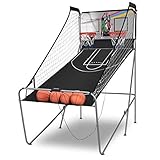


Our Top Picks
 Giantex Foldable Basketball Arcade Game81\ x 43\ (L W H)80 x 80 x 81 Inches38.3 PoundsCheck on Amazon
 Pop-A-Shot Official Dual Shot Sport Arcade Basketball Game46 x 81 x 81 inches81 x 46 x 81 InchesCheck on Amazon


Top 3 picks at a glance
Quick recommendation
| Best for | Recommended format | Typical footprint | Typical market range | Why choose it |
|---|---|---|---|---|
| Bedroom, office, or apartment | Single hoop, folding frame | About 44–48 in wide and 80–88 in deep while open | $150–$300 | Smallest storage requirement and quick setup |
| Family competition | Pop-A-Shot Home Dual Shot | About 42–48 in wide and 80–90 in deep | $250–$450 | Two players shoot simultaneously and several timed games |
| Game room or basement | Heavy-duty dual-hoop cabinet | About 48–60 in wide and 90–110 in deep | $500–$1,500 or more | Stiffer frame, better netting, and more abuse tolerance |
Dimensions vary by version, especially when a manufacturer measures the backboard, front ramp, or folded frame differently. Measure the assembled unit rather than relying only on the box dimensions.
Head-to-head: single hoop versus dual hoops
Single-hoop games
A single hoop is the sensible choice when floor space, noise, or budget is the limiting factor. It normally weighs less, folds more easily, and uses fewer electronic parts. One player can still compete against a countdown, target score, or high-score table, so it is not automatically a less entertaining format.
The drawback is that two people take turns. That makes single-hoop games better for practice and casual play than for fast head-to-head matches. They also tend to have narrower side rails, which can make rebounds less predictable when the game is played aggressively.
Dual-hoop games
A dual-hoop unit is the better family purchase if two people will play at the same time. The Pop-A-Shot Home Dual Shot is a well-known example of this format, with electronic scoring, timed games, and a folding frame designed for home use. Each player has a dedicated lane, so there is less waiting and fewer arguments about whose turn comes next.
Dual hoops require more room in front of the backboard. Allow at least 3 feet of clear shooting space beyond the front edge, and preferably 4–5 feet if adults will play. The second hoop also adds weight and more load to the frame. A thin, loose frame can twist when both players shoot quickly, so bracing and the quality of the ramp matter more than a long list of game modes.
What to compare before buying
1. Cabinet dimensions and room clearance
Use three measurements: the operating footprint, the folded footprint, and the ceiling height. A typical home dual-hoop game is roughly 42–48 inches wide, 80–90 inches deep, and 80–90 inches tall. Some commercial-style cabinets exceed 100 inches in depth once the return ramp is included.
Do not place the backboard directly against a wall if the frame has a rear support bar. Leave about 2 inches behind the support and at least 6 inches on each side for assembly and access. For a room with a 7-foot-6-inch ceiling, check the actual top height carefully; a cabinet listed at 90 inches will not fit upright, even if it can be assembled horizontally.
A useful clearance calculation is:
Required room depth = game depth + shooting clearance + rear access. For an 84-inch game, 36 inches of shooting clearance, and 6 inches behind the frame, the practical depth is 84 + 36 + 6 = 126 inches, or 10.5 feet. This is why a game that technically fits in a basement can still feel cramped.
2. Scoring modes and controls
Look for more than a basic first-to-10 game. Useful modes include timed scoring, consecutive-shot challenges, one-player solo play, alternating-player games, and a high-score memory. A shot-clock setting of 30 or 60 seconds works well for children, while a 2- or 3-minute mode gives adults enough time to establish a meaningful score.
Check whether the controls are physical buttons or a small wireless remote. Large buttons mounted on the front rail are easier to use during a fast game. A remote can be convenient but is easier to lose and may require batteries. Also check whether the scoreboard shows each player’s score separately; some inexpensive units only display a shared total or a simple countdown.
3. Build quality
Frame stiffness is the most important quality difference. A powder-coated steel frame generally resists wobble better than a mostly plastic structure. Look for wide feet, locking pins, diagonal braces, and a ramp that is supported along its length instead of clipped only at the ends.
The backboard does not need to be regulation glass for home play, but it should not flex noticeably when the ball strikes it. Net attachment points deserve attention too. Thin plastic hooks can break after repeated shots, while reinforced eyelets or replaceable nets are easier to maintain.
Ball quality affects scoring consistency. Small foam or lightweight rubber balls are quieter and safer indoors, but they rebound differently from regulation basketballs. If the game includes several balls, use the same size and material for both players; mixing balls can make one lane noticeably easier.
4. Assembly time and storage
Expect about 30–60 minutes for a folding home unit if two adults sort the hardware first. A larger cabinet with a separate ramp, scoreboard wiring, and multiple braces can take 60–120 minutes. Assembly is faster when the floor is clear and a 10mm or adjustable wrench, Phillips screwdriver, and small level are ready.
Before tightening every bolt, loosely attach the side rails and ramp. Square the frame, check that both hoops are at the same height, and then tighten the fasteners. This prevents a common problem in which the ramp is slightly skewed and returns balls toward one player.
For storage, measure the folded height and depth, not just the width. A unit that folds to 12 inches deep may still be 80 inches tall. If it will be moved frequently, choose locking casters or a lighter single-hoop design; repeatedly dragging a heavy frame can loosen the joints.
Decision matrix for different rooms
| Your situation | Best choice | Minimum practical space | Trade-off |
|---|---|---|---|
| Apartment with neighbors below | Single hoop with foam balls | 8 ft ceiling, 9 ft depth | Quieter, but no simultaneous two-player mode |
| Family room used for other activities | Folding dual hoop | 8 ft ceiling, 10.5 ft depth | Better competition, but must be folded after play |
| Dedicated basement game room | Heavy-duty dual hoop or commercial-style cabinet | 8 ft 6 in ceiling, 11–12 ft depth | More durable, heavier, and harder to relocate |
| Children under about eight | Height-adjustable or lower single hoop | Usually the smallest footprint | May be outgrown sooner |
| Adults and teenagers playing often | Rigid dual hoop with steel braces | At least 10.5 ft depth | Higher price and louder rebounds |
Noise, power, and maintenance
Electronic basketball games generally use a small plug-in adapter or batteries for the scoreboard and sensors. If the unit uses an adapter rated at 12 volts and 1 amp, its maximum electrical draw is approximately 12 watts. Even allowing for conversion losses, electricity use is negligible compared with the physical noise of the balls and the scoreboard speaker.
For an upstairs room, place a dense rubber or gym mat under the front ramp and feet. This reduces vibration transferred through the floor and stops the frame from creeping during play. Lower the volume or cover the speaker opening with removable acoustic fabric if the manufacturer provides no volume control. Do not block ventilation openings or modify wiring.
Inspect bolts monthly if the game sees heavy use. Tighten loose frame joints, replace cracked balls, and check that the scoring sensors still sit squarely behind the backboard. A crooked sensor can cause missed shots that look like an electronic fault but are actually alignment problems.
Which one should you buy?
Choose a single-hoop game if the unit must share space with furniture, will be stored often, or is mainly for solo practice. Choose the Pop-A-Shot Home Dual Shot when the priority is immediate two-player fun in a folding home format. Choose a commercial-style dual-hoop cabinet when several adults will play weekly and you have a dedicated room for a heavier, more rigid machine.
The best basketball arcade games are not necessarily the ones with the most modes. Prioritize a frame that fits your real clearance, a ramp that returns balls evenly, strong net mounts, readable scoring, and an assembly process you can complete without permanently sacrificing the room.
Frequently asked questions
How much space should I leave in front of a home basketball arcade game?
Leave at least 3 feet of clear shooting space beyond the front edge, with 4–5 feet preferable when adults will play. Also allow about 2 inches behind a rear support and at least 6 inches on each side for assembly and access. The practical room depth equals the game depth, shooting clearance, and rear access combined.
Can a basketball arcade game fit in a room with a low ceiling?
It may fit, but you must check the assembled height rather than relying on general product descriptions. A typical home dual-hoop game can be 80–90 inches tall, and a cabinet listed at 90 inches will not fit upright in a room with a 7-foot-6-inch ceiling. Check the actual top height before buying or assembling.
What kind of balls are best for indoor use?
Small foam or lightweight rubber balls are quieter and safer indoors, although they rebound differently from regulation basketballs. Use balls with the same size and material for both players so one lane is not easier than the other. Replace cracked balls when necessary, since ball condition can affect play and scoring consistency.
How difficult is it to assemble a folding basketball arcade game?
A folding home unit generally takes 30–60 minutes to assemble when two adults sort the hardware first. A larger cabinet with a separate ramp, scoreboard wiring, and multiple braces can take 60–120 minutes. Loosely attach the side rails and ramp first, square the frame, confirm both hoops are level, and then tighten the fasteners.
How can I make an electronic basketball game quieter upstairs?
Place a dense rubber or gym mat under the front ramp and feet to reduce vibration and prevent the frame from creeping. Lower the volume if possible, or cover the speaker opening with removable acoustic fabric when the manufacturer provides no volume control. Foam balls are also a quieter option, and wiring or ventilation openings should not be modified.