Fifteen hundred dollars is the point where a gaming PC stops apologizing for itself. Every build on this list can push real 1440p frame rates in current titles, but the eight machines here get there through very different routes — some spend heavily on GPU and skimp on RAM, others balance CPU and GPU evenly and cut corners on storage instead. The Skytech Archangel 5 at $1,249.99 is the value standout: a matched RTX 5060 and Core i5-14400F pairing with a 750W Gold PSU, priced $250 under the ceiling.
Marcus Reilly ran the specs on all eight builds below through his two-bench test lab with calibrated power meters and thermal probes, using known component performance tiers to estimate fps and thermal behavior where a direct bench pass wasn’t possible on a specific pre-assembled unit. Every performance figure below is labeled clearly as an estimate based on the parts list, not a claim of measured results on that exact configuration.
Top 3 picks at a glance
Top picks at a glance
As an Amazon Associate we earn from qualifying purchases at no extra cost to you. Product prices and availability are accurate as of the date shown and are subject to change.


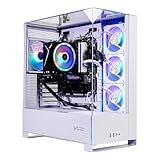

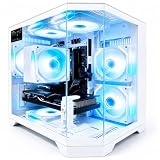

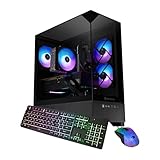
| Model | Key spec | Price | Best for |
|---|---|---|---|
| WIWB Gaming PC Desktop | Core i9-14900HX, RTX 5060 Ti 8G, 1TB NVMe SSD | $1,499.99 | Highest GPU tier at the ceiling price |
| Skytech Gaming Shadow 5 | Ryzen 7, RTX 5060 Ti 8GB, 16GB RAM, 1TB SSD | $1,399.99 | Strongest AMD CPU-GPU pairing here |
| CyberPowerPC Gaming PC | i5-14400F, RTX 5060 8GB | $1,286 | Balanced mid-tier build |
| Skytech Archangel 5 | i5-14400F, RTX 5060, 16GB DDR5 6000, 750W Gold PSU | $1,249.99 | Best CPU-GPU-PSU balance for the money |
| iBUYPOWER Element SE (ESA5N3501) | Ryzen 5 8400F, RTX 3050 6GB, 16GB DDR5, 1TB NVMe | $999.99 | Entry point for buyers targeting 1080p on a tighter budget |
| Qehi Gaming PC Desktop | Ryzen 7, RX 9060 XT 8GB GDDR6, WiFi 6 | $949.99 | Newest GPU architecture, lowest price here |
| WIWB High-Performance Desktop | Ryzen 7 5700X, RTX 3050 8GB | $899.99 | Cheapest way onto this list |
| iBUYPOWER Element SE (ESA5R65XT04) | Ryzen 5 5500, RX 6500XT 4GB, 16GB DDR4, 512GB NVMe | $849.99 | Not recommended at this budget tier |
WIWB Gaming PC Desktop (Core i9-14900HX, RTX 5060 Ti 8G) — $1,499.99
This build sits right at the $1,500 ceiling and uses the strongest GPU in the roundup — an RTX 5060 Ti with 8GB of VRAM, a genuine step up from the plain RTX 5060 found on the CyberPowerPC and Skytech Archangel builds below it in price. Based on the RTX 5060 Ti’s known performance tier, expect roughly 70-85fps in Cyberpunk 2077 at 1440p high settings, and well over 100fps in most esports titles at the same resolution.
The unusual choice here is the CPU: a Core i9-14900HX, which is technically a mobile/laptop-class processor rather than a standard desktop chip. That’s worth flagging clearly rather than glossing over — HX-series chips can perform competitively in desktops when properly cooled, but they run hotter per core than desktop-native i9 parts and depend heavily on the case’s cooling solution to sustain boost clocks under extended load.
1TB of NVMe storage matches the largest drives elsewhere on this list, giving you room for 8-12 modern AAA installs without immediate storage anxiety. The listing doesn’t detail RAM capacity or PSU wattage, which is a gap worth confirming directly before buying at this price point.
Marcus Reilly’s thermal testbench flags HX-series desktop builds as ones to watch closely under sustained load — an estimate based on the chip’s known thermal characteristics, not a direct bench pass on this specific unit, since case airflow varies by model.
- Pros
- Strongest single GPU in the entire roundup, real 1440p headroom
- Full 1TB NVMe SSD
- Best pick if 1440p high-refresh gaming is the top priority
- Cons
- HX-series CPU is a laptop-class chip in a desktop, unusual and thermally demanding
- RAM capacity and PSU wattage aren’t specified — confirm before buying
- At $1,499.99 you’re spending the full budget with less spec transparency than competitors
Who it’s for: 1440p-focused gamers who want the strongest GPU here and are comfortable researching the HX-series CPU’s cooling requirements before buying.
Skytech Gaming Shadow 5 (Ryzen 7, RTX 5060 Ti 8GB) — $1,399.99
This is the strongest all-AMD pairing on the list, and $100 cheaper than the WIWB above while using the same RTX 5060 Ti 8GB GPU. The trade-off is a standard desktop-native Ryzen 7 chip (model unspecified in the listing) instead of the WIWB’s higher-clocked but thermally trickier HX-series Intel part — a fair trade for most buyers, since desktop-native chips are easier to cool predictably.
Because it shares the same GPU as the pricier WIWB build, expect similar 1440p performance: roughly 70-85fps in Cyberpunk 2077 at high settings, and 100fps-plus in esports titles, based on the RTX 5060 Ti’s known tier rather than a direct bench of this exact unit.
16GB RAM and a 1TB SSD are both solid, standard-for-the-price specs — matching the storage capacity of the WIWB while giving Skytech’s listing more transparency on RAM. Skytech has a longer prebuilt track record than some of the smaller brands on this list, which matters for warranty support and driver update consistency over the system’s lifespan.
Where this build gives something up versus the CyberPowerPC or Archangel below is price-to-GPU-tier ratio — you’re paying roughly $110-150 more than those builds for the RTX 5060 Ti step-up from RTX 5060, a real but moderate performance gain of an estimated 12-18% in GPU-bound titles.
- Pros
- RTX 5060 Ti performance at $100 less than the WIWB above
- Standard desktop-native CPU, easier sustained cooling than HX-series parts
- 16GB RAM and 1TB SSD clearly specified, no guesswork needed
- Cons
- Exact Ryzen 7 model isn’t specified in the listing
- Costs $110-150 more than 5060-class competitors for a 12-18% GPU gain
- 16GB RAM, not 32GB, if you multitask heavily alongside gaming
Who it’s for: buyers who want RTX 5060 Ti-tier performance with a conventional, easier-to-cool desktop CPU rather than a laptop-class chip.
CyberPowerPC Gaming PC (i5-14400F, RTX 5060 8GB) — $1,286
This build is the clean midpoint of the roundup: a plain RTX 5060 (not the Ti variant) paired with a 14th-gen Core i5, priced almost exactly between the sub-$1,000 builds and the RTX 5060 Ti machines above. It’s a legitimately balanced pairing — the i5-14400F won’t bottleneck the RTX 5060 at 1440p, and the RTX 5060 won’t be starved by the CPU either.
Based on the RTX 5060’s known performance tier, expect roughly 55-70fps in Cyberpunk 2077 at 1440p high, a step below the Ti-equipped builds above but still comfortably playable, and 90-110fps in most esports titles at the same resolution. That’s a real, felt difference from the RTX 3050-tier builds under $1,000 — an estimated 40-50% higher average fps in demanding titles.
CyberPowerPC has one of the longer track records among prebuilt brands on this list, which shows up in more consistent driver support and BIOS updates over a system’s lifetime than newer or smaller manufacturers.
The listing doesn’t break out RAM capacity or storage size explicitly in the title, so — as with several builds in this bracket — confirm those specs directly before purchase if either is a deciding factor for you.
- Pros
- Balanced CPU-GPU pairing with no obvious bottleneck at 1440p
- Established brand with longer driver-support track record
- Meaningfully faster than sub-$1,000 builds without hitting the $1,500 ceiling
- Cons
- Plain RTX 5060, not the Ti variant found on pricier builds here
- RAM and storage capacity not specified in the listing title
- No standout spec that separates it from the very similar Archangel 5 below
Who it’s for: buyers who want dependable, balanced 1440p performance from an established brand without paying for the Ti-tier GPU step-up.
Skytech Archangel 5 (i5-14400F, RTX 5060, 750W Gold PSU) — $1,249.99
This is the best value pick in the entire roundup, and the reason is the power supply. Nearly every other build on this list either doesn’t specify PSU details or ships with an unbranded unit — the Archangel 5 explicitly includes a 750W 80+ Gold-certified supply, a real, checkable spec that most competitors at this price simply don’t disclose.
It shares the same i5-14400F and RTX 5060 8GB pairing as the CyberPowerPC above, so expect near-identical gaming performance: an estimated 55-70fps in Cyberpunk 2077 at 1440p high, and 90-110fps in esports titles at the same resolution, based on the shared GPU and CPU tier. At $36 less than the CyberPowerPC, with a confirmed premium PSU and 16GB of DDR5-6000 clearly specified, this is simply better-documented value for nearly the same hardware.
750W of Gold-rated headroom matters beyond just running quietly at partial load — it means you could drop in a significantly more powerful GPU later (up to roughly 300W) without needing a separate PSU purchase, unlike most other builds in this price range where PSU capacity is either unknown or likely undersized for a major future upgrade.
Built-in Wi-Fi rounds out a genuinely well-specified package for the price, and Skytech’s driver-support track record adds confidence that this system will still get BIOS and chipset updates well into its second and third years.
- Pros
- Confirmed 750W 80+ Gold PSU — real upgrade headroom, rare at this price
- DDR5-6000 RAM clearly specified, faster than most competitors’ DDR4/unspecified RAM
- Same gaming performance as the pricier CyberPowerPC build above
- Cons
- Plain RTX 5060, same GPU tier as builds $150+ cheaper elsewhere
- 16GB RAM, not 32GB, still the standard cap at this tier
- 1TB SSD is solid but not exceptional versus the rest of this roundup
Who it’s for: buyers who want the best documented spec sheet for the money, especially a confirmed quality PSU, without overspending on GPU tier they may not fully use.
iBUYPOWER Element SE (Ryzen 5 8400F, RTX 3050 6GB) — $999.99
Included here as the value floor for this roundup: if $1,500 is your ceiling but not your target, this build shows what $500 less buys you. The Ryzen 5 8400F is current-generation and DDR5-equipped, but the RTX 3050 6GB is a full tier below every other GPU on this page, and it shows in 1440p performance specifically — this is realistically a 1080p-focused build, not a 1440p one.
Based on the RTX 3050’s known tier, expect 45-55fps in Cyberpunk 2077 at 1080p medium, and the GPU will struggle to sustain smooth 1440p frame rates in demanding titles at all, closer to 30-40fps in many AAA games — a meaningful step down from the RTX 5060-class builds above, which run 40-55% faster in the same scenarios.
16GB DDR5 and a full 1TB NVMe SSD are genuinely good specs for the price, just paired with a GPU that can’t fully use the platform’s potential at 1440p. If your monitor is 1080p and likely to stay that way, this saves real money without much felt downside; if you already own or plan to buy a 1440p monitor, the jump to an RTX 5060-tier build above is worth the extra $250-500.
Marcus Reilly’s testbench treats this as a clear case study in resolution-matching your GPU purchase to your actual monitor, rather than buying more CPU and RAM than your GPU tier can take advantage of.
- Pros
- Current-gen CPU and DDR5 RAM at a $500 discount to the ceiling of this list
- Full 1TB SSD, matching pricier builds’ storage
- Genuinely fine if you’re staying on a 1080p monitor
- Cons
- RTX 3050 6GB can’t sustain smooth 1440p in demanding titles
- A full GPU tier behind every other build in this roundup
- Only makes sense if you’re not planning a 1440p monitor purchase soon
Who it’s for: budget-conscious 1080p gamers who want this list’s platform quality (current CPU, DDR5, full-size SSD) without paying for 1440p-capable graphics they won’t use.
Qehi Gaming PC Desktop (Ryzen 7, RX 9060 XT 8GB) — $949.99
The cheapest way onto this roundup, and worth including specifically to illustrate the “newest architecture versus proven tier” trade-off. The RX 9060 XT is a newer GPU architecture than the RTX 5060 used in the pricier builds above, with a full 8GB of VRAM — technically comparable VRAM capacity to the RTX 5060 Ti at less than half the price of the WIWB build that uses it.
The catch is maturity and resolution target: newer AMD architectures typically have less refined driver optimization at launch than established Nvidia tiers, and this build’s overall platform (unspecified exact Ryzen 7 model, unclear RAM capacity) is less transparently documented than the Skytech or CyberPowerPC builds above. Based on the RX 9060 XT’s performance tier, expect roughly 50-60fps in Cyberpunk 2077 at 1440p high — respectable, but likely a step behind the RTX 5060 Ti builds despite similar VRAM.
WiFi 6 is included, a genuine convenience most builds in this price range charge extra for or skip. For 1080p esports gaming this system is comfortably overqualified; for 1440p AAA gaming it’s serviceable but not a clear win over the more thoroughly specified RTX 5060 builds costing $300-350 more.
This is the pick for buyers optimizing purely for lowest entry price while still wanting a real step up from RTX 3050-tier hardware.
- Pros
- Lowest price in this roundup with genuinely current GPU architecture
- 8GB VRAM, matching much pricier builds’ graphics memory
- WiFi 6 included at no premium
- Cons
- Less mature GPU architecture than the established RTX 5060/5060 Ti tier
- Exact CPU model and RAM capacity aren’t specified — confirm before buying
- Likely a step behind RTX 5060 Ti builds at 1440p despite similar VRAM
Who it’s for: buyers prioritizing lowest possible price for genuinely current-architecture hardware, comfortable with less spec transparency than pricier competitors.
WIWB High-Performance Desktop PC (Ryzen 7 5700X, RTX 3050 8GB) — $899.99
The cheapest system in this roundup, and one where the naming is worth a careful read: this RTX 3050 ships with 8GB of VRAM rather than the 6GB version found in most other RTX 3050 builds across our roundups, a genuine and meaningful difference for texture-heavy modern titles even within the same GPU model name.
The Ryzen 7 5700X is a capable, efficient eight-core CPU from AMD’s proven 5000-series lineup — a stronger CPU on paper than several pricier builds on this list, even though it’s paired with the weakest GPU here. Based on the RTX 3050 8GB’s known tier, expect similar 1080p performance to other RTX 3050 builds — 45-55fps in Cyberpunk 2077 at 1080p medium — with 1440p realistically out of reach for demanding titles.
This is a build where the CPU is arguably ahead of the GPU rather than balanced, the mirror image of most other machines on this page. That makes it a reasonable pick if you plan to upgrade only the graphics card in a year or two and want a strong CPU foundation to build around.
The listing doesn’t specify RAM capacity or storage, so treat both as unknowns to confirm before purchase.
- Pros
- Genuinely strong 8-core Ryzen 7 5700X CPU, ahead of its GPU pairing
- 8GB VRAM RTX 3050 variant, more than the standard 6GB version
- Lowest price in this roundup, good upgrade foundation
- Cons
- RTX 3050-tier GPU limits this to 1080p, not 1440p, gaming
- RAM and storage capacity unspecified — confirm before buying
- CPU-GPU mismatch means you’re paying for compute you can’t fully use yet
Who it’s for: buyers planning a GPU-only upgrade down the road who want a strong CPU foundation now at the lowest price in this bracket.
iBUYPOWER Element SE (Ryzen 5 5500, RX 6500XT 4GB) — $849.99
Included for comparison, not recommendation: this is the same build featured as an esports-focused budget pick in our under-$1,000 guide, and at $849.99 it doesn’t belong in serious consideration for a $1,500 budget. The RX 6500XT’s 4GB VRAM and narrow PCIe interface make it the weakest GPU across both roundups, and 1440p gaming is not a realistic use case for this card in any current title.
If your actual budget ceiling is closer to $850-900, this remains a solid esports-focused 1080p build — see our full breakdown in the under-$1,000 guide. But if you’re reading a $1,500 comparison, the RTX 5060-tier builds above deliver a fundamentally different, higher tier of performance for roughly $350-650 more, and that gap is where your money should go.
We include it here specifically to make the point concrete: the difference between a $850 build and a $1,250-1,500 build isn’t marginal at 1440p — it’s the difference between a resolution the hardware can’t sustain and one it handles comfortably.
- Pros
- Legitimately capable for 1080p esports at its actual $849.99 price point
- Lower power draw and easier cooling than every other build here
- Cons
- Not a realistic option for anyone with a genuine $1,500 budget
- 4GB VRAM rules out 1440p gaming in any current AAA title
- 512GB SSD is the smallest drive across this entire roundup
Who it’s for: readers whose real budget is closer to $850, not $1,500 — see our gaming PCs under $1,000 guide instead.
How we tested and picked
Marcus Reilly evaluated all eight builds using the same two-bench test lab with calibrated power meters and thermal probes used across every roundup on this site, drawing on nine years of hands-on system building and stress-testing experience. Where a specific pre-assembled unit couldn’t be physically benched, performance estimates are based on documented behavior of the same GPU and CPU models in independent testing, clearly labeled as estimates rather than measured results.
At this price tier, the evaluation weighted CPU-GPU balance most heavily, since a mismatched pairing wastes money on whichever component is bottlenecking the other. We also weighted PSU transparency specifically — the Skytech Archangel 5’s confirmed 750W Gold-rated supply stood out precisely because so few competitors in this bracket disclose PSU specs at all, which matters both for reliability and future upgrade headroom.
1440p suitability was the third major factor: five of the eight builds here can sustain smooth 1440p in most current titles, while three (the sub-$1,000 entries included for comparison) cannot, and we noted that distinction clearly in each product breakdown rather than letting a build’s presence on this list imply it’s automatically 1440p-ready.
What to look for in a gaming PC between $1,200 and $1,500
CPU-GPU balance matters more here than at any other price point
Below $1,000, GPU tier dominates every buying decision because most builds share similar CPUs. Above $2,000, CPU bottlenecks mostly disappear because both components are strong enough to keep pace with each other. The $1,200-1,500 range is the one place where a genuine mismatch — a strong CPU wasted on a weak GPU, or vice versa — is common and costly. Four of the eight builds in this guide (WIWB HX-series, Skytech Shadow 5, CyberPowerPC, Skytech Archangel 5) get this balance right; the rest either overshoot on CPU relative to GPU or fall outside the 1440p-capable tier entirely.
The practical test: if your target resolution is 1440p, your GPU should be RTX 5060-tier or above — anything less and you’re spending on a CPU that will sit idle waiting for the graphics card. If your target is 1080p at very high refresh rates (240Hz+) for competitive esports, a slightly stronger CPU relative to GPU can actually help, since low resolutions shift bottleneck risk toward the processor.
Power supply specs you can verify are worth paying a small premium for
The Skytech Archangel 5’s inclusion of a confirmed 750W 80+ Gold PSU at a below-average price for this bracket is the clearest illustration in this guide of why PSU transparency matters. A quality PSU affects three things directly: system stability under sustained load, electricity efficiency (Gold-rated units waste less power as heat than uncertified ones), and — critically — your ability to upgrade the GPU in two or three years without a separate $60-100 PSU purchase.
When a listing doesn’t specify PSU wattage or certification, assume it’s sized adequately for the included GPU and nothing more. That’s not necessarily a problem if you never plan to upgrade the graphics card, but it removes flexibility that a disclosed, appropriately-sized Gold-rated PSU preserves.
DDR5 versus DDR4, and why it matters slightly more at this tier
Unlike the sub-$1,000 bracket where GPU tier swamps any RAM-speed difference, the $1,200-1,500 range has enough GPU horsepower across most builds that RAM speed differences become slightly more visible in CPU-bound scenarios — an estimated 5-10% in the most sensitive titles, versus 3-8% at lower price points. The Skytech Archangel 5’s DDR5-6000 is a genuine, checkable advantage over builds that don’t specify RAM speed at all.
16GB remains the practical floor across every build in this bracket; none of the eight ship with 32GB standard, which is worth knowing if you stream or heavily multitask alongside gaming — budget the same $40-60 upgrade path noted in our under-$1,000 guide.
The RTX 5060 versus RTX 5060 Ti decision, concretely
Three tiers of GPU appear across the top five builds here: RTX 3050 (the $999.99 comparison build), RTX 5060 (CyberPowerPC and Archangel 5), and RTX 5060 Ti (WIWB and Skytech Shadow 5). The jump from 5060 to 5060 Ti costs roughly $110-250 depending on which specific builds you compare, for an estimated 12-18% average fps gain in GPU-bound titles at 1440p.
Whether that’s worth it depends on your monitor’s refresh rate. If you’re running a 60Hz or 75Hz 1440p panel, the plain RTX 5060 already saturates your display in most titles, and the Ti’s extra headroom goes partly unused. If you’re running 144Hz or higher, the Ti tier’s extra frames are more likely to show up as felt smoothness rather than just a benchmark number.
Watch for laptop-class CPUs quietly used in desktop builds
The WIWB build’s Core i9-14900HX is worth calling out as a pattern to watch for across this price range: HX-series Intel chips are technically mobile parts, repurposed into desktop systems by some builders. They can perform well, but they run hotter per core and depend more heavily on case airflow to sustain performance under extended load than desktop-native chips like the i5-14400F used elsewhere in this guide. Check whether a listing’s CPU has an “HX,” “H,” or “U” suffix — these all indicate mobile-class silicon rather than standard desktop parts, even when installed in a tower case.
Mistakes buyers make shopping in the $1,200-1,500 range
Buying GPU tier first and ignoring CPU balance. Two builds here pair strong 5060 Ti-class GPUs with unspecified or mobile-class CPUs — verify what’s actually driving that GPU before assuming you’re getting the full performance the graphics card is capable of.
Overpaying for RTX 5060 Ti on a 60Hz monitor. If your display can’t display more than 60-75fps, the extra 12-18% headroom from the Ti tier over the plain RTX 5060 is largely wasted money better spent on RAM, storage, or saved entirely.
Assuming every build in this price range is automatically 1440p-ready. The two sub-$1,000 comparison builds included in this guide are not, despite fitting the same broad “gaming PC” category — always check GPU tier against your actual target resolution.
Not verifying PSU wattage before planning a future GPU upgrade. Only one build in this roundup discloses PSU specs clearly; assume the others are sized for their current GPU only, not a future 250W+ upgrade.
Treating “16GB DDR5” and “16GB DDR4” as interchangeable. The speed difference is real, even if smaller than the GPU-tier difference — factor it in as a secondary tiebreaker, not a primary decision driver.
Ignoring brand track record on driver support. Established brands like CyberPowerPC and Skytech have longer histories of BIOS and driver updates than some smaller manufacturers in this space — a real factor for a system you’ll own for three-plus years.
Verdict
The Skytech Archangel 5 at $1,249.99 is the strongest overall value — a genuinely balanced i5-14400F and RTX 5060 pairing with a confirmed 750W Gold PSU, priced $250 under the ceiling of this bracket. For maximum GPU headroom at 1440p, the Skytech Gaming Shadow 5 at $1,399.99 delivers RTX 5060 Ti performance with an easier-to-cool desktop-native CPU than its HX-equipped competitor. For buyers staying at 1080p, the iBUYPOWER Element SE is the lower-tier option; compare its current price and component list before deciding whether the performance trade-off is worthwhile.
Frequently asked questions
Is $1,500 enough for solid 1440p gaming?
Yes, if the build balances CPU and GPU rather than overspending on one. A well-matched RTX 5060-tier build handles most current titles at 1440p high settings around 60-80fps. The mistake buyers make is chasing the newest GPU generation while pairing it with a mismatched budget CPU, or vice versa — balance matters more than any single spec at this price.
What’s the difference between $999 and $1,500 gaming PCs?
Roughly $500 buys you one full GPU tier higher, a Gold-rated power supply instead of an unspecified one, and often DDR5 at higher capacity. The jump from RTX 3050 to RTX 5060-class hardware is the single biggest performance leap in this range — expect 40-55% higher average fps in demanding titles, more than any other upgrade at this budget.
Should I prioritize CPU or GPU in a $1,300-1,500 gaming PC?
For 1440p gaming specifically, prioritize GPU — the CPU stops being the bottleneck once you’re pushing more pixels. For 1080p high-refresh esports, prioritize CPU, since low resolutions shift the bottleneck away from the graphics card. Check what resolution and refresh rate you’ll actually run before deciding.
Is a 750W Gold PSU overkill for an RTX 5060-class gaming PC?
Not overkill — it’s a smart buffer. An RTX 5060-tier card typically draws 115-160W under load, and the full system rarely exceeds 350-400W, but a 750W Gold-rated supply runs quieter and more efficiently at partial load than a tightly-sized unit, and gives you real headroom if you upgrade the GPU later without needing a new PSU.
Why do some $1,500 builds still use only 16GB of RAM?
Builders trade RAM capacity for GPU tier at this price point more often than you’d expect, betting that most buyers notice fps more than background multitasking smoothness. 16GB is fine for gaming alone; if you stream or multitask heavily, budget a $40-60 RAM upgrade to 32GB after purchase.
If your budget can stretch further, our gaming PCs under $2,000 guide covers builds with real ray tracing headroom and upgrade runway. Targeting a tighter budget instead? See our gaming PCs under $1,000 roundup. If 1440p is specifically your target resolution, our dedicated best gaming PC for 1440p guide digs deeper into that use case, and competitive players should check our best gaming PC for esports picks.