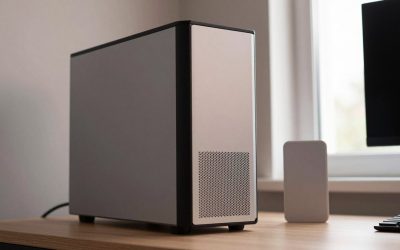
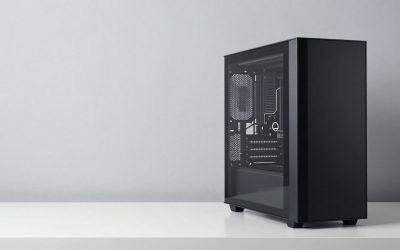
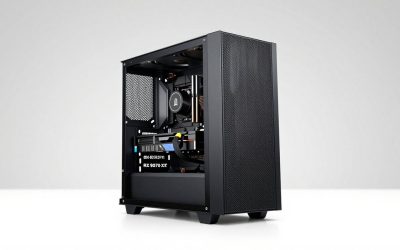
If you are shopping for a prebuilt gaming PC for your living room, office, or bedroom, you have probably noticed two case sizes dominate the market: compact Mini ITX and the slightly larger Micro ATX. Both can pack the same RTX 5060 or RTX 5070 graphics and the latest Ryzen processors, but they live very differently in your home. The real decision is not just about power — it is about how much space you are willing to give up, how much noise and heat you can tolerate, and how easy you want future upgrades to be.
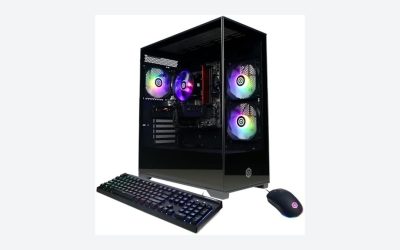
A Mini ITX prebuilt is built around a 6.7 x 6.7-inch motherboard and a small-form-factor case that is designed to disappear on a desk or in a media console. A Micro ATX prebuilt uses a 9.6 x 9.6-inch board and a mid-tower case that trades compactness for breathing room, more slots, and easier access. For most homes, that trade-off matters more than a few frames per second.
As an Amazon Associate we earn from qualifying purchases at no extra cost to you.


Our Top Picks
 ASUS ROG Strix B850-I Gaming WiFi AMD AM5Mini-ITX | M.2x2 | WiFi 79 x 3.8 x 7.3 inches2.3 PoundsCheck on Amazon
Pros & cons
- Built-in 11.3 inch smart display shows live temps and usage
- 850W 80+ Gold PSU leaves headroom for upgrades
- Arrives fully assembled with Windows 11 Home installed
- Monitor must connect to the graphics card, not motherboard ports
- 360mm liquid cooler takes up significant case space


Top 3 picks at a glance
Quick Verdict
Choose a Mini ITX prebuilt gaming PC if space, aesthetics, and portability are your top priorities and you are comfortable with a premium price for a smaller footprint. Choose a Micro ATX prebuilt if you want lower cost per performance, cooler and quieter operation, and simpler upgrades over time. For families, renters who move often, or anyone putting a PC in a shared living space, Mini ITX often justifies its price. For dedicated offices, game rooms, and long-term value, Micro ATX is the smarter buy.
Side by Side
| Feature | Mini ITX Prebuilt Gaming PC | Micro ATX Prebuilt Gaming PC |
|---|---|---|
| Comfort (Noise & Heat) | More noticeable fan noise under load (35-42 dB typical); compact case traps heat faster, can warm a small room | Generally quieter (30-36 dB typical); larger volume and more fans dissipate heat more evenly |
| Durability & Thermals | Tighter airflow; components run 5-10°C hotter; relies on premium cooling design | More airflow headroom; lower thermal stress on CPU/GPU; easier to keep dust-free |
| Price Range (Prebuilt) | $1,300 – $2,300 for RTX 5060 / RTX 5070 builds; Mini ITX tax of $100-$250 over equivalent ATX parts | $1,100 – $2,100 for same GPU/CPU class; better value for storage and RAM upgrades |
| Maintenance | Cramped interior; GPU, RAM, and storage swaps often require removing multiple parts | Open interior; tool-less side panels, easier cable management, and simpler part swaps |
| Space Needed | Case dimensions typically 13-15″ H x 7-8″ W x 11-14″ D; 15-22 lbs; fits on desk or in TV stand | Case dimensions typically 16-18″ H x 8-9″ W x 15-17″ D; 22-30 lbs; needs floor or large desk area |
| Look & Placement | Minimalist cube or slim tower; blends with modern decor; vertical or horizontal placement | Traditional tower; tempered glass and RGB more common; statement piece for office or game room |
| Upgrade Path | 1x PCIe x16 slot, 2 RAM slots, 2-3 M.2 slots max; limited CPU cooler height (often <135mm) and GPU length | 1x PCIe x16 plus 1-2 extra PCIe slots, 4 RAM slots, 3-4 M.2 slots; supports taller coolers and longer GPUs |
| Resale & Longevity | Strong demand from small-space buyers; holds value well if well-cooled, but fewer buyers overall | Broadest resale market; appeals to gamers, students, and families looking for affordable power |
| Best For | Apartments, dorms, living rooms, and anyone prioritizing footprint over expandability | Home offices, dedicated gaming setups, and buyers who want to upgrade gradually |
Where Mini Itx Wins
Mini ITX is about living better with your PC, not just gaming on it. A typical Mini ITX prebuilt is about 30 to 40 percent smaller by volume than a comparable Micro ATX tower, which means you can place it on a 42-inch desk without losing your entire work surface or tuck it into an IKEA Kallax or media console that would never fit a mid-tower.
That small size also means lighter weight and true portability. At 15 to 22 pounds fully built versus 22 to 30 pounds for Micro ATX, a Mini ITX box is far easier to move between rooms or take with you when you relocate. For renters, that matters.
Style is the other advantage. Mini ITX cases are designed to look like home furniture, not office equipment. With clean panels, mesh fronts, and compact proportions, they blend into bedrooms and living rooms where a large tower would dominate. If your PC lives next to bookshelves, plants, and a sofa, Mini ITX looks intentional.
Performance is no longer the compromise it once was. Modern Mini ITX motherboards like the ASRock B650I Lightning WiFi or the ASUS ROG Strix B850-I Gaming WiFi bring the same AM5 socket, DDR5 support, PCIe 5.0, and WiFi 6E or WiFi 7 that you find in larger boards, so a compact prebuilt can run a Ryzen 7 9700X or Ryzen 7 8700F with an RTX 5070 or RTX 5060 without giving up current-gen features. You will find prebuilts such as the KOTIN Prebuilt Gaming PC RTX 5070 12GB configuration or the LXZ Prebuilt Gaming PC with RTX 5060 using these efficient platforms to keep a small chassis powerful. The trade-off is that builders must use low-profile cooling and SFX power supplies to make it all fit, which is part of why the price is higher.
Finally, power draw can be slightly lower at idle because there are fewer fans and often a more efficient SFX power supply, typically 650W to 850W Gold-rated in Mini ITX prebuilts, compared to 650W to 850W ATX units in Micro ATX. The difference is small, but it helps in a warm apartment.
Where Micro Atx Prebuilt Gaming Pc Wins
Micro ATX wins on practicality and price. Because its case and motherboard are larger and more standardized, builders do not have to source premium compact parts. That typically saves $100 to $250 at checkout for otherwise identical CPU and GPU combinations. You also get more for that money: four RAM slots instead of two, additional M.2 and SATA storage options, and full-size ATX power supplies that are cheaper to replace.
Cooling is the biggest everyday benefit. A Micro ATX case holds two to four 120mm or 140mm fans and CPU coolers up to 160-165mm tall, versus 110-135mm in many Mini ITX cases. That extra air volume keeps the CPU and GPU cooler and lets fans run slower, which is why a Micro ATX prebuilt often measures 4 to 6 dB quieter under gaming load. In a shared home office or family room, that lower hum is easier to live with for hours.
Upgrades are also far simpler. Need to add 32GB of RAM, a second 2TB SSD, or a longer triple-fan GPU in two years? Micro ATX gives you the physical clearance and slots to do it without rebuilding the system. With Mini ITX, every upgrade requires checking cooler height, GPU length, and power supply limits. For first-time owners who want to learn to upgrade themselves, Micro ATX is more forgiving.
Durability follows the same logic. Lower operating temperatures and less dust constriction mean components experience less thermal cycling, and cleaning is as simple as popping off a front panel and using compressed air. Cables stay out of the airflow path, which helps both thermals and long-term reliability.
Cost Over 5 Years
Upfront, a Micro ATX prebuilt with an RTX 5060, Ryzen 7 8700F, 16GB DDR5, and 1TB SSD often lands between $1,100 and $1,400, while a comparable Mini ITX version of the same spec runs $1,299 to $1,600 due to the smaller board and SFX power supply. For an RTX 5070 build with a Ryzen 7 9700X, 32GB DDR5, and 1TB SSD, expect $1,800 to $2,100 for Micro ATX and $1,950 to $2,400 for Mini ITX.
Energy cost is similar for both if you use the same GPU and CPU. A gaming PC with an RTX 5070 will draw 380 to 480 watts while gaming and 65 to 90 watts at idle or browsing. At 15 hours of gaming per week plus daily general use, that translates to roughly 450 to 600 kWh per year, or about $65 to $95 per year at the U.S. average of around $0 per kWh. Over five years, energy alone is $325 to $475 regardless of form factor.
The real five-year difference is upgrades and maintenance. Adding RAM, storage, or even a GPU in year three typically costs $0 to $50 in extra parts for Micro ATX, since you can reuse your case, cooler, and power supply. With Mini ITX, a GPU that is 10mm too long or a cooler that is too tall can force you to buy a new case or SFX power supply, adding $120 to $220. As of 2026, affordable DDR5 and PCIe 4.0/5.0 SSDs make storage and memory upgrades inexpensive for both, but Micro ATX makes them friction-free.
If you never plan to open the case, total five-year ownership is close — Mini ITX costs roughly $150 to $300 more overall. If you plan to upgrade incrementally, Micro ATX often ends up $300 to $500 cheaper across five years.
Which One for Your Home
Small Apartment or Studio (300-600 sq ft)
Choose Mini ITX. When your desk is also your dining table or your PC shares a 10-foot wall with your bed, footprint and noise character matter more than expandability. Look for a compact case under 14 inches deep with a mesh front panel and a 240mm AIO or quality low-profile air cooler. Place it on the desk or on a raised stand, not on carpet, and leave 4 to 6 inches of clearance on the exhaust side. A build similar in size to those built around the ASRock B650I Lightning WiFi is ideal if you want a clean, apartment-friendly look without sacrificing WiFi connectivity.
Family with Kids or Pets
Choose Micro ATX. A heavier, floor-standing tower is harder for kids or pets to knock over, and its larger filters are easier to clean when dealing with pet hair and dust. The extra interior space also means you can add parental controls, additional storage for family photos and games, and a robust air cooler that does not need frequent attention. If the PC lives in a family room, prioritize a case with a solid front filter and front-panel USB-C for easy access.
Rental or Frequent Moves
Choose Mini ITX if you move every 12 to 24 months, Micro ATX if you move rarely. A 16-pound Mini ITX prebuilt in its original box is manageable in a car or apartment elevator, while a 28-pound Micro ATX tower with a glass panel is more stressful to pack and protect. If you choose Micro ATX for a rental, keep the original packaging for the next move and consider an air cooler over a large AIO to avoid transport worries.
Long-Term Home or Dedicated Office
Choose Micro ATX. When you have space for a proper desk or a dedicated gaming corner, the advantages of Mini ITX shrink. A Micro ATX prebuilt lets you start with a system like the LXZ Prebuilt Gaming PC Ryzen 7 8700F RTX 5060 or step up to a higher-end option like the KOTIN Prebuilt Gaming PC RTX 5070, and still add a second SSD, more RAM, or a GPU upgrade in year three without case constraints. You will appreciate the quieter cooling during long work-from-home days and the lower cost when it is time to refresh.
FAQ
Is Mini ITX slower than Micro ATX with the same parts?
No, not if both are properly cooled. With the same CPU and GPU — for example a Ryzen 7 9700X with an RTX 5070 — gaming performance is within 1 to 3 percent. Mini ITX may run slightly hotter and boost a bit less if the case is very restrictive, but well-designed prebuilts avoid that with mesh panels and SFX power supplies that leave room for airflow.
Do Mini ITX prebuilts overheat in summer?
They run warmer than Micro ATX, but they should not overheat if placed correctly. Keep the PC off the floor, out of enclosed cabinets while gaming, and clean the dust filters monthly. If your room regularly exceeds 78°F in summer, a Micro ATX case with more fans will be quieter and give you more thermal headroom.
Can I upgrade parts later in either size?
Yes, but Micro ATX is easier. Mini ITX usually limits you to two RAM sticks, one full-size GPU, and SFX power supplies. Always check the case spec for maximum GPU length (typically 315-335mm for Mini ITX vs 360-400mm for Micro ATX) and CPU cooler height before buying an upgrade. For storage, both sizes support modern M.2 SSDs, but Micro ATX often offers two extra slots.
Which size is better if my PC will be in the living room?
Mini ITX is usually better for shared living spaces because it looks like furniture and takes up less visual space next to a TV or bookshelf. Look for a case with WiFi 6E or WiFi 7, a front USB-C port, and a power supply rated 650W Gold or better for efficient, quiet operation. If your living room has space for a closed cabinet and you prioritize quiet browsing and movie streaming, a Micro ATX tower placed on the floor behind the TV stand can be more silent day to day.
Related guides
- Best Gaming PC for Fortnite: Eight Prebuilt Desktops Sorted by Refresh Rate Goal (2026)
- Best RX 9070 XT Prebuilt Gaming PCs: Seven Desktops and Three Cards Compared: 10 Compared (2026)
- CyberPowerPC vs iBUYPOWER Gaming PC: How the Two Brands Compare
- Best RX 9070 XT Prebuilt Gaming PC (2026): 5 Picks Compared