As an Amazon Associate we earn from qualifying purchases at no extra cost to you.

Our Top Picks


The Short Answer
For most small form factor builders, liquid cooling is not worth it — unless you’re running a high-TDP CPU (roughly 150W and above) in a case too small for a quality air tower. That’s the one condition. If your build draws moderate power and your chassis has decent airflow, a good low-profile or compact air cooler will match or beat a budget AIO on thermals while costing less, weighing less, and carrying zero pump-failure risk.
What You Actually Get
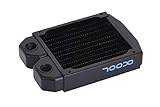
Small form factor liquid cooling typically means one of two things: a compact closed-loop (AIO) with a small radiator, or a custom loop built around slim hardware like the Alphacool NexXxoS ST25, a full-copper 92mm single radiator that’s just 25mm thick and retails around $66. The appeal is obvious — a radiator plus slim fans can fit where a 125mm-tall tower cooler physically cannot, and moving heat to a radiator mounted near exhaust vents gets it out of the case faster.
What you get in practice:
– Thermal headroom under sustained load. A 240mm or larger AIO in a case that supports it will hold a high-wattage CPU at lower sustained clocks degradation than most low-profile air coolers can manage.
– Clearance flexibility. Removing the tower cooler frees space around the socket — useful in micro-ATX cases with crowded motherboards or tall RAM.
– Lower CPU-adjacent weight. A tower cooler hanging on the motherboard can stress the PCB during transport; a radiator mounted to the case panel shifts that load to the chassis.
But there’s a catch specific to small builds: a 92mm radiator like the ST25 moves roughly the same heat as a competent 92mm air cooler. The radiator isn’t magic — it’s constrained by its surface area and the same case airflow you’d rely on anyway. You pay the pump and tubing premium for mounting flexibility, not for raw cooling capacity.
Pros
- Fits height-constrained cases. Where CPU cooler clearance is under ~70mm, a slim radiator is often the only way to cool a hotter chip.
- Better sustained performance for 150W+ CPUs. When radiator space allows it (240mm or 280mm), liquid cooling holds boost clocks under all-core loads more consistently than low-profile air.
- Quieter at high loads in some layouts. A radiator mounted directly at the exhaust dumps heat out immediately rather than warming the whole case interior.
- Radiator mounting frees motherboard space. No 1.5–2 lb heatsink cantilevered off the socket, which matters if you move the PC often.
- Cleaner visuals. If you have a tempered glass panel, tubes and a block generally look tidier than a dense fin stack.
Cons
- Cost. Even a modest slim radiator runs $60–$80, and a quality 240mm AIO runs $80–$130. A strong low-profile air cooler costs $40–$60.
- Small radiators underperform expectations. A 92mm single radiator adds pump noise, cost, and a failure point while cooling roughly on par with a $30 air cooler.
- Pumps add noise and risk. A whining pump in a quiet small build is more noticeable than in a full tower, and an AIO failure takes your system down entirely.
- Limited lifespan. Most AIOs carry 3–6 year warranties; permeation slowly drops coolant levels regardless of usage.
- Installation complexity. Radiator mounting points, tube routing, and pump clearance are all harder to plan in a cramped chassis.
- Airflow dependence. If your case exhausts poorly, the radiator dumps heat back into the loop — you gain little.
Who Should Buy It
– You’re running a CPU that pulls 150W or more under load (think high-end Ryzen or unlocked Intel chips) in a case with CPU cooler clearance under 100mm.
– Your case supports a 240mm or larger radiator — if it only fits a 92mm slim radiator, reconsider entirely.
– You push sustained multi-core workloads (rendering, compiling, simulation) for hours daily.
– You’re building a sandbag-proof transport rig where a heavy tower cooler on the motherboard is a genuine concern.
Who Should Skip It
– Your CPU draws under 100–120W. A $40–$55 low-profile air cooler handles that comfortably and quietly.
– You’re considering a single 92mm radiator as an “upgrade” — it won’t outperform equivalently sized air cooling and adds failure points.
– Your case has strong stock airflow and room for a compact tower (many modern micro-ATX cases clear 155mm coolers easily).
– Your budget is tight; put the $60–$100 difference toward the GPU or a better power supply instead.
Cheaper Alternatives
| Option | Cost | Trade-off |
|---|---|---|
| Low-profile air cooler (e.g., 47mm–70mm class) | $35–$60 | Handles up to ~120–130W well; taller than a radiator setup but zero pump noise and no liquid risk. |
| High-airflow micro-ATX case (e.g., Cooler Master Q300L V1 at around $39, with mesh front and transparent panel) | $40–$60 | No CPU cooling upgrade by itself, but strong front-to-back airflow makes a mid-range air cooler behave like a better one. |
| Compact tower cooler (120mm–140mm, 145–155mm tall) | $40–$70 | Outperforms 92mm and often 120mm radiators; needs CPU clearance most SFF cases can provide if you plan ahead. |
| Undervolt / power limit your CPU | $0 | Cuts 20–40W of heat for free; often costs only 2–4% performance in common workloads. |
The practical combo for budget small builds: an airflow-focused micro-ATX case like the Q300L V1 plus a $45 compact tower cooler costs about $85 total and outperforms most slim-radiator setups. If you’re reading this in 2026, the current generation of efficient CPUs has pushed the crossover point even higher — more chips than ever simply don’t need liquid to sustain full clocks in a well-ventilated small case.
FAQ
Does a small radiator cool worse than a small air cooler?
Generally they’re comparable at the same fan size. A 92mm radiator and a good 92mm low-profile cooler move similar heat; the radiator’s advantage is mounting location, not capacity. Below 120mm of radiator width, you’re usually paying more for flexibility rather than lower temperatures.
Will liquid cooling make my small build quieter?
Not automatically. You trade fan noise for pump noise plus radiator fan noise. A 240mm AIO at low RPM can be quieter than a desperate 92mm air cooler at max RPM, but a slim radiator with one small fan often ends up louder overall.
How long do small form factor AIOs last?
Most manufacturers warrant AIOs for 3–6 years. Coolant permeation through the tubing is gradual and unavoidable, so plan on replacement within the warranty window — a real consideration if you keep small builds for five-plus years.
Is a custom loop worth it in a small case?
For nearly everyone, no. A minimal custom loop with slim radiators runs $200–$400 in components, demands meticulous planning in tight spaces, and requires maintenance. It’s a hobbyist project, not a cooling strategy — an AIO or air cooler delivers 90% of the benefit for a third of the cost.