The best slab saws for clean, precise cuts are 10-inch trim/slab combo saws for hobbyists cutting agate and jasper under 4 inches thick, and 14- to 18-inch power-feed slab saws for anyone regularly cutting larger agate nodules, petrified wood, or quartzite where slab flatness and parallel cuts matter more than portability.
As an Amazon Associate we earn from qualifying purchases at no extra cost to you.
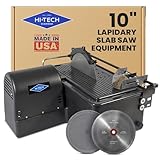

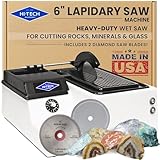

Our Top Picks


Top 3 picks at a glance
How to Choose the Right Slab Saw Size
Buying a slab saw is mostly buying cutting capacity. Unlike a trim saw where you hand-feed small rough, a true slab saw clamps the rock in a vise and feeds it into the blade at a controlled rate. That gives you parallel slabs and a much better polish later, but it also locks you into a maximum rock size.
Use this rule: your usable slab diameter is roughly 1/3 to 1/2 of the blade diameter because you need blade exposure above the arbor and clearance in the vise. A 10-inch blade will reliably slab rocks 3.5 to 4.5 inches in diameter. A 14-inch blade handles 5.5 to 6.5 inches, and an 18-inch blade handles 7 to 8 inches. If your rough is larger than your vise can grip, you will be trimming it with a tile saw or hammer first, which defeats the purpose of a precision saw.
Blade Size and Cutting Capacity Compared
| Blade Size Class | Max Rough Size (Vise) | Max Slab Thickness | Typical Motor | Best For | General Market Range |
|---|---|---|---|---|---|
| 6″ – 8″ Trim Saw | 2.5 – 3″ | Unlimited (hand-fed) | 1/4 – 1/3 HP | Small agates, trimming slabs, cabbing preforms | usually $300–$550 |
| 10″ Slab / Trim Combo | 3.5 – 4.5″ | ~4″ with vise | 1/3 – 1/2 HP | Entry slabbing for agates, jasper, obsidian | usually $700–$1,100 |
| 12″ – 14″ Power-Feed Slab Saw | 5 – 6.5″ | 5.5 – 6″ | 1/2 – 3/4 HP | All-around lapidary for nodules and petrified wood | usually $1,400–$2,800 |
| 16″ – 18″ Power-Feed Slab Saw | 7 – 8″ | 7 – 7.5″ | 3/4 – 1 HP | Large agates, quartzite, production slabbing | usually $2,800–$5,000 |
| 20″ – 24″ Large Slab Saw | 9 – 11″ | 9 – 10″ | 1 – 1.5 HP | Very large rough, club/shared shop use | usually $4,500–$8,500+ |
If you only cut one or two rocks per week under 4 inches, a 10-inch combo unit with a vise and power feed saves space and money. If you are cutting Brazilian agates, Montana agates, or petrified wood rounds that are 6 inches across, buying a 10-inch saw will leave you immediately wanting to upgrade.
Decision Matrix: Match Your Material to the Machine
Hardness, brittleness, and oil vs. water tolerance determine more than blade size. Use this matrix to narrow your choice before you look at brands.
| Your Situation | Recommended Saw Type | Coolant | Feed Rate & Blade Choice |
|---|---|---|---|
| Soft / brittle material: turquoise, obsidian, opal, labradorite | 10″ with light power feed or hand-assist | Water with rust inhibitor | Very thin 0.032″ sintered blade, slow feed, low vise pressure to prevent breakout |
| Medium-hard: agate, jasper, petrified wood under 5″ | 10″ to 14″ power-feed | Oil preferred for finish, water acceptable | Standard 0.040″-0.050″ 303/301 diamond blade, medium feed |
| Hard / dense: quartzite, jade (nephrite), large agatized nodules over 6″ | 14″ to 18″ power-feed with autofeed clutch | Mineral oil | Thick 0.062″ notched or segmented rim, slow feed, higher HP to prevent stalling |
| Need portability / apartment or garage with no drain | 10″ tabletop combo with enclosed reservoir | Water | Continuous-rim thin blade, change water frequently to control sludge |
| High-volume slabbing for sale or cabbing business | 18″ or larger, fully enclosed cabinet | Mineral oil with filtration | Heavy-duty notched blade, automatic power feed + cross-feed vise |
What Actually Affects Finish Quality
A slab saw does not polish. It determines how much grinding time you need to remove saw marks. Three factors control that:
- Blade stiffness and tension: Thin blades cut faster with less kerf loss but deflect more, leaving washboard marks. For show-grade slabs, a 0.050″ to 0.062″ continuous-rim or fine-notched 303-grade diamond blade will leave a flatter surface than an aggressive 0.032″ blade, even though it wastes more stone.
- Feed rate consistency: Hand-feeding almost always creates chatter. A screw-drive or belt-drive power feed that advances at 0.5 to 2 inches per minute keeps blade load constant. If the motor labors or the blade pings, the feed is too fast for that hardness. Most power-feed saws allow you to adjust feed speed via pulley or gearbox.
- Coolant and sludge management: Oil cools better and carries swarf away without flash rusting the blade or vise. Water works but requires a rust inhibitor and frequent cleaning. Dirty coolant recirculates grit and causes undercutting and scratches that look like blade wobble.
Worked Calculation: Kerf Loss and True Cost Per Slab
Blade thickness directly costs you material. Here is how to estimate it before you cut expensive rough.
Example: You have a 4-inch (100mm) thick agate nodule and want 6mm thick slabs for cabbing.
With a thin 0.040-inch (1.02mm) blade at a typical 1.5mm kerf with wobble, each cut consumes: 6mm slab + 1.5mm kerf = 7.5mm of rough.
Usable slabs = 100mm / 7.5mm = 13.3, so 13 slabs.
With a heavy-duty 0.062-inch (1.57mm) blade at a 2.1mm kerf, each cut consumes: 6mm + 2.1mm = 8.1mm.
Usable slabs = 100mm / 8.1mm = 12.3, so 12 slabs.
That one extra slab lost to kerf may be worth $15 to $40 in rough value, which is why production cutters keep both a thin blade for high-value agates and a thick, rigid blade for large, fracture-prone quartzite where flatness saves hours of grinding.
Grinding cost matters too: A slab that leaves the saw with 0.3mm deep saw marks requires about 15-20 minutes on a 80-grit wheel to flatten. A slab with 0.1mm marks from a rigid blade and slow feed takes under 8 minutes. Over 100 slabs, that difference is 15+ hours of grinding time.
Water vs. Oil Management: The Most Overlooked Spec
Every slab saw needs flood coolant. The choice changes where you can run the saw and how clean your cuts stay.
- Water + additive (10-inch class): Easier disposal, no fumes, can run indoors with ventilation. Requires a full drain and wipe-down after each day to prevent rust on the arbor, vise, and blade core. Add a rust inhibitor and change water when it turns to thick slurry, typically every 4 to 8 hours of cutting.
- Mineral oil (12-inch and larger): Better lubricity, longer blade life, superior finish on hard agate, and no rust. Needs an enclosed cabinet with splash guard and lid. Oil mist requires outdoor or well-ventilated shop space. Oil must be filtered through paper or bag filter to remove fines, otherwise it embeds in slabs. Food-grade white mineral oil is the common low-odor choice.
If you plan to cut indoors or in a shared garage, a 10-inch water-cooled combo saw with a sealed tub and recirculating pump is the practical limit. Oil saws above 14 inches are best treated as stationary shop equipment with a dedicated stand and drain plug.
Portability, Assembly, and Power Requirements
Weight scales quickly with size. A 10-inch combo saw typically weighs 45 to 75 lbs and can be carried by one person and stored under a bench. A 14-inch cabinet saw weighs 180 to 280 lbs, and an 18-inch saw weighs 350 to 500 lbs and ships on a pallet. Check your floor and doorway before buying larger.
Assembly for most current models like the Highland Park Lapidary 10-inch and 14-inch slab saws, Lortone Panther 14-inch, and Covington Engineering slab saws is minimal: attach the legs or stand, mount the motor and belt, align the vise to the blade, and fill coolant. The critical setup step is vise alignment. Loosen the vise carriage, bring the blade to just touch the vise jaw, and verify the jaw is parallel to the blade within 0.010 inch over its length. An out-of-parallel vise creates wedge-shaped slabs that never polish flat.
Power budget is simple but often missed. A 1/3 HP 10-inch saw draws about 5-6 amps at 120V. A 1 HP 18-inch saw draws 12-14 amps at 120V and should be on a dedicated 15A circuit with no extension cord or a 12 AWG cord under 25 feet. Under-voltage from a long thin cord causes hard starting, stalling in the cut, and premature motor capacitor failure.
Feed Speed Settings That Prevent Chipping
Start conservative and increase only if the cut stays flat and quiet:
- Obsidian, opal, soft jade: 1.5 to 2.0 inches per minute, light clamping force
- Agate, jasper, petrified wood: 0.7 to 1.2 inches per minute
- Quartzite, hard jade, large nodules: 0.4 to 0.7 inches per minute
If you hear a rhythmic thumping or see curved gouges, stop and reduce feed or dress the blade by making a shallow cut into a silicon carbide dressing stick or old brick to re-expose diamonds. A glazed blade cuts hotter and deflects instead of abrading.
Which Class Should You Buy?
Choose a 10-inch combo power-feed saw if you cut less than 5 hours per week, work mostly with rough under 4.5 inches, need to trim slabs into preforms on the same machine, and need water cooling for indoor use. Limitations: you will still need to break larger nodules before slabbing.
Choose a 14-inch cabinet slab saw if you cut agate nodules and petrified wood 5 to 6 inches regularly and want consistently flat slabs with minimal grinding. This is the best value capacity for most dedicated hobbyists.
Choose an 18-inch or larger slab saw if you slab 7-inch and larger rough weekly, sell slabs, or run a club shop. Expect higher upfront cost, oil management, and permanent floor space, but lower cost per slab on large rough and far better slab parallelism at that scale.
For clean, precise cuts regardless of size, prioritize a screw-driven power feed with auto-stop, a vise that clamps from both sides (not a single screw pushing the rock against a wall), a fully enclosed coolant tank, and a standard arbor size (usually 5/8 inch for 10-inch, 1 inch for 14-inch+) so replacement blades are easy to source.
Maintenance for Precision Over Time
Clean the tank and filter coolant after every large rock or 6-8 hours of runtime. Check blade tension and arbor nut tightness monthly. Inspect the vise jaws for embedded grit and file smooth if scarred, otherwise the rock can shift mid-cut. Keep a spare belt and a dressing stick on hand. A blade that still has diamond but has gone out of flat by more than 0.015 inch side-to-side should be replaced, not hammered straight.
Frequently asked questions
Can one saw handle both trimming and slabbing?
Yes, a slab/trim combo saw can handle both tasks when its vise and cutting capacity match your rough. A 10-inch combo unit is suited to entry-level slabbing of agates, jasper, and obsidian under roughly 4 inches in diameter, while hand-fed trim saws are useful for small rough, trimming slabs, and cabbing preforms.
How do I know whether my electrical circuit is adequate?
Check the saw’s motor demand, circuit capacity, and cord length before operating it. A 1/3 HP 10-inch saw draws about 5-6 amps at 120V. A 1 HP 18-inch saw draws 12-14 amps at 120V and should use a dedicated 15A circuit. Long, thin extension cords can cause hard starting, stalling, and capacitor failure.
What should I do if the saw starts making curved gouges?
Stop the cut and reduce the feed rate or dress the blade. Curved gouges or rhythmic thumping indicate that the blade is not cutting smoothly under the current conditions. The article recommends starting conservatively, matching feed speed to material hardness, and dressing the blade by making a shallow cut.
How often should water coolant be replaced?
Replace water coolant when it becomes thick with slurry, typically every 4 to 8 hours of cutting. Water should also be drained and the saw wiped down after each day to help prevent rust on the arbor, vise, and blade core. Adding a rust inhibitor helps, but dirty coolant can still cause scratches and undercutting.
How can I prevent wedge-shaped slabs?
Prevent wedge-shaped slabs by aligning the vise parallel to the blade before cutting. Loosen the vise carriage, bring the blade until it just touches the vise jaw, and verify parallelism within 0.010 inch over its length. An out-of-parallel vise produces tapered slabs that will not polish flat, even if the blade and feed settings are appropriate.