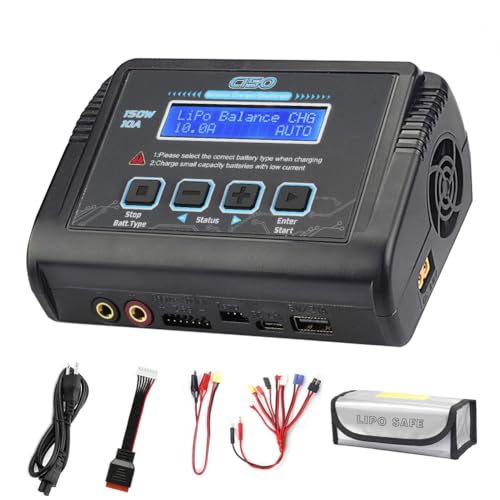
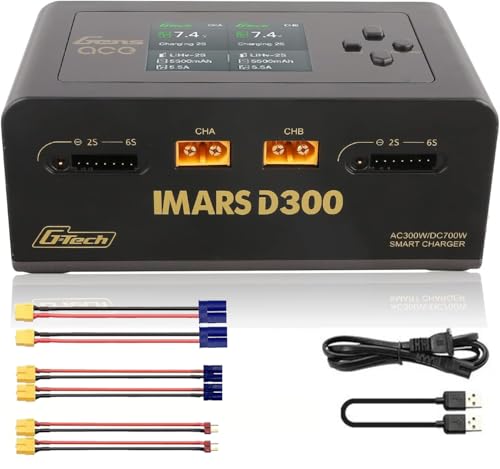
The best RC car chargers in 2026 are programmable balance chargers matched to your battery chemistry, connector, cell count, and available power: the HOTA D6 Pro is the strongest all-round dual-channel choice, the SkyRC T200 suits straightforward hobby charging, and the ISDT K2 Air is a compact high-power option for drivers who charge frequently at the track.
As an Amazon Associate we earn from qualifying purchases at no extra cost to you.


Our Top Picks
 Prettyia 19 Groups of nimh Battery Chargers rcThe line length is 1.5M2 x 2 x 2 inches0.1 PoundsCheck on Amazon

Top 3 picks at a glance
Best RC Car Chargers Compared
| Charger | Channels | Maximum output | Input | Battery support | Best for |
|---|---|---|---|---|---|
| HOTA D6 Pro | 2 | 2 × 650W with suitable DC input, subject to input limits | DC and AC | LiPo, LiHV, LiFe, Li-Ion, NiMH, NiCd, lead-acid | Serious racers and multi-pack households |
| ISDT K2 Air | 2 | Up to 500W total, depending on power source and channel allocation | DC | LiPo, LiHV, LiFe, Li-Ion, NiMH, NiCd, lead-acid | Portable high-power charging |
| SkyRC T200 | 2 | 200W total; up to 100W per channel in typical operation | AC | LiPo, LiHV, LiFe, Li-Ion, NiMH, NiCd, lead-acid | Simple home charging |
| Gens Ace iMars S100 | 1 | 100W | AC | LiPo, LiHV, LiFe, Li-Ion, LiFe and NiMH, depending on firmware and version | One-pack charging on a budget |
| Spektrum S2100 Smart Charger | 2 | 200W total | AC | Spektrum Smart-compatible packs and common supported lithium chemistries | Spektrum Smart ecosystems |
Output ratings are not interchangeable with charging speed. A charger may advertise hundreds of watts, but the battery, power supply, connector, balance lead, and channel-sharing rules can reduce the usable figure. Always confirm the exact model revision and manual before buying.
How to Choose the Right RC Charger
1. Match the battery chemistry
For most modern cars, LiPo is the central requirement. A standard LiPo cell charges to 4.20 volts, while a LiHV cell charges to 4.35 volts. Selecting the wrong program can overcharge a pack, so a LiHV battery should only use a charger with a clearly labeled LiHV mode and the correct cell count.
- LiPo: usually 3.7 volts nominal per cell and 4.20 volts fully charged.
- LiHV: usually 3.8 volts nominal per cell and 4.35 volts fully charged.
- LiFe: a lower-voltage lithium chemistry that requires its own charge profile.
- NiMH: common in beginner cars and some older platforms; it does not use lithium balance charging.
- NiCd and lead-acid: supported by many advanced chargers, but they need chemistry-specific settings.
Storage charging is equally important. For lithium packs, storage mode normally brings each cell close to about 3.8 volts, rather than leaving a pack full for weeks. This can reduce stress compared with long-term storage at maximum charge.
2. Calculate the charging power you actually need
The basic estimate is:
Charging watts ≈ battery voltage × capacity in amp-hours × charge rate in C.
Consider a 4S 5,000mAh LiPo. Its nominal voltage is 14.8V and its capacity is 5Ah. At a conservative 1C charge rate:
14.8V × 5Ah × 1C = 74W.
A 100W single-channel charger can therefore handle that pack at approximately 1C, although balancing and conversion losses mean the charger may operate near its limit. A 2C charge would require roughly 148W, so you would need a charger with more headroom and a battery manufacturer that explicitly permits 2C charging.
For two identical 4S 5,000mAh packs charged simultaneously at 1C, the estimated requirement is about 148W before losses. A 200W dual charger is a reasonable fit; a 100W total charger will have to reduce current or charge one pack at a time. Do not increase the charge rate just because the charger has spare wattage. The battery label and manufacturer instructions take priority.
3. Check connectors, rather than assuming compatibility
The main power connector carries the charging current. Common types include Deans or T-plug, XT30, XT60, XT90, EC3, EC5, IC3, and IC5. The balance connector is often a JST-XH plug, but Spektrum Smart packs can use Smart-specific connections and electronics.
A charger may include bare output sockets, banana plugs, or a proprietary adapter system. You may need a charge lead that has the charger-side banana plugs and the battery-side connector. For high-current 4S, 6S, and 8S packs, use a properly rated lead with secure solder joints and avoid loose adapters chained together.
Never connect a battery using only the balance plug for a normal high-current charge unless the pack and charger are specifically designed for that method. The balance lead is for cell monitoring and balancing; the main leads normally carry the charging current.
Head-to-Head: Which Charger Fits Your Setup?
| Your situation | Recommended type | Why | What to check |
|---|---|---|---|
| One 2S or 3S pack for a casual beginner car | 100W AC single-channel charger | Enough power for common 4,000–5,000mAh packs at about 1C | Included balance board or JST-XH support and your main connector |
| Two packs between heats at home | 200W dual-channel AC charger | Can charge two medium packs without requiring a separate DC power supply | Per-channel limits and whether total power is shared |
| Large 4S or 6S racing packs | High-power dual DC charger | More headroom for fast charging and multiple packs | A suitable 500W-or-higher DC supply, cable ratings, and ventilation |
| Charging at a track or away from mains power | Compact DC charger | Works from a field supply, generator, or suitable battery station | Frequently asked questions