The best racing wheels for PC for most sim racers in 2026 are the Logitech G923 for entry-level belt-gear hybrid value, the Thrustmaster T300 RS GT for smoother belt-driven force feedback on a budget, the Moza R5 Bundle for entry-level direct drive, the Fanatec CSL DD for mid-range direct drive modularity, and the Logitech G Pro Racing Wheel or Fanatec ClubSport DD+ for pro-level high-torque performance.
Choosing between them comes down to three technical factors that affect feel and setup more than marketing specs: force feedback strength and type, pedal construction and load cell capability, and desk mount compatibility. Get those right for your space and budget and you avoid the most common upgrade regret.
As an Amazon Associate we earn from qualifying purchases at no extra cost to you.



Our Top Picks
 Logitech G920 Racing Wheel and Pedals for Xbox10.94 inches10.24 x 10.94 x 10.63 inches4.96 PoundsCheck on Amazon
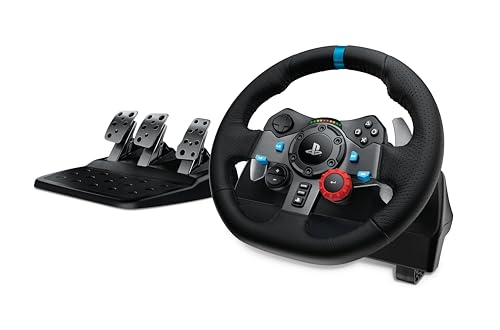 Logitech G29 Racing Wheel and Pedals for PS5/PS4/PC10.24 x 10.94 x 10.63 inches4.96 poundsDVD-ROMCheck on Amazon
 Logitech G923 Racing Wheel and Pedals for Playstation/PS5/PS410.24 x 10.94 x 6.57 inches11.9 PoundsDVD-ROMCheck on Amazon

Top 3 picks at a glance
How to Choose the Best Racing Wheel for PC: 3 Decision Criteria
Sim wheels are not all the same technology. Understanding the drive system tells you what kind of feedback detail and strength to expect before you look at any model name.
- Gear / Hybrid-driven (e.g., Logitech G923, Thrustmaster T248): Uses gears or a hybrid belt-gear system. Typically 2-3 Nm of torque. More mechanical noise and a notchy feeling at the center, but affordable and very reliable.
- Belt-driven (e.g., Thrustmaster T300 RS GT, Thrustmaster T-GT II): Uses belts between motor and wheel. Typically 3-6 Nm. Smoother and quieter than gear systems, with better detail for curb and slip details.
- Direct Drive (e.g., Moza R5, Moza R12, Fanatec CSL DD, Fanatec ClubSport DD+, Logitech G Pro): Wheel rim mounts directly to the motor shaft. Ranges from 5 Nm to over 15 Nm. Zero belt slack, fastest response, and the widest dynamic range for nuanced feedback. Requires more solid mounting.
If you race on a desk and want plug-and-play simplicity, gear or belt systems are the safest start. If you have or plan to buy an aluminum profile rig or a heavy-duty wheel stand, direct drive is the long-term platform.
Force Feedback Strength Explained: How Much Torque Do You Actually Need?
Manufacturers list peak torque in Newton-meters (Nm). That number determines how hard the wheel can pull against your hands to simulate tire load, understeer, and collisions. More torque does not automatically make you faster, but it increases headroom for detail.
Entry gear wheels peak around 2.2 Nm. Budget direct drive starts at 5-6 Nm. Mid-range direct drive is 8-12 Nm. Pro-grade direct drive is 15-21 Nm. Most competitive sim racers run their high-torque bases at 60-80% strength for endurance and detail, not at 100%.
Worked Calculation: Usable Torque vs. Desk Clamp Limits
This is why mounting matters before you buy power. Force at the rim = Torque / Rim Radius. For a standard 280mm diameter wheel (0.14m radius):
A 8 Nm base produces: 8 / 0.14 = 57.1 Newtons of force at the rim edge. That is about 5.8 kg of sustained force pulling your hands.
A 15 Nm base produces: 15 / 0.14 = 107.1 Newtons, or about 10.9 kg of force.
Most included desk clamps are rated by manufacturers for up to 8-10 Nm without flex. Above that, the clamp will slip or the desk will flex and mute detail. If you do not have a rig rated for 15 Nm, you will have to turn a pro base down to 50% anyway, which negates the price premium. Match base torque to what your mount can actually hold.
Concrete Force Feedback Settings That Work on PC
Direct drive and belt wheels share the same tuning logic on PC titles like Assetto Corsa Competizione, iRacing, and F1 24. Use these as a starting point, then adjust gain until clipping disappears:
- Gaming software gain: Set Logitech G HUB, Moza Pit House, or Fanatec Fanatec Control Panel to 100% strength, then limit force in-game. This gives the game full dynamic range.
- In-game gain (ACC example): 65-75% for 8 Nm bases, 45-60% for 15 Nm+ bases. If the FFB clipping meter hits red on straights, lower gain by 5% until it stays green.
- Damper and friction: 0-10% for direct drive, 10-20% for belt/gear to hide center notching. Higher values mask detail.
- Minimum force / dynamic damping: 0% for direct drive, 3-5% for gear-driven wheels to feel light tire forces.
- Rotation: 900 degrees for road cars and rally, 360-540 degrees for GT3 and Formula. Set wheel and game to match to avoid steering ratio mismatch.
Reasoning: Clipping is when the game asks for more torque than the base can deliver, flattening all detail into one heavy feeling. Lowering in-game gain restores the peaks and valleys that tell you when the front tires are about to lose grip.
Pedal Materials and Why Load Cell Brakes Matter More Than the Wheel
The wheel gives you information, but pedals determine consistency. The biggest performance jump is not wheel torque, it is moving from a potentiometer brake to a load cell brake.
- Potentiometer pedals (plastic or mixed metal, e.g., standard Logitech G923, Thrustmaster T3PM): Measures how far you press the pedal. Inexpensive and light, but muscle memory for braking is inconsistent because travel distance changes with foot position.
- Load cell pedals (all-metal, e.g., Moza SR-P, Fanatec CSL Pedals LC, Logitech G Pro Pedals): Measures how hard you press, up to 60-100 kg of pressure. Usually 100% aluminum or steel with elastomers or springs for progressive feel. Lets you brake by muscle pressure like a real car, which cuts lap time variation significantly.
For durability and feel, look for: full metal pedal arms and base plate, replaceable elastomer stack or die springs in the brake, and a 12-bit or higher sensor (4096 steps) for throttle resolution. Hall-effect sensors are preferred over potentiometers for longevity as they have no physical contact to wear out.
If you race in socks on a floor, potentiometer pedals with a carpet grip are fine. If you race with shoes or want to trail-brake accurately, budget for a load cell brake even if it means choosing a cheaper wheel base initially.
Desk Mount Compatibility: Will It Fit Your Setup?
Many high-torque wheels do not include a desk clamp in the box because they are designed for cockpits. Check three points before buying:
- Desk thickness and lip: Most clamps support 15mm to 50mm thick desks. Desks with a crossbar, drawer, or beveled edge under 25mm may not clamp securely.
- Mounting pattern: Fanatec, Moza, and Logitech G Pro bases use bottom M6 T-nuts or bolt patterns for rigs. Belt/gear bases like the T300 RS GT and G923 use integrated clamp systems plus optional M6 hard-mount holes.
- Desk flex: Particle board or glass desks flex above 5 Nm. A wheel stand or foldable cockpit, usually $150-$300, solves flex without a full rig and folds away.
All PC wheels in this guide connect via USB-A or USB-C to Windows 10/11 and present as DirectInput devices. Compatibility with console is separate and does not affect PC function. Wheel rims with console licensing still work on PC.
Top Picks by Sim Setup Tier
Entry-Level: Logitech G923 and Thrustmaster T248 / T300 RS GT
Best for desk use, tight spaces, and first-time buyers who want complete bundles. Usually $250-$450 for wheel and pedals. The G923 uses TrueForce and a hybrid gear system with strong desk clamp integration and all-plastic pedals (upgradeable). The Thrustmaster T300 RS GT uses a dual-belt system that is smoother and quieter and includes the better T3PM all-metal pedal set with Hall sensors. Both are 900-degree wheels with 2-4 Nm usable torque and low power draw, so they work on any desk and USB port without external bracing.
Entry Direct Drive: Moza R5 Bundle and Fanatec CSL DD (5-8 Nm)
Best for buyers who want direct drive fidelity without building a full rig immediately. Usually $400-$650 for bundle with pedals. The Moza R5 is a 5.5 Nm compact direct drive with aluminum SR-P Lite pedals and a desk clamp included. The Fanatec CSL DD (Ready2Race) is a 5-8 Nm modular base with optional boost kit to 8 Nm and optional desk clamp. Both are direct drive, meaning zero deadzone and much faster detail for catching slides. The 5 Nm level is safe for sturdy desks; 8 Nm benefits from a wheel stand.
Mid-Range to Pro: Moza R12, Fanatec ClubSport DD/DD+, Logitech G Pro Racing Wheel
Best for dedicated rigs, endurance racing, and drivers who keep the same base for years. Usually $700-$1,200+ for base and wheel rim. The Moza R12 delivers 12 Nm, the Fanatec ClubSport DD is 12 Nm and DD+ is 15 Nm, and the Logitech G Pro is 11 Nm with TrueForce direct drive. All use full aluminum quick-release rims, high-resolution encoders, and all-metal load cell pedals. They require hard mounting to an aluminum profile rig or heavy tubular cockpit. If you must use a desk, you will run them at reduced strength, so buy the lower-torque version and invest the savings in load cell pedals.
PC Racing Wheel Comparison Table
| Model | Drive Type | Peak Torque | Rotation | Stock Pedal Material | Desk Clamp Included | Mounting for Rig |
|---|---|---|---|---|---|---|
| Logitech G923 | Hybrid Gear/Belt | 2.3 Nm | 900 deg | Plastic + Steel | Yes, integrated | 2x M6 bolt points |
| Thrustmaster T300 RS GT | Dual Belt | 4.3 Nm | 1080 deg | Full Metal (T3PM) | Yes, integrated | Hard-mount clamp + M6 |
| Moza R5 Bundle | Direct Drive | 5.5 Nm | Unlimited* | Steel/Aluminum (SR-P Lite) | Yes | 4x M6 bottom |
| Fanatec CSL DD | Direct Drive | 5 Nm / 8 Nm w/ Boost | Unlimited* | Steel/Aluminum (CSL) | Optional | T-slot + M6 |
| Moza R12 | Direct Drive | 12 Nm | Unlimited* | Aluminum (SR-P LC optional) | No | 4x M6 + profile brackets |
| Fanatec ClubSport DD+ | Direct Drive | 15 Nm | Unlimited* | Aluminum (CSL Elite V2 / ClubSport) | No | 3x M6 + Fanatec pattern |
| Logitech G Pro Racing Wheel | Direct Drive | 11 Nm | Unlimited* | Full Metal 100kg Load Cell | Optional | Desk clamp or M6 rig mount |
* Unlimited rotation via direct drive motor; software limited per game.
Situation-to-Choice Matrix
| Your Situation | Recommended Class | Why |
|---|---|---|
| Thin desk, apartment, no rig space | Logitech G923 or Thrustmaster T300 RS GT | Low torque, integrated clamp, quiet enough for shared walls, no rig needed |
| Sturdy desk, want direct drive feel | Moza R5 or Fanatec CSL DD 5 Nm | Direct drive detail at clamp-safe torque, easy upgrade path |
| Wheel stand or foldable cockpit | Moza R12 or Fanatec CSL DD 8 Nm | Handles 8-12 Nm without flex, load cell brake becomes viable |
| Full aluminum rig, long sessions | Logitech G Pro or Fanatec ClubSport DD+ | High-torque headroom, sustained force without thermal fade, modular rims |
| Mainly rally / drift | Belt or direct drive with handbrake support | Requires fast counter-steer; gear systems feel too slow and notchy |
FAQ
Do I need a direct drive wheel to be competitive on PC?
No. Lap times are set by pedals and practice more than peak torque. Many competitive iRacing and ACC drivers use belt or entry direct drive bases. Direct drive improves consistency and detail, not outright pace, unless your current wheel has large deadzones.
Will a racing wheel damage my desk?
It can if the desk is particle board or glass and the base is over 8 Nm. Use the clamp with rubber pads, add a board underneath to spread load, and check clamp tightness every few sessions. For mid to pro bases, a wheel stand is cheaper than replacing a desk.
Are load cell pedals worth it for beginners?
Yes, if your budget allows. A load cell brake shortens the learning curve for threshold and trail braking because you repeat pressure rather than foot position. You can start with a budget wheel and upgrade only the pedals later; most ecosystems let you mix USB pedals on PC.
What PC power and USB requirements should I check?
Gear and belt wheels draw under 50W from a wall adapter and one USB 2.0 port. Direct drive bases draw 80W to 300W+ and include a dedicated power brick. Connect the wheel to a direct motherboard USB port, not an unpowered hub, to avoid force feedback dropouts.