The best magnetic power banks in 2026 are the Anker MagGo Power Bank 10K for the strongest all-round feature set, the Belkin BoostCharge Pro Magnetic Power Bank 10K for dependable Qi2 charging, and the ESR Qi2 10,000mAh power bank for value-conscious iPhone owners who want strong alignment and built-in finding support.
As an Amazon Associate we earn from qualifying purchases at no extra cost to you.


Our Top Picks
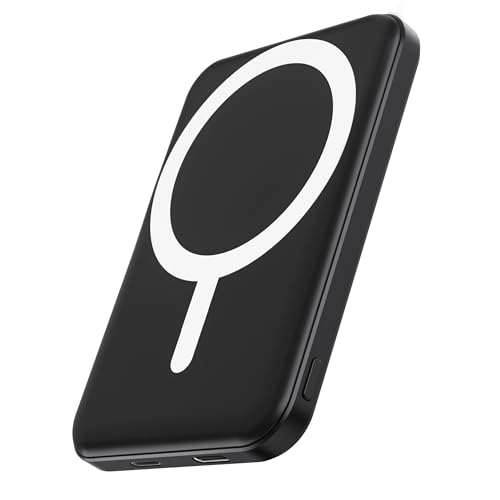


Top 3 picks at a glance
Best magnetic power banks compared
Magnetic power banks are not interchangeable: a model can have a large battery but charge slowly, hold securely but become uncomfortable in a pocket, or work perfectly with one phone case and barely attach to another. The table below focuses on the differences that affect daily use rather than capacity alone.
| Model | Battery capacity | Wireless output | Wired output | Best for | Typical market range |
|---|---|---|---|---|---|
| Anker MagGo Power Bank 10K | 10,000mAh | Qi2 up to 15W | Up to 27W or 30W, depending on version | Best overall features and display options | Usually $70–$100 |
| Belkin BoostCharge Pro Magnetic Power Bank 10K with Qi2 | 10,000mAh | Qi2 up to 15W | Up to 20W | Reliable charging for compatible iPhones | Usually $60–$90 |
| ESR Qi2 10,000mAh Power Bank | 10,000mAh | Qi2 up to 15W | Varies by version, commonly up to 20W | Strong magnetic attachment and practical value | Usually $50–$80 |
| Apple MagSafe Battery Pack | 1,460mAh at 7.62V | Up to 15W when wired, 5W while attached wirelessly | Not designed as a high-output USB-C bank | Small emergency top-ups for older iPhones | Often varies because it is discontinued |
Output can vary slightly by regional version and connected-device conditions. Qi2 phones and cases are also required to reach 15W wirelessly; a standard Qi phone may charge more slowly even when the battery pack supports Qi2.
Our top pick: Anker MagGo Power Bank 10K
The Anker MagGo 10K is the most flexible choice for people who want a magnetic battery for everyday use but still expect useful wired charging. Its Qi2 pad can provide up to 15W to compatible devices, while its USB-C connection is substantially faster than wireless charging for phones, tablets, handheld consoles, earbuds, and other accessories.
Some versions include a built-in USB-C cable, which solves a common annoyance: carrying a magnetic pack but forgetting the cable needed to charge the pack itself or power a second device. Select versions also include a screen showing remaining battery percentage, making them easier to manage than four-LED designs.
Why it stands out
- Qi2-certified 15W wireless charging for compatible phones.
- Higher wired output than many slim magnetic batteries.
- 10,000mAh capacity is large enough for a meaningful phone recharge.
- Useful battery readout on versions equipped with a display.
- Good choice when one power bank must serve both a phone and other USB-C devices.
The trade-off is thickness. A 10,000mAh magnetic pack is unlikely to feel invisible in a trouser pocket, especially while attached to a phone. It is better suited to a jacket pocket, backpack, or desk than to a slim-jeans setup.
Best for dependable Qi2 charging: Belkin BoostCharge Pro 10K
Belkin’s BoostCharge Pro Magnetic Power Bank 10K with Qi2 is a strong choice when alignment and predictable wireless performance matter more than maximum wired output. Qi2 uses a magnetic attachment system and a standardized charging profile, so the phone is less likely to sit slightly off-center and charge inefficiently.
Its built-in stand is useful for watching video or making a video call while the phone charges. The 10,000mAh capacity makes it suitable for travel days, navigation, photography, and gaming sessions, although the actual energy delivered to a phone is lower than the printed capacity suggests.
Best match
Choose the Belkin if you use a Qi2-compatible iPhone, want a recognizable accessory ecosystem, and mainly charge wirelessly. It is less compelling if you regularly need to charge a laptop, tablet, or handheld gaming device, because its wired output is more modest than the fastest Anker alternatives.
Best value-oriented option: ESR Qi2 10,000mAh power bank
ESR’s Qi2 10,000mAh magnetic power banks appeal to users who want a secure connection without paying primarily for branding or a premium display. Depending on the version, features can include a kickstand and Apple Find My support. Check the exact model before buying because ESR sells several similarly named magnetic batteries with different wireless and USB-C specifications.
The important advantage is practical: a good magnetic connection keeps the charging coil aligned as you move the phone, reducing the need to repeatedly reposition the battery. A case with an official MagSafe or Qi2 magnetic ring is still essential. A plain silicone case, thick wallet case, or weak aftermarket ring can make even a strong power bank detach.
Capacity versus real-world charging
A 10,000mAh label does not mean a 10,000mAh phone battery can be recharged completely. Power banks rate capacity at the internal cell voltage, usually around 3.7 volts, while USB and wireless systems must convert that energy to the phone’s battery voltage. Conversion losses, heat, and standby consumption reduce the usable amount.
Here is a realistic estimate:
- 10,000mAh × 3.7V = approximately 37Wh stored energy.
- Assume 75% total usable efficiency after voltage conversion and wireless losses.
- 37Wh × 0.75 = approximately 27.75Wh delivered to the phone.
- A phone with a 4,000mAh battery at about 3.85V stores roughly 15.4Wh.
- 27.75Wh ÷ 15.4Wh = about 1.8 full battery equivalents.
In practice, expect roughly one-and-a-half to nearly two full charges for a modern phone, depending on temperature, screen use, charging speed, and whether the phone is being used during charging. A 5,000mAh magnetic battery is more pocket-friendly but commonly provides around 0.7 to 1.0 full phone charge.
Magnetic strength and phone compatibility
Magnetic strength is not measured consistently across brands, so a larger number in a product description does not automatically indicate a better experience. Look for a Qi2 certification, a properly aligned magnetic ring, and a design that does not place excessive leverage on the phone’s camera bump.
| Your situation | Recommended specification | Why |
|---|---|---|
| iPhone with MagSafe and a thin compatible case | Qi2, 5,000–10,000mAh, 15W wireless | Strong alignment and a useful balance of size and runtime |
| iPhone with a thick case or wallet attachment | Qi2 pack plus a certified magnetic case or ring | Extra layers can weaken the connection and increase heat |
| Android phone | Qi2-certified phone or a case with a properly positioned magnetic ring | Magnetic attachment is not guaranteed by ordinary wireless charging |
| Gaming, navigation, or video recording | 10,000mAh, 20W-plus USB-C output, preferably with a cable | Wired charging is more efficient and less likely to pause from heat |
| Small pockets and short trips | 3,000–5,000mAh, slim body, around 15W wireless | Lower weight matters more than maximum recharge count |
iPhones with MagSafe are the simplest match. Android compatibility depends on the phone model: some newer devices support Qi2 directly, while others need a compatible case or adhesive magnetic ring. A ring must be centered over the phone’s wireless charging coil; placing it too high or low can cause slow charging or no charging at all.
Wireless speed, heat, and pocket comfort
“15W wireless” is a maximum input rate, not a guaranteed continuous speed. The phone may reduce power when its battery is nearly full, when the device becomes warm, or when the pack itself is low. Wireless charging also loses more energy as heat than a short USB-C cable.
For the fastest top-up, connect the power bank to the phone with USB-C. For convenience while walking or commuting, use the magnetic pad. If the phone becomes noticeably hot, remove a thick case, stop demanding games or camera recording, and place the phone and battery on a hard surface. Heat management is more useful than choosing a pack with an extra few watts on its specification sheet.
How to choose the right magnetic power bank
- Confirm the phone connection. Check whether the phone supports MagSafe, Qi2, or only ordinary Qi charging.
- Choose the capacity based on your day. Select 5,000mAh for portability and 10,000mAh for travel or heavy use.
- Prioritize Qi2 certification. It improves alignment and enables up to 15W wireless charging on compatible devices.
- Check wired output. Choose at least 20W if you want fast emergency charging; choose 27W or more for broader USB-C device support.
- Measure the thickness. A battery can be comfortable in a backpack but awkward in a pocket once attached to a phone.
- Inspect case compatibility. Remove wallet attachments and use a magnetic-compatible case when the connection feels weak.
Frequently asked questions
Can I use a magnetic power bank with an Android phone?
Yes, if the phone supports Qi2 or you use a compatible case or magnetic ring. Ordinary Qi charging alone does not guarantee magnetic attachment. If using a ring, center it over the phone’s wireless charging coil; incorrect placement can lead to slow charging or no charging.
Will a 10,000mAh power bank recharge my phone two full times?
Not necessarily; expect roughly one-and-a-half to nearly two full charges for a modern phone. Some stored energy is lost during voltage conversion and charging, and heat, standby use, and using the phone while charging affect the result. A 5,000mAh pack commonly provides around 0.7 to 1.0 full phone charge.
How can I get the fastest charge from a magnetic power bank?
Use a USB-C cable rather than the wireless pad. Wireless charging loses more energy as heat, while wired charging is generally faster. The phone can still reduce charging power if it becomes warm, its battery is nearly full, or the power bank is low.
Can I keep using my phone while it charges wirelessly?
Yes, but demanding activities such as gaming or camera recording can add heat, and wireless charging may slow down or pause when the phone gets warm. If it becomes noticeably hot, remove a thick case, stop demanding activities, and place the phone and battery on a hard surface.
What should I check before buying a magnetic power bank for a thick case?
Check that the case has an official MagSafe or Qi2 magnetic ring, or use a certified magnetic case or ring. Extra layers, wallet cases, and weak aftermarket rings can weaken attachment. A poorly centered ring can also cause slow charging or prevent charging.
Final verdict
The Anker MagGo Power Bank 10K is the best magnetic power bank for most buyers because it combines Qi2 charging, useful wired output, substantial capacity, and convenient status information. The Belkin BoostCharge Pro 10K is a dependable alternative for straightforward Qi2 charging and stand functionality, while the ESR Qi2 10K is a sensible value choice when strong attachment and practical features matter more than maximum USB-C performance. For the smallest emergency backup, choose a 5,000mAh class model; for all-day travel, 10,000mAh remains the better balance.