The best kids luggage depends on the trip: choose a ride-on case such as the JetKids by Stokke BedBox for airport-heavy travel, a compact Trunki for short journeys and toddlers, or a light two-wheel cabin case with an adjustable handle for older children who will carry their own clothes.
A child’s suitcase should be easy to steer, light enough to lift when tired, durable enough for baggage handling, and sized around the child rather than the airline’s maximum cabin allowance. The most important comparison is not decoration or character branding; it is whether the wheels, handle, shell, and interior storage match the way your family travels.
As an Amazon Associate we earn from qualifying purchases at no extra cost to you.


Our Top Picks
 Wrangler 22" Hardside Spinner Carry-On Luggage22-Inch9.5 x 21.5 x 14.5 inches6.4 PoundsCheck on Amazon


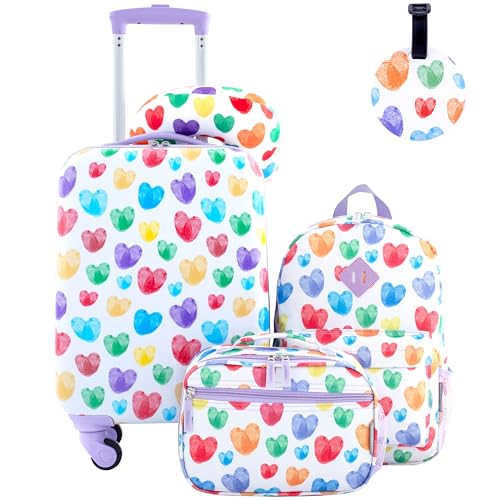
Top 3 picks at a glance
Quick comparison: the best kids luggage by travel type
| Best for | Suitable age or height | Typical size | Typical empty weight | Wheel design | Main advantage |
|---|---|---|---|---|---|
| Short trips with toddlers | About 2–5 years | Approximately 46–52 cm long | 1.5–2.0 kg | Two recessed wheels | Simple, compact, and easy to ride or pull |
| Airport travel with a tired child | About 3–7 years | Approximately 46 × 36 × 20 cm | About 3.0 kg | Four ride-on-compatible wheels | Can provide a seat and, on compatible models, a rest solution |
| Older children packing independently | About 6–12 years | Approximately 50–55 cm cabin size | 2.0–3.0 kg | Two or four spinner wheels | Better organization and a usable telescopic handle |
| Checked family luggage | Any age with adult supervision | Approximately 65–75 cm | 3.5–5.0 kg | Four larger spinner wheels | More capacity and stronger structure |
These are practical comparison ranges rather than universal specifications. Airline cabin limits differ, and the exact capacity of a case changes with its shape, wheels, and handle housing. Measure the complete outside dimensions, including wheels and handles, before relying on a cabin-size label.
Head-to-head: which type of kids luggage wins?
Trunki-style ride-on cases: best for compact toddler travel
Trunki is a familiar example of a small ride-on case designed for young children. Its low height lets a child sit on the case while an adult pulls it with a strap, and its compact shape is less awkward than a full-size suitcase in a crowded terminal. A hard plastic shell can tolerate ordinary knocks, while the internal space is sufficient for a change of clothes, pajamas, small toys, and toiletries.
The trade-off is storage. The clamshell interior is not as efficient as a rectangular cabin case, and the wheels are primarily designed for being pulled rather than smoothly pushed in every direction. A toddler may also outgrow the case quickly. Choose this style when the case is part luggage, part mobility aid—not when you need one bag for a week-long trip.
JetKids by Stokke BedBox: best for long airport days
The JetKids by Stokke BedBox combines a child-sized ride-on case with a surface that can be used with approved accessories to create a rest area during some flights. Its strongest feature is not maximum packing capacity; it is reducing fatigue during connections, queues, and long walks through terminals.
It is relatively heavy for its size, so the usable packing allowance is lower than the exterior dimensions suggest. The wheels and shell are more valuable for airport movement than for rough checked-baggage handling. Confirm the airline’s rules before using any in-flight bed or leg-rest function, because cabin crew approval and aircraft policy can vary.
Small spinner cases: best for school-age independence
A compact four-wheel spinner is usually the best kids luggage choice for children who can walk confidently and want to manage their own belongings. Four wheels reduce the pulling force and allow the case to roll beside the child, but small spinner wheels can struggle on cobblestones, carpet transitions, and cracked pavements.
Look for wheels that are recessed into protected housings and rotate without scraping the shell. A two-wheel case with larger wheels may be better for train stations and outdoor sidewalks, even though it is less nimble indoors. The correct handle height matters: when extended, the grip should sit roughly between the child’s hip and lower waist without forcing the shoulder upward.
Character hard-shell luggage: best for recognition and motivation
Licensed Disney and other character cases can make a child more willing to carry and look after their own bag. That practical benefit is worth considering, especially for first-time flyers. However, graphics do not indicate shell quality. Inspect the closure, wheel mounts, handle rails, and corner protection before choosing a design.
Printed finishes can show scratches more clearly than textured or molded shells. If the case will be checked, a darker textured surface and replaceable-looking hardware are generally more sensible than a glossy finish chosen only for appearance.
Decision matrix: match the case to your trip
| Your situation | Recommended format | Prioritize | Acceptable compromise |
|---|---|---|---|
| Weekend road trip | Small two-wheel or soft-sided case | Flexible storage, low weight, easy loading | Less impact protection |
| Short-haul flight with one connection | Compact spinner or Trunki-style case | Cabin dimensions, light shell, smooth wheels | Limited clothing capacity |
| Long-haul flight with a young child | JetKids-style ride-on case plus adult luggage | Mobility, child fatigue management, secure latch | Higher empty weight |
| Train and city walking | Two-wheel case with large wheels | Wheel diameter, handle strength, maneuverability over gaps | Must be tilted while moving |
| Checked baggage | Medium hard-shell case | Corner protection, robust wheel mounts, compression straps | Too large for a young child to control alone |
How to compare the specifications that matter
Size and usable capacity
A child’s suitcase should not be sized only by liters. A case may claim 20 liters but lose several liters to wheel housings, a deep lid, or a bulky handle mechanism. For a three- to five-day child trip, around 15–25 liters is often practical if an adult carries outerwear and shoes. For a week, 25–35 liters may be more suitable, but the case can become too heavy for a child to control.
Use this simple load calculation before buying: if clothing, shoes, and toiletries weigh 3.5 kg and the case weighs 2.5 kg, the child must move 6 kg. Add a water bottle or toy and the total can exceed 6.5 kg. For younger children, keeping the packed case near 10–15% of body weight is a useful comfort target, even though it is not a formal luggage rule.
Wheel quality
Wheel diameter and protection matter more than the number of wheels. Small exposed spinner wheels are convenient on smooth airport floors but vulnerable to impacts. Larger two-wheel designs roll more easily over door thresholds and pavement. Check that each wheel spins freely, has no side-to-side wobble, and is attached through a reinforced mount rather than thin decorative plastic.
Shell durability
ABS plastic is usually light and affordable but may show dents or cracks after repeated hard impacts. Polycarbonate generally offers better impact resistance and flexibility, but it often costs more and can still be damaged at corners. A fabric case can be lighter and easier to compress into a car trunk, although it offers less protection against spills and crushing.
For carry-on use, a lightweight shell is usually enough. For checked luggage, prioritize reinforced corners, a strong zipper or latch, and wheels that do not protrude far beyond the body.
Handle height and control
A handle that is too low makes the child lean forward; one that is too high causes the shoulder to lift and the case to veer. Test the case with the child wearing shoes and a light jacket. The grip should feel natural with a slightly bent elbow. Two or three locking positions are more useful than an extra-long handle intended for adults.
Interior storage
Children benefit from visible organization. A zipped divider keeps socks and underwear from disappearing, while elastic straps stop clothing from shifting. A front pocket is useful for a boarding pass, headphones, or a comfort item, but it reduces protected interior space. Avoid overcomplicated compartments that add weight without helping the child pack independently.
Features worth paying for—and features to skip
- Worth paying for: smooth sealed wheels, a reinforced telescopic handle, compression straps, a washable lining, and a sturdy zipper or latch.
- Useful for some families: a ride-on seat, removable laundry bag, name-card slot, or matching backpack attachment.
- Usually optional: built-in lights, elaborate character accessories, and rigid dividers that consume packing space.
- Check carefully: any case marketed as a bed, leg rest, or in-flight aid, because airline approval may differ by aircraft and route.
Frequently asked questions
Can a child use a ride-on suitcase during a flight?
A ride-on suitcase may be useful in airports, but its in-flight use depends on airline rules and cabin crew approval. The JetKids by Stokke BedBox can provide a rest solution with compatible accessories on some flights, but aircraft policies vary. Confirm the airline’s rules before using any in-flight bed or leg-rest function.
How much should a child’s packed suitcase weigh?
A useful comfort target is to keep a younger child’s packed case near 10–15% of their body weight. Include both the luggage and its contents in the calculation. For example, clothing, shoes, and toiletries weighing 3.5 kg in a 2.5 kg case create a 6 kg load, before adding items such as a water bottle or toy.
Are four-wheel spinner cases better than two-wheel cases for children?
Four-wheel spinners are often easier indoors because they can roll beside the child and require less pulling force. Two-wheel cases with larger wheels can be better over cobblestones, pavement, door thresholds, and other uneven surfaces. The best choice depends on where the child will travel, since small spinner wheels may struggle on rougher ground.
What should parents check before buying a cabin-size kids suitcase?
Measure the complete outside dimensions, including wheels and handles, because airline cabin limits differ. Also consider the case’s empty weight, wheel housings, handle mechanism, and usable interior capacity. A cabin-size label does not guarantee acceptance, and a case with bulky components may hold less than its stated capacity suggests.
Is ABS or polycarbonate better for children’s luggage?
Polycarbonate generally offers better impact resistance and flexibility, but it often costs more. ABS plastic is usually lighter and more affordable, although it may show dents or cracks after repeated hard impacts. For carry-on use, a lightweight shell is usually sufficient; for checked luggage, prioritize reinforced corners, a strong closure, and protected wheel mounts.
Final buying recommendation
For toddlers taking short trips, choose a light Trunki-style ride-on case with a secure latch and easy-clean interior. For long airport days, the JetKids by Stokke BedBox is the more specialized choice if its extra weight and airline restrictions are acceptable. For children roughly six and older, a compact spinner or two-wheel cabin case with a height-appropriate handle will usually provide the best balance of independence, capacity, and long-term usefulness.
Before purchasing, pack a representative load, weigh the complete case, measure its outside dimensions, and test the handle at the child’s height. The best kids luggage is the case your child can control when it is full—not merely the case with the largest capacity or the most appealing design.