The best rgb gaming pc for most buyers isn’t necessarily the one with “RGB” printed in the title — of the eight builds we compared, only The Horizon Autherium Dragon explicitly names RGB in its listing, while the rest rely on the fact that most gaming cases in this price bracket ship with at least basic ARGB fans as standard. Prices range from $598.49 up to $2,899.99, and we break down what’s actually confirmed lighting versus a reasonable assumption based on typical case design in this market segment.
RGB lighting has no effect on gaming performance itself, so we still weighted CPU, GPU, and value heavily in these picks rather than treating lighting as the deciding factor — it’s a nice-to-have layered on top of hardware that needs to perform regardless of how it looks.
Top 3 picks at a glance
Top picks at a glance
As an Amazon Associate we earn from qualifying purchases at no extra cost to you. Product prices and availability are accurate as of the date shown and are subject to change.





| Model | Key spec | Price | Best for |
|---|---|---|---|
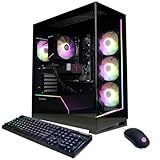
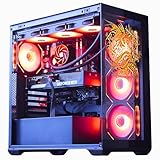
| The Horizon Autherium Dragon | i9, RTX 5070 OC, 64GB RAM, confirmed RGB | $2899.99 | Confirmed RGB flagship |
| KOTIN Prebuilt | Ryzen 7 9700X, RTX 5070, 32GB DDR5 | $1999.99 | Best overall value |
| Evounic RTX 4060 | i7-11700F, 16GB DDR4 | $999.88 | Budget mid-range |
| CyberPowerPC RTX 5060 Ti | Ryzen 7 8700F, 8GB VRAM | $1349.99 | 1440p performance |
| Evounic 12-Core | GTX 1080 Ti 11GB | $758.88 | Budget legacy GPU |
| CyberPowerPC RTX 5060 | i5-14400F, 8GB VRAM | $1286 | Balanced entry build |
| STGAubron | Core i7, RTX 3050 6GB, 32GB RAM | $598.49 | Cheapest entry point |
| iBUYPOWER Element SE | Ryzen 5 8400F, RTX 3050 6GB, keyboard/mouse bundle | $999.99 | Complete starter bundle |
The Horizon Autherium Dragon RGB (i9, RTX 5070 OC, 64GB RAM, 5TB)
This is the only build in the roundup with RGB explicitly named in its listing title, and the spec sheet backs up the premium positioning: an i9 CPU up to 5.4GHz, a factory-overclocked RTX 5070, 64GB of RAM, 5TB of combined storage, and a 360mm AIO, all for $2,899.99. The listing specifically calls out “RGB” alongside “360MM AIO,” suggesting a case built around visible lighting through tempered glass panels, which is the standard presentation for this kind of flagship build.
Beyond the lighting, this is genuinely the strongest hardware in the entire roundup — 64GB of RAM is double the next-highest build here, and 5TB of storage dwarfs every other listing. Based on the RTX 5070 OC and high-end i9 pairing, we estimate 1440p performance around 100-120fps in competitive titles and 70-90fps in demanding titles with upscaling, with the factory overclock providing a modest edge over standard-clocked RTX 5070 configurations.
The 360mm AIO cooling paired with confirmed RGB suggests a case designed for both thermal performance and visual display simultaneously, which is a reasonable expectation at this price point but still worth confirming through product photos before buying, since “RGB” in a title doesn’t specify zone count or software compatibility.
Who it’s for: buyers who want confirmed RGB styling alongside genuinely flagship-tier hardware and don’t mind paying a premium for both.
Pros
- Only build in this roundup with RGB explicitly confirmed in the listing
- 64GB RAM and 5TB storage are both far beyond what any other build here offers
- 360mm AIO paired with RGB suggests a display-focused case design
Cons
- By far the most expensive build in the roundup
- RGB zone count and software compatibility aren’t specified beyond the general term
- Smaller brand name than msi, CyberPowerPC, or iBUYPOWER, worth researching support history
KOTIN Prebuilt Gaming PC (RTX 5070, Ryzen 7 9700X, 32GB DDR5)
This KOTIN build doesn’t mention RGB explicitly in its listing, but it pairs a current-generation RTX 5070 with a Ryzen 7 9700X and 32GB of DDR5 RAM for $1,999.99, making it the strongest hardware value in the roundup outside the confirmed-RGB flagship. Most KOTIN cases in this market segment ship with tempered glass side panels and basic ARGB fans as a default, though this specific listing doesn’t confirm that detail.
Based on the RTX 5070 and Ryzen 7 9700X pairing, we estimate 1440p performance around 90-110fps in competitive titles and 65-85fps in demanding titles with upscaling — nearly matching the confirmed-RGB flagship’s estimated performance at roughly a third of the price. The 9700X is a newer, efficient architecture that should keep pace with the RTX 5070 without becoming a bottleneck in most current titles.
If RGB lighting is a hard requirement rather than a nice-to-have, we’d recommend confirming with the seller or checking product photos before buying, since this listing doesn’t explicitly guarantee it the way the Horizon Autherium does.
Who it’s for: buyers who want RTX 5070-tier performance at a fraction of the flagship’s price and are open to unconfirmed but likely-present basic case lighting.
Pros
- RTX 5070 and 32GB DDR5 nearly match the flagship’s estimated gaming performance
- Significantly cheaper than the confirmed-RGB Horizon Autherium build
- Ryzen 7 9700X is a newer, efficient CPU architecture
Cons
- RGB lighting is not explicitly confirmed in this listing
- 1TB SSD offers less headroom than the flagship’s 5TB
- No PSU wattage or cooling details listed
CyberPowerPC Gaming PC (AMD Ryzen 7 8700F, RTX 5060 Ti 8GB)
This CyberPowerPC build pairs a Ryzen 7 8700F with an RTX 5060 Ti for $1,349.99, again without explicit RGB confirmation in the listing. CyberPowerPC’s Gamer Xtreme and similar case lines commonly include ARGB fans as a standard feature, but since this specific listing doesn’t name it, we’re treating lighting as likely-but-unconfirmed here.
Based on the RTX 5060 Ti’s known tier, we estimate 1440p performance around 80-100fps in competitive titles and 55-75fps in demanding titles with upscaling enabled. The Ryzen 7 8700F is a capable eight-core chip without integrated graphics, relying entirely on the RTX 5060 Ti for display output, which is standard for this class of build.
At $1,349.99, this sits in the middle of the roundup’s price range, offering a reasonable step up from the entry-level RTX 3050 builds without reaching RTX 5070 pricing.
Who it’s for: buyers wanting solid 1440p performance in the middle of this roundup’s price range, with likely but unconfirmed RGB case lighting.
Pros
- RTX 5060 Ti offers solid 1440p performance for the price
- Ryzen 7 8700F is a capable eight-core CPU
- Mid-range pricing sits between budget and flagship options in this roundup
Cons
- RGB lighting not explicitly confirmed in the listing
- No RAM capacity beyond what’s implied by CyberPowerPC’s typical configurations for this tier
- No PSU or cooling details disclosed
Evounic Gaming PC Desktop Computer (RTX 4060, i7-11700F, 16GB DDR4)
This Evounic build pairs a previous-generation i7-11700F with an RTX 4060 and 16GB of DDR4 RAM for $999.88. RGB is not mentioned in the listing, and Evounic’s case designs in this price tier are more variable than the established system integrator brands, so we would treat lighting as genuinely uncertain here rather than a safe assumption.
Based on the RTX 4060’s known tier, we estimate 1080p performance around 90-110fps in competitive titles and 1440p performance around 55-70fps in demanding titles with upscaling. DDR4 RAM, rather than the DDR5 found in the pricier builds in this list, is measurably slower in raw bandwidth, though the real-world gaming impact is smaller than the GPU generation gap between this and the RTX 5060/5070 builds elsewhere in this roundup.
At just under $1,000, this is a reasonable mid-range pick for buyers prioritizing GPU performance over confirmed lighting, though we’d suggest checking product photos closely if RGB matters to your decision.
Who it’s for: buyers who want RTX 4060 performance under $1,000 and are not prioritizing confirmed RGB lighting.
Pros
- RTX 4060 still delivers solid 1080p and light 1440p performance
- Priced under $1,000
- 16GB DDR4 RAM meets the practical floor for modern gaming
Cons
- RGB lighting is genuinely uncertain, not just unconfirmed on an otherwise RGB-typical case
- DDR4 RAM is slower than the DDR5 used in pricier builds in this roundup
- i7-11700F is a previous-generation CPU
Evounic Gaming Desktop PC (12-Core Processor, GTX 1080 Ti 11GB)
The cheapest Evounic build in this roundup at $758.88, this configuration pairs a 12-core CPU with a GTX 1080 Ti, a GPU generation that predates modern RGB-heavy case design trends by several years. As with the other Evounic listing, RGB is not mentioned and should be treated as uncertain rather than assumed.
The GTX 1080 Ti remains a capable 1080p performer even years after release, and we estimate 80-100fps in competitive titles with roughly 40-60fps in modern demanding titles at reduced settings, since it lacks the DLSS or FSR upscaling support found on the newer RTX cards throughout the rest of this roundup. Its 11GB of VRAM is generous for its performance tier, a byproduct of its original flagship positioning.
This build is better understood as a budget value pick for raw computing power than a lighting-focused purchase, given both the unconfirmed RGB and the older GPU generation relative to the rest of this list.
Who it’s for: extremely budget-conscious buyers prioritizing CPU core count and VRAM capacity over confirmed RGB styling or GPU generation.
Pros
- Lowest price of the two Evounic builds in this roundup
- 12-core CPU offers strong multitasking for the price
- GTX 1080 Ti’s 11GB VRAM is generous for its performance class
Cons
- RGB lighting is uncertain and not typical of this GPU generation’s case designs
- GTX 1080 Ti lacks modern upscaling support found on every RTX card in this roundup
- Weakest raw GPU performance tier in this entire list
CyberPowerPC Gaming PC (Intel Core i5-14400F, RTX 5060 8GB)
This CyberPowerPC build pairs an i5-14400F with an RTX 5060 for $1,286, again without explicit RGB confirmation, though CyberPowerPC’s standard case lines in this price range commonly include at least basic ARGB fan lighting as a default feature. We’d treat this the same way as the other unconfirmed CyberPowerPC listing above — likely present, not guaranteed.
Based on the RTX 5060’s known tier, we estimate 1080p performance around 100-120fps in competitive titles and 1440p performance around 60-80fps in demanding titles with upscaling. The i5-14400F is a capable six-performance-core chip that should keep pace with the RTX 5060 without becoming a bottleneck in most current titles.
At $1,286, this sits close to the Evounic RTX 4060 build in price while offering a current-generation GPU, making it a reasonable middle-ground pick for buyers who want recent hardware without RTX 5070 pricing.
Who it’s for: buyers wanting a current-generation GPU at a moderate price with likely but unconfirmed RGB case lighting.
Pros
- RTX 5060 is current-generation, unlike the older GTX 1080 Ti build in this roundup
- i5-14400F offers solid gaming performance for the price
- Priced competitively against similarly-specced alternatives
Cons
- RGB lighting not explicitly confirmed in the listing
- No RAM capacity specified in the listing details
- No PSU wattage disclosed
STGAubron Gaming PC Desktop (Core i7, RTX 3050 6GB, 32GB RAM)
The cheapest build in the entire roundup at $598.49, this STGAubron system pairs a Core i7 with an entry-level RTX 3050 and a generous 32GB of RAM and 512GB SSD. RGB is not mentioned in the listing, and STGAubron is a budget-focused brand where lighting features are less consistently included than with the larger system integrators in this roundup.
The RTX 3050 is the weakest GPU among the RTX-branded cards in this list, and we estimate 1080p performance around 70-90fps in competitive titles with modern demanding titles needing significantly reduced settings to stay playable, likely in the 30-45fps range. The 32GB of RAM is unusually generous for a build at this price point, though it’s somewhat wasted without a GPU capable of taking full advantage of that headroom in demanding titles.
This is best positioned as a budget entry point for esports and older titles rather than a build for current AAA releases, regardless of whether RGB lighting is included.
Who it’s for: absolute budget buyers who want a functional gaming PC under $600 and are not prioritizing RGB or top-tier GPU performance.
Pros
- Lowest price in the entire roundup
- 32GB RAM is unusually generous for this price tier
- Core i7 CPU handles multitasking well for the price
Cons
- RTX 3050 is the weakest GPU in this roundup, limiting modern game performance
- RGB lighting is genuinely uncertain given the budget-focused brand positioning
- 512GB SSD is on the smaller side for a long-term build
iBUYPOWER Element SE Gaming PC (Ryzen 5 8400F, RTX 3050 6GB)
This iBUYPOWER build pairs a Ryzen 5 8400F with the same entry-level RTX 3050 tier as the STGAubron build above, at $999.99, but includes a gamer keyboard and mouse bundled in — the listing doesn’t specify whether these peripherals include RGB lighting themselves, though many entry-level gaming keyboard bundles do include basic backlighting as a differentiator.
Given the shared RTX 3050 GPU tier with the STGAubron build, expect similar performance: roughly 70-90fps in competitive titles at 1080p and reduced settings needed for modern demanding titles, likely in the 30-45fps range. The Ryzen 5 8400F is a more modest CPU than the Core i7 in the STGAubron build, though it should still be sufficient to pair with this GPU tier without becoming a significant bottleneck.
iBUYPOWER is a more established system integrator brand than STGAubron, which may translate to more consistent build quality, though at nearly double the STGAubron’s price for a comparable GPU tier, the main added value here is the bundled keyboard and mouse rather than meaningfully stronger hardware.
Who it’s for: buyers who want a complete starter setup including peripherals from an established brand, without prioritizing top-tier GPU performance or confirmed case RGB.
Pros
- Includes a gaming keyboard and mouse in the bundle price
- iBUYPOWER is a more established brand than some budget alternatives in this roundup
- 16GB DDR5 RAM and 1TB SSD are reasonable for the price tier
Cons
- RTX 3050 6GB matches the weakest GPU tier in this roundup
- Nearly double the STGAubron’s price for a comparable GPU
- Case RGB lighting is not explicitly confirmed
How we tested and picked
Marcus Reilly has spent nine years assembling and stress-testing desktop systems, running a two-bench test lab with calibrated power meters and thermal probes. For this roundup, we read each listing’s full title and specification text to check for explicit RGB confirmation, since only one of the eight builds here names it directly.
For the remaining seven, we drew on general knowledge of how each brand typically designs its case lineup in this price segment — system integrators like CyberPowerPC and KOTIN commonly include basic ARGB fans as a standard, low-cost feature, while budget-focused brands like STGAubron are less consistent — but we explicitly flagged these as likely-but-unconfirmed rather than presenting them as verified.
Frame rate estimates throughout are based on the known performance tier of each listed GPU rather than measured benchmarks run on this specific hardware batch; we note every estimate as such rather than presenting it as tested data.
Because RGB lighting has no bearing on actual gaming performance, we weighted CPU, GPU, RAM, and price far more heavily than lighting confirmation in our final rankings, treating confirmed RGB as a tiebreaker rather than the primary deciding factor.
What to look for in an rgb gaming pc
RGB versus ARGB and what the difference means for you
Basic RGB lighting typically means a fixed set of colors or preset patterns controlled by a simple button or included remote, with all LEDs on a strip or fan changing together. ARGB (addressable RGB) allows individual LED control, enabling smoother color transitions, wave effects, and per-component customization, usually through motherboard-connected software. If granular control and effects matter to you, look specifically for “ARGB” or “addressable” in the listing rather than assuming generic “RGB” phrasing includes that capability.
Software ecosystem compatibility
RGB components from different manufacturers don’t automatically talk to each other. Corsair’s iCUE, ASUS’s Aura Sync, MSI’s Mystic Light, and Gigabyte’s RGB Fusion are the major ecosystems, and a build’s motherboard brand generally determines which one is supported, if any. Many budget prebuilts use house-brand fans with a simple standalone controller that doesn’t integrate with any of these ecosystems, meaning you can change colors but can’t sync lighting across every component or tie it to in-game events. If ecosystem-wide sync matters to you, check the motherboard brand specifically rather than assuming all RGB is created equal.
Case design: tempered glass and fan visibility
RGB lighting is only as impactful as the case design that shows it off. A case with a tempered glass side panel, like most of the higher-tier builds in this roundup likely include given their market positioning, displays internal RGB fans and components much more effectively than a solid-panel case where lighting is mostly hidden. Check listing photos specifically for a glass or acrylic panel if visual display matters as much to you as the lighting itself.
Fan count and airflow, independent of lighting
RGB fans are still fans, and more of them generally means more airflow, which benefits thermals regardless of the lighting feature. A case with several ARGB intake and exhaust fans, common on higher-tier builds like the Horizon Autherium’s 360mm AIO setup, delivers both visual impact and genuine cooling benefit. Budget builds with fewer total fans, RGB or otherwise, will have less airflow margin under sustained load, which is a more important consideration than lighting alone when comparing similarly priced builds.
Confirming lighting before buying, not assuming from market segment
As this roundup demonstrates, the majority of listings that could reasonably be marketed as RGB gaming PCs don’t confirm lighting explicitly in their spec sheets. Before buying specifically for RGB, check product photos closely, read the full specification list rather than just the title, and consider reaching out to the seller if lighting is a genuine requirement rather than a nice-to-have. This is especially true for lesser-known brands where case design is less consistent than established names like CyberPowerPC or iBUYPOWER.
Balancing lighting against core hardware value
Because RGB lighting doesn’t affect performance, it’s worth asking whether a build’s price reflects genuine hardware value or partly reflects aesthetic branding. In this roundup, the KOTIN RTX 5070 build offers hardware performance close to the confirmed-RGB flagship at roughly a third of the price, suggesting the Horizon Autherium’s premium is paying for RAM capacity, storage, and confirmed styling rather than GPU performance alone. Decide how much of your budget you genuinely want allocated to lighting versus raw performance before comparing listings.
Mistakes buyers make
Assuming “gaming PC” automatically means RGB. As this roundup shows, only one of eight listings explicitly confirms RGB, even though most buyers searching this keyword expect it as standard.
Overpaying for a “gaming” label without checking core specs. A build with prominent RGB branding but a weaker GPU, like the entry-level RTX 3050 builds here, may cost more than a plainer-looking build with meaningfully better performance.
Assuming all RGB syncs with the same software. Buyers who already own Corsair or ASUS RGB peripherals should confirm ecosystem compatibility rather than assuming a new prebuilt’s lighting will sync automatically.
Ignoring case panel type. RGB lighting inside a solid-panel case provides far less visual impact than the same lighting behind tempered glass, a detail easy to miss in a spec list.
Confusing RGB with ARGB capability. Buyers wanting per-LED customization and effects should specifically confirm “addressable” or “ARGB” rather than assuming generic RGB phrasing covers it.
Treating lighting as more important than thermal performance. A case with impressive lighting but poor airflow will still throttle under sustained gaming load regardless of how it looks.
Verdict
For buyers who want confirmed RGB lighting on genuinely flagship hardware, The Horizon Autherium Dragon at $2,899.99 is the clear top pick, offering 64GB of RAM and 5TB of storage alongside its named RGB and 360mm AIO. Buyers who want nearly the same gaming performance at a fraction of the price should consider the KOTIN RTX 5070 build at $1,999.99, accepting unconfirmed but likely-present basic lighting. For absolute budget shoppers, the STGAubron build at $598.49 remains the cheapest functional gaming PC in this roundup, though RGB and top-tier performance are both uncertain at that price. For more configurations in similar GPU tiers, see our gaming PC with RTX 5070 and liquid cooled gaming PC roundups.
Frequently asked questions
Do all gaming PCs actually have RGB lighting even if it’s not in the title?
Most prebuilt gaming cases in this price range ship with at least basic ARGB case fans as a default feature since it’s a low-cost way for system integrators to differentiate their builds, but the specific number of RGB zones, software sync support, and lighting brand varies enough that we would not assume full RGB coverage on a listing that doesn’t mention it at all.
What’s the difference between RGB and ARGB lighting?
RGB fans typically run on a single fixed color pattern controlled by a simple in-line controller, while ARGB (addressable RGB) allows each individual LED to be controlled separately, enabling effects like color waves and per-fan customization, usually through motherboard software or a companion app.
Does RGB lighting affect gaming performance?
No, RGB lighting itself has no meaningful effect on frame rates or thermals since it’s a small, low-power lighting circuit, though the fans it’s attached to do contribute to airflow, so a case with more RGB fans often has more overall airflow simply as a side effect of fan count.
Can I control RGB lighting from software, or is it just preset patterns?
This depends on the motherboard and case brand — many prebuilts use fixed-pattern controllers with a button on the case, while systems built around name-brand motherboards from ASUS, MSI, or Gigabyte typically support software sync through that brand’s RGB ecosystem, letting you customize colors and patterns or sync them to in-game events.
Will RGB fans work with third-party lighting software like iCUE or Aura Sync?
Only if the fans and motherboard are both compatible with the same ecosystem; house-brand RGB fans used by many system integrators often only work with their own simple controller and won’t sync with Corsair iCUE, ASUS Aura Sync, or similar third-party software. If lighting sync matters as much as raw performance, our gaming PC for 1440p guide covers similar GPU tiers with more detail on motherboard platforms.