The best shotgun microphones for wildlife recording are the Sennheiser MKH 8060 for overall field performance, the Rode NTG5 for lightweight backpacking, and the Sennheiser MKH 8070 or Sanken CS-3e for long-distance reach, because wildlife recording prioritizes ultra-low self-noise, RF-biased weather resistance, and effective wind protection over studio specs like max SPL.
As an Amazon Associate we earn from qualifying purchases at no extra cost to you.



Our Top Picks
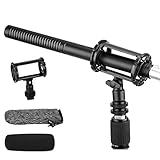
 BOYA XLR Microphone BY-BM6060 Super-Cardioid Shotgun Condenser MicrophoneBY-BM606013.3 x 4.8 x 3 inches0.5 poundsCheck on Amazon


Top 3 picks at a glance
What Actually Matters for Wildlife Recording
Wildlife is quiet, distant, and outdoors. That flips the normal shotgun priorities. In a studio you worry about off-axis rejection for dialogue; in the field you worry about hearing a warbler at 30 meters without hiss, and keeping the mic alive through fog and wind.
1. Self-Noise Is More Important Than Sensitivity
Most recordists focus on sensitivity (mV/Pa), but self-noise (equivalent noise level, dB-A) determines your noise floor when you boost gain for distant birds or mammals. A difference of 3 dB is clearly audible in quiet dawn chorus recordings. Anything above 15 dB-A will produce noticeable hiss when recording quiet sources at 20+ meters. 13 dB-A or lower is ideal, 10-11 dB-A is excellent.
2. Pickup Distance Is About Interference Tube Length, Not Magic
Longer interference tubes give narrower, more directional pickup at mid-high frequencies, which helps isolate a single animal in the distance. But they do almost nothing below 500Hz, add weight, catch more wind, and are harder to maneuver in brush. A short shotgun (150-210mm) is best for general woodland and close to mid-distance, a long shotgun (400mm+) is a specialist tool for open fields, wetlands, and shy species you cannot approach.
3. Weather Resistance Decides If Your Day Ends Early
Standard AF condenser shotguns (most Rode, Audio-Technica, Deity models) use a high-impedance capsule that is sensitive to humidity. Condensation on a cold morning can cause crackling, loss of output, or temporary failure. RF condenser designs (Sennheiser MKH series, Sanken CS series, DPA 4017) use a low-impedance RF-biased capsule that is inherently moisture resistant and the proven choice for all-day field work in fog, rain, and coastal environments.
Top Shotgun Microphones for Wildlife Compared
These models are widely used by field recordists and natural sound recordists in 2026 and represent distinct design trade-offs.
| Model | Type / Length | Weight | Self-Noise (dB-A) | Sensitivity | Phantom Current | Weather Resistance |
|---|---|---|---|---|---|---|
| Sennheiser MKH 8060 | Short shotgun / 175mm | 112g | 11 dB-A | -34 dBV/Pa | 2.9 mA | RF condenser, excellent |
| Rode NTG5 | Short shotgun / 203mm | 76g | 10 dB-A | -28.5 dBV/Pa | 2.8 mA | AF condenser, moderate (RF-bias conformal coating) |
| Sanken CS-M1 | Ultra-short / 153mm | 44g | 12 dB-A | -32 dBV/Pa | 1.8 mA | RF condenser, excellent |
| DPA 4017B | Short shotgun / 210mm | 70g | 13 dB-A | -32 dBV/Pa | 2.7 mA | RF condenser, excellent |
| Sennheiser MKH 416 | Medium shotgun / 250mm | 175g | 13 dB-A | -32 dBV/Pa | 2.0 mA | RF condenser, excellent |
| Sennheiser MKH 8070 | Long shotgun / 557mm | 250g | 8 dB-A | -37 dBV/Pa | 3.1 mA | RF condenser, excellent |
| Sanken CS-3e | Medium-long / 312mm | 130g | 15 dB-A | -29 dBV/Pa | 5.5 mA | AF condenser, good |
Prices in 2026 generally fall into three bands: compact AF shotguns like the NTG5 and Deity S-Mic 2S usually $400-$600, professional short RF shotguns like the MKH 8060, CS-M1 and DPA 4017B usually $900-$1400, and long-reach RF shotguns like the MKH 8070 usually $1300-$1700. The Sanken CS-3e sits in the middle, usually $900-$1100.
Head-to-Head: Which Pickup Pattern Fits Your Habitat
For Dense Woodland and Close Work: MKH 8060 vs Rode NTG5 vs Sanken CS-M1
All three are short and light enough for handholding on a pistol grip for hours. The MKH 8060 has the best combination of low noise and proven moisture resistance, making it the default choice if you record regularly before sunrise. The NTG5 is 36g lighter, has the lowest self-noise on paper at 10 dB-A, and its extremely low weight matters on long hikes, but you must be more careful with humidity management and carry silica gel in your blimp. The Sanken CS-M1 is the lightest RF option at just 44g and only 153mm long, ideal for stealth work, rigging on a small parabolic side-mount, or when you need a second mic on a stereo rig without adding bulk. It trades about 1-2 dB more noise for that size.
For Open Country and Distance: MKH 8070 vs Sanken CS-3e
These are different approaches to distance. The MKH 8070 is a true long shotgun with an exceptionally low 8 dB-A self-noise, which is a major advantage for very quiet distant calls. Its 557mm length provides the narrowest acceptance angle above 2kHz, but it is heavy, catches wind, and is impractical in forest. The Sanken CS-3e is shorter but uses a unique three-capsule array that maintains directivity down to lower frequencies than a traditional interference tube. This makes it better at rejecting nearby low-frequency noise like distant traffic or surf when trying to isolate a bird across a marsh. It is noisier at 15 dB-A and draws more current, so it is less ideal for ultra-quiet dawn recording.
The Workhorse Middle Ground: Sennheiser MKH 416 and DPA 4017B
The MKH 416 remains relevant because it is nearly indestructible, moisture proof, and its slight presence peak around 6-8kHz can help bird vocalizations cut through, though it can sound harsh for close ambience. The DPA 4017B is more neutral and highly rated for natural timbre, with very good off-axis rejection without aggressive coloration, making it better if you also want natural-sounding habitat ambience and not just isolated calls.
Decision Matrix: Match the Mic to Your Field Situation
| If Your Situation Is… | Best Fit | Why |
|---|---|---|
| You hike 5+ miles, record general birds and mammals, need one versatile mic | Sennheiser MKH 8060 | Best balance of weight, noise, and all-weather reliability for daily use |
| Ultra-light backpacking or dual-mic rig (shotgun + stereo pair) | Rode NTG5 or Sanken CS-M1 | Lowest weight penalty; CS-M1 if you need RF weather sealing on a budget of grams |
| You record shy species on wetlands, grasslands, or lakes from 40m+ | Sennheiser MKH 8070 | Lowest noise and longest tube for maximum isolation and clean gain |
| Noisy environment with low-frequency interference (road, wind, surf nearby) | Sanken CS-3e | Superior low-mid rejection keeps isolation where long shotguns lose pattern control |
| You need the most natural timbre for documentaries and sound libraries | DPA 4017B | Flattest, most transparent response and smooth off-axis sound |
Wind Protection, Weight, and Power: The Field System
Wind Protection Is Not Optional
A bare shotgun is unusable outdoors above 5-7 mph. For wildlife, plan on a full blimp/zeppelin with fur cover (often called a windshield system) from Rycote or Bubblebee, plus a high-pass filter on your recorder.
- Foam alone: Only usable indoors or in dead calm. Reduces wind noise ~10 dB.
- Blimp + fur: Reduces wind noise 30-40 dB. Essential. Add 300-450g and considerable bulk.
- For strong or gusty wind, set your recorder’s low-cut to 80Hz (or 120Hz for small birds) with a 12 or 18 dB/oct slope. This prevents wind rumble from eating headroom without affecting most bird vocal energy above 1kHz. For owls, grouse, or mammals with energy below 150Hz, use 40-60Hz instead.
Wind protection effectiveness scales with size. A long shotgun like the MKH 8070 needs a correspondingly longer blimp, which increases sail area and handling noise. This is a hidden cost of long shotguns for windy coasts.
Weight Budget for Handheld Recording
Total handheld weight = mic + shock mount + blimp + recorder on belt or in bag. A lightweight rig (NTG5 76g + Rycote Super-Blimp 350g + pistol grip 80g = ~506g) can be held for an hour. A heavy rig (MKH 8070 250g + long blimp 500g + grip 80g = ~830g) causes fatigue much faster and increases handling noise. If you are handholding, every 100g matters more than the spec sheet suggests.
Power Requirements: A Worked Battery Runtime Calculation
All of these shotguns require 48V phantom power. Your field recorder’s battery runtime drops significantly when supplying phantom, and cold weather reduces capacity further.
Use this formula to estimate runtime:
Usable Capacity (mAh) x 0.85 (efficiency loss for phantom converter) / Total Current Draw (mA) = Runtime in hours
Worked example for a typical compact recorder running two mics:
- Recorder base current: ~320 mA at 7.2V (e.g., Sound Devices MixPre-3 II, Zoom F3 class)
- Two Sennheiser MKH 8060 at 2.9 mA each on 48V. The DC-DC converter to make 48V is not 100% efficient; a good estimate is phantom draws ~15-20mA from the main battery per mic. Use 18mA x 2 = 36mA extra.
- Total draw: 320 + 36 = 356 mA
- Battery: Sony NP-F750 type, 4400 mAh, 7.2V
- Estimated runtime: 4400 x 0.85 / 356 = ~10.5 hours at 20C
- In 0C / 32F cold, lithium capacity drops ~20%: 4400 x 0.80 = 3520 effective mAh, so runtime becomes 3520 x 0.85 / 356 = ~8.4 hours
Now compare with a higher-draw mic: two Sanken CS-3e at 5.5 mA each draw roughly 30mA from the battery per mic, or 60mA total. Total draw becomes 380mA, runtime drops to 4400 x 0.85 / 380 = ~9.8 hours at 20C, and ~7.8 hours in the cold. The 24mA difference seems small, but over a 10-hour day you lose nearly an hour. If you run a small recorder on AA batteries (e.g., ~2000 mAh usable), that same phantom load can cut runtime by 25-30%, so carrying one spare set is mandatory.
To extend runtime: use a recorder with dedicated high-capacity sleds or USB-C PD power bank, turn off phantom on unused channels, and keep batteries inside your jacket until needed in winter.
Field Settings That Make a Cheap Mic Sound Better Than an Expensive One
- Gain staging: Set gain so your loudest expected call peaks at -12 dB to -8 dBFS. Leave headroom for sudden close calls. Do not chase meters for quiet birds; it is better to record at 24-bit/96kHz with peaks at -30 dBFS and boost in post than to run preamps at maximum and add hiss. Modern 32-bit float recorders eliminate this risk entirely.
- Sample rate: 96kHz is the standard for wildlife. It captures ultrasonic detail for bats (when used with appropriate mics) and gives you high-frequency headroom for pitch-shifting. 192kHz doubles file size and battery drain for little benefit with these shotguns, which roll off above 50kHz.
- Positioning: Never point the interference tube directly into the wind. Angle 30-45 degrees off-wind and use your body as a windbreak. Keep the mic 20-30cm outside the blimp’s turbulence zone and avoid pointing down at reflective ground within 1 meter, which causes comb filtering.
FAQ
Do I need a long shotgun for wildlife?
Only if you regularly cannot get within 25 meters of your subject. For most forest and garden recording, a short shotgun like the MKH 8060 or NTG5 is more practical, lighter, and has lower wind handling issues. Long shotguns excel on open wetlands, shorelines, and for shy raptors.
Is a shotgun better than a parabolic dish for distance?
A 60cm parabolic dish provides 15-20 dB more gain at high frequencies than any shotgun, but it is bulky, mono, and colors the sound heavily below 1kHz. Shotguns sound more natural and are better for general recording and video. Many recordists own both and use the parabola for extreme distance and the shotgun for everything else.
Can I use a camera-mounted shotgun for serious wildlife audio?
Camera preamps are usually noisier than a dedicated field recorder and camera handling adds noise. Use the shotgun on a separate recorder or mixer with clean preamps (self-noise below -128 dBu EIN) to benefit from a low-noise mic. Sync in post.