The best rc monster trucks for speed and off-road fun balance top speed, scale size, and suspension durability, with the Traxxas X-Maxx and Arrma Kraton 6S leading for hardcore backyard bashing, while the Traxxas Maxx, Arrma Granite BLX, and Losi LMT are better for balanced speed and tighter tracks.
Choosing between bashing and racing completely changes which specs matter. Bashers need large-scale durability, long suspension travel, and waterproof electronics to survive jumps and rough terrain, while speed-focused trucks and racers prioritize lower weight, efficient power systems, and tighter handling for consistent lap times.
As an Amazon Associate we earn from qualifying purchases at no extra cost to you.


Our Top Picks
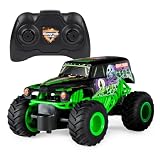
 Monster Jam Official Grave Digger RC TruckOne Size11.25 x 5.88 x 5.63 Inches1.07 PoundsCheck on Amazon
 Monster Jam Chomping Megalodon RC Toy Monster TruckOne Size13.25 x 10 x 11.38 inches2.74 PoundsCheck on Amazon


Top 3 picks at a glance
How to Choose the Right Scale for Your Terrain
Scale is not just about size, it determines weight, speed potential, parts cost, and where you can actually drive.
- 1/10 Scale: The most versatile class for backyard bashing. Trucks like the Traxxas Stampede 4×4 VXL and Arrma Granite 3S BLX are usually 16-20 inches long, light enough to be fast on 2S-3S LiPo, and small enough to run in a typical yard or skate park. General market range is usually $300-$450 for brushless RTR packages.
- 1/8 Scale: The sweet spot for speed and durability. Models like the Arrma Kraton 6S BLX and Traxxas Sledge are heavier (11-14 lbs), handle 4S-6S power, and hit 50-65+ mph while still being manageable to transport. This is the preferred scale for serious bashing and informal racing. General market range is usually $550-$750.
- 1/7 to 1/5 Scale: Maximum presence and rough-terrain capability. The Traxxas X-Maxx (1/7) and Arrma Outcast 8S or Kraton 8S (1/5) are over 30 inches long and 20+ lbs. They roll over almost anything but need large open fields and stronger batteries. General market range is usually $900-$1200+ before batteries and charger.
If your primary area is a small to medium backyard with grass, dirt, and a few jumps, 1/10 or 1/8 will be more fun and less destructive. If you have access to open construction lots, BMX tracks, or large fields, a 1/7 or 1/5 scale truck makes sense because its ground clearance and wheel diameter let it handle ruts that would trap a smaller truck.
Top Speed vs. Usable Speed: What Actually Matters Off-Road
Advertised top speeds are measured on pavement with high-voltage batteries and optional gearing. Off-road, traction, weight, and suspension setup reduce that number by 15-30%.
For example, a truck rated for 65 mph on 6S might only reach 45-52 mph on short grass or loose dirt due to tire ballooning and wheel spin. For backyard bashing, acceleration from 0-35 mph and stability on landing matter far more than a 70 mph top speed you can never use.
Speed and Power Comparison by Class
| Model (Class) | Scale | Stock Power System | Advertised Top Speed | Realistic Off-Road Speed | Weight (Ready to Run) |
|---|---|---|---|---|---|
| Arrma Granite 3S BLX | 1/10 | 3200Kv Brushless, 3S LiPo | 50 mph (with 3S) | 35-42 mph | 6.2 lbs |
| Traxxas Maxx | 1/10 Wide | 2400Kv Brushless, 4S LiPo | 60+ mph (with 4S) | 42-50 mph | 8.8 lbs |
| Traxxas Sledge | 1/8 | 2000Kv Brushless, 6S LiPo | 65 mph (with 6S) | 48-55 mph | 13.1 lbs |
| Arrma Kraton 6S BLX | 1/8 | 2050Kv Brushless, 6S LiPo | 60 mph (with 6S) | 46-53 mph | 12.5 lbs |
| Traxxas X-Maxx | 1/7 | 1275Kv Brushless, 8S LiPo | 50 mph (with 8S) | 38-45 mph | 19.1 lbs |
| Losi LMT 4WD Solid Axle | 1/8 | 2200Kv Brushless, 3S-4S LiPo | 35 mph (with 3S) | 28-33 mph | 9.5 lbs |
The Losi LMT is an outlier here. It is slower on paper because it uses a solid axle design for scale monster truck realism and jumping dynamics, not outright speed. It is ideal for freestyle bashing and backflips rather than flat-out racing.
Battery Runtime: A Worked Calculation You Can Use Before Buying
Runtime is determined by battery capacity (mAh), voltage (S count), and average current draw, which depends on terrain and throttle use. You can estimate it without guessing.
Formula: Runtime (minutes) = (Battery Capacity in Ah / Average Amp Draw) x 60
Example 1: 1/10 Scale on 3S for Backyard Bashing
Battery: 5000mAh (5.0Ah) 3S LiPo (11.1V)
Average draw while bashing on grass with frequent acceleration: ~45 Amps
Runtime = (5.0 / 45) x 60 = 6.66 minutes at full continuous draw. In practice, bashing is not continuous full throttle, so you get a 35-40% rest factor from braking and cornering. Effective runtime = 6.66 / 0.65 = ~10-15 minutes. Two 5000mAh packs will give you 20-30 minutes of hard bashing.
Example 2: 1/8 Scale on 6S for Speed Runs
Battery: 5000mAh 6S LiPo (22.2V) configured as two 3S 5000mAh in series
Average draw at high speed on pavement: ~70 Amps
Runtime = (5.0 / 70) x 60 = 4.28 minutes continuous. With on-off throttle, effective runtime = ~8-12 minutes. This is why most 6S and 8S drivers buy two sets of batteries.
Key takeaway: Do not judge a truck by voltage alone. A heavier 8S truck draws far more amps to move its weight, so a 5000mAh 8S setup does not automatically run longer than a 5000mAh 3S setup. For longer sessions, prioritize efficiency (lower Kv motor with taller gearing) and buy batteries with at least 5000mAh and 50C+ discharge rating.
Suspension and Durability: What Separates Bashers from Racers
Durability off-road comes down to four areas: arms, shocks, drivetrain, and chassis bracing.
- A-Arms and Hubs: Bash-oriented trucks use thick composite arms and oversized hub carriers. The Traxxas Maxx and X-Maxx use their WideMaxx-style arms to increase track width and reduce stress on the suspension during cartwheels. Thinner race-style arms are lighter but crack more easily on bad landings.
- Shocks: Look for oil-filled, aluminum-bodied shocks with at least 4mm shafts. Plastic-bodied shocks fade quickly when hot and bend on jumps over 4-5 feet. 1/8 scale bashers like the Kraton 6S use 16mm bore shocks with threaded preload collars for tuning ride height.
- Drivetrain: Steel CVD driveshafts, metal spur gears, and sealed differentials are mandatory for 4S+ power. Trucks that still use plastic driveshafts or slipper clutches without center diffs will strip gears under 6S torque.
- Chassis: A flat 3mm+ 6061 aluminum chassis plate (common on Arrma 6S/8S) resists bending better than a composite tub chassis, but a composite chassis flexes to absorb impacts. For pure backyard bashing with 10+ foot jumps, aluminum is generally more durable long-term.
Recommended Settings for Backyard vs. Race Use
Tuning your truck correctly extends parts life and improves control. These are starting points for most 1/8 to 1/10 monster trucks and truggies:
- Shock Oil: 40WT front / 35WT rear for bashing on grass and dirt jumps (softer landing). 50WT front / 45WT rear for high-traction racing or skate parks (prevents bottoming out). Reason: Thicker oil slows piston speed, reducing chassis slap on hard landings but making the truck harsher on small bumps.
- Ride Height (Droop): Set arms level with the ground or slightly above for bashing to maximize ground clearance. Set 5-8mm lower for racing to lower the center of gravity and reduce body roll.
- Slipper Clutch / Center Diff Fluid: Loosen slipper 1/4 turn from fully tightened for bashing on loose dirt to protect the drivetrain. For center diffs, use 500k-1M cSt fluid for bashing (more front drive, better wheelie control) and 100k-300k cSt for racing (more balanced power distribution).
- Punch Control / Throttle Expo: Reduce punch to 30-50% or set throttle expo to -15% for loose terrain. This smooths initial torque and prevents instant wheel spin that overheats the motor and strips tires from the wheels.
Decision Matrix: Which Best RC Monster Truck Fits Your Situation
Use this matrix to map your driving style and location to the right class instead of just picking the fastest model.
| If You Want… | And You Drive On… | And Your Budget Is… | Best Match | Why |
|---|---|---|---|---|
| Maximum speed on pavement and short grass, occasional jumps | Large flat yard, parking lot | Usually $500-$750 | Arrma Kraton 6S BLX or Traxxas Sledge | 1/8 scale speed, stable at 50+ mph, strong enough for 6S power without being unmanageable |
| Extreme bashing, big air, backflips, running over anything | Rough field, skate park, BMX track | Usually $900-$1200+ | Traxxas X-Maxx or Arrma Kraton 8S | Massive ground clearance, self-righting, driveline built for 8S abuse |
| Balanced fun, easier to carry, lower running costs | Typical backyard, street, light dirt | Usually $300-$450 | Arrma Granite 3S BLX or Traxxas Maxx (4S) | Lighter, cheaper batteries, still 40-60 mph, less breakage from weight |
| Scale realism, freestyle, solid-axle monster truck action | Dirt, ramps, freestyle course | Usually $500-$700 | Losi LMT | Solid axle suspension gives realistic articulation and flipping behavior, not designed for pure speed |
| Entry-level learning, durability for beginners/kids | Grass and pavement | Usually $200-$350 | Traxxas Stampede 4×4 VXL or Arrma Granite 4×2 Boost | Simpler 2WD/4WD layout, slower on 2S for learning, upgradeable to 3S later |
Maintenance Tips That Prevent Most Breakages
Most premature failures come from heat and loose hardware, not defects. After every 4-6 packs:
- Check and re-tighten wheel nuts and motor mount screws. Vibration loosens them, and a loose wheel nut will strip a hex instantly.
- Clean and re-oil bearings if you run in wet grass or sand. Water and grit increase rolling resistance and amp draw, which shortens both runtime and motor life.
- Inspect shock shafts for scratches and check for oil leaks. A bent shaft will score the seal and cause damping loss.
- Monitor motor and ESC temperatures. Keep motor temps under 160F (71C) and ESC under 140F (60C). If hotter, gear down one tooth on the pinion or improve airflow. Overheating is the primary cause of magnet failure in brushless motors.
FAQ
Is a 6S or 8S truck overkill for a small backyard?
Yes, for most yards under 50 feet long. A 6S or 8S truck will reach its top speed in under 3 seconds and needs significant braking distance. In a small space you will spend more time braking and repairing than driving. A 3S or 4S truck gives you better throttle control and longer effective runtime in confined areas.
Can I use 4S batteries in a 6S-capable monster truck?
In most cases, yes. Trucks like the Arrma Kraton 6S and Traxxas Sledge can run on 4S with reduced top speed but longer runtime and less heat. Check the ESC manual for minimum cell count. Running 4S is a good way to learn control before moving to full 6S power.
What is the difference between a monster truck and a truggy for bashing?
A monster truck has larger, softer tires, higher ground clearance, and a higher center of gravity for crushing obstacles and doing stunts. A truggy has lower, wider racing tires and a lower stance for cornering speed and stability. For backyard bashing and jumps, a monster truck is more forgiving. For mixed bashing and informal racing, a truggy is faster per lap.