Our Top Picks
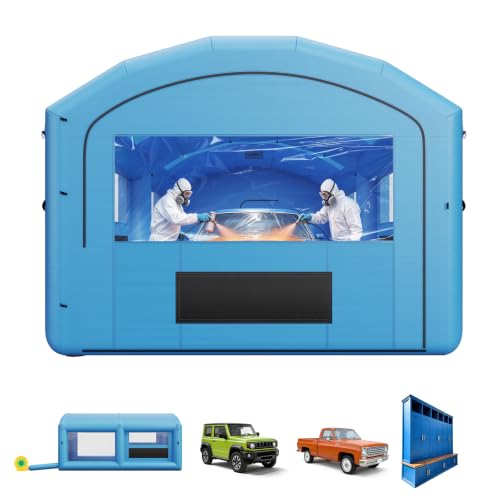
 OZIS 10.8x8.2x7.2Ft Inflatable Paint Booth with Blower and10.8x8.2x7.2Ft129.6 x 98.4 x 86.4 inches29.6 PoundsCheck on Amazon
 FLAPKWAN 39X18X15FT Inflatable Paint Booth for Trucks Portable39X18X15FT468 x 216 x 180 Inches146 PoundsCheck on Amazon
Top 3 picks at a glance
Best Professional Portable Paint Booths for Auto Body
The best professional-grade portable paint booths for auto body work are inflatable, filtered enclosures sized to keep the vehicle, lights, and operator inside while maintaining a controlled path for clean intake air and exhaust. For most single-car garage users, a booth around 26 × 15 × 10 feet is a practical starting point; choose a longer or wider model for full-size trucks, generous walk-around clearance, or a dedicated prep area.
Portable booths are not automatically equivalent to permitted, code-compliant automotive spray booths. Before spraying, confirm that the booth’s intended use, exhaust arrangement, filters, electrical equipment, and location meet local fire, building, and environmental rules. Solvent-based automotive coatings can create flammable vapors; an ordinary fan or household extension cord is not a safe substitute for equipment specified for that atmosphere.
As an Amazon Associate we earn from qualifying purchases at no extra cost to you.


Shortlist by garage and job
| Garage or job | Useful interior target | What to prioritize | Likely fit |
|---|---|---|---|
| Parts, motorcycle panels, or spot repairs | About 10–15 ft long × 8–10 ft wide × 7–8 ft high | Replaceable intake and exhaust filters, stable inflation, a separated compressor location | Compact inflatable enclosure |
| Small car or coupe | About 20–24 ft × 12–14 ft × 9–10 ft | Room for doors to open, filtered make-up air, accessible service zippers | Mid-size single-vehicle booth |
| Full-size car, SUV, or pickup | About 26–30 ft × 14–16 ft × 10–12 ft | Actual interior dimensions, exhaust capacity, roof clearance, vehicle-length allowance | Large inflatable booth or purpose-built garage booth |
| Repeated commercial refinishing | Determined by vehicle, process, and applicable code | Documented airflow and filtration, approved equipment, service support, compliance | Professionally engineered or permitted booth—not a portable tent by default |
These dimensions are planning targets, not universal product specifications. Compare the listed usable interior—not just the outside footprint—and allow room to walk around the vehicle without brushing the enclosure.
What matters more than the product name
1. Fit the booth to the vehicle and the garage
Measure the garage’s clear width, depth, and ceiling height, including open doors, shelving, lights, and the route for exhaust ducting. Then measure the vehicle with doors open. A booth that fits the car with its doors closed may leave too little working space for masking, spraying, and inspection.
As a planning rule, leave roughly 3 feet of working space at the sides and ends where the job requires access. Add room for the filter wall or plenum, duct bends, and the blower outside the clean work area. If the garage cannot provide that clearance, a smaller booth may be suitable for panels—but not for spraying a complete vehicle.
2. Treat airflow as a measured requirement
“High airflow” on a listing is not enough. Ask for the fan’s airflow under operating conditions, the filter arrangement, and the airflow direction. Filters and ducts restrict flow, so a fan’s free-air rating can overstate what reaches the booth. Crossdraft designs move air from filtered intake panels toward an exhaust wall; other designs use a different intake and exhaust layout. Choose a layout that carries overspray away from the painter and vehicle, rather than recirculating contaminated air.
A useful screening calculation is airflow = booth floor area × target air velocity. For a 26 × 15 ft booth, the floor area is 390 square feet. At a planning velocity of 50 feet per minute, the arithmetic gives 19,500 cubic feet per minute (CFM). That is a sizing illustration, not a universal code requirement or a guarantee of safe performance: actual requirements depend on booth design, coating, filter pressure drop, and local regulations. Have the manufacturer or a qualified booth contractor confirm the required operating airflow and verify it with appropriate measurements after setup.
3. Check filtration at both ends
Intake filters help keep dust and insects off the finish; exhaust filters capture overspray before air leaves the enclosure. Confirm that both are included or available, that replacement filters are specified for the booth, and that the filter area matches the fan. A small filter face can become restrictive quickly, cutting airflow and making the booth harder to keep clean.
Filters do not make hazardous vapor safe to breathe. Use the respiratory protection required by the coating’s safety data sheet, and do not direct exhaust toward people, neighboring property, air intakes, or ignition sources. Follow the coating and booth manufacturers’ instructions for filter changes and disposal.
Setup time: what the headline number leaves out
Inflatable booths can be much quicker to erect than rigid construction, but “setup” may mean only unrolling and inflating the enclosure. A realistic first-use plan also includes clearing the garage, laying a clean floor covering, installing filters and ducting, routing power safely, checking the doors and seams, and confirming airflow. For a familiar crew, inflation may take minutes; a careful first installation can take an hour or more once site preparation and checks are counted.
- Before unpacking: Clear a footprint larger than the booth, remove dust sources, and confirm the exhaust route and electrical requirements.
- During assembly: Position intake and exhaust components as designed. Keep the blower and electrical connections in the locations specified by the manufacturer.
- Before spraying: Check that filters are seated, doors close, the enclosure remains stable, and air moves in the intended direction. Do not proceed if airflow is weak, reversed, or visibly leaking around filters.
- After the job: Follow the maker’s procedure for ventilation, cleanup, filter handling, deflation, and storage. Do not fold contaminated filters into a clean storage bag.
Choose by use case, not by the biggest CFM number
For occasional panel work in a small garage
Choose a compact enclosure only if the part, spray gun, and painter fit without crowding. Prioritize easy filter replacement and a cleanable interior. A small booth is not a practical shortcut for painting a whole vehicle if the operator has to work against the walls.
For a full vehicle and a finished-garage setup
Favor a larger booth with enough interior clearance for open doors and a clear path from intake to exhaust. Before buying, compare its assembled dimensions with the garage’s narrowest point and verify that the exhaust can be routed outdoors as required. An extra few feet of width can be more useful than a higher advertised fan rating if the current booth would force the painter too close to the vehicle.
For frequent paid work
Put compliance, documented design data, serviceability, and repeatable airflow ahead of rapid inflation. A portable enclosure may suit certain prep or controlled applications, but frequent automotive refinishing can require a permanent or professionally engineered installation. Ask the local authority having jurisdiction and your insurer before treating any portable model as a commercial spray booth.
Buying checks that prevent expensive mismatches
- Get interior dimensions, not just the shipping or exterior footprint.
- Request operating airflow with the specified filters and ducting installed.
- Confirm included intake filters, exhaust filters, blower, ducts, floor, lights, and repair kit; packages vary.
- Check power requirements against the garage circuit and the manufacturer’s installation instructions.
- Ask how filters are sourced, how often they need replacement, and whether the enclosure fabric is rated for the intended application.
- Confirm permitted coating types and local ventilation, fire, and emissions requirements before purchase.
For a home garage, the best choice is usually the smallest booth that still gives the vehicle and painter adequate clearance, paired with verified filtered airflow and a safe exhaust plan. For production work, do not substitute portability or a high CFM claim for documented performance and local approval.
Frequently asked questions
Can I use a portable paint booth in an attached home garage?
Possibly, but only if the setup and location meet local fire, building, and environmental rules. Check the garage’s clearance, exhaust route, and electrical requirements, and make sure the equipment is specified for the coating and atmosphere. An ordinary fan or household extension cord is not a safe substitute for equipment specified for flammable vapors.
Will a portable booth remove paint fumes?
No—the article says filters do not make hazardous vapor safe to breathe. Intake filters help keep dust and insects off the finish, while exhaust filters capture overspray. Use respiratory protection required by the coating’s safety data sheet, and route exhaust away from people, neighboring property, air intakes, and ignition sources.
Can I paint a full vehicle in a compact booth?
Only if the vehicle, open doors, and painter fit with enough room to work. The article says compact enclosures may suit parts or panel work, but a booth that crowds the operator or leaves too little access is not a practical shortcut for a complete vehicle. Compare usable interior dimensions with the vehicle and garage.
How can I tell whether a booth’s advertised airflow is adequate?
Ask for airflow under operating conditions with the specified filters and ducting installed, since restrictions can reduce a fan’s free-air rating. The article gives a floor-area-times-target-velocity calculation as a screening illustration, but says actual requirements depend on the booth, coating, filters, and local rules. Have the required airflow confirmed and measured after setup.
What should I do if airflow seems weak after setup?
Do not proceed with spraying if airflow is weak, reversed, or visibly leaking around filters. Check that filters are seated and the intake and exhaust components are positioned as designed, then follow the manufacturer’s instructions. The article recommends confirming airflow with appropriate measurements after setup rather than relying only on a listing’s airflow claim.