Our Top Picks
 INIU 10000mAh 45W Fast Charging Portable ChargerSmall Size5.26 x 2.7 x 0.5 inches0.5 PoundsCheck on Amazon

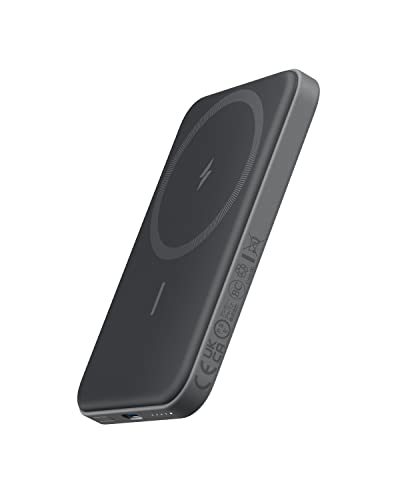

Top 3 picks at a glance

Best power banks for iPhone: the quick picks
The best power bank for iPhone depends on whether you value pocketable MagSafe convenience or the faster, more efficient charging of a USB-C cable: choose the Anker MagGo Power Bank (10K, Slim) for a magnetic all-day carry, the Apple MagSafe Battery Pack only if you have a compatible older iPhone and want a compact fit, or a USB-C power bank with at least 20W output for the quickest practical top-ups across modern iPhones.
For travel, capacity printed on the pack is not the amount that reaches your phone. Conversion losses, charging conditions, and using the phone while charging all reduce usable energy. A well-chosen 10,000mAh pack is usually the balanced option; 5,000mAh is lighter but better for a single rescue charge, while 20,000mAh suits long days away from an outlet.
As an Amazon Associate we earn from qualifying purchases at no extra cost to you.


Shortlist by use case
- Best magnetic all-rounder: Anker MagGo Power Bank (10K, Slim), a 10,000mAh Qi2 magnetic pack with a built-in stand. It suits commuting and travel when you want to use your phone while it charges.
- Best for fast wired top-ups: A USB-C PD power bank rated for 20W or more. Pair it with a USB-C cable for iPhone 15 and later, or a USB-C-to-Lightning cable for iPhone 14 and earlier.
- Best for light carry: A slim 5,000mAh magnetic pack. It adds less bulk, but should be treated as extra runtime rather than a guaranteed full recharge.
- Best for a long day or multiple devices: A 20,000mAh USB-C PD pack. It is heavier, but gives you more charging margin and can support an iPad or another phone as well.
MagSafe, Qi2, or wired: what changes?
MagSafe and Qi2 charge through a magnetic wireless connection, so you can keep the phone attached while navigating or reading. The alignment helps avoid the inefficient positioning that can make ordinary wireless charging frustrating. However, wireless charging creates more heat and wastes more energy than a cable, so a magnetic pack’s rated capacity does not translate into the same number of phone charges as a wired pack.
Qi2-certified power banks can deliver up to 15W wireless charging to compatible iPhones, including iPhone 13 and newer models that support Qi2. Apple MagSafe charging can reach up to 25W on supported newer iPhones when paired with the appropriate adapter; a battery pack’s own output may be lower. Check the specific pack’s supported output rather than assuming every magnetic charger offers the maximum phone charging speed.
A USB-C cable is generally the better choice when speed and energy efficiency matter. Many recent iPhones can reach roughly 50% charge in about 30 minutes with a suitable USB-C power adapter and cable, though a power bank, phone temperature, and current battery level affect results. A pack’s “20W” rating is its output capability, not a promise that the iPhone will draw 20W continuously.
| Power-bank class | Typical rated capacity | Practical use | Best fit |
|---|---|---|---|
| Compact magnetic | 5,000mAh | Roughly half to one phone recharge, depending on model and use | Light carry or an emergency top-up |
| Mid-size magnetic or wired | 10,000mAh | Often around one to two iPhone recharges in wired use; fewer over wireless | Daily carry and travel days |
| Large USB-C PD | 20,000mAh | Several phone top-ups, with capacity left for another device | Long trips, heavy use, or shared charging |
These are planning ranges, not guaranteed counts. iPhone battery sizes differ, and navigation, gaming, poor signal, and screen brightness consume power during charging.
Estimate how much capacity you actually need
A useful way to compare packs is to convert their rated capacity into rough usable energy. Most power banks list capacity at the cells’ nominal voltage, while a phone charges at a different voltage. Energy conversion and heat consume part of the total.
For a 10,000mAh power bank, a rough estimate is:
10,000mAh × 3.7V ÷ 5V × 0.8 efficiency ≈ 5,920mAh delivered at 5V.
The 0.8 factor is a planning assumption, not a fixed rating. If your iPhone has a roughly 3,500mAh battery, that works out to about 1.7 battery-equivalents under favorable wired conditions. In real use, expect less if you charge wirelessly, use the phone heavily, or top up while the phone is hot. This is why a 10,000mAh pack is a sensible daily choice, but not necessarily a promise of two complete recharges.
Choose by size, speed, and travel needs
| Your situation | Recommended choice | Trade-off to expect |
|---|---|---|
| Light sightseeing or a few hours away | 5,000mAh magnetic pack | Easy to carry, but limited reserve and slower than wired charging |
| Commute, workday, or regular daily carry | 10,000mAh pack; Qi2 for convenience or USB-C PD for speed | More useful capacity means more weight and thickness |
| Long travel day with maps, photos, and video | 10,000mAh or larger, with 20W+ USB-C output | A cable charges more efficiently, but is less convenient in hand |
| Weekend away or charging several devices | 20,000mAh USB-C PD pack | Best reserve, but noticeably bulkier; check airline rules before flying |
Check the details before buying
- Confirm your iPhone connector: iPhone 15 and newer use USB-C; iPhone 14 and earlier use Lightning. A USB-C power bank works with either when you have the correct cable.
- Check magnetic compatibility: iPhone 12 and newer have MagSafe, but a compatible magnetic case may be needed. A thick or non-magnetic case can weaken the connection.
- Look for USB-C PD output: For fast wired charging, choose a pack that explicitly supports USB Power Delivery and provides at least 20W from its USB-C port.
- Consider pass-through charging carefully: Some packs can charge themselves while charging a phone, but this can add heat. It is useful on a desk, not an ideal everyday substitute for charging devices separately.
- Check airline limits: Power banks are generally carried in cabin baggage, not checked luggage. Many common 10,000mAh and 20,000mAh models fall below the usual 100Wh threshold, but verify the watt-hour label and your airline’s current rules.
Frequently asked questions
Can I charge an iPhone 14 or earlier with a USB-C power bank?
Yes, use a USB-C-to-Lightning cable with the power bank. iPhone 15 and later use USB-C, while iPhone 14 and earlier use Lightning. A USB-C power bank can work with either group when paired with the correct cable. For faster wired charging, choose a pack that supports USB Power Delivery and provides at least 20W from its USB-C port.
Will a 10,000mAh power bank fully recharge every iPhone twice?
No, two complete recharges are not guaranteed. A rough calculation estimates that a 10,000mAh pack may deliver about 5,920mAh at 5V under an assumed 0.8 efficiency. Actual results are lower when charging wirelessly, using the phone heavily, or charging while it is hot. Battery sizes also differ between iPhone models.
Can I use my iPhone while it is attached to a magnetic power bank?
Yes, magnetic charging lets you keep the phone attached while navigating or reading. A built-in stand can make that use more convenient. However, wireless charging creates more heat and wastes more energy than a cable, and using navigation, gaming, poor signal, or a bright screen can reduce the energy available for charging.
Do I need to remove my iPhone case for magnetic charging?
Not always, but a compatible magnetic case may be needed. iPhone 12 and newer models have MagSafe, while a thick or non-magnetic case can weaken the magnetic connection. If the pack does not align securely, the case may be interfering. Check the specific magnetic compatibility of the phone, case, and power bank before buying.
Can I bring a 20,000mAh power bank on an airplane?
Usually, power banks must be carried in cabin baggage rather than checked luggage. Many common 10,000mAh and 20,000mAh models fall below the usual 100Wh threshold, but you should verify the watt-hour label and your airline’s current rules before flying. A larger pack offers more reserve, but it is also noticeably bulkier.
Bottom line
For most people, a 10,000mAh power bank is the best balance between capacity and portability. Choose a Qi2 magnetic model such as the Anker MagGo Power Bank (10K, Slim) if you want cable-free convenience; choose a 20W-or-higher USB-C PD pack if faster charging and better energy use matter more. Go down to 5,000mAh for a lighter emergency backup, or up to 20,000mAh when you need reliable power for a full travel day or more than one device.