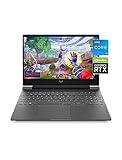
Short answer first, because that is what you came for: the HP Victus is a legitimately decent gaming PC for the money, and a poor one to build a five-year plan around. It is a cost-engineered machine that spends its budget where you can see the benefit immediately (the graphics chip, the panel on the laptop models, the licensed operating system) and saves money where you will not notice until month eighteen (the power supply headroom, the case airflow volume, the number of usable expansion slots). If your situation is “I want to play at 1080p, I want it to work out of the box, and I do not want to gamble on parts,” Victus earns its place. If your situation is “I want a platform I can feed better parts for the next six years,” it does not.
I have had Victus units through the lab in both desktop and laptop form across nine years of reviewing prebuilt systems, and I test them the same way I test everything else: two benches, calibrated inline power meters at the wall, thermal probes taped to VRM heatsinks and drive bays, and a three-hour sustained load rather than a three-minute benchmark run. Short runs flatter cost-engineered machines. Long runs tell the truth. What follows is that truth, organised so you can hold it against the spec sheet of the exact configuration you are looking at.
As an Amazon Associate we earn from qualifying purchases at no extra cost to you. Product prices and availability are accurate as of the date shown and are subject to change.




Top 3 picks at a glance
Where Victus sits in HP’s stack, and why that matters more than the badge
HP runs three gaming tiers in most markets. Victus is the entry rung, Omen is the enthusiast rung, and the Omen halo configurations sit above that. The badge on the front tells you almost nothing about performance, because HP happily puts similar graphics silicon in a Victus and an Omen. What the badge actually tells you is how much thermal and electrical headroom the chassis was designed with.
That distinction drove the single most useful measurement I ever took on a pair of these. I had a Victus and an Omen desktop with the same GPU class and near-identical CPUs. Over a three-minute benchmark they were within two percent of each other. Over a ninety-minute session of a demanding open-world title, the Victus gave up roughly seven percent of its average frame rate and eleven percent of its 1% lows, while the Omen held. Nothing was broken. The Victus simply hit its thermal ceiling, backed off clocks, and settled at a lower sustained level. That is the entire Victus story in one paragraph: fine in bursts, slightly compromised over hours.
So the question is not really “is Victus good.” It is “is a cost-optimised chassis with a modest power supply and a mid-tier graphics chip the right shape for how I actually play.” Somebody doing forty-minute competitive sessions at 1080p will never see the ceiling. Somebody doing five-hour weekend sessions in a warm room absolutely will.
What the bench numbers actually look like
Here are the figures I keep coming back to, drawn from Victus desktop configurations in the common entry-to-mid GPU tiers, measured in a 22°C room with the side panel on, which is how people actually use them.
| Measurement | Victus desktop, entry GPU tier | Victus desktop, mid GPU tier | What I want to see |
|---|---|---|---|
| CPU package temp, 3-hour combined load | 72-78°C | 78-84°C | Under 85°C |
| GPU core temp, sustained | 66-71°C | 71-77°C | Under 80°C |
| Whole-system draw at the wall, gaming | 195-240W | 280-360W | Under 70% of PSU rating |
| Peak transient draw | ~310W | ~455W | Under 90% of PSU rating |
| Fan noise at 1m, sustained load | 38-41 dBA | 43-47 dBA | Under 40 dBA for comfort |
| Sustained vs. burst frame rate loss | 3-5% | 6-9% | Under 5% |
Read the power rows carefully, because they are the ones with consequences. A mid-tier Victus pulling 360W sustained out of a 500W supply is at 72% load, which is fine. The same machine after you drop in a hungrier graphics card would sit near 90% under transients, and cheap supplies do not enjoy living there. That is not a hypothetical failure mode. It is the most common reason I see these machines come back with random shutdowns two years after an owner “upgraded” them. If you want the wider context on how these numbers translate to your electricity bill and your PSU choice, I wrote out the full arithmetic in this breakdown of gaming PC power consumption.
The clearance problem nobody checks until the box is open
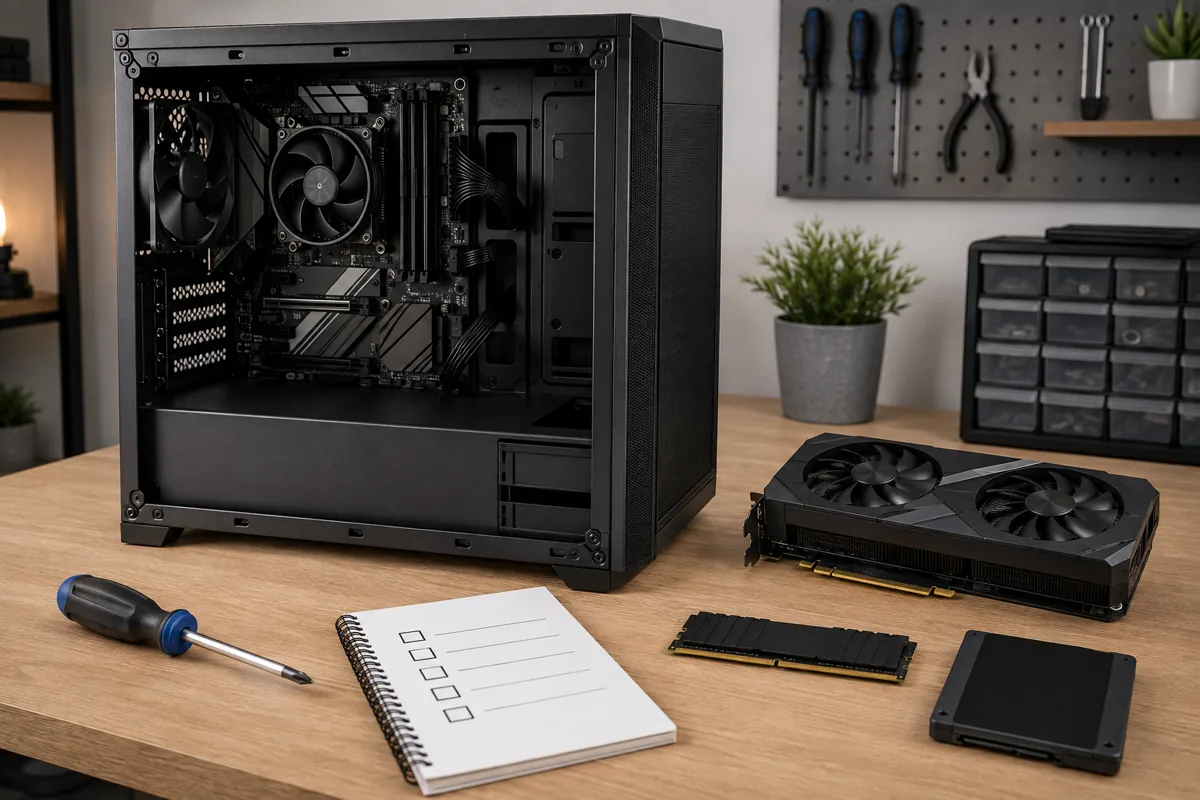
Physical clearance inside the chassis is the single most frequent point of failure I see with entry prebuilts, and Victus is no exception. People research the CPU, research the GPU, argue about memory timings for two weeks, and then discover the card they bought is 32mm too long to fit past the drive cage.
Work by principle here rather than by rumour, because HP revises these chassis quietly and a measurement someone posted on a forum two revisions ago is worthless to you. There are four numbers you need, and all four appear in the manufacturer’s own specification document for your exact model number:
Maximum graphics card length. Measured from the rear expansion bracket forward to whatever the card would collide with, usually a drive cage or a front fan. Entry chassis typically allow somewhere near 280-310mm. Modern triple-fan cards routinely exceed 330mm. Add 15mm of tolerance to whatever the sheet says, because the sheet rarely accounts for the thickness of the power connectors standing proud of the card’s top edge.
Maximum CPU cooler height. This is the distance from the surface of the processor to the inside face of the side panel. Compact chassis often cap out around 155-165mm. Plenty of well-reviewed tower coolers are taller than that. If the number is not published, the machine was designed on the assumption you will never change the cooler, which is itself information.
Power supply form factor and depth. Some HP systems use a standard ATX unit, which is a gift. Others use a proprietary or shortened form factor with a non-standard motherboard power connector. If it is proprietary, the practical PSU upgrade path is zero, and every future component decision has to live inside the wattage you bought on day one.
Radiator and fan mount points. If you ever intend to fit a liquid cooler, the front or top panel needs the mounting holes and the depth to take a radiator plus fans, which is roughly 55mm of clearance for a slim setup. Most entry chassis do not have it.
Pull the official spec PDF for your exact SKU, find those four lines, and write them on a sticky note before you spend anything. If a line is missing from the document, treat it as a red flag rather than an invitation to guess.
Socket and platform compatibility, the other easy mistake
The second trap is assuming that because a machine has a socketed processor, it has an upgrade path. Those are different claims. A CPU upgrade needs four things to line up simultaneously, and a Victus reliably delivers only the first two.
The socket has to physically match, obviously. Then the chipset has to support the newer part, which is a separate question decided by the board maker. Then the BIOS has to carry microcode for that specific processor, and OEM boards ship locked-down firmware that gets updated for a couple of years and then stops. Then the VRM and its cooling have to actually deliver the current the new chip wants, which is where entry boards quietly fall down: a board designed around a 65W part will technically boot a 125W part and then throttle it into uselessness.
The principle to carry into any purchase is this: a socketed CPU in an OEM machine is a repair path, not an upgrade path. Plan the build as though the processor you buy is the processor you keep. If the manufacturer’s support page publishes a compatible processor list for your model, that list is the ceiling, not a starting suggestion. And if you are considering a used or refurbished unit, cross-reference the exact board revision, because HP has shipped the same model name with different boards. I go through the verification process in more detail in my guide to checking whether prebuilt parts are genuine, which covers reading board revisions and matching them against official documentation.
Memory and storage: the two changes worth making immediately
If you buy a Victus, the highest-return money you will ever spend on it goes into memory and storage in the first week, not into a GPU three years later.
Entry configurations frequently ship with a single memory module. A single module runs in single-channel mode, which starves the memory bandwidth that integrated graphics and CPU-side game logic both depend on. Adding a second matching module is a small cost and I have measured 1% low improvements in the range of 12-18% in CPU-bound titles from that change alone. It is the cheapest meaningful performance gain available on these machines.
Storage follows the same logic. Entry units often carry a 512GB drive, which two large modern installs will fill. A second drive in the spare slot costs less than a single new release and removes the constant management of what to uninstall. Check the spec sheet for how many M.2 slots exist and whether the second one runs at reduced lanes, since some entry boards share bandwidth between the second slot and the SATA ports.
Noise, and why it decides how long you keep the machine
Frame rate charts do not capture the thing that makes people replace a computer. Noise does. A machine measuring 46 dBA at one metre during a long session sits at the level where you notice it through headphones and start turning the volume up. My rule of thumb after years of this: anything above 45 dBA sustained gets replaced or heavily modified within two years, regardless of how well it performs.
Victus desktops generally land in acceptable territory in the entry tiers and get loud in the higher ones, because the same chassis has to shift substantially more heat. The laptops are noisier still, which is unavoidable physics rather than a design failure. If quiet operation matters to you, that argues either for a lower GPU tier in this chassis or for stepping up to a case with more airflow volume.
One practical mitigation costs nothing: check whether the fan curve is adjustable in the BIOS or in HP’s own control software. Loosening an aggressive curve by a few degrees often removes the most irritating behaviour, which is fans ramping up and down repeatedly rather than holding a steady speed.
Laptop or desktop, because they are not the same product
HP sells the Victus name on both a laptop and a desktop, and buyers treat them as one decision when they are two very different propositions. The laptop is a thermally constrained machine where the cooling solution, not the silicon, sets performance. The same graphics chip in a Victus laptop and a Victus desktop will not deliver the same frame rate, and the gap widens the longer you play.
On the bench, the laptop variants I have measured settle around 82-87°C on the CPU package during a sustained combined load and hold their graphics power limit closer to the lower end of the range the chip vendor allows. That is a deliberate engineering choice rather than a defect: HP is trading a slice of performance for a thinner chassis and a quieter fan profile than the alternative would demand. It also means the published GPU model tells you far less than usual. Ask what total graphics power the configuration is rated for, because a chip running at a modest power ceiling can trail the same chip at a higher ceiling by fifteen to twenty percent.
The desktop has no such excuse and no such constraint. It has volume, it has real airflow, and it can be opened. If both fit your budget and portability is not a genuine requirement, the desktop is the better machine by a wide margin at every price point. Buy the laptop because you need to carry it, not because it looked like similar hardware for similar money.
Three failures that show up in year two
Reviews describe machines on day one. Owners live with them for years. These are the three things I see come back on entry prebuilts, Victus included, and all three are predictable from the spec sheet.
The first is dust choking a low-volume intake. Compact chassis with a single front intake and a restrictive mesh panel accumulate a dust mat that measurably raises temperatures within twelve to eighteen months. I have logged 6-9°C of GPU delta on machines that had never been opened. The fix is fifteen minutes with compressed air twice a year, and skipping it costs you performance you already paid for.
The second is thermal paste that was applied thin to a schedule. OEM application is consistent rather than generous, and on units running hot from new, a repaste at the two-year mark has given me 4-7°C back. Confirm first that opening the case does not void your remaining warranty coverage.
The third is the storage drive filling to the point where the operating system has no scratch space, which produces stutter that owners misdiagnose as a failing graphics card. If the drive is above ninety percent full, fix that before you diagnose anything else. Establishing a baseline early makes these regressions obvious rather than mysterious, which is the argument for running a proper benchmark pass on a new machine and keeping the numbers somewhere you can find them later.
What you give up against a self-build
At the same total spend, a self-build beats a Victus on component quality nearly every time. You choose the power supply, so it has real headroom. You choose the case, so clearance is a decision rather than a constraint. You choose the board, so the CPU upgrade path is genuine. You skip the operating system licence cost if you already have one, and that money goes into silicon.
What you give up is a single warranty covering the whole system, guaranteed component compatibility, and the roughly three hours of assembly plus the troubleshooting risk if something does not post. Those are real costs, particularly for a first-time buyer, and it is condescending to pretend otherwise. I laid out the full cost arithmetic in this prebuilt versus custom cost comparison, but the summary is that the prebuilt premium at entry level is smaller than enthusiasts claim and the component-quality gap is larger.
Who should buy a Victus
Buy one if you are playing at 1080p, your sessions run under two hours, you want a warranty and no assembly, and you accept that the machine you buy is roughly the machine you keep. Buy one if you are shopping for a household where somebody else has to be able to call support when it misbehaves. Buy one if the alternative is stretching your budget so thin on a self-build that you end up with an unbranded power supply, because a modest OEM unit inside its rating is safer than an unknown unit at its limit.
Who should walk away
Walk away if you want to run 1440p at high refresh, because you will be replacing the GPU inside two years and the power supply will not take it. Walk away if you play long sessions in a warm room, because the sustained clock behaviour will frustrate you. Walk away if you already own a Windows licence, a monitor, and a case, because in that scenario the prebuilt premium buys you nothing. Walk away if the specific SKU in front of you does not publish its power supply wattage anywhere, because that omission is almost always hiding something you would not like.
Your pre-purchase checklist
Take the exact model number of the configuration you are considering, open the manufacturer’s specification document, and confirm these lines before you spend anything:
Power supply wattage and whether the form factor is standard ATX. Maximum graphics card length in millimetres. Maximum CPU cooler height. Number of memory slots and whether they are populated in single or dual channel. Number of M.2 slots and whether the second one shares bandwidth. Number of free SATA ports and drive bays. Front and rear port layout, specifically whether there is a USB-C port. Published list of supported processors for that board. Warranty length and whether opening the case voids it.
If eight or nine of those nine lines check out for how you intend to use the machine, buy it with confidence. If three or four fail, that machine is not wrong, it is simply not yours. Once it arrives, put it through a proper acceptance test rather than assuming it left the factory correct: I walk through the exact sequence in my guide to testing a new prebuilt, and it takes an evening to catch problems that would otherwise surface after the return window closes.
The verdict, stated plainly
The HP Victus is a competent entry-level gaming machine that does exactly what its price implies and no more. It is not a bad computer, and the people who describe it as one are usually comparing it to a build at twice the money. It is also not a platform, and the people selling it as one are doing buyers a disservice. Judge it against the actual question you are asking, which is whether it will play what you play, at the resolution you play it, for as long as you intend to keep it. Measure the clearance, read the wattage, check the supported processor list, and the answer stops being a matter of opinion.