Skytech Gaming is worth buying at some price points and not others, and the dividing line is almost always the power supply and the cooler rather than the processor or graphics card. The standout in this group is the King 95 with a Ryzen 7 9800X3D and an RTX 5070 Ti at $2,599.99, because it is the one configuration where the CPU, the GPU, the 850W-class supply and the 360mm cooling are all sized for each other. Below that, the picture gets uneven fast. Two systems in this lineup carry an RTX 5060 and cost within $50 of each other, yet one ships 16GB of DDR5 and the other ships 32GB of DDR4 on an older platform. That kind of inconsistency is normal for a builder that assembles from whatever inventory is cheapest that month, and it is why a brand-level verdict is useless. This review works through all eight configurations individually, states what each one gives up, and flags the specific parts that limit what you can do with the machine two years from now.
Top 3 picks at a glance
Configurations at a glance
As an Amazon Associate we earn from qualifying purchases at no extra cost to you. Product prices and availability are accurate as of the date shown and are subject to change.




| Configuration | Key specs | Price | Best for |
|---|---|---|---|
| Skytech Azure 3 (Ryzen 7, RTX 5060) | RTX 5060, 16GB RAM, 1TB SSD | $1,199.99 | Entry 1080p high-refresh play |
| Skytech Crystal (Ryzen 7 5700, RTX 5060) | RTX 5060, 32GB DDR4-3200, 650W Gold | $1,199.99 | Multitaskers on a tight budget |
| Skytech Archangel 5 (i5-14400F, RTX 5060) | RTX 5060, 16GB DDR5-6000, 750W Gold | $1,249.99 | Buyers who want PSU headroom cheap |
| Skytech Crystal (Ryzen 7 7700, RTX 5060 Ti) | RTX 5060 Ti 8GB, 32GB DDR5-5600, 650W Gold | $1,649.99 | 1440p at medium-high settings |
| Skytech Azure 3 (Ryzen 7, RTX 5070) | RTX 5070, 24GB RAM, 1TB SSD | $1,899.99 | Serious 1440p without flagship pricing |
| Skytech King 95 (9800X3D, RTX 5070 Ti) | Ryzen 7 9800X3D, RTX 5070 Ti | $2,599.99 | Best overall balance in the lineup |
| Skytech King 95 (9800X3D, RTX 5070 Ti, 2TB) | 2TB Gen4 NVMe, 32GB DDR5-6000, 850W Gold, 360mm AIO | $2,899.99 | Fully specced flagship, no guesswork |
| Skytech Azure 3 (9850X3D, RX 9070 XT) | Ryzen 7 9850X3D, Radeon RX 9070 XT | $2,899.99 | Radeon buyers and heavy 1440p rasterization |
The eight configurations in detail
Skytech Gaming PC Azure 3, Ryzen 7, RTX 5060, 16GB RAM, 1TB SSD
At $1,199.99 this is the cheapest entry point in the group, and the listing tells you less than any other configuration here. You get an unspecified Ryzen 7, an RTX 5060 with 8GB of VRAM, 16GB of system memory and a single 1TB NVMe drive. The missing detail matters: a Ryzen 7 5700X and a Ryzen 7 7700 are two platform generations apart, and only one of them gives you an AM5 socket with a future CPU upgrade path.
Based on the parts list rather than any measurement we took, an RTX 5060 paired with a modern Ryzen 7 should be a comfortable 1080p card at high settings in most current titles, and a capable 1440p card only if you accept medium presets or lean on upscaling. The 8GB frame buffer is the ceiling here, not the core count. Expect the whole system to sit somewhere in the 350W to 420W range under a combined CPU and GPU load, which is an estimate derived from the class of parts involved.
Pros
- Lowest price of entry into the Azure chassis, which has better airflow than the entry-level cases
- 1TB of NVMe storage rather than the 500GB that often appears at this price
- RTX 5060 is the right GPU class for a $1,200 budget
Cons
- CPU model is not stated, so you cannot tell whether you are getting AM4 or AM5
- 16GB of RAM at $1,199.99 when the Crystal at the same price ships 32GB
- No power supply wattage or 80 Plus rating listed, which is the single most important omission
Who it is for: a buyer who wants the Azure case and RTX 5060 performance for the least money and is willing to message the seller for the exact CPU and PSU model before ordering.
Skytech Gaming Crystal, AMD Ryzen 7 5700 3.7GHz, RTX 5060, 32GB DDR4-3200, 650W Gold
This is the same $1,199.99 as the Azure 3 above but a completely different proposition. The Ryzen 7 5700 is an eight-core AM4 chip at a 3.7GHz base, paired with 32GB of DDR4-3200 and a 650W 80 Plus Gold supply. The specification is fully disclosed, which is worth something on its own. The catch is the platform: AM4 is at the end of its life, and the non-X 5700 in particular runs a PCIe 3.0 x16 link rather than PCIe 4.0, so a modern card is fed by half the bandwidth it expects.
In practice, from the configuration rather than a bench run, that link speed costs a small single-digit percentage in most games and rather more in the handful of titles that stream assets aggressively. The 32GB of memory is the real win. It removes the most common frustration in a $1,200 machine, and it means you can run a game, a Discord call and a browser without the system paging to disk.
Pros
- 32GB of RAM at the lowest price in this lineup
- Fully disclosed 650W 80 Plus Gold power supply
- Eight cores handle streaming and background encoding better than a six-core i5
Cons
- AM4 is a dead-end socket with no meaningful CPU upgrade left
- PCIe 3.0 x16 link on the non-X 5700 slightly throttles a modern GPU
- DDR4-3200 is slower than the DDR5-6000 in the Archangel 5 at $50 more
Who it is for: a buyer who values memory capacity and a named PSU wattage today over any upgrade path in three years.
Skytech Gaming Archangel 5, Intel i5-14400F, RTX 5060, 1TB NVMe, 16GB DDR5-6000, 750W Gold
The Archangel 5 at $1,249.99 is the best-documented budget configuration in the group. A Core i5-14400F gives you six performance cores and four efficiency cores with no integrated graphics, 16GB of DDR5-6000 sits on a modern memory standard, and the 750W 80 Plus Gold supply is the most generous wattage anywhere under $1,500 here. That PSU is the reason to look twice at this system: it leaves room for a considerably larger graphics card later without touching the power supply, which is the upgrade most owners actually want. Our guide on upgrading a prebuilt gaming PC walks through why supply headroom decides how far a machine can go.
Estimated from the parts rather than measured, the i5-14400F will not bottleneck an RTX 5060 at 1080p or 1440p in any meaningful way, and total system draw under a gaming load should land near 330W to 390W, leaving the 750W unit loafing at well under half capacity where its efficiency curve is best.
Pros
- 750W Gold supply with real headroom for a future GPU
- DDR5-6000 memory rather than DDR4
- Every major component is named on the listing
Cons
- Only 16GB of RAM, and DDR5 kits are best replaced in matched pairs
- LGA1700 is an end-of-line socket, so CPU upgrades are limited to used parts
- Stock Intel cooling gets audible on the 14400F during long sessions
Who it is for: the buyer who intends to keep the chassis and supply for five years and swap the graphics card once.
Skytech Gaming Crystal, AMD Ryzen 7 7700, RTX 5060 Ti 8GB, 32GB DDR5-5600, 650W Gold
At $1,649.99 this Crystal is the best-balanced mid-tier system in the lineup on paper. The Ryzen 7 7700 is an eight-core AM5 chip with a 65W nominal rating, so it runs cool and quiet relative to its performance, and AM5 gives you a socket that will still accept newer chips. The 32GB of DDR5-5600 is the right capacity, and the 650W Gold supply is adequate for this exact combination.
The problem is the graphics card’s memory. An RTX 5060 Ti with 8GB rather than 16GB is a real constraint at $1,650, because the 5060 Ti has enough compute to push 1440p but not enough VRAM to hold high-resolution textures at that resolution in newer titles. Estimated from the configuration, you should expect comfortable 1440p at medium to high settings with upscaling, and occasional texture-related stutter in the most demanding recent releases if you push presets to ultra. If you are shopping specifically at this resolution, weigh that 8GB buffer against the 16GB cards further up this list before committing.
Pros
- AM5 socket with a genuine CPU upgrade path
- 32GB DDR5-5600 with no capacity compromise
- 65W-class CPU keeps case temperatures and fan noise reasonable
Cons
- 8GB VRAM on a $1,650 machine is the weakest part of the build
- 650W supply has less GPU upgrade headroom than the cheaper Archangel 5’s 750W
- Air cooling only, so the 7700 will thermal-limit during long rendering loads
Who it is for: a 1440p player who prioritizes CPU longevity and memory capacity and accepts that the graphics card is the part they will replace first.
Skytech Gaming PC Azure 3, Ryzen 7, RTX 5070, 24GB RAM, 1TB SSD
The $1,899.99 Azure 3 moves up to an RTX 5070, which is the point in the current stack where 1440p at high settings stops requiring compromises. The 24GB memory figure is unusual and worth understanding: it almost certainly means a mismatched or three-module arrangement rather than a clean matched pair, which can cost you a little memory bandwidth compared with a straightforward 32GB dual-channel kit.
As with the cheaper Azure 3, the listing does not name the exact Ryzen 7 or the power supply, and at $1,900 that omission carries more weight. An RTX 5070 draws meaningfully more than an RTX 5060, and a 650W unit of unknown origin is a different risk at this price than at $1,200. Estimated from the parts, total system draw under a heavy gaming load should sit in the 450W to 520W range, which is why the supply question is not academic. We cover how these numbers translate into real electricity and heat in our explainer on gaming PC power consumption.
Pros
- RTX 5070 is the sweet spot for 1440p high-refresh play
- More than 16GB of memory, unlike the cheaper Azure 3
- Azure chassis has better front intake than the entry-level cases
Cons
- 24GB is an odd capacity that hints at an unmatched memory arrangement
- PSU wattage, rating and brand are all unlisted at a $1,900 price
- 1TB of storage fills quickly once you install three or four large modern titles
Who it is for: a 1440p player who wants RTX 5070 performance and is willing to confirm the CPU and PSU with the seller before buying.
Skytech Gaming King 95, Ryzen 7 9800X3D, RTX 5070 Ti
At $2,599.99, this is the configuration we would point most high-end buyers toward. The Ryzen 7 9800X3D is the current gaming CPU of choice because its large stacked cache disproportionately helps the frame-rate-limited titles that punish other chips, and pairing it with an RTX 5070 Ti and its 16GB frame buffer removes the VRAM ceiling that hobbles the cheaper 5060 Ti build. The King 95 shell is Skytech’s flagship, which in practice means better fan placement and a supply and cooler chosen for a higher thermal load.
The listing here is abbreviated compared with the $2,899.99 King 95, so memory capacity, storage size, PSU wattage and cooler type are all unconfirmed on this particular entry. That $300 gap between the two King 95 systems is almost certainly explained by the storage and cooling difference rather than any change in CPU or GPU. Estimated from the components, this pairing should hold well above 100 fps at 1440p in most competitive titles and handle 4K at high settings with upscaling enabled.
Pros
- 9800X3D is the strongest gaming CPU choice in the entire lineup
- 16GB of VRAM on the RTX 5070 Ti removes the texture ceiling
- $300 less than the fully specced King 95 for the same CPU and GPU
Cons
- RAM, storage, PSU and cooler are all unlisted, so you are buying partly blind
- The 9800X3D needs real cooling, and an air tower would leave performance on the table
- Likely 1TB of storage rather than the 2TB in the dearer King 95
Who it is for: the buyer who wants flagship gaming CPU performance and is prepared to verify the supporting parts before paying.
Skytech Gaming King 95 Desktop PC, Ryzen 7 9800X3D, RTX 5070 Ti 16GB, 2TB Gen4 NVMe, 32GB DDR5-6000, 850W Gold, 360mm AIO
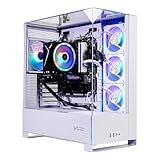
This $2,899.99 King 95 is the only configuration in the group with nothing left to guess at. The Ryzen 7 9800X3D runs a 4.7GHz base with a 5.2GHz boost, the RTX 5070 Ti brings 16GB of VRAM, storage is a 2TB Gen4 NVMe drive, memory is 32GB of DDR5-6000, the supply is an 850W 80 Plus Gold unit and cooling is a 360mm ARGB all-in-one. Wi-Fi and Windows 11 are included. That is a coherent parts list rather than a collection of whatever was in stock.
The 850W supply is what makes this system worth its premium over the $2,599.99 version. A 9800X3D and an RTX 5070 Ti together should pull roughly 500W to 570W under a hard combined load, an estimate based on the class of parts, which leaves the 850W unit operating in its efficient middle band and with genuine room for a larger card later. The 360mm radiator is the difference between a 9800X3D that holds its boost clocks and one that backs off during a long session.
Pros
- Every component is named, including PSU wattage, rating and cooler size
- 2TB of Gen4 NVMe storage rather than the usual 1TB
- 850W Gold supply with real headroom for a future GPU upgrade
Cons
- $300 more than the same CPU and GPU in the abbreviated King 95 listing
- The AIO pump brand is not named, and pumps are the shortest-lived part in a liquid loop
- 360mm radiators need a case with clean front intake to justify themselves
Who it is for: the buyer who wants a high-end machine with no unanswered questions and no immediate upgrades required.
Skytech Gaming Azure 3, Ryzen 7 9850X3D, Radeon RX 9070 XT
The third $2,899.99-class system takes the Radeon route. A Ryzen 7 9850X3D with an RX 9070 XT is a strong rasterization pairing, and the 9070 XT’s larger frame buffer makes it a comfortable 1440p and entry-level 4K card in traditional rendering. Where it gives ground is heavy ray tracing and the maturity of the upscaling stack, which remains NVIDIA’s advantage.
The concern is placement rather than parts. This is an Azure 3 chassis at King 95 money, and the listing does not state RAM capacity, storage size, power supply wattage or cooling method. An RX 9070 XT is a power-hungry card, and putting it in a mid-tier shell with an unnamed supply is exactly the pattern that makes buyers nervous about the brand. Estimated from the configuration, expect combined draw around 520W to 590W under load, which means a 650W unit would be uncomfortably close to its limit. Ask before you buy.
Pros
- Excellent rasterization performance per dollar from the RX 9070 XT
- 9850X3D carries the same stacked-cache advantage as the 9800X3D
- Generous VRAM compared with the RTX 5060 Ti configurations
Cons
- Azure 3 chassis and unlisted cooling for a high-wattage card
- No stated PSU wattage on a system that likely needs 750W or more
- Ray tracing performance trails the similarly priced RTX 5070 Ti builds
Who it is for: a Radeon-preferring buyer focused on raw rasterized frame rates who will confirm the supply and cooling before ordering.
How we evaluate prebuilts
Marcus Reilly leads reviews here and has spent nine years building and servicing systems, and the evaluation runs through a two-bench test lab with calibrated power meters and thermal probes. That equipment shapes what we care about. A power meter at the wall tells you whether a 650W supply is being asked to deliver 480W continuously, which is the condition that shortens a cheap unit’s life. Thermal probes tell you whether a case with one exhaust fan is recirculating GPU heat back into the CPU cooler intake.
For a single-brand review like this one, the analysis starts with what the listing actually discloses. A configuration that names its power supply wattage, its 80 Plus rating, its memory speed and its cooler size is telling you the builder is confident in those parts. A configuration that lists only the CPU and GPU is telling you something too. We weight disclosure heavily because it correlates with what we find inside the case.
Performance figures in this review are estimates derived from the published parts lists, not measurements taken from these specific units. We do not publish frame rates we have not recorded ourselves on hardware we have in hand. What we will do is tell you which component sets the ceiling in each configuration, because that is the number that decides how the machine ages. If you want a broader field, our roundup of the best prebuilt gaming PCs compares Skytech against the other major assemblers.
How Skytech tiers its lineup
The line names describe chassis and cooling class, not raw performance, and this trips up more buyers than any other aspect of the brand. Archangel is the volume line: a conventional mid-tower with air cooling, RGB fans and mid-range supplies in the 650W to 750W band. Shadow sits alongside it as a similar mainstream shell with slightly different front panel styling and fan arrangement. Crystal is the tempered-glass mid-tower, again air-cooled, usually paired with 650W Gold units and either DDR4 or DDR5 depending on the platform underneath.
Azure moves up to a case with better intake area and appears across a wide price band, from $1,199.99 to $2,899.99 in this group alone, which is precisely why the name tells you so little. King 95 is the flagship. It is the line where 850W supplies, 360mm all-in-one coolers and 2TB storage drives become standard rather than optional, and it is the only tier here where the cooling is specified as liquid on the listing.
The practical rule: ignore the line name and read the wattage, the cooler and the memory capacity. Two Azure 3 systems in this review differ by $1,700, and the only reliable way to tell them apart is the parts list. A King 95 is a better machine than a Crystal not because of the badge but because Skytech spends more on the parts you cannot see.
The problems Skytech buyers actually hit
The power supply is the recurring complaint, and it is a legitimate one. In the cheaper tiers, Skytech frequently ships house-branded or thinly documented units. A 650W Gold rating on a listing tells you the efficiency class but not the manufacturer, the capacitor quality or the transient response, and transient response is what matters with modern graphics cards that spike well above their nominal draw for milliseconds at a time. When a listing gives no wattage at all, as with two configurations here, you are buying the least visible and most consequential part sight unseen. The Archangel 5’s disclosed 750W Gold unit at $1,249.99 is a better sign than the unlisted supply in a $1,899.99 Azure 3.
Cooling is the second issue, and it is worst in the smaller air-cooled cases. A single 120mm front intake and a single rear exhaust cannot move enough air to keep a Ryzen 7 and an RTX 5060 Ti both in their comfort zones during a three-hour session. What happens is not a crash; it is a slow slide as the GPU fan curve ramps to compensate, the case gets loud, and the CPU quietly trims boost clocks. Adding two case fans costs about $25 and fixes most of it, which is the single highest-value modification on any air-cooled Skytech.
Skimping shows up in memory and storage at specific price points. Two systems here ship 16GB when a competing configuration at the same price ships 32GB, and every configuration under $2,600 ships a single 1TB drive that three modern installs will fill. Neither is a disaster because both are user-fixable, but you should price the fix into the purchase rather than discovering it later.
Upgrade limits are mostly about the supply and the socket. An AM4 Ryzen 7 5700 has no CPU upgrade path worth taking, and a 650W unit constrains what graphics card you can fit later. Before you commit, it is worth reading how to check whether a prebuilt has bottlenecks, because the limiting part is rarely the one on the box. As for support, a large assembler like Skytech typically handles the system as a whole rather than sending you to individual component manufacturers, which is generally the better arrangement when something fails in the first year. Terms change, so confirm the current coverage on the listing rather than trusting any figure quoted in a review.
Who should buy a Skytech, and who should build instead
Buy a Skytech if you want a working machine this week, you are shopping between roughly $1,200 and $1,700, and you pick a configuration that discloses its power supply. In that band the prebuilt genuinely competes, because Windows, assembly and the risk of a dead-on-arrival part are all absorbed by the seller, and the parts savings a self-builder can capture are modest. The Archangel 5 and the Ryzen 7 7700 Crystal are both reasonable buys on that basis.
Build instead if your budget crosses about $2,000. At $2,899.99 you are spending flagship money, and a self-build lets you specify the exact supply, the exact cooler and the exact memory kit rather than accepting whatever the assembler sourced. You will spend an evening on assembly and you will handle each component’s warranty separately, but you gain the ability to see every part before you buy it. Our prebuilt versus custom build cost comparison puts real numbers on how that gap changes with budget.
The other case for building is a specific requirement the prebuilt market handles badly: a small-form-factor case, a particular quiet cooler, or a 4TB storage configuration from day one. Skytech’s configurations are fixed combinations, and paying to swap a part you did not want is worse value than choosing correctly at the start.
Verdict
The best overall configuration is the King 95 with the Ryzen 7 9800X3D and RTX 5070 Ti at $2,899.99. It is the only system here where the power supply, cooler, memory and storage are all disclosed and all sized correctly for the CPU and graphics card, and the 850W Gold unit gives it a longer useful life than anything else in the range. The value pick is the Archangel 5 at $1,249.99, chosen not for its RTX 5060 but for its 750W Gold supply, which is more headroom than several systems costing $400 more. Add 16GB of memory and a second drive and it becomes a five-year machine. The high-end alternative is the RX 9070 XT Azure 3 at $2,899.99 for buyers who want maximum rasterized performance and do not weight ray tracing heavily, though we would confirm its supply and cooling before ordering. Avoid the 16GB Azure 3 at $1,199.99 while the 32GB Crystal exists at the same price.
Frequently asked questions
Is Skytech Gaming a good brand for a first gaming PC?
Skytech is a reasonable first prebuilt if you buy a configuration where the listed power supply is an 80 Plus Gold unit of at least 650W and the RAM is 32GB. The brand’s weakness is not the assembly, it is the parts nobody photographs: the PSU, the case fans and the stock CPU cooler. Configurations like the Archangel 5 at $1,249.99 list a 750W Gold unit, which is the kind of detail that separates a safe buy from a gamble.
What is the difference between Skytech’s Archangel, Crystal, Azure and King lines?
The names describe the chassis and cooling class, not the performance tier. Archangel and Crystal are the mainstream mid-tower cases with air cooling and mid-wattage supplies, typically 650W to 750W. Azure sits above them with more airflow and higher-wattage configurations. King 95 is the flagship shell, and it is the only line in this group that regularly ships with a 360mm all-in-one liquid cooler and an 850W Gold supply. Two systems with the same GPU can sit in different lines.
Do Skytech PCs come with enough power supply headroom to upgrade the graphics card later?
It depends entirely on the tier. The 650W Gold units in the Crystal configurations leave enough room for a card in the RTX 5060 Ti class but very little beyond it, especially with a Ryzen 7 pulling 90 to 140 watts under load. The 850W Gold unit in the King 95 has genuine headroom for a larger card later. Check the wattage and the 80 Plus rating on the listing before you plan any GPU upgrade, because Skytech changes suppliers between batches.
Is 16GB of RAM enough in a Skytech gaming PC at around $1,200?
For gaming alone, 16GB still works in most titles, but it is the first thing you will feel if you stream, keep a browser open with thirty tabs, or run a voice client and a capture tool at once. Two of the configurations here ship 32GB for the same or nearly the same money, which makes the 16GB Azure 3 and Archangel 5 harder to justify. RAM is also the cheapest upgrade you can perform yourself, so it is a fixable weakness.
Is a Skytech prebuilt cheaper than building the same specification yourself?
At the mid tiers the gap is small, often $100 to $200 in the prebuilt’s favor once you count Windows, assembly and the shipping risk on individual parts. At the top of the range the calculus flips: a self-build with a 9800X3D and an RTX 5070 Ti lets you choose a named power supply and a specific cooler, which is exactly where Skytech’s cost savings come from. Confirm current pricing on the listing, since GPU street prices move constantly.