This review analyzes published product information. We have not performed detailed research of this unit.
As an Amazon Associate, we earn from qualifying purchases.
An AMD configuration with a distinct buying decision
The Corsair Vengeance a7500 reviewed here pairs an AMD Ryzen 7 9800X3D processor with Radeon RX 9070 XT graphics, 32GB of Vengeance RGB DDR5 memory and a 1TB M.2 SSD. It is the black configuration housed in Corsair’s 3500X ARGB mid-tower case. The attraction is a clearly identified CPU-and-GPU pairing inside a display-oriented desktop; the hesitation is how little the supplied listing reveals about the supporting components.
This is specification-based analysis, not a hands-on test. The listing identifies the headline hardware, but it does not establish gaming results, operating temperatures or noise levels. Those distinctions matter because the feature descriptions promise broad gaming and cooling benefits without supplying measurements.
This configuration is materially different from the previously covered Vengeance i7500 with a Core i9-14900KF, GeForce RTX 5080, 32GB DDR5 and 2TB SSD. The processor platform, graphics hardware and storage capacity all change. That makes the a7500 a separate configuration decision, not a cosmetic relisting, while preserving its place in the Vengeance desktop family.
The exact hardware the listing establishes
| Component | Listed specification |
|---|---|
| Desktop model | Corsair Vengeance a7500 |
| Processor | AMD Ryzen 7 9800X3D |
| CPU cooling | Liquid cooling; cooler model unspecified |
| Graphics | AMD Radeon RX 9070 XT |
| Memory | 32GB Corsair Vengeance RGB DDR5; described as optimized for AMD |
| Storage | 1TB M.2 SSD; feature description specifies NVMe |
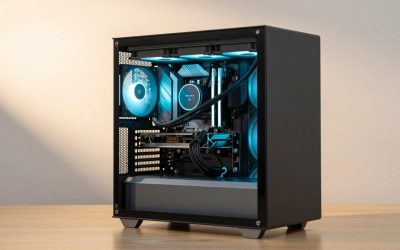
| Case | Corsair 3500X ARGB mid-tower with wraparound tempered glass |
| Listed fan locations | Side, rear and roof |
| Dimensions | 18.1 × 9.4 × 19.9 inches; axis labels not supplied |
| Weight | 30.78 pounds |
Component balance: clear identities, incomplete detail
The named processor and graphics card make this listing more useful than one that specifies only processor and GPU series. Buyers can identify the exact pairing they are considering. However, the supplied evidence does not support a resolution-specific recommendation, a performance comparison with the i7500, or a claim that either component will always limit the other. Your games, display and quality settings should drive that assessment.
Corsair’s listing positions the processor for gaming and content creation and describes the graphics hardware in terms of AMD’s RDNA 4 architecture and ray-tracing capabilities. These are listing claims rather than demonstrated results from this desktop. For a mixed gaming-and-work machine, check the requirements of your particular applications rather than treating broad creator language as proof of suitability.
The 32GB memory capacity is explicit, but the memory speed, timings and module arrangement are not. The AMD-optimization language does not establish which memory settings are enabled when the system arrives. That leaves an important gap for anyone comparing apparently similar prebuilts: matching capacity and DDR generation alone does not establish identical memory configurations.
The 1TB SSD deserves early planning
Storage is the most obvious capacity distinction from the previously reviewed i7500: this a7500 lists 1TB rather than 2TB. If your intended game and application library is large, storage should be part of the purchase decision from the start, rather than an assumed future fix. Whether 1TB is sufficient depends on what you keep installed.
The listing identifies M.2 NVMe storage, but not the drive manufacturer, model, interface generation or endurance specification. Its responsiveness claims should therefore not be read as evidence of a particular SSD performance tier. There is also no supplied inventory of occupied or free storage connectors.
Before planning a second drive, ask for the motherboard model, available M.2 slots and any applicable clearance restrictions. Without those details, this review cannot confirm that adding storage will be straightforward or that a particular drive format will fit beyond the installed M.2 device.
A showcase enclosure is not a cooling test
The 3500X ARGB case, wraparound tempered glass and illuminated memory make the interior presentation a deliberate part of this configuration. That is a tangible benefit if you want visible components rather than a visually understated tower. The listed dimensions and weight also deserve checking against your intended desk or floor location; the dimensions are provided without axis labels, so confirm orientation before assessing a tight space.
The feature description places fans at the side, rear and roof, and the CPU is liquid-cooled. These details describe the cooling arrangement, but they do not prove quiet operation or sustained cooling performance. Fan quantity, radiator size and the CPU cooler’s model are absent from the supplied evidence.
In particular, the named cooler in the prior i7500 listing should not be carried over to this a7500. Shared case branding does not establish identical cooling hardware. Buyers with strict noise requirements need configuration-specific information beyond the presence of liquid cooling.
Upgrade confidence depends on the missing parts list
The biggest obstacle to evaluating this as a long-term build foundation is the missing motherboard and power-supply information. Neither the PSU’s wattage and connectors nor the motherboard’s expansion layout is supplied. Consequently, future graphics upgrades, additional memory and storage expansion cannot be approved from this listing alone.
Request a complete bill of materials before buying with a specific upgrade in mind. Also confirm rear and front connectivity, networking, operating-system inclusion and warranty terms, none of which are established by the provided facts. For wider prebuilt-shopping context, our gaming desktop buying guide offers another starting point; it is not evidence for this configuration’s capabilities.
Frequently asked questions
What processor and graphics card does the Corsair Vengeance a7500 use?
The Corsair Vengeance a7500 uses an AMD Ryzen 7 9800X3D processor and AMD Radeon RX 9070 XT graphics. The article treats this CPU-and-GPU pairing as the system’s defined core specification. It does not provide gaming results or establish which component will limit performance, because that depends on the games, display and quality settings involved.
How much memory does the a7500 include, and what remains unknown?
The a7500 includes 32GB of Corsair Vengeance RGB DDR5 memory described as optimized for AMD. The listing does not establish the memory speed, timings or module arrangement, so matching its capacity and DDR generation with another system would not prove that the configurations are identical. The article also does not confirm which memory settings are enabled when the system arrives.
Is the included storage likely to be enough for a large game library?
The system includes a 1TB M.2 SSD, with the feature description specifying NVMe, but whether that is enough depends on the games and applications kept installed. The listing does not identify the drive manufacturer, model, interface generation or endurance specification. The article recommends treating storage capacity as part of the purchase decision rather than assuming expansion will be simple.
What case and physical details are provided for this desktop?
The a7500 is housed in Corsair’s black 3500X ARGB mid-tower case, which has wraparound tempered glass. Listed dimensions are 18.1 × 9.4 × 19.9 inches, and the listed weight is 30.78 pounds. Because the dimensions have no axis labels, the article recommends confirming their orientation before evaluating whether the desktop will fit a particular desk or floor location.
What information should a buyer request before planning upgrades?
A buyer should request the motherboard model, power-supply wattage and connectors, available M.2 slots, clearance restrictions and the complete bill of materials. The listing does not establish the motherboard’s expansion layout or the PSU details, so future graphics, memory and storage upgrades cannot be approved from the published listing information alone. Connectivity, networking, operating-system inclusion and warranty terms also remain unconfirmed.
Verdict: a defined core, with expansion still unverified
The Vengeance a7500 is worth considering if you specifically want the Ryzen 7 9800X3D and Radeon RX 9070 XT pairing, 32GB DDR5 and a glass-sided Corsair enclosure. Its clearest tradeoffs are the 1TB storage allocation and incomplete supporting-component disclosure. Treat the core specification as established, but confirm the cooler, motherboard, PSU and expansion options before choosing it for a planned upgrade path.
Sources: Configuration and physical specifications are drawn from the supplied retailer listing for this Corsair Vengeance a7500. Performance and cooling descriptions remain seller claims, not independently measured findings.
Check the exact product and current offer on Amazon