Our Top Picks

The Short Answer
It depends, but for most people a small form factor PC is worth it for gaming only if you are willing to pay a premium for space savings over raw performance per dollar. If you want a powerful, quiet, living-room-friendly system that disappears on a desk or in an entertainment center and you do not plan to constantly upgrade parts, an SFF PC is an excellent choice. If your top priority is getting the highest frame rates for the least money and having the easiest upgrade path, a standard mid-tower will beat it every time.
The one condition that decides it: you have to be okay with paying 15 to 30 percent more for the same gaming performance in a much smaller box, and living with tighter thermal and component limits.
As an Amazon Associate we earn from qualifying purchases at no extra cost to you.

What You Actually Get
A small form factor PC, or SFF PC, is not one specific size. The category generally covers anything from ultra-compact mini PCs under 2 liters to mini-ITX builds around 10 to 20 liters. For context, a traditional mid-tower gaming PC is typically 35 to 45 liters, stands 18 to 20 inches tall, and weighs 25 to 35 pounds empty. An SFF system flips that.
At the smallest end you have machines like the ACEMAGICIAN S3A Gaming Mini PC. It uses a laptop-style Ryzen 7 H 255 processor with Radeon 780M integrated graphics, 16GB of RAM, and a 512GB PCIe 4.0 SSD inside a chassis that is roughly 5 x 5 x 2 inches and weighs under 2 pounds. It draws about 65 to 120 watts under load and can be tucked behind a monitor. It will handle esports titles, older AAA games, and indie games at 1080p with modest settings, but it is not a replacement for a discrete graphics card for demanding modern titles.
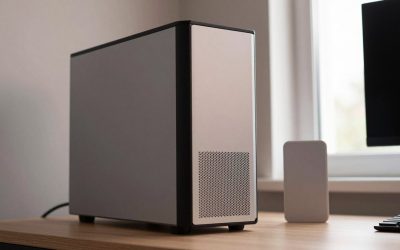
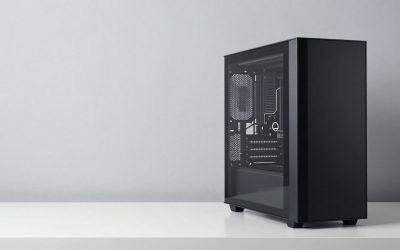
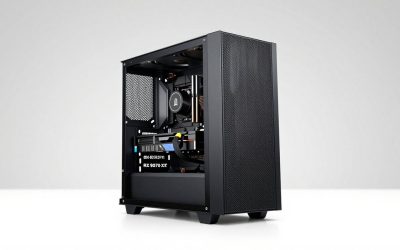
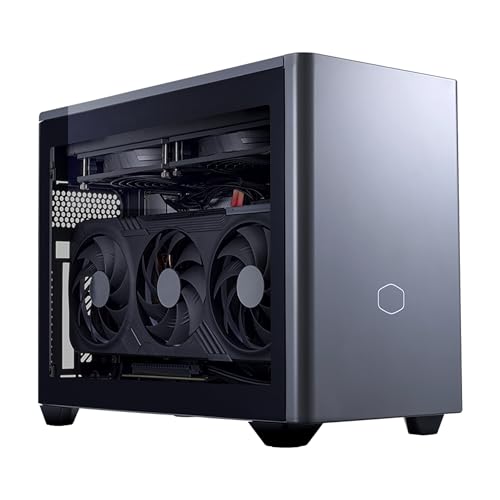
At the other end of the SFF spectrum you have true compact gaming desktops like the Cooler Master NR2 Pro build pairing a Ryzen 7 9800X3D with an RTX 5070 Ti. That is a no-compromise mini-ITX gaming PC in a case around 14 to 18 liters, measuring roughly 14 x 8 x 10 inches and weighing 15 to 20 pounds fully built. It delivers full desktop-grade 1440p and 4K gaming performance and draws 400 to 650 watts under load, but requires careful layout, premium airflow-focused cooling, and an SFX or SFX-L power supply to fit everything in.
In 2026, that range is the whole market: from $500 integrated-graphics mini PCs for casual gaming to $2,500 to $3,500 compact powerhouses with current-gen CPUs and GPUs. What they share is density. You get desktop Windows, full peripheral support, and Wi-Fi 6E or Wi-Fi 7 and Bluetooth built in, just in 30 to 70 percent less volume than a tower.
Pros
- Massive space savings. An SFF PC frees up serious desk and floor space. A sub-4-liter mini PC can mount to the back of a monitor with a VESA bracket. Even a larger 15-liter mini-ITX case takes up about half the desk footprint of a mid-tower, making it ideal for apartments, dorm rooms, small home offices, and living rooms.
- Portability and placement flexibility. Weighing 2 to 20 pounds versus 30+ pounds for a tower, SFF systems are genuinely portable. You can move them between rooms, take them to a friend’s house, or fit them in a TV stand where a tower never would. For LAN parties or hybrid work-from-home setups, that matters.
- Lower power and noise when sized right. Integrated-graphics mini PCs often idle at 15 to 25 watts and stay very quiet for everyday use. Even compact gaming builds with efficient components can be tuned to be quieter than a large tower with multiple cheap fans, because quality SFF cases rely on two or three large, well-placed fans and mesh panels.
- Clean, modern aesthetics. SFF cases tend to look more like home electronics than gaming towers. Wood, mesh, and minimalist aluminum designs blend into offices and living rooms without RGB towers dominating the space.
- Full PC functionality without compromise on everyday tasks. Unlike a console or handheld, you still get a complete Windows PC for content creation, programming, office work, and gaming on one machine, with support for multiple monitors, fast storage, and modern connectivity.
Cons
- You pay more for less performance per dollar. Miniaturization costs money. SFF-specific parts like SFX power supplies, low-profile coolers, and premium mini-ITX cases add $150 to $400 to a build over equivalent ATX parts. Prebuilt SFF gaming PCs carry a similar premium. A $500 mini PC will game like a $500 laptop, not a $500 tower with a discrete GPU.
- Thermals and noise are harder to manage. Packing a 200 to 300 watt GPU and a 100+ watt CPU into 12 to 18 liters leaves little margin for heat. Expect CPU and GPU temperatures 5 to 15 degrees Celsius higher than in a well-ventilated mid-tower. Under heavy load, small fans have to spin faster, which can mean more noise unless you invest in premium cooling and undervolting.
- Strict component limits and compatibility headaches. SFF cases limit graphics card length (often 280 to 336mm max), cooler height (often 50 to 135mm), and power supply form factor. Many ultra-compact cases only support two-slot GPUs or require riser cables. You cannot fit every card or cooler you want, and future GPU generations may not fit at all.
- Harder to build and upgrade. Building in an SFF case takes longer, requires careful cable management, and often means removing multiple parts to access one. Upgrading is similar. Swapping RAM and SSDs is easy, but changing the GPU, cooler, or power supply can be a full teardown. If you like to tinker or upgrade yearly, a tower is far more forgiving.
- Fewer ports and expansion slots. Mini-ITX motherboards typically offer two RAM slots (max 64GB to 96GB on most current boards), one PCIe x16 slot, and one or two M.2 slots versus four RAM slots and three to four M.2 slots on ATX. Rear I/O is also more limited, and ultra-compact mini PCs may rely on USB-C hubs or docks for extra connectivity.
Who Should Buy It
An SFF PC makes the most sense for gamers who value space, aesthetics, and simplicity over maximum upgradability.
You should buy one if you live in a small apartment or want a PC in the living room, you prefer a clean desk and do not want a large tower on the floor, or you move your setup often. It is also ideal if you want one quiet, efficient machine for work and casual to serious gaming without building a second system.
For casual gamers, an integrated-graphics mini PC in the $450 to $650 range is often enough for 1080p esports titles like Valorant, League of Legends, Fortnite, and Rocket League at 60 to 144 frames per second on low to medium settings, plus excellent everyday performance. For enthusiast gamers who want high-refresh 1440p or 4K without a tower, a compact RTX 5070, 5070 Ti, or similar build in the $1,800 to $3,200 range delivers that experience in a case that actually fits on a shelf.
If you are comfortable buying the right configuration upfront and not upgrading the core platform for three to five years except for storage, an SFF PC will feel like a smart, space-saving investment rather than a compromise.
Who Should Skip It
Skip SFF if your goal is the best performance for the lowest price, or if you love upgrading.
Budget-focused builders who want to maximize frames per dollar should choose a mid-tower. For the same $1,200 to $1,500, a tower will typically let you buy a tier-higher GPU, a larger and cheaper ATX motherboard, and a standard ATX power supply, which translates directly to higher performance.
You should also skip it if you plan to overclock heavily, run the hottest flagship components, or reuse oversized parts you already own. Large triple-fan GPUs over 340mm long, 160mm+ tall air coolers, and 360mm all-in-one liquid coolers simply will not fit most SFF cases. Content creators working with multiple PCIe cards, several 3.5-inch hard drives, or 128GB+ of RAM will also find SFF too limiting.
Finally, first-time builders who are nervous about tight builds should start with a micro-ATX or ATX case. The building experience is far more forgiving, troubleshooting is easier, and airflow is less sensitive to small mistakes.
Cheaper Alternatives
| Option | Cost | Trade-off |
|---|---|---|
| Micro-ATX Gaming Tower | $800 – $1,400 | Still compact at 28 to 35 liters but much cheaper parts and easier cooling; takes more desk and floor space than SFF |
| Mid-Tower ATX Build | $750 – $1,600 | Best value and widest component choice; large footprint at 35 to 45 liters and heavier at 25 to 35 pounds |
| Console (PlayStation 5 / Xbox Series X) | $450 – $550 | Excellent value for 4K gaming on a TV; limited to console games, no PC versatility or mods |
| Gaming Laptop (RTX 4060 / 4070 class) | $900 – $1,600 | Built-in portability and screen; louder under load, limited upgrades, and smaller screen than desktop setup |
| Integrated-Graphics Mini PC Only | $400 – $650 | Ultra-compact and efficient at 1 to 4 liters and 30 to 120 watts; not powerful enough for demanding AAA games at high settings |
FAQ
Do small form factor PCs overheat more than regular gaming PCs?
They run hotter than a large tower with the same components, but a well-designed SFF case with mesh panels and a proper cooler does not overheat if you stay within its rated wattage. Expect slightly higher temperatures and more sensitivity to dust and fan curves. Ultra-compact mini PCs with integrated graphics run cool, while high-power mini-ITX builds need quality cooling and good cable management to stay quiet.
Can you upgrade a small form factor gaming PC later?
Yes, but upgrades are more limited. RAM and M.2 SSDs are easy to swap on most models. Swapping the graphics card, CPU cooler, or power supply is possible in mini-ITX builds but constrained by size limits, and some mini PCs use soldered or laptop-style parts that cannot be upgraded at all. Always check case specs for max GPU length, GPU width, CPU cooler height, and PSU form factor before buying.
Are mini PCs good enough for modern AAA gaming?
It depends on the type of mini PC. A small mini PC with integrated Radeon 780M or similar graphics is good for esports, indie, and older AAA titles at 1080p, but will struggle with demanding new releases at high settings. For smooth 1440p or 4K AAA gaming at high to ultra settings, you need an SFF desktop with a discrete GPU like an RTX 4070, 5070, or 5070 Ti and the power and cooling to support it.
How much should you budget for a good small form factor gaming PC?
For casual gaming and everyday use, budget $450 to $700 for an integrated-graphics mini PC. For a compact system that rivals a tower in AAA games, budget $1,500 to $3,000 for a prebuilt mini-ITX PC or $1,300 to $2,600 if you build it yourself, with the case, SFX power supply, and mini-ITX motherboard accounting for much of the price premium over a standard tower.
Related guides
- Best Gaming PC for Fortnite: Eight Prebuilt Desktops Sorted by Refresh Rate Goal (2026)
- Best RX 9070 XT Prebuilt Gaming PCs: Seven Desktops and Three Cards Compared: 10 Compared (2026)
- CyberPowerPC vs iBUYPOWER Gaming PC: How the Two Brands Compare
- Best RX 9070 XT Prebuilt Gaming PC (2026): 5 Picks Compared