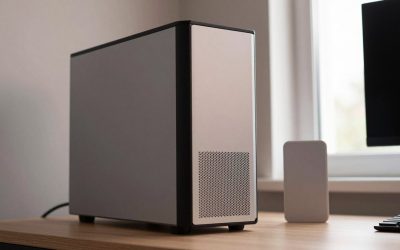
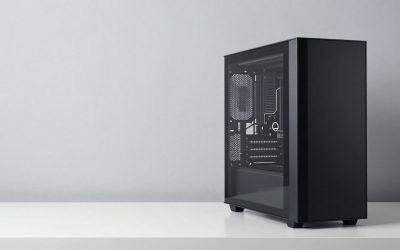
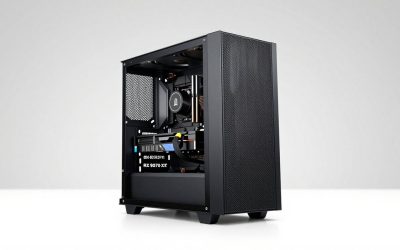
Our Top Picks


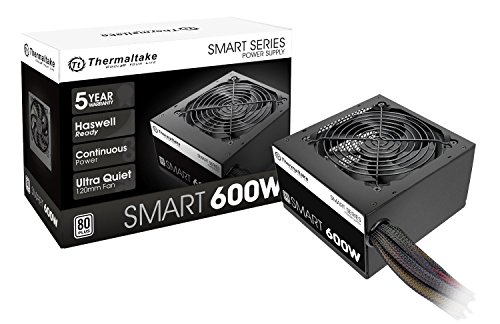

Top 3 picks at a glance
The Short Answer
For most new gaming PC builds, a 750W to 850W ATX power supply is the practical sweet spot. It provides enough power for a modern gaming processor and graphics card while leaving useful headroom for power spikes, extra drives, cooling fans, and future upgrades.
- 600W–650W: Entry-level and midrange gaming PCs with efficient graphics cards.
- 750W: The best all-around choice for many mainstream gaming builds.
- 850W: A strong choice for high-performance graphics cards, power-hungry CPUs, or buyers planning upgrades.
- 1,000W and above: Best for flagship graphics cards, heavily upgraded systems, custom water cooling, or demanding workstation-and-gaming setups.
Physical size matters, too. Most gaming towers accept a standard ATX power supply, which is 5.91 inches (15 cm) wide and 3.39 inches (8.6 cm) tall. The important variable is its depth: compact ATX units may be 5.51 inches (14 cm) deep, while high-wattage models can reach 7.09 inches (18 cm) or more. Always measure the available depth in your case before ordering.
As an Amazon Associate we earn from qualifying purchases at no extra cost to you.



As a useful real-world reference, a compact 750W modular, 80 Plus Gold unit typically costs around $85 to $100, while an 850W ATX 3.1, PCIe 5.1-ready model is commonly $105 to $120. Basic 600W non-modular units can cost about $40 to $55, but they may offer less cable flexibility and fewer upgrade options.
Standard Sizes
| Power Supply Format | Width | Height | Typical Depth | Best For |
|---|---|---|---|---|
| ATX | 5.91 in / 15 cm | 3.39 in / 8.6 cm | 5.51–7.09 in / 14–18 cm | Most mid-tower and full-tower gaming PCs |
| SFX | 4.92 in / 12.5 cm | 2.50 in / 6.35 cm | 3.94 in / 10 cm | Small-form-factor and mini-ITX cases |
| SFX-L | 4.92 in / 12.5 cm | 2.50 in / 6.35 cm | 5.12 in / 13 cm | Compact cases needing higher wattage or a larger fan |
| TFX | 3.35 in / 8.5 cm | 2.56 in / 6.5 cm | 6.89 in / 17.5 cm | Slim desktop cases and select prebuilt systems |
| Flex ATX | 3.21 in / 8.15 cm | 1.59 in / 4.05 cm | 5.91 in / 15 cm | Very small specialty cases |
ATX is the default format for a gaming PC. A standard ATX unit fits the vast majority of cases sold for gaming, especially mid-towers with an enclosed lower power-supply compartment. Even within the ATX category, check depth carefully. A 140 mm-deep model is easier to install than a 180 mm-deep unit in a compact case because it leaves more room for cable bends and hard-drive cages.
SFX and SFX-L units are made for mini-ITX builds. They are much smaller than ATX models, often cost more at the same wattage, and may require an included or separately purchased bracket to mount in a case designed for ATX power supplies.
How to Measure Your Space
- Find the power supply bay. In most gaming cases, it sits at the bottom rear, below the motherboard. In older designs, it may be at the top rear.
- Measure width and height. Measure the inside opening where the power supply mounts. An ATX opening should accommodate roughly 5.91 by 3.39 inches (15 by 8.6 cm).
- Measure usable depth. Start at the rear mounting panel and measure toward the front of the case. Stop at the first obstruction, such as a drive cage, radiator, fan, or cable-management bar.
- Reserve cable room. Add at least 1 to 2 inches (2.5 to 5 cm) beyond the power supply’s listed depth. Modular cable connectors and stiff graphics-card power cables need room to bend safely.
- Check fan clearance. If the power supply mounts fan-down, verify that the case has a vented bottom panel and enough clearance above the desk, carpet, or floor for airflow.
- Confirm connector needs. Count the CPU, graphics card, SATA, and fan/RGB hub connections before buying. Physical fit is only half the equation.
For example, if your case provides 7.5 inches (19 cm) of clear depth, a 5.51-inch (14 cm) compact ATX power supply is an easy fit. A 7.09-inch (18 cm) unit may technically fit, but it could leave too little space for clean cable routing.
By Room or Use Case
Bedroom or Shared-Space Gaming Setup
For a typical gaming desk in a bedroom, choose a quiet, compact ATX power supply in the 650W to 750W range. These systems often use a midrange graphics card, one or two storage drives, and several case fans. A 140 mm-deep modular unit keeps the lower compartment less crowded, which is helpful in smaller cases placed close to a wall or tucked beside a desk.
A 750W 80 Plus Gold modular model in the $85 to $100 range is often the best balance of cable management, efficiency, and room to upgrade.
Living Room Gaming PC
A living room PC is frequently built in a smaller case, so physical dimensions are especially important. Many console-style or mini-ITX cases require an SFX or SFX-L power supply, not ATX. Check the case manual rather than assuming an adapter will solve the problem.
For a compact gaming system, 650W to 750W is usually sufficient. SFX units may cost more than full-size models, but their smaller 4.92-inch width and 2.50-inch height make them essential for tight layouts. Prioritize a fully modular design so unused cables do not block airflow inside the case.
Main Gaming Desk or Performance Build
For a primary gaming PC with a powerful graphics card, multiple NVMe drives, liquid cooling, and a modern multicore processor, select an 850W ATX power supply. This wattage gives the system breathing room without moving into unnecessarily large, expensive territory.
Look for ATX 3.1 and PCIe 5.1 support if you are buying a new high-end graphics card. A native 12V-2×6 graphics cable can reduce cable clutter compared with multi-plug adapters. Compact 850W Gold units around 140 mm deep are particularly convenient in standard mid-tower cases. Expect pricing around $110 to $120 for a well-equipped modular model.
Creative Workstation That Also Games
If your computer handles gaming alongside video editing, 3D rendering, software development, or frequent long workloads, consider 850W to 1,000W. Extra wattage is useful when the CPU and graphics card are both under sustained load, especially with many storage devices, capture cards, USB accessories, and liquid-cooling pumps.
Do not choose 1,000W solely because it sounds better. A quality 850W unit is more appropriate for many systems and may be shorter, easier to cable, and less expensive. Move to 1,000W or higher when your selected CPU and graphics card manufacturer recommendations, plus your components and planned upgrades, justify it.
Common Sizing Mistakes
- Confusing wattage with physical size. A 750W unit can be shorter than a 600W unit. Read the listed dimensions instead of judging by wattage alone.
- Buying exactly the calculated wattage. If a component calculator suggests 620W, a quality 750W model usually gives more comfortable headroom.
- Ignoring graphics-card connectors. Confirm that the unit includes the required PCIe cables or a native 12V-2×6 cable where needed.
- Forgetting cable clearance. A power supply that fits the bay may still create a difficult installation if there is no room for connectors behind it.
- Using an oversized unit in a compact case. A long ATX power supply can block drive mounts or force sharply bent cables.
- Choosing only by price. A basic 600W unit around $43 may work in a modest build, but a modular 750W or 850W model can be a better long-term investment for a performance gaming PC.
FAQ
Is 750W enough for a gaming PC?
Yes. A quality 750W power supply is enough for many gaming PCs with a capable modern graphics card and processor. It is a particularly sensible choice for mainstream-to-upper-midrange builds, provided it has the correct graphics-card and CPU connectors.
Should I get 750W or 850W?
Choose 750W for a balanced gaming build with one graphics card and normal storage and cooling. Choose 850W if you are using a high-performance graphics card, a power-hungry CPU, extensive cooling, or want more upgrade flexibility. The price difference is often only about $15 to $25, making 850W attractive for buyers building in 2026.
Will an ATX power supply fit every gaming case?
No. ATX fits most mid-tower and full-tower cases, but many mini-ITX, slim, and console-style cases require SFX, SFX-L, TFX, or another specialized format. Check both the required format and maximum supported power-supply depth.
Does a higher-watt power supply use more electricity?
Not automatically. A 1,000W power supply does not constantly draw 1,000 watts. Your PC draws power based on what its components need. However, buying far more wattage than your system requires can cost more upfront and may not offer a practical benefit. Choose a quality unit with sensible headroom rather than simply buying the highest number.
Related guides
- Best Gaming PC for Fortnite: Eight Prebuilt Desktops Sorted by Refresh Rate Goal (2026)
- Best RX 9070 XT Prebuilt Gaming PCs: Seven Desktops and Three Cards Compared: 10 Compared (2026)
- CyberPowerPC vs iBUYPOWER Gaming PC: How the Two Brands Compare
- Best RX 9070 XT Prebuilt Gaming PC (2026): 5 Picks Compared