A game library of 30+ titles easily eats through a secondary drive, and when a build goes wrong you need a single plug-and-play disk to rescue every save, shader cache, and config file before you wipe the boot volume. The external hard disk market splits into two camps: bare-bones bulk storage at the lowest dollar-per-terabyte rate, and software-loaded drives that bundle backup utilities, encryption, and ransomware shields.
What separates a good pick from a bad one here is rarely raw speed—spinning HDDs are all bottlenecked by the mechanical platter—but whether the included software actually works on your OS, whether the drive is formatted for Mac or Windows out of the box, and whether the manufacturer stands behind it with real recovery support.
As an Amazon Associate we earn from qualifying purchases at no extra cost to you. Product prices and availability are accurate as of the date shown and are subject to change.



Top 3 picks at a glance
Quick Picks
| Product | Best for | Price |
|---|---|---|
| Seagate 2TB Portable (STGX2000400) | Everyday backup without frills | $129.99 |
| Seagate Portable 5TB (STGX5000400) | Multi-console game libraries | $219.96 |
| WD Elements 5TB (WDBU6Y0050BBK-WESN) | Cross-platform plug-and-play | $214.10 |
| Seagate Portable 1TB (STGX1000400) | Budget starter with Rescue Service | $119.80 |
| UnionSine 500GB Ultra Slim | Ultra-cheap one-time transfers | $37.46 |
| Seagate Portable 4TB (SRD0NF1) | Best value per terabyte with recovery | $189.98 |
| 500GB External HDD USB-C | Dual-port modern laptops | $35.99 |
| WD My Passport 4TB (WDBPKJ0040BBK-WESN) | Security-conscious builders | $180.10 |
How We Picked
We ranked these external hard disks on three criteria that separate practical buys from shelf-ware. First, cost per usable terabyte, because a gaming library grows every season and overpaying for redundant capacity is the most common buyer regret. Second, software and recovery support—Seagate’s Rescue Service and WD’s bundled tools matter when a drive fails mid-playthrough. Third, consistent owner reports on reliability, including whether the warranty covers actual data recovery or only a blank replacement disk.
The 8 Best External Hard Disk in 2026
Seagate 2TB Portable Hard Drive (STGX2000400)
This sits in the sweet spot for gamers who want a simple backup disk without overpaying for capacity they won’t fill. At 2 TB it comfortably holds a half-dozen AAA titles plus every save file and screenshot your library has produced.
- USB 3.0 keeps transfer times reasonable for a mechanical HDD.
- Compact enough to live on a desk without looking out of place.
- No bundled backup software—you’ll need to supply your own solution.
Skip it if your library already exceeds 1.5 TB of installed content; you’ll run out of headroom quickly.
Seagate Portable 5TB External Hard Drive (STGX5000400)
The 5 TB capacity makes this the obvious choice for anyone juggling game libraries across PC, PS4, and Xbox simultaneously. One-Year Rescue Service adds data-recovery insurance that no budget drive offers, which matters when a platter degrades mid-season.
- Rescue Service provides professional recovery if software methods fail.
- Wide console and OS compatibility out of the box.
- Black chassis picks up fingerprints and scuffs under desk lighting.
Skip it if you only back up one PC and already run an automated cloud solution—the Rescue Service becomes redundant.
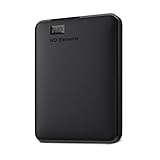
WD Elements 5TB Portable External Hard Drive (WDBU6Y0050BBK-WESN)
WD’s Elements line is the plug-and-play workhorse, and this 5 TB model is the one to buy when you want maximum capacity without software bloat. Windows and Mac are both recognized natively, making it ideal for builders who swap between machines.
- No pre-installed software means nothing running in the background eating RAM.
- USB 3.2 Gen 1 is the latest interface standard on this list.
- Zero bundled protection—no password, no encryption, no backup utility.
Skip it if you handle sensitive mod configs or personal files and want built-in encryption.
Seagate Portable 1TB External Hard Drive (STGX1000400)
At 1 TB this is the entry point for players who just finished a build and need a bare-minimum rescue disk before their first session goes sideways. The Rescue Service at this price tier makes it a stronger value than most 500 GB competitors.
- Rescue Service included at the lowest capacity tier we found.
- Compact and light enough to toss in a laptop bag.
- Fills up fast—a single AAA install can claim 100 GB or more.
Skip it if you’re archiving multiple years of saves and shader caches; the capacity ceiling arrives sooner than expected.
UnionSine 500GB Ultra Slim Portable External Hard Drive
This is the cheapest external hard disk on our list and the only one under $40, making it a stopgap for quick transfers rather than long-term backup. The slim profile helps it disappear into a backpack, but 500 GB won’t cover a modern game library for long.
- Genuinely ultra-slim and portable at this price point.
- USB 3.0 avoids the old USB 2.0 speed trap.
- Little-known brand with sparse owner-reported reliability data.
Skip it unless your use case is a one-time file transfer; the capacity and support gap is too wide for daily backup.
Seagate Portable 4TB External Hard Drive (SRD0NF1)
The 4 TB tier hits the best balance between price and space for a single-gamer PC running a rotating library of 20-30 titles. Rescue Service is included, and console-compatible firmware means it works identically whether you plug into a tower or a controller dock.
- Best dollar-per-terabyte among all Rescue Service models on this list.
- Broad console and OS support without configuration changes.
- No included backup application—you’ll configure Time Machine or Macrium manually.
Skip it if you already own the 5 TB Seagate; the capacity delta doesn’t justify a second drive for most households.
500GB External Hard Drive USB 3.0 and USB-C Storage Expansion
Dual USB 3.0 and USB-C ports set this apart from the purely-A-drive competition, making it the go-to for newer laptops that dropped the full-size port entirely. At $35.99 it’s the cheapest path to a modern connector without an adapter.
- USB-C eliminates dongle dependency on current-gen notebooks.
- Price is hard to beat for any spinning HDD with dual connectors.
- 500 GB capacity is below the threshold where a game library stays functional long-term.
Skip it if your desktop case has full-size USB-A ports and you want a drive you won’t replace within a year.
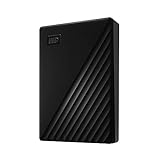
WD My Passport 4TB External Hard Drive (WDBPKJ0040BBK-WESN)
The My Passport is the only drive on this list bundling password protection and ransomware-defense software in the box. For streamers or content creators who keep unreleased builds and personal footage on the same disk, that extra layer is meaningful rather than gimmicky.
- Ransomware shield and password lock ship active out of the box.
- USB 3.1 interface is a step above plain 3.0 on the controller side.
- Bundled software can interfere with automated backup schedulers at default settings.
Skip it if you manage encrypted volumes via VeraCrypt or your OS natively—the included protection becomes redundant overhead.
Buying Guide
Interface and Throughput
The practical difference between USB 3.0, 3.1, and 3.2 Gen 1 on a mechanical HDD is negligible—spinning platters top out well below any of those bus limits. What matters is connector availability on your machine. A USB-A-only drive is a problem on modern ultrabooks that shipped with only USB-C. If you run a desktop with front-panel headers, the generation label is irrelevant.
Capacity Planning for Game Libraries
A single AAA title routinely occupies 80-150 GB on install. A library of 25 titles will consume 3-4 TB of archive space if you keep every save and shader cache. Budget 500 GB per five titles as a safe rule, then add twenty percent headroom for temp files and OS dumps. One larger drive is cheaper and simpler than managing two smaller disks.
Software and Recovery Coverage
Seagate’s Rescue Service and WD’s bundled backup tools are the real differentiators. Rescue Service sends the physical drive to a lab for platter-level recovery if software methods fail—a service that costs hundreds to arrange independently. WD’s password and ransomware modules add protection that VeraCrypt can replicate but not as conveniently. Decide whether you want software that handles one thing automatically or a bare drive you configure yourself.
Our Verdict
Top pick: the WD My Passport 4TB combines high capacity, the latest interface standard on this list, and the only bundled ransomware protection—making it the most well-rounded choice for a gaming PC owner who also values data security. Budget pick: the Seagate Portable 1TB is the lowest price that still includes Rescue Service, ideal for a quick rescue disk. Condition: the WD Elements 5TB wins outright if you need maximum capacity per dollar with zero interest in bundled software.
FAQ
Do I need an external hard disk if I already have a NAS?
A NAS handles local redundancy but not offsite disaster recovery. An external hard disk gives you a physical copy you can store in a drawer or hand to a friend, which a network-attached drive cannot do.
Is USB 3.2 Gen 1 faster than USB 3.0 on an HDD?
Not in practice. Both carry the same 5 Gbps theoretical ceiling, and no spinning hard disk saturates that bandwidth. The advantage of 3.2 Gen 1 branding is newer controller compatibility on very recent motherboards.
Can I use an external hard disk directly for gaming on a console?
Seagate and WD list PS4 and Xbox compatibility on select models, but load times increase noticeably because the console’s internal SSD is far faster. Treat the external drive as an archive—install to internal, back up to external.
How long should I expect these drives to last with daily use?
Owner reports suggest three to five years is typical for a portable HDD used a few times per week. Drives left spinning continuously tend to reach end-of-life faster, so a rescue service or a backup-of-your-backup is the practical hedge.