Choosing a motherboard for a 12th Gen Intel build starts with two forks that cannot be undone later: DDR4 or DDR5 memory, and a B660 board that covers the essentials or a Z690 board that adds overclocking headroom and faster slots. Every board below earned its place the same way, with a listing that states LGA1700 and 12th Gen Intel Core support in its own title or fields. Memory type is printed per board, because the two standards are not interchangeable and the listings never mix them.
Four of the five are DDR4 boards, which suit builders reusing memory or watching the total build cost; the single DDR5 board is the forward-looking option. They suit new 12th Gen builds and upgrades of early LGA1700 systems alike. Every pick was chosen from the names and specifications on its Amazon product page, and the notes for this package record that these listings rest on mirror captures, so their product codes deserve a live check before ordering.
Top 3 picks at a glance


Quick Picks
As an Amazon Associate we earn from qualifying purchases.
| Product | Best for | Key spec from title |
|---|---|---|
| MSI PRO B660M-A DDR4 | A wired 12th Gen build that wants the modern essentials without paying for wireless it will not use. | B660 mATX, LGA1700, DDR4, PCIe 4.0, 2.5G LAN |
| MSI PRO B660M-A WiFi DDR4 | A 12th Gen build that needs Wi-Fi 6 and an SSD heatsink on the same value-led B660 board. | B660 mATX, DDR4, Wi-Fi 6, M.2 Shield FROZR |
| MSI MAG B660M Mortar WiFi DDR4 | A gaming-styled 12th Gen micro-ATX build that wants Wi-Fi 6 and fast M.2 storage on B660. | B660 mATX gaming board, DDR4, Wi-Fi 6, 2.5G LAN |
| ASUS Prime Z690-P WiFi | A forward-looking 12th Gen build moving to DDR5, with room for faster graphics and storage later. | Z690 ATX, DDR5, PCIe 5.0, WiFi 6, Thunderbolt 4 support |
| GIGABYTE B660M AORUS Elite AX DDR4 | An upper-range 12th Gen processor in a micro-ATX build that wants the strongest stated VRM and WiFi 6E. | B660 mATX, DDR4, WiFi 6E, 12+1+1 VRM design |
How to Choose
DDR4 or DDR5 is the first and permanent fork
The memory standard is fixed by the board and cannot be changed later: DDR4 boards take DDR4 kits, the DDR5 board takes DDR5, and the two do not fit each other’s slots. DDR4 suits builders reusing memory or minimising today’s total; DDR5 suits a platform bought to grow. Four of these five listings are DDR4 because that is where the verified 12th Gen range sits, and the single DDR5 board is flagged clearly in its entry.
B660 covers most builds; Z690 is for headroom
The B660 boards here state PCIe 4.0, fast M.2 storage and 2.5G networking, which is the whole requirement list for most 12th Gen systems. The Z690 board adds a stated PCIe 5.0 slot, more power stages and processor overclocking territory that B660 does not offer. If you will never overclock or fit a future flagship graphics card, the B660 money is better spent elsewhere in the build. The DDR4 side of the fork also benefits from maturity: the boards here are later revisions of a settled platform, with the early LGA1700 quirks already ironed out.
Wireless is a listing-level difference, not a range feature
Two boards here are near-identical MSI models separated mainly by the Wi-Fi in the title, and the set spans no Wi-Fi, Wi-Fi 6 and Wi-Fi 6E. Retail pages blur these variants together, so read the exact title of the listing you are ordering. A board bought for a room without Ethernet needs the radio in the box; a wired build pays for it unused. Boards in this set also state their slot and port counts plainly, so a Z690 premium buys expansion room rather than a different class of everyday performance.
Form factor and VRM decide the physical fit
Four boards are micro-ATX and one is full ATX, which decides the case size before anything else. Within the same size, the stated power design separates boards that will feed an upper-range 12th Gen chip comfortably from those aimed at mid-range processors. Match the board’s stated VRM class to your processor’s appetite, and the form factor to your case’s stated motherboard support. A final variant trap is memory: the same board name can exist in both standards, so the title check protects the memory order as much as the board order.
The 5 Best Options
MSI PRO B660M-A DDR4

The PRO B660M-A DDR4 is the straightforward businesslike board of the set: a micro-ATX B660 whose title states 12th Gen Intel Core and LGA1700 outright. It covers the modern essentials as listed, PCIe 4.0, M.2 slots, USB 3.2 and 2.5G LAN, with four DDR4 slots in the family specification running dual channel. There is no Wi-Fi on this listing, which is a feature rather than a flaw for a wired desk build. For a 12th Gen office or gaming system that lives on Ethernet, it is the clean baseline.
Specs
- Chipset and socket: Intel B660, LGA 1700 per listing title
- Form factor: mATX (Micro-ATX) per listing title
- Memory: DDR4, 4 DIMMs dual channel, up to DDR4-4800+ (OC) per the family specification
- Expansion: PCIe 4.0 per listing title
- Networking: 2.5G LAN per listing title; no Wi-Fi on this listing
- Storage: M.2 slots per listing title
- USB: USB 3.2 per listing title
- Series: PRO B660M-A per listing
Best for: A wired 12th Gen build that wants the modern essentials without paying for wireless it will not use.
Watch out for: This is the non-WiFi listing; the near-identically named WiFi version is a separate product with its own code, so check the title on the live page.
MSI PRO B660M-A WiFi DDR4
The WiFi version of the PRO B660M-A adds the two things the base board lacks: an Intel Wi-Fi 6 module and an M.2 Shield FROZR heatsink for the primary SSD, per its feature list. The rest of the stated package matches its sibling, B660 chipset on LGA1700, four DDR4 slots, PCIe 4.0 and 2.5G LAN, plus USB 3.2 Gen 2 Type-A at the rear and a front-panel USB 3.2 Gen 1 Type-C header. For a build that cannot run an Ethernet cable to the desk, this is the same sensible board with the wireless box ticked.
Specs
- Chipset and socket: Intel B660, LGA 1700 per listing title
- Form factor: mATX per listing title
- Memory: DDR4, 4 DIMMs dual channel, up to DDR4-4800+ (OC) per family specification
- Wireless: Wi-Fi 6 (Intel) per listing feature list and title
- Networking: 2.5G LAN per listing title
- Storage: M.2 slots with M.2 Shield FROZR per feature list
- USB: USB 3.2 Gen 2 Type-A; front USB 3.2 Gen 1 Type-C per feature list
- Expansion: PCIe 4.0 per listing title
Best for: A 12th Gen build that needs Wi-Fi 6 and an SSD heatsink on the same value-led B660 board.
Watch out for: The family documentation has described CPU support differently across revisions; the Amazon title states 12th Gen, which is the claim to rely on for this listing.
MSI MAG B660M Mortar WiFi DDR4
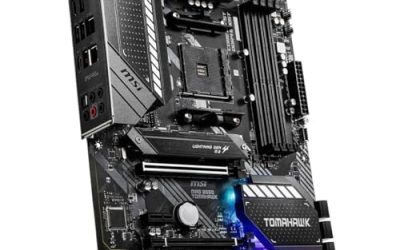
The MAG B660M Mortar WiFi is MSI’s gaming-line take on the same B660 foundation, titled a gaming motherboard where the PRO boards are titled for work. Its stated package runs to PCIe 4.0 with Lightning M.2 slots in the description, 2.5G LAN and Wi-Fi 6, on a micro-ATX frame with DDR4 memory. Builders choosing between this and the PRO WiFi are really choosing trim and tuning presentation over substance, since the chipset, socket and memory standard match. The Mortar is the pick for a gaming-styled 12th Gen build.
Specs
- Chipset and socket: Intel B660, LGA 1700 per listing title
- Form factor: mATX per listing title
- Memory: DDR4 per listing title
- Expansion: PCIe 4.0; Lightning M.2 slots per listing description
- Wireless: Wi-Fi 6 per listing title
- Networking: 2.5G LAN per listing title
- Model name: B660M Mortar per listing fields
Best for: A gaming-styled 12th Gen micro-ATX build that wants Wi-Fi 6 and fast M.2 storage on B660.
Watch out for: Mirror records for this board include a mismatched record pointing at a Tomahawk model; confirm the live page’s model name reads Mortar before ordering.
ASUS Prime Z690-P WiFi

The Prime Z690-P WiFi is this set’s DDR5 board and its step-up chipset option: a full ATX Z690 whose listing states LGA1700 for 12th Gen Intel Core, DDR5 memory across four slots, PCIe 5.0 and 14+1 power stages. Three M.2 slots, WiFi 6, Bluetooth 5.2, 2.5Gb Ethernet and Thunderbolt 4 support via header round out a board aimed at builders who will keep it through upgrades. If your 12th Gen build is also your platform for faster memory and graphics later, this is the listing that plans for it.
Specs
- Chipset and socket: Intel Z690, LGA 1700 for 12th Gen Intel Core per listing
- Form factor: ATX per listing
- Memory: DDR5, 4 DIMMs dual channel per listing specification
- Power: 14+1 DrMOS power stages per listing
- Expansion: PCIe 5.0 x16 SafeSlot plus PCIe 4.0 x16 per listing
- Storage: 3 x M.2 slots per listing
- Wireless: Intel WiFi 6 and Bluetooth 5.2 per listing
- Networking and ports: 2.5Gb Ethernet; USB 3.2 Gen 2×2 Type-C; Thunderbolt 4 support (header) per listing
Best for: A forward-looking 12th Gen build moving to DDR5, with room for faster graphics and storage later.
Watch out for: A DDR4 sibling of this board exists under a very similar name; DDR5 and DDR4 memory are not interchangeable, so confirm the live title says DDR5 before ordering either board or memory.
GIGABYTE B660M AORUS Elite AX DDR4

The AORUS Elite AX is the power-delivery pick among the B660 boards: its description states a 12+1+1 VRM design with 60A DrMOS stages, the strongest stated power section in this DDR4 group. Around it sit dual M.2 slots on PCIe 4.0, WiFi 6E (the only 6E radio here), 2.5GbE LAN and a USB 3.2 Gen2 Type-C port as the title words it. For a 12th Gen processor at the upper end of the range in a micro-ATX case, that VRM figure is the argument.
Specs
- Chipset and socket: Intel B660, LGA 1700 per listing title
- Form factor: Micro-ATX per listing title
- Memory: DDR4 per listing title
- Power design: 12+1+1 VRM with 60A DrMOS per listing description
- Storage: dual M.2 slots, PCIe 4.0 per listing title
- Wireless: WiFi 6E per listing title
- Networking: 2.5GbE LAN per listing title
- USB: USB 3.2 Gen2 Type-C per listing title
Best for: An upper-range 12th Gen processor in a micro-ATX build that wants the strongest stated VRM and WiFi 6E.
Watch out for: One description capture words the Type-C port a generation faster than the title does; rely on the title’s USB 3.2 Gen2 wording when planning port speeds.
Which One Fits Your Situation
A wired gaming or office build on DDR4
Take the MSI PRO B660M-A DDR4: the essentials stated plainly, with the budget kept for the processor and graphics card. It is also the easiest board here to hand to a future owner, since its specification needs no explaining beyond the standards it states.
The same build, but the desk has no Ethernet
Take the PRO B660M-A WiFi DDR4 for its Wi-Fi 6 module and SSD heatsink over its sibling’s otherwise matching specification. The SSD heatsink is a small line with real effect on a fast drive under sustained loads, and it arrives fitted rather than as an accessory to order.
A gaming-styled micro-ATX build
Take the MAG B660M Mortar WiFi DDR4, or the AORUS Elite AX if the processor is an upper-range model that values its stated VRM design and WiFi 6E. Between the two gaming boards, the choice is trim and radio generation rather than capability, so let the case size and the processor decide.
A platform bought to upgrade over years
Take the ASUS Prime Z690-P WiFi: DDR5 memory, a PCIe 5.0 slot and three M.2 slots give the 12th Gen build somewhere to grow. Three M.2 slots also postpone the day a storage upgrade means replacing a drive instead of adding one, which is the upgrade that actually happens.
Common Mistakes
- Ordering DDR5 memory for a DDR4 board or the reverse, since the listings state the standard per board and the kits are physically incompatible.
- Buying the non-WiFi version of a board whose name differs by one word from the WiFi version, then discovering the radio was never in the box.
- Fitting a full ATX board into a micro-ATX case plan, or the reverse, without checking the form factor line in the listing title.
- Assuming every LGA1700 board states the same processor support wording, when family documents vary; rely on the Amazon title’s 12th Gen statement for these listings.
- Paying for a Z690 board’s headroom on a build that will never overclock or upgrade, when the B660 listings cover the stated essentials for less complexity.
Frequently Asked Questions
Can these boards take 13th or 14th Gen processors later?
This guide claims only what the Amazon titles state, which is 12th Gen Intel Core support on LGA1700. Family documents for some of these boards mention later generations, but that wording is not uniform, so treat any upgrade path as something to confirm on the live listing and the maker’s CPU support list.
Which board should I choose for DDR5?
The ASUS Prime Z690-P WiFi is the only DDR5 listing in this set. It pairs the memory move with a PCIe 5.0 slot and three M.2 slots. The other four boards are DDR4 and are not lesser for it; they simply serve the other side of the fork.
Do I need Wi-Fi on the board?
Only if the build cannot reach a router by cable. Two listings here include Wi-Fi 6, one includes WiFi 6E and one includes no wireless at all. A wired build gains nothing from the radio, while a wireless build cannot add the board’s integrated solution later as neatly.
Why do the notes flag these listings for a live check?
Their product codes were captured from mirror copies of the Amazon listings rather than from Amazon’s own pages in this research pass. The specifications above follow those captures, but confirming each code on the live page before ordering is the prudent final step.
Related guides
More from Amazon
Programs that pair well with the guide above. Offers and eligibility are set by Amazon and may change.
Free shipping on eligible items, Prime Video and more. Eligible new members can start with a free trial.
Start a Prime free trialAd-free music streaming. Eligible new subscribers can start with a free trial.
Try Music Unlimited freeA Prime membership for ages 18-24 with a trial period. Eligibility is set by Amazon.
See Prime for Young AdultsAudiobooks and podcasts to listen to on the go. Eligible new members can start with a free trial.
Try Audible freeAs an Amazon Associate we earn from qualifying purchases.