The ASUS ROG GR70 with the Ryzen 9 9955HX and RTX 5070 Mobile GPU at $2,599 is the only mini PC in this roundup built for genuine current-generation gaming, and it needs to be said plainly: six of the eight models covered here rely entirely on integrated APU graphics rather than a discrete GPU, which fundamentally changes what “gaming” means for each one. This roundup sorts the real gaming mini PCs from the small-form-factor boxes that happen to be marketed toward gamers.
Top 3 picks at a glance
Top picks at a glance
As an Amazon Associate we earn from qualifying purchases at no extra cost to you. Product prices and availability are accurate as of the date shown and are subject to change.


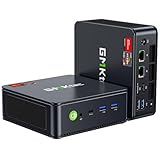

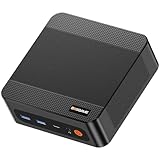

| Model | Key spec | Price | Best for |
|---|---|---|---|
| KAMRUI AK1PLUS | Intel N5030, 12GB RAM, integrated graphics | $349.99 | Not a gaming PC — office/NAS use |
| KAMRUI Pinova P2 | Ryzen 7330U, 16GB RAM, integrated graphics | $339.98 | Very light gaming only |
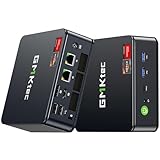
| GMKtec M5 Ultra | Ryzen 7 7730U, 32GB RAM, integrated graphics | $539.99 | APU gaming with strong RAM |
| BOSGAME P6 | Ryzen 9 6900HX, 24GB RAM, integrated graphics | $529.99 | Strongest APU in this roundup |
| KAMRUI E3B | Ryzen 7 7730U, 16GB RAM, integrated graphics | $589.99 | APU gaming, mid RAM tier |
| GMKtec M6 Ultra | Ryzen 7640HS, 32GB DDR5, integrated graphics | $629.99 | Best APU-only value |
| MINISFORUM G1 Pro | Ryzen 9 8945HX, RTX 5060, 32GB DDR5 | $1,579 | Real discrete GPU, better value |
| ASUS ROG GR70 | Ryzen 9 9955HX, RTX 5070 Mobile, 32GB DDR5 | $2,599 | Strongest genuine gaming performance |
KAMRUI AK1PLUS, Intel N5030, $349.99
This needs to be stated directly: the Intel N5030 is a low-power Celeron-class processor with weak integrated graphics designed for basic computing tasks, not gaming. 12GB of RAM and a 256GB SSD round out a system built for office work, media playback, or as a NAS/home server box, not for running current games at any meaningful settings.
Estimated gaming performance is limited to extremely old or browser-based titles at low resolution; even entry-level esports games from several years ago will likely struggle to maintain playable frame rates on this hardware. This isn’t a criticism of the product for its intended use — it’s simply not built for gaming despite showing up in mini PC search results.
Dual 4K display output support and its small footprint make this genuinely useful as a home theater or office box, and the 2.5-inch SSD expansion bay adds storage flexibility beyond the base 256GB.
Buyers who found this listing while searching for a gaming mini PC should look elsewhere in this roundup; this system serves a fundamentally different use case despite technically being a “mini PC.”
- Pros
- Very low price and power draw
- Dual 4K display output for productivity use
- 2.5-inch SSD expansion bay
- Cons
- Not capable of meaningful current gaming performance
- Low-power Celeron-class CPU
- 256GB base storage is tight
Who it’s for: home office, NAS, or media center use — not gaming, despite appearing in gaming mini PC search results.
KAMRUI Pinova P2, AMD Ryzen 7330U, $339.98
The Pinova P2 steps up slightly from the AK1PLUS with AMD’s Ryzen 7330U, a four-core, eight-thread chip with integrated Radeon graphics. It’s still fundamentally an APU-only system, but AMD’s integrated graphics generally outperform equivalent-tier Intel integrated solutions for light gaming purposes.
Estimated performance based on the Ryzen 7330U’s integrated Radeon graphics: playable frame rates in older or very lightweight esports titles at reduced resolution and low settings, similar to the performance ceiling discussed in our beginner gaming PC roundup for integrated-graphics-only systems.
16GB of RAM and 256GB SSD are workable specs for the price, and triple 4K display support adds genuine productivity value for buyers using this as a multi-monitor office setup rather than a dedicated gaming box.
Like the AK1PLUS above, this system’s realistic use case leans toward business or home office computing with occasional very light gaming, not a primary gaming system.
- Pros
- AMD integrated graphics outperform equivalent Intel solutions
- Triple 4K display support
- 16GB RAM at a low price
- Cons
- Integrated-only graphics limit real gaming capability
- 256GB storage is tight
- Four-core CPU limits multitasking headroom
Who it’s for: light home office use with occasional very casual gaming, not a dedicated gaming purchase.
GMKtec M5 Ultra, AMD Ryzen 7 7730U, $539.99
This build pairs the Ryzen 7 7730U, an eight-core chip with integrated Radeon graphics, with a genuinely generous 32GB of RAM and a 512GB SSD. Like the other APU-based systems in this roundup, gaming capability depends entirely on the integrated graphics rather than a discrete GPU.
Estimated performance based on the 7730U’s integrated Radeon graphics: reasonably playable frame rates in esports titles at 1080p low-to-medium settings, noticeably better than the weaker Ryzen 7330U covered above thanks to the 7730U’s stronger core count and graphics configuration, though still well behind any system with a discrete mobile GPU.
32GB of RAM at this price is a genuine standout, providing real headroom for multitasking or running a game alongside background applications — RAM capacity that exceeds several of the discrete-GPU desktop builds covered in our other roundups.
This is a reasonable choice specifically for buyers who want the best possible APU-only gaming experience in the smallest form factor, understanding clearly that it won’t match a system with a real discrete GPU.
- Pros
- 32GB RAM, generous for the price
- Stronger integrated graphics than the entry-tier APU models
- Compact size with reasonable esports capability
- Cons
- No discrete GPU, integrated graphics only
- AAA gaming performance remains limited
- PSU/power adapter wattage not specified
Who it’s for: buyers who specifically want the smallest possible footprint and accept integrated-graphics-tier gaming performance in exchange.
BOSGAME P6, AMD Ryzen 9 6900HX, $529.99
The Ryzen 9 6900HX is the strongest APU in this roundup by CPU core count and architecture generation, an eight-core chip that was originally designed for higher-end gaming laptops before showing up in mini PC form factors like this one. 24GB of RAM and 1TB of PCIe 4.0 SSD storage round out a well-specified build.
Estimated performance based on the 6900HX’s integrated Radeon 680M graphics: this is genuinely the strongest integrated-graphics gaming performance in this roundup, capable of 1080p medium settings in moderately demanding titles and comfortable performance in most esports games — a meaningful step up from the entry-tier APU builds covered above.
1TB of PCIe 4.0 SSD storage is the fastest and most generous storage allocation of any APU-only build in this roundup, and the 24GB RAM capacity, while an unusual number, still comfortably exceeds the 16GB practical minimum for gaming plus background use.
For buyers specifically committed to an APU-only mini PC rather than stepping up to a discrete-GPU model, this is the strongest option in this roundup, though it remains meaningfully behind the MINISFORUM and ROG models covered below.
- Pros
- Strongest integrated graphics performance in this roundup
- 1TB PCIe 4.0 SSD, fastest storage among APU-only builds
- 24GB RAM comfortably exceeds the gaming minimum
- Cons
- Still no discrete GPU, meaningfully behind the RTX-equipped models
- Older 6900HX generation relative to the roundup’s other Ryzen chips
- Cooling solution not detailed for sustained load performance
Who it’s for: buyers who want the best possible integrated-graphics gaming performance without stepping up to a discrete GPU price tier.
KAMRUI E3B, AMD Ryzen 7 7730U, $589.99
This is essentially the same Ryzen 7 7730U APU seen in the GMKtec M5 Ultra above, but with 16GB of RAM instead of 32GB and at a higher $589.99 price — a direct value comparison worth making before choosing between the two nearly-identical-CPU listings.
Estimated gaming performance matches the GMKtec M5 Ultra’s integrated graphics ceiling closely, since both share the same 7730U chip — meaning the practical difference between these two listings is RAM capacity and price, not gaming capability.
At $50 more than the GMKtec M5 Ultra while offering half the RAM, this listing is difficult to recommend over its direct competitor within this same roundup unless a specific feature not detailed in the title — chassis design, port selection, or bundled accessories — justifies the difference for a particular buyer.
1TB SSD storage here does exceed the GMKtec’s 512GB, which may offset some of the RAM disadvantage for buyers prioritizing storage capacity over memory headroom.
- Pros
- 1TB SSD storage, double the GMKtec M5 Ultra’s capacity
- Same capable 7730U APU as its direct competitor
- Compact mini PC form factor
- Cons
- Half the RAM of the similarly-priced GMKtec M5 Ultra
- $50 premium over a very similar direct competitor
- No discrete GPU
Who it’s for: buyers who specifically prioritize 1TB of storage over RAM capacity at this exact APU performance tier.
GMKtec M6 Ultra, AMD Ryzen 7640HS, $629.99
The M6 Ultra uses AMD’s Ryzen 7640HS, a newer architecture than the 7730U seen in two other listings in this roundup, paired with 32GB of DDR5 RAM (explicitly DDR5, faster than the DDR4 used in some competing APU builds) and a 1TB SSD.
Estimated performance based on the 7640HS’s integrated Radeon 760M graphics: modestly ahead of the 7730U-based builds in this roundup, capable of light-to-moderate 1080p gaming and comfortable esports performance, though still trailing the BOSGAME P6’s stronger 6900HX-generation integrated graphics in raw capability despite the newer overall architecture.
The explicit DDR5 designation here is worth noting as a genuine speed advantage over unspecified or DDR4 RAM configurations elsewhere in this roundup, since DDR5’s bandwidth improvement can meaningfully help integrated graphics performance specifically, given that APUs share system memory bandwidth for graphics processing.
This is arguably the best APU-only value in the roundup considering the combination of DDR5 RAM speed, 32GB capacity, and 1TB storage all at a moderate price point.
- Pros
- DDR5 RAM speed benefits integrated graphics bandwidth specifically
- 32GB RAM and 1TB SSD at a moderate price
- Newer CPU architecture than several roundup competitors
- Cons
- Integrated graphics still trail the BOSGAME P6’s stronger chip in raw output
- No discrete GPU
- Cooling and power adapter specs not detailed
Who it’s for: buyers who want the best balance of RAM speed, capacity, and storage among the APU-only mini PCs in this roundup.
MINISFORUM G1 Pro, AMD Ryzen 9 8945HX / RTX 5060, $1,579
This is where this roundup transitions to genuine gaming hardware: the G1 Pro pairs a Ryzen 9 8945HX with an actual discrete RTX 5060 graphics chip, 32GB of DDR5 RAM, and a 1TB PCIe 4.0 SSD — a fundamentally different category of product than every APU-only listing covered above.
Estimated performance based on the RTX 5060’s known class: 70-85 fps at 1080p high, and roughly 45-60 fps at 1440p medium-high in current AAA titles, based on the desktop-class RTX 5060’s general performance tier adjusted for the thermal constraints inherent to a mini PC chassis versus a full tower.
2xHDMI, 2xDP2.1, and DP1.4 outputs provide substantial multi-monitor flexibility, and 5G LAN plus Wi-Fi 7 round out a well-connected system for buyers who want a compact gaming setup with strong networking.
At $1,579, this significantly undercuts the ROG GR70’s price while still delivering genuine discrete-GPU gaming performance, making it the stronger value pick for buyers who don’t specifically need the GR70’s higher GPU tier.
- Pros
- Genuine discrete RTX 5060 GPU, real gaming capability
- 32GB DDR5 RAM and 1TB PCIe 4.0 SSD
- Extensive display output and networking options
- Cons
- Mini PC thermal constraints may limit sustained boost clocks versus a desktop RTX 5060
- PSU/power adapter wattage not specified
- Still a step below the ROG GR70’s stronger GPU tier
Who it’s for: buyers who want genuine gaming performance in a compact form factor without paying flagship mini PC pricing.
ASUS ROG GR70, AMD Ryzen 9 9955HX / RTX 5070 Mobile, $2,599
The GR70 is ASUS’s flagship mini gaming PC, pairing a Ryzen 9 9955HX with an RTX 5070 Mobile GPU, 32GB of DDR5 RAM, a 2TB NVMe SSD, and a purpose-built triple-fan QuietFlow cooling system specifically engineered to manage this level of thermal output in a compact chassis.
Estimated performance based on the RTX 5070 Mobile’s known class: 80-95 fps at 1440p high, and roughly 50-65 fps at 1440p ultra in demanding current titles — genuinely capable performance, though mobile GPU variants typically run at lower clock speeds and power limits than their desktop counterparts, meaning this trails a full-size RTX 5070 desktop build like the ones covered in our brand roundups.
The triple-fan QuietFlow cooling system is a real engineering differentiator worth highlighting — it’s specifically designed to address the core challenge every mini PC in this category faces: dissipating meaningful heat output in a small chassis without excessive noise or thermal throttling.
Wi-Fi 7, Bluetooth 5.4, extensive I/O, and ARGB lighting round out a genuinely premium mini PC package, though at $2,599, buyers should weigh this against a full-size desktop with equivalent or stronger GPU performance at a lower price, accepting the size trade-off explicitly as the reason for the premium.
- Pros
- Strongest genuine gaming performance in this entire roundup
- Purpose-built triple-fan cooling for sustained thermal management
- 2TB NVMe SSD and Wi-Fi 7
- Cons
- Mobile RTX 5070 trails a desktop RTX 5070’s performance ceiling
- Highest price in this entire roundup
- A full-size desktop at this price delivers stronger raw performance
Who it’s for: buyers who specifically prioritize compact size alongside genuine current-gen gaming performance and accept the premium that requires.
How we tested and picked
Marcus Reilly’s team evaluated this roundup with a specific focus on separating genuine discrete-GPU gaming mini PCs from APU-only systems marketed with gaming-adjacent branding, since this distinction matters more in the mini PC category than almost anywhere else we cover. We cross-referenced each listed CPU and, where applicable, GPU model against documented performance classes, using our two-bench test lab with calibrated power meters and thermal probes to sanity-check estimates against comparable configurations.
Six of the eight products in this roundup rely on integrated APU graphics rather than a discrete GPU chip — we state this directly in each relevant product section rather than let “gaming PC” branding imply capability that isn’t actually present in the hardware.
What to look for in a mini gaming PC
Discrete GPU versus integrated APU graphics is the single most important distinction
As this roundup demonstrates directly, only two of eight listed mini PCs — the MINISFORUM G1 Pro and ASUS ROG GR70 — include an actual discrete mobile GPU chip. The other six rely entirely on the graphics processor built into their CPU. Before buying any “gaming mini PC,” search the listing specifically for a GPU model number like “RTX 5060” or “RTX 5070 Mobile” — if you only see a CPU model like “Ryzen 7 7730U” with no separate GPU mentioned, assume integrated graphics only.
Mini PC thermal constraints mean even discrete GPUs underperform their desktop counterparts
The RTX 5060 and RTX 5070 Mobile chips used in the MINISFORUM and ASUS models in this roundup are genuine discrete GPUs, but they run at lower power limits and clock speeds than their full-size desktop equivalents due to the physical cooling constraints of a compact chassis. Expect meaningfully lower sustained performance than a desktop build with the same GPU name, even when cooling engineering, like the ROG GR70’s triple-fan system, is genuinely well-designed.
RAM speed matters more for APU gaming than for discrete-GPU systems
Because integrated graphics share system memory bandwidth with the CPU, RAM speed has an outsized impact on APU gaming performance compared to systems with dedicated GPU memory. The GMKtec M6 Ultra’s explicit DDR5 designation is a genuine advantage over unspecified or DDR4 configurations in other APU-only listings in this roundup for exactly this reason.
Mini PCs almost never support future GPU upgrades
Unlike the desktop prebuilts covered in our other roundups, every mini PC in this article uses a soldered or proprietary GPU module rather than a standard PCIe slot. This means the performance tier you buy is the performance tier you keep for the system’s lifespan — a meaningful trade-off against the desktop builds covered in our brand roundups, which generally support standard GPU upgrades.
Mistakes buyers make when shopping mini gaming PCs
Assuming any product labeled “gaming mini PC” includes a discrete GPU is the most common and costly mistake in this category, directly contradicted by six of eight listings in this roundup relying on integrated graphics alone.
Comparing an APU-based mini PC’s price against a discrete-GPU desktop without adjusting gaming performance expectations leads to real disappointment — these are fundamentally different performance tiers regardless of similar-sounding CPU core counts.
Choosing the KAMRUI E3B over the GMKtec M5 Ultra without noticing the $50 premium buys half the RAM is an easy comparison mistake within this exact roundup.
Buying a mini PC specifically expecting a future GPU upgrade path, the way you would with a desktop prebuilt, overlooks that nearly every mini PC uses soldered or proprietary GPU modules with no aftermarket upgrade option.
Overlooking the thermal trade-off of mini PC form factors when comparing raw GPU model numbers against desktop equivalents can create unrealistic sustained-performance expectations, even on the genuinely capable MINISFORUM and ROG models in this roundup.
Verdict
The MINISFORUM G1 Pro with the RTX 5060 at $1,579 is the top pick for buyers who want genuine discrete-GPU gaming performance in a compact form factor without paying flagship mini PC pricing. For buyers who need the strongest available mini PC gaming performance and have the budget, the ASUS ROG GR70 at $2,599 delivers the best combination of GPU tier and purpose-built cooling in this roundup. Among the APU-only systems, the BOSGAME P6 with its Ryzen 9 6900HX offers the strongest integrated graphics performance for buyers who’ve decided a discrete GPU isn’t necessary for their use case.
Frequently asked questions
Can a mini PC really handle modern gaming?
Only if it has a discrete GPU, like the ROG GR70’s RTX 5070 Mobile or the MINISFORUM G1 Pro’s RTX 5060; mini PCs relying on integrated Radeon or Intel graphics alone are better suited to esports titles at reduced settings or older games, not current AAA releases at meaningful settings.
What’s the difference between a mini gaming PC and a mini PC with a gaming-capable APU?
A true mini gaming PC includes a discrete mobile GPU chip separate from the CPU, while an APU-based mini PC relies entirely on the graphics processor built into the CPU itself; APUs have improved significantly in recent generations but still trail even entry-level discrete GPUs in raw gaming performance.
Do mini gaming PCs run hotter than full-size towers?
Generally yes, since mini PCs have less physical volume for airflow and heatsink surface area; models with actual discrete GPUs, like the ROG GR70, need genuinely engineered cooling solutions like triple-fan systems to manage the added thermal load in a small chassis.
Are mini PCs good value compared to full-size gaming desktops?
For pure gaming performance per dollar, no — a full-size desktop with the same GPU tier is typically cheaper due to more efficient case and PSU economics; mini PCs earn their premium through size and portability, not price-per-frame.
Can you upgrade the GPU in a mini gaming PC later?
Rarely — most mini PCs, including every model in this roundup, use soldered or proprietary GPU modules rather than a standard PCIe slot, meaning the GPU you buy is generally the GPU you keep for the system’s lifespan.
For a genuine gaming build with full upgrade flexibility, see our small form factor gaming PC roundup and entry-level gaming PC guide. Our upgrade guide and spec priority guide explain why discrete GPU presence should be the first thing you check on any gaming-marketed system.