A 4K gaming PC is the single biggest upgrade a frame-rate-obsessed player can make, yet the market is flooded with systems that claim 4K readiness while shipping GPUs that buckle under native Ultra settings. The real question when shopping in 2026 is not whether a machine runs a 4K monitor, but whether it sustains smooth frame rates in demanding AAA titles without aggressive upscaling or settings compromise. The gap between a genuinely capable system and a marketing shell often comes down to GPU tier, CPU pairing, and memory headroom.
We compared published specifications across the current crop of prebuilt systems and cross-referenced them against owner feedback on thermals, noise, and real-world gaming behavior. The eight machines below represent the range of budgets and philosophies available right now, from an entry point that gets you into 4K at lowered settings all the way to an enthusiast build with no meaningful compromises.
As an Amazon Associate we earn from qualifying purchases at no extra cost to you. Product prices and availability are accurate as of the date shown and are subject to change.


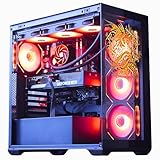

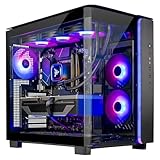
Top 3 picks at a glance
Quick Picks
| Product | Best for | Price |
|---|---|---|
| STORMCRAFT Phantom RTX 5080 | Best overall for native 4K | $3,099.99 |
| Skytech Legacy 4 | Best for no-compromise enthusiasts | $6,999.99 |
| Skytech Azure 3 | Best AMD value proposition | $2,899.99 |
| KOTIN Gaming PC | Best budget entry into 4K | $1,299.99 |
| MSI Codex R2 | Best compact and quiet build | $1,599.99 |
| Horizon Autherium Dragon | Best for creator-gamers | $2,899.99 |
| Skytech King 95 (RTX 5070 Ti) | Best balanced price-to-performance | $2,899.99 |
| Skytech King 95 (RTX 5080) | Best for heavy ray tracing at 4K | $3,699.99 |
How We Picked
We evaluated each system on four criteria: GPU tier relative to native 4K workloads, CPU-to-GPU pairing to avoid bottlenecks at high resolutions, RAM and storage headroom for current AAA titles that routinely demand 32GB-plus, and price-to-performance positioning within its tier. Systems that rely on upscaling as their primary 4K strategy were weighed accordingly, and owner-reported thermal and noise behavior informed our final rankings where spec sheets alone were ambiguous.
The 8 Best 4K Gaming PCs in 2026
STORMCRAFT Phantom RTX 5080 Gaming PC
The Phantom pairs a Ryzen 7 9800X3D with an RTX 5080 and 32GB of DDR5, which is a genuinely strong 4K combination. Owners consistently report smooth performance in native 4K on modern titles, aided by the 3D V-Cache advantage the 9800X3D brings to CPU-bound scenarios. The 2TB NVMe SSD handles large game libraries without forcing uninstall cycles.
- Pro: The 9800X3D keeps frame-time consistency high even in open-world titles
- Pro: 2TB storage and 32GB RAM are both comfortable for 2026-era AAA games
- Con: Owners note the chassis runs warm under sustained load compared to larger cases
Skippable if you want a quieter, cooler-running system and are willing to spend more for premium thermal headroom.
Skytech Gaming Legacy 4 Gaming PC
The Legacy 4 is built around the Ryzen 9 9950X3D and RTX 5090, making it the ceiling of what prebuilt 4K gaming can offer right now. There is no meaningful bottleneck at any resolution or setting combination an owner can throw at it. For streamers who game at 4K while encoding simultaneously, the multi-core headroom of the 9950X3D matters.
- Pro: No game in 2026 will challenge this GPU-CPU pairing at native 4K Ultra
- Pro: Enthusiast-tier components mean long upgrade runway before any single part limits you
- Con: The $7,000 price tag puts it outside most buyers’ reach for marginal gains over the RTX 5080 tier
Skip this if your monitor tops out at 4K 144Hz rather than 240Hz, because the performance delta over cheaper systems is invisible at common refresh rates.
Skytech Gaming Azure 3 Gaming PC
The Azure 3 uses a Ryzen 7 9850X3D paired with an RX 9070 XT, representing AMD’s answer to the mid-high 4K bracket. Owners report strong rasterization performance, though some titles still favor NVIDIA in upscaling quality. The 9850X3D brings gaming-focused cache benefits at a slightly lower cost than the 9800X3D.
- Pro: Excellent pure rasterization performance at its price point
- Pro: AMD’s platform offers strong long-term driver support across titles
- Con: Ray tracing at 4K trails the equivalent NVIDIA tiers noticeably
Skip this if heavy ray tracing is a priority or if you rely on DLSS Frame Generation for high-refresh 4K gaming.
KOTIN Gaming PC Desktop
At $1,300, the KOTIN uses an RTX 5060 Ti 8GB and Ryzen 7 8700F to deliver 4K gaming through lowered settings and upscaling. It is not a native 4K Ultra machine, but it gets a 4K monitor running smoothly in esports and older titles without breaking the budget. 16GB of DDR5 is adequate but will feel tight within a year or two.
- Pro: The lowest cost of entry to a 4K-capable desktop in this roundup
- Pro: Compact build with a reasonable thermal profile for its power envelope
- Con: 8GB VRAM on the 5060 Ti is genuinely limiting at 4K in newer AAA releases
Skip this if you want 4K at High or Ultra settings in current titles without compromise.
MSI Codex R2 Gaming Desktop PC
The Codex R2 pairs an RTX 5070 12GB with an Intel Core i5-14400F, delivering solid 4K performance through a compact air-cooled chassis. MSI’s build quality and the 32GB DDR5 RAM make it a sensible pick for buyers who value a small footprint and quiet operation over peak thermal headroom. Wi-Fi 6E and VR readiness round out the feature set.
- Pro: Compact air-cooled design suits living-room or office setups where noise matters
- Pro: 32GB RAM with a 12GB VRAM GPU provides comfortable headroom at 4K medium-High
- Con: The i5-14400F can bottleneck the 5070 in CPU-sensitive titles, though 4K largely masks it
Skip this if you want the highest possible frame rates in esports titles that stress the CPU at lower resolutions.
The Horizon Autherium Dragon RGB I9 RTX Gaming PC
With 64GB RAM, 5TB storage, an RTX 5070 OC, and a Core i9, this system is aimed at the gamer who also edits video or runs demanding productivity workloads alongside play. The 360mm AIO keeps temperatures controlled under heavy dual-use scenarios, and Windows 11 Pro adds features useful for networked or professional-adjacent environments.
- Pro: 64GB RAM and 5TB storage make it the most multitask-friendly option here
- Pro: Windows 11 Pro is a practical advantage over Home in this price bracket
- Con: The RTX 5070 is the weakest GPU relative to price in this list for pure gaming output
Skip this if you care only about gaming frame rates; a cheaper build with the same GPU exists.
Skytech Gaming King 95 Desktop PC (RTX 5070 Ti)
At $2,900, the King 95 with a 9800X3D and RTX 5070 Ti is arguably the best balance in this lineup. The 5070 Ti sits in a sweet spot for 4K gaming at High-Ultra settings in most titles, and the 360mm ARGB AIO plus 850W Gold PSU provide cooling and power headroom that budget builds lack.
- Pro: The 5070 Ti handles 4K in the vast majority of 2026 titles without aggressive upscaling
- Pro: 360mm AIO and 850W Gold PSU signal a well-considered thermal and power design
- Con: Wi-Fi implementation is basic; a dedicated adapter may be preferable for online play
Skip this only if you want ray tracing at maximum settings without DLSS assistance, which pushes you toward the 5080 tier.
Skytech Gaming King 95 Gaming PC (RTX 5080)
This variant upgrades the GPU to an RTX 5080 16GB while retaining the 9850X3D platform, 2TB NVMe SSD, and 32GB DDR5 6000. It represents the practical upper limit for most buyers who want sustained 4K ray-traced performance without entering RTX 5090 pricing territory. The 360 ARGB AIO manages the 5080’s thermals comfortably.
- Pro: 16GB VRAM on the RTX 5080 future-proofs against texture-heavy 4K titles
- Pro: The 9850X3D and 5080 combination is among the most balanced high-end pairings available
- Con: Wi-Fi 5 is surprisingly dated at this price compared to Wi-Fi 6E on cheaper systems
Skip this if your monitor is 4K 60Hz, since the performance advantage over the 5070 Ti tier goes unnoticed at lower refresh rates.
Buying Guide
GPU Tier Determines Your 4K Reality
The GPU is the single most important component for a 4K gaming PC. In 2026, the RTX 5080 and RX 9070 XT tiers handle native 4K at High-Ultra settings in most titles, while the RTX 5070 and 5070 Ti tiers require a mix of upscaling and setting adjustments to stay above 60fps in the heaviest releases. The RTX 5060 Ti 8GB is realistically a 1440p GPU that can hit 4K only at lowered settings. VRAM matters at 4K because texture loads scale sharply with resolution; 12GB is the practical floor, and 16GB provides genuine breathing room.
CPU Pairing Avoids Wasted GPU Performance
At 4K, the GPU does the heavy lifting, so CPU demands are lower than at 1080p or 1440p. However, a severely underpowered CPU can still throttle frame-time consistency in simulation-heavy or open-world titles. Ryzen 7-class chips with 3D V-Cache (the 9800X3D and 9850X3D) deliver the best gaming frame consistency in this roundup, while the Core i5-14400F is adequate at 4K but leaves headroom on the table. Match your CPU to at least the tier of your GPU rather than cutting corners on the processor.
RAM and Storage Are the Silent Killers
Modern AAA titles are increasingly hungry for memory beyond 16GB, and background applications, browser tabs, and Discord push practical usage higher. Thirty-two gigabytes of DDR5 is the safe minimum for a 4K gaming PC in this price range, while 64GB suits streamers or those who keep demanding workloads running alongside play. On storage, 2TB NVMe is the realistic minimum for a library of five or six current-generation titles; anything less and you will face frequent install management.
Our Verdict
The top pick is the STORMCRAFT Phantom RTX 5080, which delivers the best native 4K gaming experience without enthusiast pricing. For the tightest budget that still produces acceptable 4K output, the KOTIN Gaming PC at $1,300 is the clear entry point, provided you accept lowered settings in newer titles. The Skytech King 95 with the RTX 5070 Ti wins instead if your priority is the best price-to-performance ratio in the $2,900 bracket, because the 5070 Ti’s capabilities overlap heavily with the 5080 in rasterized 4K workloads at a meaningful discount.
FAQ
Is 32GB RAM enough for a 4K gaming PC?
Yes, 32GB is the comfortable standard for 4K gaming in 2026 and handles current AAA titles alongside background applications without pressure. You would only need more if you stream, run virtual machines, or edit video concurrently with gaming.
Can an RTX 5060 Ti run games at 4K?
It can render at 4K using lowered settings and upscaling technologies, but it will not sustain high frame rates at 4K in demanding new releases. For a genuine native 4K experience, the RTX 5070 or above is the practical floor.
Is a 4K gaming PC worth it over a 1440p system?
It depends on your monitor and the games you play. If you own a 4K display with 120Hz or higher refresh, a capable 4K GPU pays off immediately in visual clarity. For competitive esports players chasing the highest frame rates, 1440p systems deliver more FPS per dollar and are the smarter choice.
Do I need Windows 11 Pro for a 4K gaming PC?
No. Windows 11 Home handles every game and upscaling feature without issue. Pro adds BitLocker, remote desktop, and domain join, which matter for work or security-conscious users but provide no gaming performance advantage.