A network-attached storage drive is the component that determines whether your home server or small office backup system hums along for years or fails at 2 a.m. on a Sunday. The problem every buyer faces is the same: general-purpose desktop drives are not built for continuous operation, RAID arrays, or multi-user access, yet the price gap between consumer and NAS-rated hardware can make the choice feel confusing. A proper nas drive is engineered for sustained 24/7 duty cycles, vibration tolerance in multi-bay enclosures, and firmware that cooperates with RAID controllers rather than fighting them.
What separates a good NAS drive from a mediocre one in 2026 comes down to three things: recording technology (CMR versus SMR), workload design targets, and whether the drive includes recovery services or advanced vibration compensation. Capacity and spindle speed matter, but they are secondary to these fundamentals. On the appliance side, a complete NAS unit adds another layer of decision-making around bay count, processor capability, and software ecosystem. This roundup covers both standalone drives and pre-built NAS systems so you can see where each option fits.
As an Amazon Associate we earn from qualifying purchases at no extra cost to you. Product prices and availability are accurate as of the date shown and are subject to change.





Top 3 picks at a glance
Quick Picks
| Product | Best for | Price |
|---|---|---|
| Seagate 8TB IronWolf | Large-capacity NAS expansion | $329.99 |
| Seagate IronWolf 4TB | Budget CMR NAS drive with rescue coverage | $189.99 |
| Seagate 8TB BarraCuda | Single-drive desktop or simple NAS enclosures | $279.99 |
| WD Red Plus 4TB | Entry-level RAID arrays | $194.99 |
| WD Red Pro 16TB | High-performance multi-bay NAS | $704.99 |
| UGREEN DXP2800 | Creators needing a ready-to-run NAS | $389.99 |
| BUFFALO LinkStation 210 | One-bay home cloud on a tight budget | $153.99 |
| WD Red Plus 12TB | Dense, quiet NAS arrays | $459.99 |
How We Picked
We narrowed this list by prioritizing drives and appliances that meet NAS-grade durability expectations: CMR recording at minimum, a 3.5-inch form factor with SATA 6 Gb/s interface, and published specs indicating suitability for multi-bay or 24/7 environments. On the appliance side, we looked at processor class, bay count relative to price, and whether the system ships with storage included. Owner feedback on reliability over the first year and software support quality served as tiebreakers where spec sheets overlapped.
The 8 Best Nas Drive in 2026
Seagate 8TB IronWolf Internal NAS Hard Drive (ST8000VNZ04)
This is the go-to capacity play for anyone filling a four-bay or larger enclosure who does not want to spend Red Pro money. IronWolf drives use CMR technology and include Rotational Vibration sensors, which keeps performance stable when multiple disks vibrate in close proximity.
- Pro: 8TB in a single CMR drive avoids the capacity-per-dollar cliff that smaller NAS drives hit.
- Pro: Integrated RV sensors make it genuinely suitable for multi-bay chassis.
- Con: At 7200 RPM it runs warmer and louder than 5400 RPM alternatives in quiet environments.
Skip it if your enclosure holds only one or two bays and silence matters more than sustained multi-user throughput.
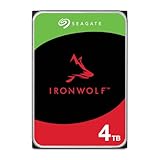
Seagate IronWolf 4TB NAS Internal Hard Drive (ST4000VNZ06/006)
The 4TB IronWolf at 5400 RPM with 64MB cache is the quiet, efficient choice for two-bay home NAS units or small office servers. The inclusion of Seagate Rescue Services covers data recovery if the drive fails within its service window, a meaningful safety net for a nas drive holding irreplaceable family photos or project files.
- Pro: Rescue Services add recovery coverage without extra subscription cost.
- Pro: 5400 RPM operation keeps power draw and noise low for living-room placement.
- Con: 64MB cache is modest; sequential write bursts will drain it faster than larger-cache competitors.
Skip it if you are building a RAID 5 or 6 array with more than three members where sustained write performance is critical.
Seagate 8TB BarraCuda Internal Hard Drive (ST8000DM004)
BarraCuda is a desktop drive, not a NAS drive, and it does not pretend otherwise. At $279.99 it undercuts the IronWolf 8TB by fifty dollars, making it tempting for a single-drive NAS or a media server where you never run RAID. Owner feedback notes it works fine in one-bay enclosures, but vibration tolerance and firmware RAID optimization are absent.
- Pro: Lowest 8TB price on this list by a clear margin.
- Pro: SATA 6 Gb/s interface and 3.5-inch form factor fit standard bays without issue.
- Con: SMR recording technology can cause write performance drops during sustained multi-user access.
Skip it entirely if your NAS runs in a multi-bay chassis or supports simultaneous streaming to several devices.
Western Digital 4TB WD Red Plus NAS Internal Hard Drive (WD40EFZZ)
WD Red Plus occupies the same 5400 RPM, CMR, 3.5-inch slot as its IronWolf rival but doubles the cache at 128MB. For a two-bay home NAS serving a handful of users, that cache headroom smooths out random-access patterns without the noise penalty of a faster spindle. It is the conservative, dependable nas drive choice.
- Pro: 128MB cache is twice the IronWolf 4TB, improving sustained mixed-read workloads.
- Pro: NASware firmware coordinates cleanly with Synology, QNAP, and Asustor RAID managers.
- Con: Five dollars more than the IronWolf 4TB without Rescue Services bundled in.
Skip it if you need drive-level data recovery coverage and do not want to budget for a separate service plan.
Western Digital 16TB WD Red Pro NAS Internal Hard Drive (WD161KFGX)
The Red Pro 16TB is the heavyweight here: 7200 RPM, 512MB cache, and CMR recording in the highest capacity WD offers on this list. It targets studios, home labs, and small offices running four or more bays where aggregate throughput under load justifies the premium. This is a nas drive built for people who fill arrays to capacity and expect consistent performance.
- Pro: 512MB cache and 7200 RPM sustain high multi-stream workloads better than any other drive listed.
- Pro: 16TB capacity reduces the number of drives needed in large arrays, cutting power and space.
- Con: The $704.99 price tag puts it in SSD territory for smaller capacities, narrowing its value window.
Skip it if your array has fewer than four bays or your workload is mostly cold storage accessed infrequently.
UGREEN NAS DXP2800 2-Bay
UGREEN has moved aggressively into the pre-built NAS space, and the DXP2800 targets advanced home users and remote workers who want an Intel-class processor, fast networking, and a polished software stack without sourcing drives separately. It is not a nas drive in the traditional sense but a complete appliance that accepts standard 3.5-inch drives.
- Pro: Ships with modern hardware that outpaces many similarly priced Synology and QNAP models.
- Pro: Two-bay layout supports RAID 1 redundancy out of the box for critical files.
- Con: Does not include drives, so total cost rises once you add two IronWolf or Red Plus units.
Skip it if you prefer to buy drives first and add the enclosure later, or if you need more than two bays.
BUFFALO LinkStation 210 2TB 1-Bay NAS
At $153.99 with a 2TB drive already installed, the LinkStation 210 is the cheapest path to a working home cloud. One bay means no redundancy, so treat it as a convenience layer for backups and media streaming rather than primary storage. The included drive is a standard 3.5-inch unit designed for this chassis.
- Pro: Lowest total entry cost for a functioning NAS with storage included.
- Pro: Simple setup with a browser-based interface suits non-technical household members.
- Con: Single bay eliminates any possibility of data protection through RAID.
Skip it if the data stored is not duplicated elsewhere, because a drive failure here means permanent loss.
Western Digital 12TB WD Red Plus NAS Internal Hard Drive (WD120EFGX)
Stepping up from the 4TB Red Plus, this 12TB variant runs at 7200 RPM with a 512MB cache while retaining the Plus-line emphasis on quiet, efficient operation. It suits three- or four-bay NAS units where you want high density without paying Red Pro prices. For a mixed home and small-office environment, this is the sweet-spot nas drive on capacity-per-dollar.
- Pro: 12TB capacity fills a four-bay array to 48TB raw with minimal spindle noise.
- Pro: 7200 RPM and 512MB cache deliver throughput close to Red Pro at significantly lower cost.
- Con: Lacks the extended workload ratings and vibration sensors that Red Pro includes for five-plus bay chassis.
Skip it if you are building a server with five or more bays where sustained vibration compensation becomes necessary.
Buying Guide
CMR vs. SMR Recording
Shingled Magnetic Recording packs tracks closer together for higher density but degrades write performance once the drive’s cache fills. In a NAS serving multiple users or running background RAID scrubbing, that slowdown compounds into timeouts and degraded array health. Always confirm a drive uses Conventional Magnetic Recording before adding it to a network-attached system.
Spindle Speed and Cache Size
5400 RPM drives are quieter and draw less power, making them ideal for living rooms or bedrooms. 7200 RPM drives deliver higher sustained throughput for multi-stream media servers and virtualization workloads. Cache size acts as a buffer: larger caches (128MB and above) reduce visible performance dips during write bursts, which matters most in RAID rebuild scenarios.
Vibration Tolerance and Bay Count
Every additional 3.5-inch drive in an enclosure adds mechanical vibration. Drives with Rotational Vibration sensors compensate in real time, preserving seek performance. If your chassis holds four or more bays, prioritize RV-sensor-equipped models or move into Pro-class drives that include them as standard.
Our Verdict
Our top pick is the Western Digital 16TB WD Red Pro (WD161KFGX) for anyone building a serious multi-bay NAS where performance at capacity matters and budget allows. The budget pick is the Seagate IronWolf 4TB (ST4000VNZ06/006), which pairs CMR reliability, low noise, and Rescue Services coverage at an accessible price. If you want a complete working system without sourcing components yourself, the UGREEN DXP2800 wins the convenience category despite lacking bundled drives.
FAQ
Can I use a regular desktop drive in a NAS?
You can physically install one, and single-bay enclosures tolerate them for light workloads. However, desktop drives typically lack CMR recording, vibration tolerance, and RAID-friendly firmware, so they degrade faster and cause more array errors under sustained multi-user access.
Do I need to buy drives separately for a NAS appliance?
Most consumer NAS units from UGREEN, Synology, and QNAP ship without drives to let you choose capacity and brand. Pre-filled options like the BUFFALO LinkStation 210 include a drive, but you sacrifice the ability to select a CMR model if the bundled unit uses SMR.
How many bays should a home NAS have?
Two bays cover the redundancy requirement for most households running RAID 1. Four bays allow RAID 5 or 6, giving you usable capacity closer to raw totals plus a second drive failure margin. Beyond four, vibration management and power draw start to influence drive selection more heavily.
Is a faster spindle always better for NAS?
No. A 7200 RPM drive in a single-bay unit serving occasional file access wastes power and adds noise with no perceptible benefit. Match spindle speed to workload intensity: 5400 RPM for backup and streaming, 7200 RPM for simultaneous multi-user reads and writes.