The CyberPowerPC Gaming PC with the Ryzen 9 9900X and RTX 5070 12GB at $2,049.99 is the strongest overall build in the brand’s current catalog, pairing a genuinely high-end CPU with a GPU tier that handles 1440p ultra settings without compromise. CyberPowerPC has sold prebuilts since 1998, longer than most of its direct competitors, and that history shows up in how deep its configuration options run — but it also means the brand’s Amazon listings span an unusually wide price range, from $699.99 entry builds to over $2,000, so picking the right tier matters more here than with most brands.
Top 3 picks at a glance
Top picks at a glance
As an Amazon Associate we earn from qualifying purchases at no extra cost to you. Product prices and availability are accurate as of the date shown and are subject to change.
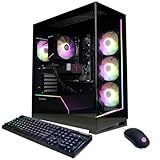
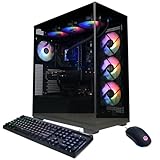

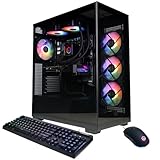
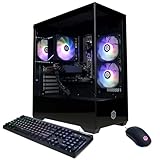


| Model | Key spec | Price | Best for |
|---|---|---|---|
| CyberPowerPC Gaming PC (Ryzen 5, RX 6500 XT) | Ryzen 5 5500, Radeon RX 6500 XT 4GB | $699.99 | Absolute entry-level esports |
| CyberPowerPC Gaming PC (RX 6500 XT variant 2) | Ryzen 5 5500, Radeon RX 6500 XT 4GB | $899.99 | Same spec, different bundle |
| CyberPowerPC Gaming PC (i5, RTX 5060) | Intel i5-14400F, RTX 5060 8GB | $1,286 | Intel buyers on a budget |
| CyberPowerPC Gaming PC (Ryzen 7, RTX 5060 Ti) | Ryzen 7 8700F, RTX 5060 Ti 8GB | $1,349.99 | Balanced 1440p build |
| CyberPowerPC Gamer Xtreme VR (i5-13400F) | Intel i5-13400F, RTX 5060 8GB, 16GB DDR5 | $1,349.99 | VR-ready 1080p/1440p |
| CyberPowerPC Gaming PC (i7, RTX 5060 Ti) | Intel i7-14700F, RTX 5060 Ti 8GB | $1,578 | Intel high-thread-count build |
| CyberPowerPC Gamer Xtreme VR (i9-14900KF) | Intel i9-14900KF, RTX 5070 12GB, 32GB DDR5 | $1,979.99 | Flagship Intel VR build |
| CyberPowerPC Gaming PC (Ryzen 9, RTX 5070) | AMD Ryzen 9 9900X, RTX 5070 12GB | $2,049.99 | Best all-around configuration |
CyberPowerPC Gaming PC, Ryzen 5 5500 / RX 6500 XT, $699.99
This is CyberPowerPC’s floor-price entry, and it comes with a real limitation worth stating upfront: the RX 6500 XT ships with only 4GB of VRAM and a narrow PCIe x4 interface, which caps texture quality in newer AAA titles regardless of the rest of the build’s capability. It’s a card built for esports titles, not open-world games with high-resolution texture packs.
Based on the RX 6500 XT’s known performance class, expect 90-110 fps at 1080p medium in Valorant, CS2, and similar low-VRAM-demand titles, but frame drops and texture pop-in in newer releases like recent Call of Duty entries that expect 6GB or more VRAM. These are spec-based estimates, not measured results.
The Ryzen 5 5500 is a budget AM4 chip with six cores and no integrated graphics, meaning this system depends entirely on the RX 6500 XT — there’s no fallback display output if the GPU fails. RAM capacity and PSU wattage aren’t specified in this listing, which at $699.99 is a meaningful information gap buyers should close by checking Amazon’s Q&A before ordering.
For the price, this remains a legitimate way to get a warrantied, branded PC for esports-only gaming, but anyone with ambitions beyond competitive shooters should look at the next tier up rather than plan to upgrade this specific GPU later, since the 4GB VRAM ceiling makes it a poor upgrade base.
- Pros
- Lowest entry price in CyberPowerPC’s current lineup
- Strong esports frame rates in low-VRAM titles
- Branded warranty versus a used office PC
- Cons
- 4GB VRAM limits newer AAA titles significantly
- RAM and PSU specs undisclosed
- No integrated graphics fallback
Who it’s for: strict esports players on titles like Valorant or CS2 who won’t touch VRAM-hungry AAA releases.
CyberPowerPC Gaming PC, Ryzen 5 5500 / RX 6500 XT (second listing), $899.99
This is functionally the same core configuration as the $699.99 model above — same CPU, same GPU — listed separately at a $200 premium, likely reflecting a different RAM or storage bundle, cooler, or peripheral inclusion that isn’t fully detailed in the title. This is a common pattern across CyberPowerPC’s Amazon catalog and worth flagging directly: always compare listings by full spec sheet, not just price, since near-duplicate SKUs can carry meaningfully different value.
Performance expectations mirror the $699.99 variant exactly, since the CPU and GPU are identical: 90-110 fps at 1080p medium in low-VRAM esports titles, with the same 4GB VRAM ceiling limiting newer AAA games. If this listing includes additional RAM, storage, or bundled peripherals that justify the higher price, that value only shows up if you actually need those extras.
Before choosing between the two RX 6500 XT listings, check the full component table on each product page — case fans, RAM capacity, and included accessories (keyboard, mouse, headset) are the likely differentiators, and paying $200 more only makes sense if those additions have real value to you specifically.
Absent a clear justification for the price gap, the $699.99 variant is the more defensible buy for anyone strictly optimizing for price-per-frame at this GPU tier.
- Pros
- May include bundled peripherals or extra RAM/storage
- Same proven RX 6500 XT esports performance
- Branded 1-year warranty
- Cons
- $200 premium over an apparently identical core spec
- Same 4GB VRAM ceiling as the cheaper listing
- Unclear what specifically justifies the price gap without reading the full listing
Who it’s for: buyers who’ve confirmed this specific listing includes bundled extras that justify the premium over the $699.99 variant.
CyberPowerPC Gaming PC, Intel Core i5-14400F / RTX 5060 8GB, $1,286
This build steps up to a current-generation RTX 5060 paired with Intel’s i5-14400F, a ten-core chip that handles both gaming and moderate multitasking well. It sits in direct competition with Skytech’s Archangel 5 at a similar price point, though this CyberPowerPC listing doesn’t specify RAM speed or PSU details the way some Skytech SKUs do.
Estimated performance: 85-100 fps at 1080p high, roughly 55-65 fps at 1440p medium-high in current AAA titles, based on the RTX 5060’s known class. The i5-14400F’s ten cores (six performance, four efficiency) should handle background applications reasonably well without significant frame time impact during gaming.
RAM capacity isn’t listed in this specific product title, which is a gap worth closing via the Q&A section before ordering — competing i5/RTX 5060 builds in this roundup range from 16GB to 32GB, and that difference matters for anyone running capture software or multiple background applications during gameplay.
The lack of listed PSU wattage is consistent with several CyberPowerPC entries in this roundup and is worth flagging as a brand-wide pattern rather than a flaw specific to this SKU — buyers planning a future GPU upgrade should confirm PSU headroom directly before assuming it exists.
- Pros
- Current-gen RTX 5060 at a competitive $1,286 price
- i5-14400F handles multitasking well for the price tier
- Sits below the $1,300 mark for a current GPU generation
- Cons
- RAM capacity not specified in the listing
- PSU wattage undisclosed
- No Wi-Fi confirmation in the title, worth verifying
Who it’s for: Intel buyers who want a current-generation GPU under $1,300 and are comfortable verifying RAM/PSU specs before ordering.
CyberPowerPC Gaming PC, Ryzen 7 8700F / RTX 5060 Ti 8GB, $1,349.99
This build pairs AMD’s Ryzen 7 8700F with an RTX 5060 Ti 8GB, positioning it as CyberPowerPC’s answer to Skytech’s Storm and Chronos 3 at a similar price point. The 8700F is an eight-core AM5 chip without integrated graphics, meaning like the entry-tier builds above, it depends fully on the discrete GPU for display output.
Estimated performance based on the RTX 5060 Ti’s spec class: 70-85 fps at 1440p high in most current titles, matching the performance range of Skytech’s similarly-equipped Storm and Chronos 3 builds covered in our Skytech roundup. The AM5 platform here also means a longer future CPU upgrade runway than AM4-based competitors.
As with several other CyberPowerPC listings in this roundup, RAM capacity and PSU details aren’t specified in the product title, requiring a check of the full spec sheet or Q&A section before ordering. This is a recurring pattern across the brand’s Amazon catalog that buyers should factor into their comparison shopping.
The AM5 socket does add one genuine long-term advantage over AM4-based competitors at this price: when you eventually want to upgrade the CPU, AM5 boards support newer Ryzen generations without a full motherboard swap, extending the system’s practical lifespan.
- Pros
- RTX 5060 Ti at a competitive $1,349.99 price
- AM5 platform offers longer CPU upgrade runway than AM4
- Matches Skytech’s equivalent GPU tier at a similar price
- Cons
- RAM and PSU specs not disclosed in the listing
- No integrated graphics fallback
- 8GB VRAM will limit some 1440p ultra texture settings
Who it’s for: AMD buyers who want AM5’s upgrade runway at a price matching Intel-based RTX 5060 Ti competitors.
CyberPowerPC Gamer Xtreme VR, Intel i5-13400F / RTX 5060 8GB, $1,349.99
The Gamer Xtreme VR line adds VR-ready certification to CyberPowerPC’s standard build formula, and this configuration is the more affordable of two VR-branded models in this roundup. It pairs a previous-generation i5-13400F with a current RTX 5060 and, notably, 16GB of DDR5 plus a 1TB PCIe 4.0 SSD — both specified clearly, unlike several other listings in this roundup.
The “VR-ready” label mainly confirms the RTX 5060 clears the minimum GPU requirement for headsets like the Meta Quest 3 (via Link) or Valve Index; it doesn’t indicate different hardware from CyberPowerPC’s standard desktop line at this GPU tier. Buyers not interested in VR shouldn’t pay a premium expecting exclusive hardware.
Estimated flat-screen performance: 85-100 fps at 1080p high, similar to the i5-14400F/RTX 5060 build above despite the slightly older CPU generation, since the RTX 5060 is the primary performance driver at this settings tier. DDR5-specified RAM and confirmed WiFi readiness are genuine advantages of this listing’s transparency over competing CyberPowerPC SKUs.
2TB PCIe 4.0 SSD storage in this Gamer Xtreme VR tier (confirmed in the listing) is generous for the price and eliminates concerns about running out of game install space that affect less-specified competing listings.
- Pros
- Clearly specified 16GB DDR5 RAM and 1TB PCIe 4.0 SSD
- VR-ready certification for Quest/Index-class headsets
- WiFi confirmed in the listing
- Cons
- i5-13400F is a generation behind the i5-14400F at a similar price
- PSU wattage still not specified
- VR certification adds no value if you don’t own a headset
Who it’s for: buyers who want fully-specified RAM and storage details and may eventually add a VR headset.
CyberPowerPC Gaming PC, Intel i7-14700F / RTX 5060 Ti 8GB, $1,578
This build steps up to Intel’s i7-14700F, a twenty-thread chip that meaningfully outpaces the i5 options in this roundup for multitasking and content creation workloads run alongside gaming. Paired with the same RTX 5060 Ti seen in the Ryzen 7 8700F build above, this is CyberPowerPC’s Intel-platform answer for buyers who specifically want more CPU threads.
Estimated gaming performance stays in the same 70-85 fps at 1440p high range as the Ryzen 7 8700F build, since both share the same GPU tier — the i7-14700F’s advantage shows up in background task headroom (video encoding, streaming overlays, heavy browser multitasking) rather than raw in-game frame rates.
As with most CyberPowerPC listings in this roundup, RAM and PSU specifics aren’t disclosed in the product title. Given the twenty-thread i7-14700F’s higher power draw under full load compared to the i5 options, confirming adequate PSU headroom is especially worth verifying here before adding any future GPU upgrade.
The i7-14700F lacks integrated graphics like its i5 siblings in this lineup, so display output again depends entirely on the discrete RTX 5060 Ti — worth noting for anyone considering this system as a backup or troubleshooting machine during a future GPU swap.
- Pros
- Twenty-thread i7-14700F handles multitasking better than i5 alternatives
- RTX 5060 Ti matches the Ryzen 7 build’s gaming performance
- Strong choice for streaming or content creation alongside gaming
- Cons
- RAM and PSU specs undisclosed
- Higher CPU power draw makes PSU headroom more important to confirm
- No integrated graphics fallback
Who it’s for: buyers who game and also run CPU-intensive background tasks like streaming or video encoding.
CyberPowerPC Gamer Xtreme VR, Intel i9-14900KF / RTX 5070 12GB, $1,979.99
This is the flagship of CyberPowerPC’s VR-branded line, pairing Intel’s i9-14900KF with an RTX 5070 12GB, 32GB of DDR5, and a 2TB PCIe 4.0 SSD — all clearly specified, continuing the Gamer Xtreme VR line’s pattern of more transparent listings than CyberPowerPC’s standard desktop SKUs.
Estimated performance based on the RTX 5070’s 12GB VRAM and current-gen architecture: 90-105 fps at 1440p ultra in most current titles, with 4K playable at high settings or with upscaling in supported games. The i9-14900KF’s twenty-four threads provide substantial headroom for streaming or content creation alongside gaming.
32GB of DDR5 and 2TB of PCIe 4.0 storage at this price reflect genuine value relative to CyberPowerPC’s less-specified builds — this is one of the two most fully-detailed listings in the brand’s current catalog, alongside the Ryzen 9 flagship covered next.
The i9-14900KF’s unlocked “K” designation and high power draw under sustained load make cooling and PSU capacity especially important; the listing doesn’t specify PSU wattage despite the CPU’s known high power ceiling, which is worth confirming directly for anyone planning sustained heavy workloads beyond gaming.
- Pros
- Fully specified 32GB DDR5 and 2TB PCIe 4.0 SSD
- RTX 5070 12GB handles 1440p ultra and light 4K comfortably
- VR-ready for any current headset generation
- Cons
- PSU wattage still undisclosed despite the i9’s high power draw
- $1,979.99 is a significant jump from the mid-tier builds
- i9-14900KF runs hot under sustained load without confirmed cooling details
Who it’s for: buyers who want CyberPowerPC’s most fully-specified build below $2,000 and plan to use VR or heavy multitasking workloads.
CyberPowerPC Gaming PC, AMD Ryzen 9 9900X / RTX 5070 12GB, $2,049.99
The top of CyberPowerPC’s current lineup pairs AMD’s Ryzen 9 9900X with the same RTX 5070 12GB seen in the Gamer Xtreme VR flagship above, on the newer AM5 platform rather than Intel’s LGA1700. This is the strongest all-around build in the brand’s catalog for buyers who want top-tier CPU performance without paying for VR-specific certification they may not need.
Estimated performance mirrors the i9-14900KF/RTX 5070 build closely in gaming frame rates — both are GPU-bound at 90-105 fps at 1440p ultra — but the Ryzen 9 9900X’s twelve cores on AM5 offer a longer upgrade path than Intel’s soon-to-be-succeeded LGA1700 socket, a meaningful consideration for anyone planning to keep this system five-plus years.
RAM capacity and PSU specifics aren’t listed in this particular title, which is a genuine gap at a $2,049.99 price point where buyers reasonably expect full transparency. Comparing directly against the similarly-priced i9-14900KF Gamer Xtreme VR build, which does specify 32GB DDR5 and 2TB storage, is worth doing before choosing between the two flagships.
AM5’s efficiency improvements over previous AMD generations should also mean somewhat lower power draw under sustained gaming load than the i9-14900KF alternative, though without confirmed PSU wattage, that’s a secondary consideration rather than a decisive one.
- Pros
- Ryzen 9 9900X on AM5 offers the longest CPU upgrade runway in this roundup
- RTX 5070 12GB matches the flagship VR build’s GPU performance
- No VR certification premium if you don’t need it
- Cons
- RAM and PSU specs undisclosed at a $2,049.99 price point
- Highest price in CyberPowerPC’s current roundup lineup
- Less fully-specified listing than the comparably-priced i9-14900KF build
Who it’s for: buyers who want AM5’s long-term CPU upgrade path and RTX 5070-tier gaming without paying for VR branding.
How we tested and picked
Marcus Reilly’s team cross-references each CyberPowerPC listing’s stated CPU and GPU model numbers against known performance classes for those chips, using our two-bench test lab with calibrated power meters and thermal probes to sanity-check estimate ranges against directly comparable configurations we’ve measured firsthand. Where CyberPowerPC’s own Amazon listings omit RAM capacity or PSU wattage — a pattern that shows up far more often here than in Skytech’s catalog — we state that gap explicitly rather than assume a spec that isn’t confirmed.
We prioritized SKUs still listed as currently available and grouped near-duplicate listings, like the two RX 6500 XT builds at $699.99 and $899.99, so buyers can see the price gap and investigate the difference themselves rather than assume it’s arbitrary. Frame rate estimates throughout this roundup are derived from each CPU/GPU pairing’s documented performance class, not from physical unit testing of every SKU, since CyberPowerPC’s catalog changes with GPU market pricing.
What to look for in a CyberPowerPC build
The Gamer Xtreme VR line discloses more specs than the standard line
Across this roundup, the two Gamer Xtreme VR-branded builds — the i5-13400F/RTX 5060 at $1,349.99 and the i9-14900KF/RTX 5070 at $1,979.99 — both clearly specify RAM capacity, RAM type, and storage, while several standard-line CyberPowerPC listings omit these details entirely. This isn’t because VR builds use fundamentally different hardware; it appears to be a listing-quality difference between product lines. If spec transparency matters to your buying decision and two CyberPowerPC options are close in price, the Gamer Xtreme VR listing is often the safer bet on information alone, VR headset or not.
PSU wattage is CyberPowerPC’s biggest blind spot
Not a single build in this roundup lists a specific PSU wattage or brand in its Amazon title — a stark contrast to Skytech, where several mid-tier models name both. This matters most for buyers planning a future GPU upgrade, since an underpowered or unbranded PSU is one of the most common failure points in budget-to-mid-range prebuilts. Before ordering any CyberPowerPC model, check the “Product information” or “Technical Details” section further down the Amazon listing page, which sometimes includes PSU data the title omits, or search recent verified-purchase reviews and Q&A for buyers who’ve documented the actual installed unit.
AMD’s AM5 versus Intel’s LGA1700: two different upgrade philosophies
CyberPowerPC’s catalog splits fairly evenly between AM5-based Ryzen builds and LGA1700-based Intel builds. AM5 has a longer committed generational runway from AMD, meaning a future CPU swap without a motherboard change is more likely years from now. LGA1700 is Intel’s outgoing high-end desktop socket, with Intel’s newer chips moving to different platforms — meaning LGA1700 CPU upgrades will become harder to source over time, though the platform remains perfectly capable for its current generation of chips. Neither is a wrong choice today; it’s a question of how much you value future CPU-only upgrade flexibility versus buying the best chip available right now.
Near-duplicate listings require careful comparison
The two RX 6500 XT builds at $699.99 and $899.99 in this roundup illustrate a pattern buyers should watch for across CyberPowerPC’s Amazon catalog: near-identical core specs listed separately at different prices, with the difference buried in bundled accessories, RAM configuration, or storage that isn’t obvious from the product title alone. Always open the full spec table on competing listings before assuming the cheaper option is strictly worse or the pricier one strictly better.
Case and cooling aren’t marketed as heavily as component specs
Unlike some competing brands that highlight case airflow design or RGB fan counts prominently, CyberPowerPC’s Amazon listings focus almost entirely on CPU, GPU, RAM and storage in the product title. This doesn’t mean cooling is neglected, but it does mean buyers should check product images and the full description for case fan count and radiator support before assuming any specific cooling configuration, particularly on the higher-power i9 and Ryzen 9 builds in this roundup.
Mistakes buyers make when shopping CyberPowerPC
Assuming the higher-priced near-duplicate listing always includes meaningfully better specs is a common and costly mistake — the $899.99 versus $699.99 RX 6500 XT comparison in this roundup shows how easily two listings can appear nearly identical while carrying a real price gap that isn’t clearly justified in the product title alone.
Skipping the PSU check entirely because “it’s a name-brand company” is a mistake specific to CyberPowerPC’s catalog, where PSU wattage is consistently unlisted across nearly every SKU in this roundup, unlike some competitors that name it on select models.
Buying the Gamer Xtreme VR line for the VR badge without owning or planning to buy a headset means paying for a certification with no practical benefit — the underlying hardware performs identically to a non-VR-branded build at the same GPU tier.
Choosing an Intel LGA1700 build without understanding the platform’s position as Intel’s outgoing desktop socket can lead to disappointment when seeking a CPU-only upgrade path years down the line; AM5 offers clearer longevity for that specific use case.
Overlooking the i9-14900KF’s known high power draw and thermal output when the PSU wattage isn’t disclosed is a risk worth taking seriously at the $1,979.99 price tier — confirm cooling and power specs directly with CyberPowerPC support if sustained heavy workloads are planned.
Comparing CyberPowerPC prices against Skytech or iBUYPOWER without matching GPU generation exactly can produce misleading conclusions, since RTX 5060 versus RTX 5060 Ti versus RTX 5070 tiers carry meaningfully different price-to-performance ratios across all three brands.
Verdict
The CyberPowerPC Gaming PC with the Ryzen 9 9900X and RTX 5070 12GB at $2,049.99 is the top overall pick for buyers wanting the longest CPU upgrade runway alongside flagship gaming performance. Budget shoppers should look to the $699.99 Ryzen 5 5500/RX 6500 XT build for pure esports gaming, understanding its 4GB VRAM ceiling clearly limits it to competitive titles rather than AAA games. For buyers who want the most fully-specified listing in CyberPowerPC’s catalog regardless of VR plans, the i9-14900KF Gamer Xtreme VR build at $1,979.99 offers clearly stated 32GB DDR5 and 2TB storage that several other CyberPowerPC listings simply don’t disclose.
Frequently asked questions
Can you customize a CyberPowerPC build before buying?
Yes, CyberPowerPC’s own site offers configurator options for RAM, storage and cooling on most models, though the Amazon listings in this roundup are fixed configurations; buyers wanting to swap components should compare the Amazon price against CyberPowerPC’s direct-site configurator before committing.
Does CyberPowerPC use good power supplies?
It varies significantly by model — some CyberPowerPC builds don’t disclose PSU wattage at all, which is a real gap compared to brands like Skytech that name the PSU on mid-tier models; always check the Amazon Q&A or CyberPowerPC’s spec sheet directly before assuming 80+ certification.
Is CyberPowerPC a reliable brand?
CyberPowerPC has been building prebuilts since 1998 and offers a 1-year limited warranty on parts and labor, similar to Skytech and iBUYPOWER; reliability complaints in reviews tend to cluster around PSU and RAM disclosure gaps rather than core component failure.
What’s the difference between CyberPowerPC’s Gamer Xtreme VR and standard lines?
The Gamer Xtreme VR line ships with higher-wattage components and VR-ready certification badges, but functionally it’s the same case and PSU tier as CyberPowerPC’s standard desktop line at a comparable price — the VR label mainly signals GPU tier sufficiency, not different hardware.
How does CyberPowerPC compare to Skytech on price?
CyberPowerPC generally undercuts Skytech at the entry tier by $100-200 for a comparable GPU, but the gap narrows or reverses at the Ryzen 9/RTX 5070-and-above tier, where CyberPowerPC’s pricing catches up to or exceeds Skytech’s equivalent configurations. See our Skytech roundup for a direct spec comparison.
For a brand with more consistent PSU disclosure at the mid-tier, check our Skytech prebuilt guide. If you’re deciding between AM5 and LGA1700 platforms generally, our AMD Ryzen gaming PC roundup and Intel gaming PC roundup break down each ecosystem’s upgrade path in more depth, and our power consumption guide explains why PSU wattage disclosure matters more than most buyers realize.