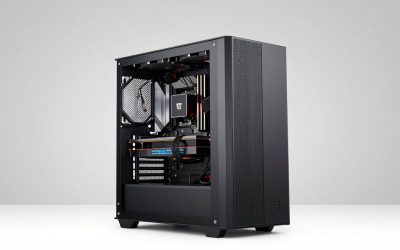
Case fans come in two dominant sizes — 120 mm and 140 mm — and the choice affects airflow, noise, and how much lighting and mounting flexibility you get. Bigger is not automatically better; the right size depends on what your case supports and whether you value quiet operation or maximum static pressure. A little fan-size literacy goes a long way toward a cooler, quieter build.
As an Amazon Associate we earn from qualifying purchases at no extra cost to you.



Our Top Picks



Top 3 picks at a glance
The physics in plain terms
A 140 mm fan has more blade area, so it can move the same volume of air as a 120 mm fan while spinning slower. Slower rotation means less noise for equal airflow. That is the core advantage of 140 mm: quieter cooling. The trade-off is that 140 mm fans are physically larger, so not every mounting spot — especially radiators and compact cases — accepts them.
Airflow versus static pressure
Fan spec sheets list two numbers: airflow (CFM) for open spaces and static pressure (mm H2O) for pushing through resistance like radiators and dense dust filters. As unrestricted intake or exhaust, 140 mm high-airflow fans excel. On radiators, 120 mm fans dominate simply because almost all AIOs use 120 mm mounting spacing.
120mm vs 140mm comparison
| Aspect | 120 mm | 140 mm |
|---|---|---|
| Airflow at equal noise | Lower | Higher (~15–25%) |
| Noise at equal airflow | Higher | Lower |
| Typical RPM range | 500–2000 | 400–1500 |
| Radiator support | Universal | Limited |
| RGB/model selection | Widest | Narrower |
| Best role | Radiators, SFF, static pressure | Quiet case intake/exhaust |
How to choose for your build
Check your case’s fan mounts first. Many mid towers accept 140 mm fans up front and 120 mm up top; SFF and mini-ITX cases are often 120 mm only. For quiet case airflow where space allows, 140 mm is the better pick. For radiators, compact builds, or anywhere you need focused pressure, 120 mm is the safe, universal standard.
Mixing sizes is fine
There is nothing wrong with running 140 mm intakes for quiet fresh-air delivery and 120 mm fans on a top-mounted radiator. Aim for slightly more intake than exhaust to maintain mild positive pressure, which keeps dust out through filtered intakes rather than sucking it through every gap.
Bearing type and lifespan
Size aside, the bearing inside a fan shapes its noise and longevity. Sleeve bearings are cheap and quiet when new but wear faster and can rattle after a few years, especially mounted vertically. Fluid-dynamic and magnetic-levitation bearings cost more but run quieter for far longer and tolerate any orientation. For fans you will rarely touch again, such as a top exhaust or a radiator, spend a little more on a better bearing. Two fans with identical airflow numbers can sound and last completely differently based on this single spec, so read reviews rather than trusting the CFM figure alone.
FAQ
Are 140mm fans always quieter than 120mm?
At the same airflow, generally yes, because they spin slower. But a premium 120 mm fan can be quieter than a cheap 140 mm one — build quality and bearing type matter alongside size.
Can I put 140mm fans on a 240mm radiator?
No. Standard AIO radiators use 120 mm mounting, so you need 120 mm fans. A few 280 mm and 420 mm radiators are built for 140 mm fans specifically.
Bottom line
Neither size is universally better. Reach for 140 mm fans when you want quiet, high-volume case airflow and your case supports them. Stick with 120 mm for radiators, small cases, and anywhere you need static pressure or the widest model choice. Confirm your mounting points, keep intake slightly ahead of exhaust, and you will get cool, low-noise results either way.