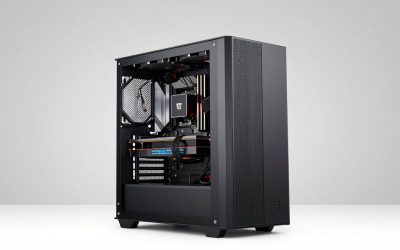
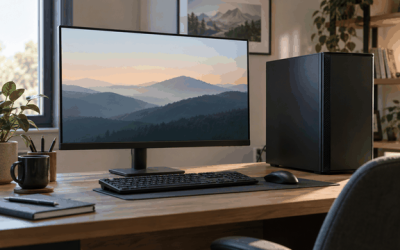
Tiny mini PCs the size of a paperback have become genuinely capable, and they tempt anyone who wants a clutter-free desk. But they occupy a very different niche than a custom desktop build. Deciding between them means being honest about what you’ll actually do with the machine, how long you want it to last, and how much you value size versus flexibility.
As an Amazon Associate we earn from qualifying purchases at no extra cost to you.



Our Top Picks


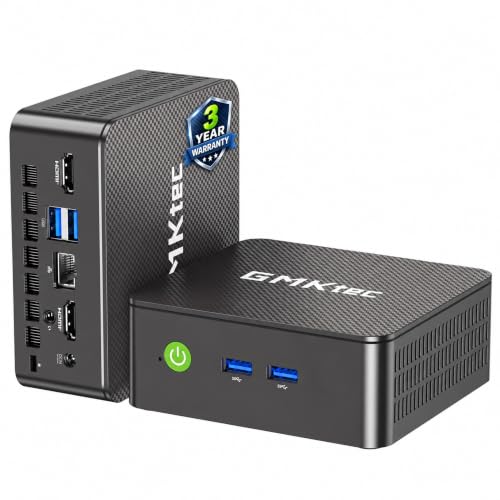
Top 3 picks at a glance
What a mini PC does well
Space, power and silence
Mini PCs excel at everyday computing in a footprint that hides behind a monitor. They sip power, often idling under 15W and peaking well below a desktop, and their small, efficient parts run quiet. For web browsing, office work, media playback and light tasks, they’re a tidy, low-energy solution that just works.
The trade-offs
That size comes at a cost. Most mini PCs use laptop-class integrated graphics, limited cooling, and soldered or minimal upgrade options. Sustained heavy workloads make their small coolers work hard, and when the machine ages you usually replace the whole unit rather than a single part.
| Factor | Mini PC | Custom desktop |
|---|---|---|
| Footprint | Tiny, hides behind monitor | Case on or under desk |
| Power draw | Very low, often under 65W peak | Higher, scales with parts |
| Gaming / heavy work | Light only | Handles demanding loads |
| Upgradeable | Limited | Fully, part by part |
| Repairable | Often replace whole unit | Swap individual parts |
Where a custom desktop wins
If you game, edit video, run demanding creative software, or want the machine to last through years of upgrades, a custom desktop is the clear choice. It accepts a full-power graphics card, offers far better sustained cooling, and lets you replace the CPU, GPU, RAM or storage individually as needs change. That upgrade path often makes a desktop the better long-term value despite the larger size.
Matching the machine to the job
Choose a mini PC when
Your workload is light to moderate, desk space is precious, low power and silence matter, and you’re comfortable replacing the whole unit in a few years. A mini PC is a superb secondary machine, media box, or office computer.
Choose a custom desktop when
You need real graphics power, run sustained heavy tasks, want to upgrade over time, or care about repairability. The desktop’s flexibility and performance headroom pay off for anyone whose needs might grow.
Think about the whole lifespan
Beyond raw specs, consider how each option ages. A mini PC is a sealed appliance you’ll likely replace whole in a few years, which is fine if you value simplicity and a tiny footprint. A custom desktop, by contrast, can be refreshed one part at a time, spreading its cost over a much longer life and reducing electronic waste.
Your total cost picture should include peripherals and upgrades, not just the sticker price. A desktop asks you to supply a monitor and input devices but rewards you with cheap future upgrades, while a mini PC bundles convenience at the expense of that flexibility. Weigh the whole lifespan, not just today’s price.
FAQ
Can a mini PC handle gaming?
Only light gaming, in most cases. Typical mini PCs rely on integrated graphics suited to older or less demanding titles at modest settings. For current games at good frame rates you need the dedicated graphics card and cooling that only a larger desktop can properly house.
Are mini PCs upgradeable?
Usually only in limited ways, such as adding RAM or storage on some models, while the CPU and graphics are fixed. If long-term, part-by-part upgrading matters to you, a custom desktop is the far more flexible and future-friendly option.
Bottom line
A mini PC is worth it when your needs are light, your desk is small, and low power and silence are the priority; it’s a tidy, efficient everyday machine. A custom desktop is worth it when you want gaming or creative power, sustained performance, and years of upgrades. Match the choice to your actual workload and how long you want the machine to serve, and either can be the right answer.