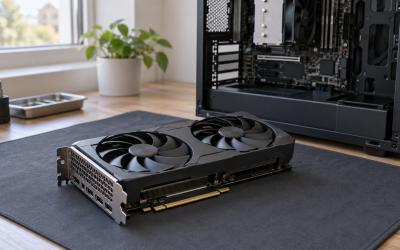
Your graphics card fans not spinning is an unnerving sight: you power on your PC and the blades sit still, or they twitch for a second and then stop, while the rest of your system appears to boot normally. Under light desktop use you may notice no immediate problem, but under load the GPU temperature climbs quickly to 80-90 degrees Celsius or higher, often followed by thermal throttling, black screens, sudden shutdowns, or a loud warning from your motherboard.
How urgent is it? If the fans never spin even when the GPU hits 60 degrees Celsius or more, stop gaming or rendering until you fix it. Modern cards can protect themselves by downclocking, but prolonged heat will shorten the life of the card and can take other components with it. As of early 2026, almost every current NVIDIA GeForce and AMD Radeon card includes a zero-RPM idle mode, so stationary fans at 30-50 degrees Celsius on the desktop are normal. Fans that stay still at 65 degrees Celsius and above are not.
Likely Causes
| Cause | How to confirm | Fix difficulty |
|---|---|---|
| Zero-RPM / Fan Stop mode is enabled | GPU temperature is 30-55 degrees Celsius at idle and fans stay at 0 RPM in monitoring software | Easy |
| Loose power cable or poor PCIe seating | GPU RGB or fans flicker on startup, card intermittently disappears in Device Manager, or system fails to POST | Easy |
| Incorrect custom fan curve | MSI Afterburner or AMD Software shows fan set to 0% until very high temperature, or Manual control is off | Easy |
| Corrupted or outdated graphics driver | Fans worked before a driver or Windows update, GPU-Z shows 0 RPM but no hardware fault | Moderate |
| Dust, cable obstruction, or seized bearing | Visual inspection shows dust buildup, a cable touching a blade, or one fan spins while the other does not when nudged gently | Moderate |
| Faulty fan header, splitter cable, or dead fan motor | Fans do not spin even at 100% manual speed, but GPU is detected and outputs video | Hard |
Fix 1: Check If Zero-RPM Mode Is Doing Its Job
What causes it
Most modern cards keep fans off below 50-60 degrees Celsius to stay silent. NVIDIA calls this Fan Stop and AMD calls it Zero RPM. It is controlled by the card’s VBIOS and by software like MSI Afterburner, ASUS GPU Tweak III, or AMD Software: Adrenalin Edition. If idle temps are low, stationary fans are intended behavior.
How to check
Install HWINFO64 or GPU-Z and check Sensors. Note GPU Temperature and Fan Speed RPM. Leave the system on the desktop for 5 minutes, then open a demanding game or run a GPU stress test for 60 seconds. If fan RPM stays at 0 while GPU Temperature climbs past 65-70 degrees Celsius, zero-RPM is not the explanation and you need to force the fans on.
What to do
Test with a manual override. Open MSI Afterburner, click the gear icon to open Settings, go to the Fan tab, check Enable user defined software automatic fan control, and drag the fan curve so that 40 degrees Celsius equals 30%, 60 degrees equals 50%, and 75 degrees equals 80%. Click Apply and then click the Auto button next to Fan Speed so it switches to User Define. Alternatively for AMD, open AMD Software: Adrenalin Edition, go to Performance > Tuning > Custom > Fan Tuning, toggle Fan Tuning to Enabled, enable Advanced Control, and set a similar curve. Click Apply Changes. Run your game again and watch RPM in HWINFO64.
How to undo it
In MSI Afterburner, go to Settings > Fan tab, uncheck Enable user defined software automatic fan control, click Apply, then click OK. In AMD Software, go to Performance > Tuning, set Tuning Control to Default and click Apply. The card will return to its default zero-RPM behavior.
Fix 2: Reseat Power Cables And The Card
What causes it
If the PCIe power connectors from the power supply are loose, missing a pin connection, or the card is not fully seated in the PCIe x16 slot, the GPU may get enough power to display video but not enough to drive the fan controller. This is common after moving a PC, installing new RAM, or using extension cables.
How to check
Shut down Windows via Start > Power > Shut down. Flip the power supply switch to Off and unplug the AC cable. Press the case power button for 5 seconds to discharge residual power. Open the side panel and look at the PCIe power plugs on the top or end of the graphics card. Wiggle them gently. If either 6-pin, 8-pin, or 12VHPWR connector clicks loose or has a visible gap, it is not seated. Also check if the card sags or the PCIe retention clip at the end of the slot is open.
What to do
Disconnect each PCIe power cable and reconnect it until you hear a firm click. For a 12VHPWR or 12V-2×6 connector, push straight in without an angle and ensure the sense pins are fully engaged with no gap between the plug and socket. Remove the card: unscrew the rear bracket screws, press the PCIe retention lever on the motherboard, lift the card straight out, then reinsert it firmly until the retention clip snaps shut. Screw the bracket back in. Reconnect AC power, flip the PSU switch On, and boot. Check fan spin during POST.
How to undo it
This is a physical reseat with no software change to reverse. If you added cable extensions or adapters to test, remove them and return to the direct cables that came with your power supply.
Fix 3: Correct A Broken Custom Fan Curve
What causes it
A custom fan curve that sets fan speed to 0% up to 80 degrees Celsius, or software that conflicts between two tuning apps, will keep fans off even under load. Having both MSI Afterburner and ASUS GPU Tweak III or EVGA Precision X1 trying to control the same card often results in neither controlling it correctly.
How to check
Open Task Manager with Ctrl + Shift + Esc, go to the Startup tab, and see if two or more GPU tools are set to Enabled. Open each tool. In MSI Afterburner look at the Fan Speed (%) slider at the bottom. If it reads 0 or Auto is off, that is suspect. In AMD Software go to Performance > Tuning > Fan Tuning and see if Zero RPM is toggled On while the curve is flat at the low end.
What to do
Choose one control program and close the others. Right-click the unwanted tool in the system tray and select Exit. In Windows Settings > Apps > Installed apps, uninstall the duplicate tool. In your chosen tool, reset the curve. In MSI Afterburner, click Settings > Fan > Default to restore the linear curve, then ensure Fan Speed Mode is set to Auto. In AMD Software, set Fan Tuning > Zero RPM to Disabled for testing, set the curve to 30% at 40 degrees, 60% at 70 degrees, and 90% at 85 degrees, then click Apply Changes. Restart the PC and verify RPM responds to temperature.
How to undo it
In MSI Afterburner, click the Reset arrow icon on the main window and then Settings > Fan > uncheck Enable user defined software automatic fan control. In AMD Software, go to Performance > Tuning and click Reset to Default. Reinstall any tuning tool you removed if you prefer it.
Fix 4: Clean Install The Graphics Driver
What causes it
A corrupted driver, a partial Windows Update, or leftover registry entries from a previous card can leave the driver unable to communicate with the fan controller. The card will still display video using the basic Microsoft display driver, but fan control and temperature reporting break.
How to check
Press Win + X and select Device Manager. Expand Display adapters. If your card shows as Microsoft Basic Display Adapter, or shows a yellow exclamation mark, the driver is not loaded correctly. Press Win + R, type dxdiag, go to the Display tab, and check Driver Model and Version. If GPU-Z shows 0 RPM and fan control is grayed out even after a restart, suspect the driver.
What to do
Download Display Driver Uninstaller (DDU) and the latest driver from NVIDIA or AMD but do not install yet. Disconnect Ethernet and turn off Wi-Fi to prevent Windows from auto-installing a driver. Press Win + I > System > Recovery > Advanced startup > Restart now. After reboot select Troubleshoot > Advanced options > Startup Settings > Restart, then press 4 for Safe Mode. In Safe Mode run DDU. Select Device Type to GPU, select NVIDIA or AMD, and click Clean and restart. After reboot, run the driver installer you downloaded. For NVIDIA choose Custom (Advanced) and check Perform a clean installation. For AMD choose Factory Reset during install. Restart once more and test fan behavior at 70 degrees Celsius.
How to undo it
If the new driver makes it worse, roll back. Press Win + X > Device Manager > Display adapters > right-click your GPU > Properties > Driver tab > Roll Back Driver. Or run the previous driver installer you had before. Re-enable your network connection.
Fix 5: Check BIOS And Power Management Settings
What causes it
PCIe Link State Power Management, ErP Ready, or an aggressive Fast Boot can keep the motherboard from initializing the GPU fan controller correctly. After a BIOS update, the slot may also be forced to the wrong PCIe generation or Resizable BAR settings may conflict.
How to check
Press Win + R, type powercfg.cpl, press Enter. Click Change plan settings next to your active plan > Change advanced power settings. Expand PCI Express > Link State Power Management. If it is set to Maximum power savings, the slot may be throttled. Restart and press Delete or F2 repeatedly during boot to enter BIOS. Check Boot > Fast Boot and Advanced > PCI Subsystem Settings > PCI Express Slot settings.
What to do
In Windows Power Options, set PCI Express > Link State Power Management to Off, click Apply and OK. In BIOS, set Fast Boot to Disabled, set PCIEX16 Slot Configuration to Auto, and ensure Above 4G Decoding and Resizable BAR are set as they were when the system last worked. If you are unsure, use BIOS option Load Optimized Defaults. Press F10 to Save and Exit. After booting to Windows, test fans with a controlled load and monitor temperature with HWINFO64.
How to undo it
Return to Control Panel > Power Options > Change advanced power settings and set Link State Power Management back to Maximum power savings or Moderate power savings. In BIOS, re-enable Fast Boot to Enabled if you prefer faster POST times, and restore any custom memory XMP or EXPO profile under AI Tweaker or OC settings that Load Optimized Defaults may have disabled.
Fix 6: Clear Obstruction And Clean The Heatsink
What causes it
Dust matted between heatsink fins, a front-panel cable resting against a blade, or a bearing that has gummed up can physically stop fans. Cards that have run for two or more years in dusty environments or with pets are especially prone.
How to check
Power off, switch off the PSU, and unplug AC as in Fix 2. Shine a flashlight into the card. Look for a cable tie or fan cable touching the blades, heavy dust blankets on the heatsink, or a fan that does not spin freely when you flick it gently with a finger. Do not spin it fast with compressed air, just test for resistance. Check if one of two or three fans turns freely while another is stiff.
What to do
Use short bursts of compressed air with the can upright, holding fans still with a finger so they do not over-spin. Blow from inside the case outward and through the heatsink fins. For matted dust, use a soft anti-static brush. Reroute any loose cables away from the GPU and secure them with small zip ties to the case tie points. If a single fan is stiff, add one tiny drop of lightweight sewing machine oil to the bearing if your model has an exposed bearing sticker on the hub, but do not disassemble the card if it is under warranty. Reassemble, boot, and set a manual fan speed of 50% in MSI Afterburner to confirm all fans spin evenly.
How to undo it
Cleaning is not reversible and needs no undo. If you oiled a fan and noise worsens, wipe excess oil with isopropyl alcohol and consider ordering a replacement fan assembly for your exact card model instead of further lubrication.
Fix 7: Test The Fan Header And Force 100 Percent Speed
What causes it
The fan motor, its small 4-pin cable to the PCB, or a splitter that joins two fans can fail while the GPU core still works. This leaves the card detectable but with zero RPM even when the system requests maximum cooling.
How to check
Boot into Windows and set fan to maximum to bypass temperature logic. In MSI Afterburner disable Auto, drag Fan Speed to 100%, click Apply. Listen and watch. If HWINFO64 still shows 0 RPM and the blades do not move, but the card appears normally in Device Manager > Display adapters without errors, power delivery is fine and the fan subsystem is suspect. Power off and inspect the tiny white fan header on the PCB edge near the backplate. See if it is unplugged or its wires are pinched.
What to do
With power fully off and AC unplugged, reseat the fan header by gently unplugging it and plugging it back in until it clicks. If your card uses a two-fan splitter cable, ensure both fan plugs are secure to the splitter. Power on and retest at 100% manual speed. If only one fan spins, that fan motor has failed. Order a replacement cooler or fan set using your exact brand and model number printed on the card’s backplate sticker, for example ASUS ROG STRIX RTX 4070 OC or Sapphire Pulse RX 7800 XT, and follow the manufacturer’s service manual. Do not solder or splice fan wires if the card is under warranty.
How to undo it
In MSI Afterburner drag Fan Speed back to Auto and click Apply, or go to Settings > Fan and uncheck Enable user defined software automatic fan control. If you unplugged the header, there is no software to undo, but keep the original fan assembly if you need to send the card for warranty service.
If Nothing Works
If fans stay at 0 RPM even at 85 degrees Celsius with a clean driver, confirmed power, and 100% manual speed, stop heavy loads and prepare for service. Check GPU temperature in HWINFO64 at idle and confirm it climbs rapidly. Take photos of the card’s power connections, fan header, and serial number sticker. If the card is less than two or three years old, file a warranty claim with the board partner using the serial number and proof of purchase. Do not remove the cooler shroud if the warranty seal would be broken.
As a temporary measure to protect the hardware, you can improve case airflow by setting case fans to 100% in BIOS under Monitor > Q-Fan Configuration or Fan Control, removing the side panel, and pointing a desk fan into the case, but do not rely on this for gaming. If you have a spare GPU or integrated graphics, switch your display cable to the motherboard video output and set BIOS > Advanced > System Agent > Initiate Graphics Adapter to iGPU to keep the system usable while you wait for replacement.
FAQ
Should graphics card fans spin at startup?
Yes, most cards spin all fans at 100% for 1-3 seconds during POST as a self-test, then stop if Zero RPM is enabled and temperature is below 50-60 degrees Celsius. If they never spin even for a second at power-on, check power cables, PCIe seating, and the fan header connection.
Is it safe to run a GPU with fans at 0 RPM?
Only while temperature stays in the zero-RPM window, typically 30-55 degrees Celsius on the desktop. If the card stays at 0 RPM above 65 degrees Celsius, it is not safe to game. Set a manual curve, clean the card, and clean-install the driver. If temperature exceeds 90 degrees Celsius, shut down immediately to avoid thermal shutdown or damage.
Why does only one fan spin?
On multi-fan cards one fan may be designated to start first, but at 70 degrees Celsius or at 60% manual speed all fans should spin together. If one stays still at 100% manual speed while the other spins, that motor or its splitter connection has likely failed and needs reseating or replacement.
Can I control GPU fans from the motherboard BIOS?
No. Motherboard BIOS controls case fans connected to CHA_FAN or SYS_FAN headers, not the GPU’s own fans. GPU fans are controlled by the card’s VBIOS and tools like MSI Afterburner, ASUS GPU Tweak III, or AMD Software: Adrenalin Edition under Performance > Tuning > Fan Tuning. Use those tools, not BIOS Q-Fan, for graphics card fan control.