Getting into machine learning at home raises a hardware question gaming guides rarely answer: what actually matters for training and running models, and should you build or buy? ML workloads care about GPU VRAM above almost everything, plus system memory and fast storage for datasets. This guide compares custom builds and prebuilts for hobbyist ML so you can put your money where the models need it.
As an Amazon Associate we earn from qualifying purchases at no extra cost to you.


Our Top Picks
 ASUS Dual GeForce RTX 4060 Ti EVO OCRTX4060Ti|OC|8GB|EVO8.9 x 4.9 x 2 inches1.4 poundsCheck on Amazon


Top 3 picks at a glance
VRAM is king
For deep learning, the single most important spec is GPU memory. Larger models and bigger batch sizes simply will not fit in too little VRAM, no matter how fast the card is. Hobbyists should target at least 12GB, and 16-24GB opens the door to meaningfully larger models. Nvidia cards dominate here because of their mature software ecosystem.
System RAM and storage
32GB of system memory is a comfortable baseline, with 64GB helpful for large datasets and preprocessing. A fast 1-2TB NVMe SSD keeps data pipelines from becoming the bottleneck.
CPU
The CPU matters less than in gaming, but a solid 8-core chip keeps data loading and preprocessing smooth so the GPU stays busy.
Custom vs prebuilt for ML
| Factor | Custom build | Prebuilt |
|---|---|---|
| Choose high-VRAM GPU | Full control | Depends on model |
| RAM to 64GB | Easy | Sometimes limited |
| Adequate PSU for big GPU | Spec 850W+ | Verify headroom |
| Cooling for sustained load | Tune it | Varies |
| Value per VRAM dollar | Usually better | Convenience premium |
Why custom often wins for ML
ML training runs the GPU at full load for long stretches, which demands strong cooling and a robust 850W-plus 80+ Gold power supply for high-end cards. Building lets you choose the highest-VRAM card your budget allows, pair it with 32-64GB of RAM and fast storage, and ensure the case airflow can handle hours of sustained heat. That balance is hard to guarantee in a gaming-oriented prebuilt.
When a prebuilt is fine
If you find a prebuilt with a high-VRAM Nvidia GPU, at least 32GB of RAM, and a quality power supply, it can absolutely serve as an ML box, and the warranty is a nice bonus. Just avoid configurations that pair a big GPU with only 16GB of RAM or a marginal PSU, which are common in gaming-focused models.
Cooling and noise during long training runs
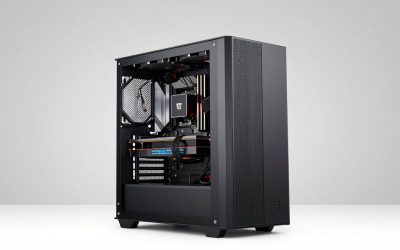
Machine learning pushes the GPU to full utilization for minutes or hours at a time, which generates far more sustained heat than gaming. That makes case airflow and cooling quality critical: a card that stays cool holds its clocks and avoids thermal throttling that would drag out training. Choose a case with strong mesh airflow, add intake and exhaust fans, and ensure the GPU has breathing room. This is an area where hastily built gaming prebuilts often fall short.
All that sustained load also means noise, so if your ML box shares a room with you, favor larger low-RPM fans and a quality cooler over screaming high-speed units. An efficient 80+ Gold power supply likewise runs quieter and cooler under long loads.
Software setup is half the battle
Hardware aside, plan for the software stack. Nvidia’s ecosystem is the smoothest path for most frameworks, so a GeForce card with ample VRAM keeps setup straightforward for beginners. Keep drivers current, and make sure your chosen frameworks support your GPU before buying, since a well-supported card saves hours of troubleshooting that raw specs cannot.
FAQ
Can I do machine learning on an AMD GPU?
You can, and support is improving, but Nvidia’s software ecosystem remains the smoother path for most frameworks and tutorials. Beginners usually have an easier time on Nvidia.
How much VRAM do I need as a hobbyist?
12GB lets you experiment with many models, 16GB is more comfortable, and 24GB handles larger models and batch sizes. Prioritize VRAM over raw speed when choosing a card.
Bottom line
For hobbyist machine learning, VRAM, system memory, and sustained-load cooling matter most, with the CPU playing a supporting role. A custom build usually delivers more VRAM per dollar, room for 64GB of RAM, and the power and airflow long training runs demand. A prebuilt works if it has a high-VRAM Nvidia card and enough RAM and PSU headroom, but check those specs carefully before buying.