The best saltwater spinning reels for inshore fishing are the Shimano Stradic FM for light inshore work, Daiwa Saltist MQ for a sealed mid-range upgrade, Penn Slammer IV for heavy surf and structure, and Shimano Saragosa SW A for offshore-capable power without Stella-level pricing.
The right choice depends less on the maximum drag printed on the box than on four practical questions: how much line you need, how quickly you must recover it, how exposed the reel will be to saltwater, and whether you are fishing open beaches or pulling fish away from structure. The comparison below covers corrosion protection, drag strength, line capacity, retrieve rate, and useful reel sizes.
As an Amazon Associate we earn from qualifying purchases at no extra cost to you.
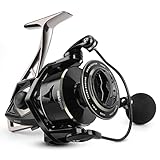


Our Top Picks


Top 3 picks at a glance
Best saltwater spinning reels at a glance
| Reel | Best use | Useful sizes | Typical drag class | Notable advantage |
|---|---|---|---|---|
| Shimano Stradic FM | Light inshore, jetties, flats | 3000–5000 | About 20–24 lb | Light, smooth, versatile retrieve |
| Daiwa Saltist MQ | Regular inshore saltwater use | 3000–6000 | About 22–33 lb | Monocoque body and strong sealing for its class |
| Penn Spinfisher VII | Surf, pier, and general saltwater abuse | 4500–8500 | About 25–50 lb | Sealed body, robust construction, good value |
| Penn Slammer IV | Heavy inshore, surf, and nearshore | 4500–8500 | About 30–50 lb | Sealed drivetrain and powerful carbon drag |
| Shimano Saragosa SW A | Offshore, large surf species, vertical work | 6000–20000 | About 22–66 lb | High line capacity and offshore-grade gearing |
Specifications vary by exact size, gear ratio, spool, and regional version. Treat the figures as useful classes rather than a substitute for the manufacturer’s size-specific specification sheet.
Head-to-head comparison
Shimano Stradic FM: best for light and medium inshore fishing
The Stradic FM is the most balanced choice for anglers fishing redfish, snook, speckled trout, flounder, striped bass, and similar species with lures or light bait. A 3000 or 4000 size pairs well with braided line in the 10–20 lb range; a 5000 adds spool capacity and a little more drag for larger jetties, docks, and current.
Its corrosion protection is good for routine saltwater use, but it is not an offshore tank. Internal water resistance and treated components help, while the reel’s relatively light construction keeps fatigue low during a day of casting. Rinse it after every saltwater trip rather than assuming the seals make maintenance unnecessary.
Retrieve rates are generally fast enough for topwater plugs and soft plastics, with many high-speed versions recovering roughly 35–40 inches per handle turn. The trade-off is capacity: smaller Stradic sizes are excellent for casting and lure control but are not intended for long runs in deep water or heavy surf.
Daiwa Saltist MQ: best mid-range corrosion-conscious upgrade
The Saltist MQ is a strong option when you want more protection and rigidity than a lightweight inshore reel provides. Its one-piece monocoque body reduces the number of body joints and creates room for a larger drive gear. Magsealed construction is designed to limit saltwater intrusion around selected rotating interfaces, although it does not eliminate the need for rinsing and servicing.
Choose a 3000 or 4000 for inshore lures and a 5000 or 6000 when fishing bridges, passes, tarpon-sized fish, or heavier leaders. Depending on size, the drag is commonly in the low-20s to low-30s in pounds, with enough reserve for braided line and locked-down pressure around structure.
The Saltist MQ is a better choice than the Stradic when body rigidity and repeated salt exposure matter more than the lowest possible weight. It is also a sensible middle ground before moving to a dedicated offshore reel.
Penn Spinfisher VII: best value for surf and rough conditions
The Spinfisher VII is built around protection and durability rather than minimum weight. Its sealed body and spool are particularly useful for surf anglers, pier anglers, and anyone who regularly deals with spray, sand, bait residue, and wet hands. Sizes around 4500–5500 suit medium surf and inshore work; 6500–8500 sizes provide more capacity for larger beaches and heavier sinkers.
Retrieve rates are moderate rather than exceptionally fast, often around the high-30-inch range in high-speed versions and lower in power-oriented models. That is useful for steady bait retrieve and plugging, but a fast retrieve model is preferable when working surface lures or quickly clearing line from a wave trough.
The main disadvantage is weight. A Spinfisher can feel tiring during continuous casting compared with a Stradic or similarly sized premium reel. In return, it tolerates rougher handling and usually costs less than highly sealed offshore models; typical market pricing is often around $150–$250 depending on size and configuration.
Penn Slammer IV: best for heavy inshore structure
The Slammer IV is the stronger Penn choice when a fish must be stopped quickly near rocks, bridge pilings, docks, or jetties. Its sealed design and sealed drag system are valuable when the reel receives frequent spray or occasional dunking, while the full-metal body and heavy gearing provide confidence under sustained load.
A 4500 or 5500 is appropriate for heavy inshore work and medium surf. Move to 6500 or larger for oversized surf baits, powerful current, and nearshore species. The drag can reach roughly 30–50 lb depending on size, but fishing at the maximum is rarely necessary. A practical setting is approximately one-quarter to one-third of the line’s tested breaking strength, adjusted for knots, abrasion, and the fish’s surroundings.
For example, with 30 lb braid and a fluorocarbon leader, starting around 8–10 lb of measured drag gives control without constantly shock-loading the leader knot. Increase pressure only when structure makes a fast stop essential.
Shimano Saragosa SW A: best for offshore capability
The Saragosa SW A is the choice when “inshore” occasionally becomes offshore: large tarpon, tuna, amberjack, kingfish, big jacks, and long-running surf fish. Its larger sizes offer substantially more spool capacity, stronger gearing, and higher drag capability than ordinary inshore reels.
Sizes 6000–8000 can cover heavy surf, large plugs, and nearshore predators. Sizes 10000–14000 and above are intended for serious line capacity and offshore pressure, though they are considerably heavier. Retrieve rates vary by model, often landing around 40–50 inches per turn in faster versions.
Do not buy a Saragosa 14000 simply because its maximum drag is impressive. If your normal target is a 3–8 lb inshore fish, the reel’s weight can reduce casting comfort and lure control. Match the reel to the fish and the environment, not just the largest fish you might encounter.
Decision matrix: match the reel to your fishing
| Your situation | Recommended size | Braid range | Best fit |
|---|---|---|---|
| Flats and light lures, fish under about 15 lb | 2500–3000 | 8–15 lb | Stradic FM |
| General inshore, docks, passes, moderate current | 3000–5000 | 15–25 lb | Stradic FM or Saltist MQ |
| Heavy structure, jetties, large soft baits | 5000–6500 | 25–40 lb | Slammer IV or Saltist MQ |
| Medium surf with long casts and bait | 5500–7500 | 30–50 lb | Spinfisher VII or Slammer IV |
| Large surf species or offshore runs | 8000–14000+ | 40–80 lb | Saragosa SW A |
How much line capacity do you actually need?
A reel should hold your intended casting distance plus the fish’s likely first run, while retaining enough line for a knot and normal respooling. A useful calculation is:
Required capacity = maximum cast + expected run + safety margin.
Suppose a surf cast reaches 100 yards, a fish may run 120 yards, and you want a 20 percent reserve. The calculation is (100 + 120) × 1.2 = 264 yards. That points toward a larger 6000–8000 reel with an appropriate braid diameter, not a compact 3000.
Remember that “300 yards of 20 lb braid” is not universal: actual capacity changes with braid diameter, spool shape, backing, and how tightly the line is wound. Fill the spool to roughly 1/16 inch below the lip. Underfilling reduces casting distance; overfilling increases wind knots and line spill.
Corrosion protection and maintenance
Sealing protects bearings, gears, and drag components, but no spinning reel is maintenance-free. After fishing, tighten the drag, rinse with a gentle freshwater stream rather than a high-pressure jet, wipe the exterior, and loosen the drag afterward for storage. High-pressure water can force salt deeper past seals.
For reels used weekly in saltwater, inspect the line roller, bail joints, handle connection, and spool lip every few trips. A gritty retrieve, rough line roller, or drag that starts and stops is a service warning—not a reason to spray lubricant into every opening. Use the manufacturer-recommended grease and oil, because excess or incompatible lubricant can damage seals or contaminate drag washers.
Frequently asked questions
Which reel is best if I mainly cast lures all day?
The Shimano Stradic FM is the best fit for repeated lure casting because its relatively light construction helps reduce fatigue. A 3000 or 4000 size pairs well with braid in the 10–20 lb range, while the 5000 adds capacity for larger jetties, docks, and current. Its retrieve is generally fast enough for topwater plugs and soft plastics.
Can I use a sealed reel without rinsing it after fishing?
No, sealed construction does not remove the need for rinsing and servicing. After fishing, tighten the drag, rinse the reel with a gentle freshwater stream, wipe the exterior, and loosen the drag for storage. Avoid high-pressure water because it can force salt deeper past the seals. This maintenance applies even to reels designed for strong saltwater protection.
How should I choose between the Spinfisher VII and Slammer IV?
Choose the Penn Spinfisher VII when value, surf use, and tolerance for spray, sand, bait residue, and rough handling matter most. Choose the Penn Slammer IV when you need stronger control around rocks, bridge pilings, docks, or jetties. The Spinfisher is generally the more economical option, while the Slammer emphasizes heavy gearing, a full-metal body, and a powerful sealed drag system.
Is maximum drag a good way to select an inshore reel?
No, maximum drag should not be the main selection criterion. The article recommends matching the reel to line strength, abrasion, knots, and nearby structure. With 30 lb braid and a fluorocarbon leader, a practical starting point is around 8–10 lb of measured drag, increasing pressure only when structure makes a fast stop essential.
Why might a larger reel be uncomfortable for ordinary inshore fishing?
A larger reel can add unnecessary weight when the usual target is a 3–8 lb inshore fish. Although a Saragosa SW A in size 14000 offers impressive capacity and drag capability, it can reduce casting comfort and lure control. The article recommends matching reel size to the fish and environment rather than choosing based only on the largest possible catch.
Final recommendation
Choose the Shimano Stradic FM for the lightest, most comfortable inshore setup; the Daiwa Saltist MQ for a more rigid and corrosion-conscious all-rounder; the Penn Spinfisher VII for economical surf durability; the Penn Slammer IV for maximum practical stopping power around structure; and the Shimano Saragosa SW A when line capacity and offshore-level drag matter most. For most inshore anglers, a 4000–5000 reel holding about 200–300 yards of 15–30 lb braid is the best compromise between casting comfort, retrieve speed, and fish-fighting reserve.