The best golf putters for beginners are usually high-MOI mallets with clear alignment aids, a face-balanced or low-torque design, and a length that lets your eyes sit comfortably over the ball—although a forgiving blade can be the better choice if you prefer a compact head and have a pronounced arc in your stroke.
As an Amazon Associate we earn from qualifying purchases at no extra cost to you.
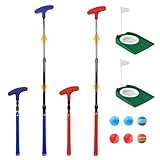

Our Top Picks


What beginners should prioritize in a putter
A putter does not need to produce long shots, but it must help you start the ball on your intended line and control distance. For a new golfer, forgiveness matters because inconsistent contact is normal while your setup and stroke are developing.
- Forgiveness: A higher-MOI head loses less direction and speed when contact is away from the center.
- Alignment: Long sightlines, contrasting shapes, and large alignment marks make it easier to aim the face.
- Head weight: Heavier heads can smooth a short, jerky stroke; lighter heads may offer better feedback and feel for players with a longer stroke.
- Toe hang: This should broadly match how much the putter face rotates during your stroke.
- Length: The correct length allows a relaxed posture, balanced sole position, and eyes that are reasonably close to the target line.
- Face technology: A milled or insert face can influence sound and launch, but consistency of setup is more important than the face material.
Mallet vs. blade: which style is more forgiving?
Mallet putters
Mallets have larger heads and can place more weight around the perimeter. That generally raises stability on mishits and creates a broader visual platform for alignment. Their rear extensions also make it easier to use a line or contrasting panels to aim the face.
A mallet is a strong starting point if you often leave putts short or long, struggle to aim, or notice the putter twisting when you strike the heel or toe. Models such as the Odyssey White Hot Versa line, TaylorMade Spider Tour family, and Ping Tyne designs represent the type of high-stability construction beginners often find useful.
Blade putters
Blades are narrower from front to back and often suit golfers who like a traditional appearance. They are not automatically unforgiving: a modern blade can include a cavity, perimeter weighting, and a high-MOI design. However, blades generally provide less visual and physical stability than a large mallet.
The Ping Anser 2 family is a well-known example of the classic cavity-back blade shape. A blade may suit you if you naturally make a flowing stroke, prefer stronger feedback on contact, or find a large mallet distracting at address.
Head-to-head comparison for new golfers
| Design choice | Typical beginner benefit | Possible drawback | Best fit |
|---|---|---|---|
| High-MOI mallet | Most resistance to twisting and strong alignment support | Can look large or feel less responsive | Inconsistent contact or aiming problems |
| Compact mallet | Forgiveness with a less bulky appearance | Usually less stable than a full-size mallet | Players moving from a blade to more forgiveness |
| Cavity-back blade | Traditional shape with useful perimeter weighting | Less alignment space than a mallet | Moderate arc and preference for a classic look |
| Toe-hang blade | Works naturally with a stroke that opens and closes the face | Can exaggerate a face rotation problem | Noticeable inside-to-inside stroke path |
| Face-balanced head | Encourages a square-to-square motion | May feel awkward if you rotate the face substantially | Straight-back, straight-through stroke |
Match toe hang to your stroke
Toe hang describes how much the toe points downward when the shaft is balanced horizontally. It is a useful starting point, not a rule that overrides comfort and results.
- Face-balanced: The face points upward when balanced. This commonly suits a stroke with minimal face rotation.
- Small or moderate toe hang: A versatile middle ground for a slight arc.
- Strong toe hang: The toe drops noticeably and may suit a golfer whose putter face opens on the backswing and closes through impact.
You can perform a simple home check. Balance the shaft across one finger or a narrow support point, keeping the putter head clear. If the face points toward the sky, it is face-balanced. If the toe points downward, it has toe hang. Then record a short video from above while making several natural practice strokes. If the face rotates visibly, avoid choosing a putter solely because its face-balanced design is marketed as forgiving.
How much head weight do you need?
Most modern putter heads fall roughly in the 330–380 gram range, although counterbalanced and oversized models can feel heavier because additional mass is placed in the grip or shaft area. Heavier heads often help beginners make a smoother pendulum-like motion, especially on fast greens or short putts.
Head weight is not the same as total club weight. A heavier head increases the club’s rotational resistance, while a heavier grip or counterweight can make the head feel lighter during the stroke. If your stroke becomes abrupt when nervous, try a heavier mallet or a model with adjustable sole weights. If you struggle to sense where the head is, a slightly lighter or more traditionally weighted putter may provide clearer feedback.
A useful practice comparison is to hit ten putts from 6 feet with two putters, recording how many finish within a 2-foot circle. Then hit ten lag putts from 30 feet and measure the average finishing distance. Choose the model that improves both starting direction and distance control, rather than the one that merely feels heavier.
Choosing the correct putter length
Common retail lengths are approximately 33, 34, and 35 inches. Length should be selected from posture and sole position, not height alone. A putter that is too long can force the hands away from the body and encourage the toe to lift. One that is too short can make you crouch excessively and pull the heel upward.
Use this fitting sequence:
- Take your natural putting stance with your eyes roughly over or just inside the ball-to-target line.
- Let your arms hang comfortably and place your hands where they would normally grip the club.
- Set the putter sole flat. Do not tilt the handle forward or backward just to make an unsuitable length work.
- Check that the lie, alignment marks, and ball position look repeatable rather than forced.
- Try at least one inch shorter and longer if possible, then compare strike location and start direction.
For many beginners, a 34-inch putter is a sensible first test, but a 33-inch model may suit a compact stance and a 35-inch model may help a taller golfer stand more upright. Adjustable-length models can be useful when two golfers share a club or when your posture is still changing.
Decision matrix: pick the right beginner style
| Your situation | Recommended starting specification | Why |
|---|---|---|
| You miss the center and the face twists | High-MOI mallet, 350–380 g head | Perimeter weighting preserves direction and speed |
| You aim left or right inconsistently | Mallet with a long sightline or contrasting alignment system | Gives you a more repeatable visual reference |
| Your stroke is straight back and straight through | Face-balanced mallet or compact mallet | Reduces the need to manipulate face rotation |
| Your stroke has a clear arc | Moderate or strong toe-hang blade or mallet | Allows the face to open and close naturally |
| You leave many putts short | Slightly heavier head with a responsive insert face | Can smooth tempo without requiring a hard hit |
| You three-putt because of poor distance control | Any stable head with consistent roll and extensive lag practice | Equipment cannot replace speed calibration |
Beginner-friendly putter categories and market ranges
Entry-level branded putters commonly cost about $100–$200. These can be excellent choices if the length, lie, and alignment system fit you. Mid-range models from major manufacturers are often around $200–$400, while premium milled or highly adjustable putters can exceed $400–$600. A more expensive head will not correct an unsuitable length or a misaligned setup.
Good categories to compare include a high-MOI mallet with a soft polymer insert, a compact mallet with moderate toe hang, and a cavity-back blade with a traditional steel face. The Odyssey White Hot Versa range is known for high-contrast alignment options, TaylorMade Spider models emphasize stability, Ping offers both mallet and classic blade shapes, and Cleveland’s Frontline and HB Soft families provide accessible alternatives. Select by shape and specifications rather than by brand name alone.
Three setup checks before you buy
- Start-line check: Roll five balls over a straight 6-foot line. If the putter repeatedly starts offline despite a square setup, test a different alignment system or toe-hang profile.
- Strike check: Place two small pieces of removable tape on the face to create a center target. Repeated heel or toe strikes point toward a more stable head, improved length, or a lie-angle fitting.
- Distance check: Roll balls to a target 20 and 30 feet away. If the first putter produces a wide spread in finishing distance, compare a heavier head or a different face feel.
The best golf putter for beginners is the one that makes your address position repeatable and produces a predictable roll on imperfect strikes. Start with a forgiving mallet if you need maximum stability, consider a compact mallet for a compromise between confidence and traditional looks, and choose a cavity-back or toe-hang blade when your stroke and visual preference clearly point that way.
Frequently asked questions
Does a more expensive putter automatically help a beginner putt better?
No, a higher price does not automatically make a putter a better fit. The article says that a more expensive head will not correct an unsuitable length or a misaligned setup. Prioritize a comfortable posture, a repeatable setup, and a head shape and alignment system that suit you.
How can I tell whether my putter face is twisting on off-center strikes?
Notice whether the head turns when you strike the heel or toe of the putter. The article identifies that twisting as a reason to consider a more stable mallet. Higher-MOI heads are described as losing less direction and speed on off-center contact.
Should I choose a face insert or a milled face?
Choose based on the sound and launch you prefer, rather than assuming one face type is automatically best. The article says a milled or insert face can influence sound and launch, but consistent setup matters more than face material. It also suggests considering a responsive insert face if you often leave putts short.
Can two golfers share an adjustable-length putter?
Yes, adjustable-length models can be useful when two golfers share a club. They may also help when your posture is still changing. Whichever length you use, the article recommends checking that your stance, comfortable hand position, and flat sole position are repeatable rather than forced.
What should I check after choosing a putter length?
Check that the putter sole sits flat and that your posture and hand position feel natural. The article also recommends comparing a putter that is shorter and one that is longer, then checking strike location and start direction. Make sure the lie, alignment marks, and ball position look repeatable.