The best dog car seats are the ones that fit your dog’s measurements, stay within the manufacturer’s weight limit, attach securely to the vehicle, and use a separate safety harness rather than relying on a collar or a loose tether.
As an Amazon Associate we earn from qualifying purchases at no extra cost to you.


Our Top Picks


Top 3 picks at a glance
Start with the right safety expectation
Most elevated dog car seats are designed mainly to prevent a small dog from climbing into the front seat or being thrown around during ordinary driving. They are not automatically crash-safe. A raised cushion, plush cover, or metal frame does not prove that a seat protects a dog in a collision.
For the highest level of crash protection, look for a product with independently documented crash testing, such as products recognized by the Center for Pet Safety. Certified crash-protection products include purpose-built carriers, crates, and harnesses; many ordinary booster seats do not have equivalent certification.
Never connect a restraint to a dog’s collar. Use a properly fitted vehicle harness, and follow the restraint maker’s instructions about whether it may be used with a booster seat. A tether that is too long can let a dog hit the seatback or door during sudden braking.
Measure your dog and your vehicle before choosing
Measure your dog while standing and sitting, then record these four numbers:
- Body length: chest to the base of the tail.
- Shoulder height: floor to the top of the shoulders.
- Seated height: floor to the top of the head when sitting.
- Weight: use the dog’s current weight, not the breed’s typical adult weight.
Compare those measurements with the usable interior dimensions of the seat. A seat may be advertised as 22 inches wide but provide less usable space after bolsters and padding are installed. Your dog should be able to sit, lie down, and turn around without folding its legs awkwardly or pushing against the restraint.
Then measure the vehicle. Check the seat width, seat-belt path, buckle location, door clearance, and whether the booster blocks the driver’s view. A tall booster can be unsuitable in a compact car if it presses against the roof or prevents the rear seat from folding.
Best dog car seats by dog size and use case
| Dog or vehicle situation | Useful seat specification | Best choice type | Important caution |
|---|---|---|---|
| Toy and small dogs up to about 15 lb | Interior around 16–20 in wide; raised base; short adjustable tether | Small bucket booster with a washable liner | Confirm the dog cannot climb over the front edge |
| Small-to-medium dogs around 15–30 lb | Interior around 20–24 in wide; reinforced seat-belt path; higher weight limit | Large booster or supported console/bench seat | Many “large” boosters still have soft walls and limited crash protection |
| Long-bodied or broad-chested dogs | Usable length at least 2–4 in longer than the dog’s body; wide opening | Flat travel bed secured with a harness, or a crash-tested harness | Do not choose by weight alone |
| Dogs over roughly 30 lb | Vehicle-rated harness or secured crate, rather than a raised booster | Crash-tested harness or properly anchored crate | Check anchor strength and compatibility with the vehicle |
| Cars with narrow rear seats | Base narrower than the available seat area; non-slip underside | Compact bucket seat or harness-only setup | Measure between bolsters, not just door-to-door width |
For toy and small dogs: a bucket booster
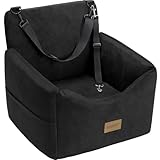
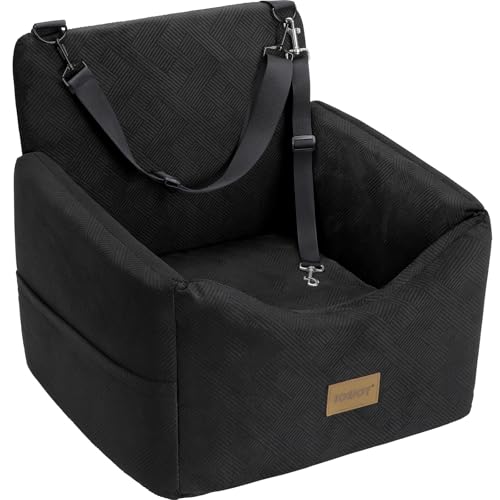
Small dogs often benefit from a deep, raised bucket because it limits wandering and improves their view out of the window. Products such as the K&H Pet Products Bucket Booster and Kurgo Skybox Booster Seat represent this category. Check the exact model’s dimensions and weight limit before buying; product lines commonly include more than one size.
Choose a booster with a firm base, a seat-belt channel that does not depend on a loose fabric strap, and an internal harness attachment point. The attachment should be short enough to stop climbing but long enough for the dog to sit and lie down. If your dog can stand on the rim, reduce the tether length or select a deeper design.
For small-to-medium dogs: prioritize usable floor area
A wider booster is not automatically better. Compare the interior floor dimensions with your dog’s body length. For example, if a dog measures 18 inches from chest to tail base, an interior length of 18 inches is only a minimum fit. A practical target is about 20–22 inches so the dog can curl up without pressing against the walls.
For a dog near the product’s maximum weight, favor a seat with a reinforced base and two-point vehicle attachment where the manufacturer provides it. A single strap may keep the seat from sliding but does not necessarily provide collision protection.
For larger dogs: use a harness or crate instead of a booster
Once a dog is too heavy or tall for a booster, a vehicle-rated harness is usually more appropriate. The Sleepypod Clickit Terrain is an example of a purpose-built crash-tested dog harness. A secured crate can also work when it is correctly sized, anchored, and positioned away from the front of the vehicle.
Do not improvise with a standard walking harness. Its buckles, webbing, and attachment points may not be designed for collision loads. Likewise, never clip a restraint to a retractable leash or a long lead inside the car.
Harness attachment and crash-protection checklist
- Use a chest harness with broad, padded straps and a snug fit.
- Keep the tether short enough to prevent contact with the front seats or doors.
- Use the vehicle’s seat belt exactly as directed: some systems route the belt through the seat, while others use a certified harness attachment.
- Prefer rear-seat placement. The front passenger airbag can seriously injure a dog.
- Do not attach two dogs to one tether unless the manufacturer explicitly permits it.
- Replace restraints after a significant collision, even if the webbing looks undamaged.
- Tighten the harness so only about two fingers fit beneath the straps, while checking that breathing and shoulder movement remain unrestricted.
Cleaning materials matter more than decorative padding
For puppies, motion-sick dogs, or muddy-weather travel, choose a removable machine-washable cover, a waterproof liner, and a base that can be wiped clean. Polyester and nylon covers are common and usually dry faster than thick cotton upholstery. Fleece is comfortable but can hold moisture and odor unless it comes off for washing.
Inspect the seams around the tether point and the underside of the cushion. These areas collect hair and grit and are also where moisture can reach the frame. Avoid using harsh bleach or solvents on restraint webbing; they can weaken fibers. Follow the care label, air-dry harnesses when required, and check every buckle after cleaning.
A simple decision process
- Measure the dog: compare seated height, body length, and weight with the product’s usable dimensions and limit.
- Measure the vehicle: confirm the base fits flat and the seat belt can follow the specified route.
- Choose the restraint level: use a booster for positioning and containment; choose a documented crash-tested harness or crate when collision protection is the priority.
- Test the fit at home: place the dog in the seat for 10–15 minutes while stationary. Look for panting, scrambling, trapped paws, or attempts to climb out.
- Take short practice drives: begin with five minutes, then increase the duration if the dog remains calm.
- Recheck after installation: push the seat sideways and forward. It should not slide enough to rotate, lift, or expose the dog to the door.
Common buying mistakes
Choosing by weight alone: two dogs weighing 20 lb can have very different body lengths and seated heights. Dimensions determine comfort and containment.
Assuming a tether makes any seat crash-safe: a tether can keep a dog in the seat during normal driving, but the seat, attachment, harness, and vehicle connection must all be engineered for crash loads to make a stronger safety claim.
Buying the largest possible booster: excessive space can allow a dog to build momentum or climb out. Select the smallest seat that still allows natural sitting, turning, and lying down.
Using a collar attachment: this creates a serious neck-injury risk during sudden stops. Use a compatible body harness instead.
Frequently asked questions
Can a dog car seat be used in the front passenger seat?
A dog car seat should generally be placed in the rear seat because a front passenger airbag can seriously injure a dog. Before installing it, check the seat-belt path, buckle location, door clearance, and whether the booster blocks the driver’s view. The seat should fit flat and remain stable without rotating, lifting, or exposing the dog to the door.
How can I tell whether my dog’s harness fits correctly?
A properly fitted harness allows only about two fingers beneath the straps while still leaving breathing and shoulder movement unrestricted. Use a chest harness with broad, padded straps, and never attach a restraint to a collar. The tether should be short enough to prevent the dog from reaching the front seats or doors, but long enough for sitting and lying down.
What should I do if my dog is nervous in the car seat?
Introduce the seat while the vehicle is stationary, keeping the dog in it for 10–15 minutes and watching for panting, scrambling, trapped paws, or attempts to climb out. Then take short practice drives, beginning with five minutes and increasing the duration only if the dog remains calm. A shorter tether or deeper design may help prevent climbing.
How should I clean a dog car seat and its restraint?
Choose a seat with a removable machine-washable cover, waterproof liner, and wipe-clean base. Follow the care label, air-dry harnesses when required, and inspect buckles after cleaning. Avoid harsh bleach or solvents on restraint webbing because they can weaken fibers. Also check seams around the tether point and beneath the cushion, where hair, grit, and moisture can collect.
What should I do with a dog car restraint after a collision?
Replace the restraint after a significant collision, even if the webbing appears undamaged. Collision loads may affect components that are not visibly broken. For future use, follow the restraint maker’s instructions about vehicle-seat-belt routing or harness attachment, and confirm that the vehicle connection, harness, tether, and seat are compatible rather than assuming any tether provides crash protection.
Bottom line
The best dog car seats for small dogs combine a correctly sized, stable booster with a short harness tether and washable materials. For medium and large dogs, move away from raised booster seats and toward a documented crash-tested harness or a properly secured crate. The decisive specifications are usable interior dimensions, weight capacity, vehicle attachment method, harness compatibility, and independently documented crash performance—not plushness or height alone.