The best D&D dungeon tiles for fast setup are D&D Dungeon Tiles Reincarnated for lightweight modular maps, WizKids WarLock Tiles for durable 3D rooms, and Dwarven Forge for premium, highly detailed layouts that can stay assembled between sessions.
As an Amazon Associate we earn from qualifying purchases at no extra cost to you.


Our Top Picks

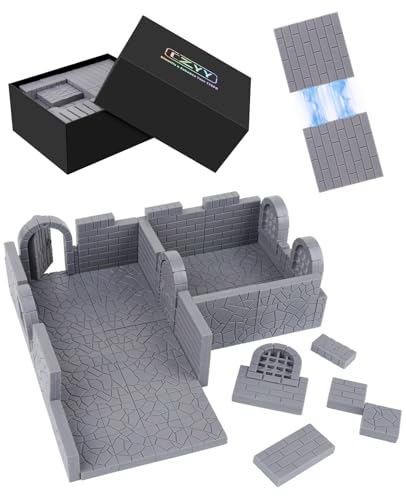


Top 3 picks at a glance
Quick Comparison: Which Dungeon Tile System Fits Your Table?
| Tile system or style | Material | Typical tile size | Grid accuracy | Approximate setup speed | Best for |
|---|---|---|---|---|---|
| D&D Dungeon Tiles Reincarnated | Printed laminated card | 1-inch squares | Very good | 2–5 minutes | Portable, flexible dungeon maps |
| Generic laminated 1-inch grid tiles | Card, plastic, or vinyl | 1-inch squares | Good to excellent | 2–6 minutes | Custom layouts and frequent reuse |
| WizKids WarLock Tiles | Hard plastic | 1-inch squares | Excellent | 10–20 minutes | Reusable 3D rooms and walls |
| Dwarven Forge dungeon terrain | Painted resin or durable terrain material | Usually 1-inch grid | Excellent | 15–45 minutes | Showpiece encounters and permanent layouts |
| Dry-erase vinyl mat | Vinyl | Usually 1-inch squares | Good, depending on printing | 1–3 minutes | Improvised rooms and unusual geometry |
What Makes a Dungeon Tile System Fast?
Setup speed is not simply the time needed to place tiles. It also includes finding the right pieces, deciding whether walls align, correcting gaps, and clearing the table afterward. A system with fewer pieces can therefore be faster even if it looks less elaborate.
For most D&D groups, prioritize these features:
- Large modular pieces: 6-by-6-inch or 6-by-8-inch sections cover a room quickly.
- Consistent one-inch grids: A standard D&D square represents 5 feet and accommodates most miniatures.
- Two-sided or reusable surfaces: Double-sided printed tiles reduce the number of pieces you must store.
- Visible room boundaries: Strong borders make it easier to read the battlefield from across the table.
- Simple storage: Flat tiles should fit in document boxes or expanding folders; 3D pieces need compartmentalized containers.
Head-to-Head: Flat Printed Tiles vs. 3D Terrain
Flat printed tiles: fastest for changing locations
Flat tile systems such as D&D Dungeon Tiles Reincarnated are the most efficient choice when the party moves through several rooms in one session. You can place a corridor, add a chamber, and remove explored sections without constructing walls or attaching accessories.
The trade-off is visual height. A flat image communicates stone floors, doors, and hazards, but it does not physically block movement or line of sight. This matters when the encounter depends on cover, elevation, locked doors, or narrow passages.
Printed tiles are also easier to transport. A set of 1-inch-grid tiles measuring roughly 12 by 18 inches when laid out can often be stored flat in a folder. That makes them a strong choice for convention games, rotating hosts, and campaigns where the game table must be cleared after every session.
Hard plastic and resin terrain: better spatial information
WizKids WarLock Tiles and Dwarven Forge terrain add physical walls, corners, doors, and room elevation. Players can see immediately which areas are enclosed and where a miniature can move. These systems are particularly useful for tactical encounters involving chokepoints, line of sight, forced movement, and area effects.
The cost of that clarity is preparation. A 20-minute encounter setup can be reasonable for a major boss battle, but excessive if the party is entering six small rooms in quick succession. Three-dimensional terrain also consumes much more storage volume, especially when walls, doors, stairs, and scatter pieces are kept separately.
Grid Accuracy: The Detail That Prevents Arguments
A nominally one-inch grid is not always precise enough for miniature play. Printed lines may be slightly offset, thick borders can reduce usable space, and some modular pieces leave a visible gap between sections.
For a reliable fit, use this check before buying or combining systems:
- Measure 10 consecutive squares with a ruler rather than measuring one square.
- Divide the result by 10 to find the average square size.
- Check whether the grid is printed to the edge or leaves an ungridded border.
- Place the largest miniature base used by your group on the surface.
If 10 squares measure 10.0 inches, the system is closely aligned with standard D&D play. If they measure 9.7 inches, each square is approximately 3% undersized. That may not matter for 25 mm or 28 mm miniatures, but it can cause noticeable crowding with 32 mm figures, large bases, or terrain walls placed directly on grid lines.
For mixed systems, choose one grid as the reference standard. A flat printed mat can serve as the underlying map while 3D walls are placed around selected rooms. Avoid combining products with different square sizes in the same encounter unless the mismatch is hidden by ungridded scenery.
Decision Matrix for Common D&D Dungeon Styles
| Your situation | Best choice | Why | What to avoid |
|---|---|---|---|
| Five or more locations in one session | Flat printed tiles | Fast repositioning and minimal cleanup | Large resin room collections |
| One set-piece combat per session | 3D plastic or resin terrain | Physical walls improve cover and line-of-sight play | Small loose tile packs that need constant rebuilding |
| Limited storage space | Printed tiles or a vinyl mat | Stores flat and travels easily | Permanent wall-and-floor assemblies |
| Frequent custom-shaped rooms | Dry-erase vinyl mat | Draws irregular corridors, circles, and traps | Fixed room tiles with limited geometry |
| Heavy miniature use and rough handling | Hard plastic tiles | Resists bent corners and surface wear | Unlaminated cardstock |
| Highly cinematic campaign finale | Premium resin terrain | Strong visual impact and detailed architecture | Building an entire dungeon when only one room matters |
Best Options by Priority
Best overall for speed: D&D Dungeon Tiles Reincarnated
This is the practical starting point for groups that want recognizable D&D artwork, standard square spacing, and quick modular layouts. The pieces are better suited to room-by-room play than to building a fully enclosed 3D dungeon, but that is exactly why setup remains quick.
Use a few large tiles for the current room and keep unexplored areas off the table. This avoids revealing the entire dungeon and reduces the amount of material that must be arranged.
Best for reusable 3D rooms: WizKids WarLock Tiles
WarLock Tiles are a good middle ground between flat maps and premium terrain. Hard plastic construction provides raised walls and architectural definition, while the modular format supports repeatable room layouts. They are especially effective for groups that use miniatures every session and want walls that can be moved or rebuilt.
To keep setup manageable, organize pieces by function rather than by product set: floors, straight walls, corners, doors, and special features. A labeled tray is faster than searching through one large container.
Best premium presentation: Dwarven Forge
Dwarven Forge is suited to groups that value detailed, physical scenery and are willing to spend more time and storage space. Its terrain is most effective when used selectively: build the throne room, ritual chamber, bridge, or final vault in 3D, then represent ordinary corridors with flat tiles.
This hybrid approach produces the visual impact of premium terrain without requiring a complete physical model of every hallway.
Best for improvisation: a dry-erase vinyl mat
A vinyl mat is the most adaptable option for dungeon masters who frequently alter maps during play. It handles irregular rooms, collapsing floors, temporary hazards, and unusual dimensions better than a collection of fixed tiles.
Choose a mat with dark, thin grid lines and a low-glare surface. Thick or faint lines make distances harder to judge, while glossy vinyl can reflect overhead lighting and obscure the grid.
How to Cut Setup Time in Half
- Pre-build encounter bundles. Store the floor pieces, walls, doors, and props for one encounter together. Label the bundle with the location and approximate footprint.
- Use a standard room vocabulary. Prepare repeatable layouts such as 6-by-8, 8-by-10, and 10-by-12 squares. Familiar dimensions make improvisation faster.
- Reveal only the active area. Keep future rooms stacked beside the table instead of laying out the complete dungeon.
- Separate scenery from rules-critical pieces. Floors and walls should be easy to reach; barrels, rubble, torches, and decorative objects can remain in a secondary box.
- Reserve premium terrain for important scenes. A physical centerpiece has more impact when ordinary locations use simpler maps.
Storage and Durability Considerations
Flat cardstock benefits from sleeves, folders, or rigid document boxes that prevent corner bends. Laminated tiles tolerate spilled drinks and repeated handling, but they should still be stored without heavy objects pressing on them.
Plastic tiles can be stacked by shape in shallow bins. Resin terrain is more fragile around thin railings, banners, stair edges, and removable doors, so use dividers or foam rather than allowing pieces to rub together. If your game space is small, measure the storage container before buying terrain; the table footprint is only half of the practical requirement.
Frequently asked questions
How much dungeon should I put on the table at once?
Put only the active area on the table rather than laying out the complete dungeon. Use a few large tiles for the current room and keep unexplored areas off the table. This reduces setup work, limits what players can see, and leaves future rooms stacked beside the table. It also makes room-by-room play more manageable when the party moves through several locations.
Can I combine flat tiles with three-dimensional walls?
Yes, a flat printed mat can serve as the underlying map while three-dimensional walls mark selected rooms. Choose one grid as the reference standard, and avoid combining products with different square sizes in the same encounter unless scenery hides the mismatch. This hybrid approach can provide physical walls where they matter while keeping ordinary corridors easier to arrange and store.
How can I organize dungeon terrain so it is faster to find?
Organize terrain by function or encounter rather than keeping every piece in one large container. Separate floors, straight walls, corners, doors, and special features, or store the pieces for one encounter together in a labeled bundle. A labeled tray makes searching faster, while encounter bundles can include the floor pieces, walls, doors, and props needed for a specific location.
What grid size works with standard D&D miniatures?
A consistent 1-inch grid is the standard choice because one square represents 5 feet and accommodates most miniatures. For a more reliable check, measure 10 consecutive squares instead of one. If they measure 10.0 inches, the system is closely aligned with standard play; if they measure 9.7 inches, the squares are approximately 3% undersized.
What should I do if my group uses larger miniature bases?
Place the largest miniature base used by your group on the surface before committing to a tile system. A slightly undersized grid may not matter for 25 mm or 28 mm miniatures, but it can cause noticeable crowding with 32 mm figures, large bases, or terrain walls placed directly on grid lines. Measuring 10 squares helps reveal whether spacing will be practical.
Final Recommendation
For the best balance of cost, grid reliability, storage, and setup speed, choose flat, laminated one-inch-grid tiles, with D&D Dungeon Tiles Reincarnated as a natural starting point. Add a dry-erase vinyl mat for improvised areas and reserve WarLock Tiles or Dwarven Forge pieces for encounters where walls, cover, and visual drama affect play. The best D&D dungeon tiles are not necessarily the most detailed ones: they are the pieces your group can find, place, and rearrange before the session loses momentum.