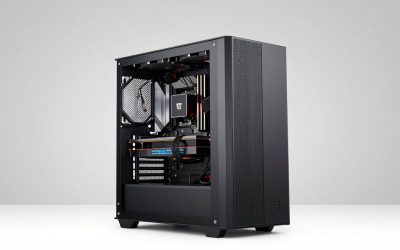
Chasing a 360Hz monitor’s full potential is a different pursuit than building for pretty visuals. To feed that many frames per second in competitive shooters, you optimize for raw CPU speed and consistent frame times, often at lower graphical settings, so the display never starves. It’s a specialist build where high refresh rate, not eye candy, is the goal.
As an Amazon Associate we earn from qualifying purchases at no extra cost to you.


Why 360Hz is CPU-bound
Competitive players run esports titles at low settings and low resolutions precisely to hit extreme frame rates. At those settings the graphics card has an easy job, and the bottleneck shifts to the CPU, which must prepare hundreds of frames per second. That’s why a top-tier gaming CPU with high clocks and strong per-core performance is the heart of a 360Hz build.
| Component | Priority | Target |
|---|---|---|
| CPU | Highest | Top gaming chip, high clocks, strong single-thread |
| GPU | High | Enough to exceed 360fps at low settings, ~8–12GB |
| RAM | Medium | 32GB, fast, low latency |
| Monitor | Essential | 360Hz panel with low response time |
Building for frames, not looks
CPU and memory
Put the biggest share of the budget into the fastest gaming CPU you can get; it directly determines your frame ceiling in esports titles. Pair it with 32GB of fast, low-latency RAM, since memory speed measurably helps minimum frame rates in competitive games. This combination keeps frame times tight so the experience feels as smooth as the number suggests.
GPU sized to the target
You don’t need the most expensive graphics card, but you do need one that can push well past 360fps at the low settings and resolutions competitive players use. A strong mid-range to upper-mid card with 8–12GB of VRAM comfortably clears that bar in popular esports games, leaving the CPU as the limiter, which is exactly what you want.
The details that unlock high refresh
Consistency matters as much as peak frames. Good cooling keeps the CPU boosting so frame times don’t wobble, so use a capable air or liquid cooler and solid case airflow. A 650–750W 80+ Gold power supply is ample. Finally, the monitor itself is essential: a genuine 360Hz panel with low response time and a fast connection is what turns all those frames into a visible advantage.
Prebuilt vs custom
Prebuilts often balance parts for visuals at higher resolutions, sometimes pairing a huge GPU with a mid CPU, the opposite of a 360Hz priority. A custom build lets you spend on the top CPU and fast RAM that competitive frame rates demand, then size the GPU precisely to the goal. For this specialized target, that control matters.
Tune settings and the whole signal chain
Hitting high frame rates is only half the battle; delivering them with low latency is the rest. Beyond the parts, competitive players lower in-game settings, cap frame rates sensibly, and use a fast display connection so the monitor receives every frame cleanly. A build tuned this way feels dramatically more responsive than the raw numbers alone suggest.
Peripherals matter here too. A low-latency mouse and keyboard, plus a mouse pad and grip that suit you, let the hardware’s speed reach your hands. There’s little point feeding 360 frames per second into sluggish input, so treat the whole signal chain, from CPU to monitor to mouse, as one system.
FAQ
Do I need the most expensive GPU for 360Hz gaming?
No. Because competitive players run low settings, the CPU is usually the limiter at 360Hz, not the GPU. You need a graphics card strong enough to exceed 360fps at those settings, but the budget priority is the fastest CPU and fast RAM, not a flagship GPU.
Does RAM speed matter for high-refresh gaming?
Yes, more than most people expect. Fast, low-latency memory improves minimum frame rates in CPU-bound esports titles, which is exactly where 360Hz builds live. Pairing a top CPU with fast 32GB RAM helps keep frame times consistent so gameplay feels genuinely smooth.
Bottom line
A 360Hz competitive build flips the usual priorities: the fastest gaming CPU and fast 32GB RAM come first, a GPU sized to clear 360fps at low settings comes second, and a genuine high-refresh monitor is the payoff. Keep cooling strong for consistent frame times, build it custom so the budget lands on speed rather than visuals, and you’ll actually feel the difference that all those frames provide.