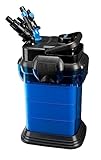
The best canister filters for 100 gallon aquariums are large-capacity canisters rated for 370 to 925 GPH with at least 1.5 gallons of media volume, with the Fluval FX6, OASE BioMaster Thermo 850, and Eheim Professional 4+ 600 being the most reliable choices for heavily stocked 100-gallon setups because they maintain adequate real-world flow after head loss and media load.
As an Amazon Associate we earn from qualifying purchases at no extra cost to you.


Our Top Picks
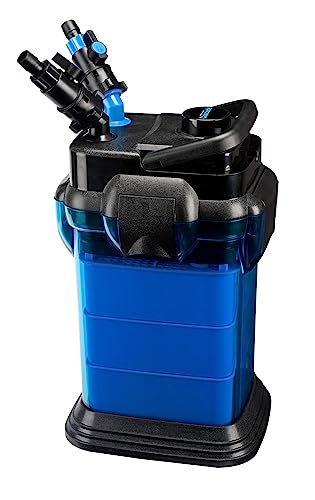

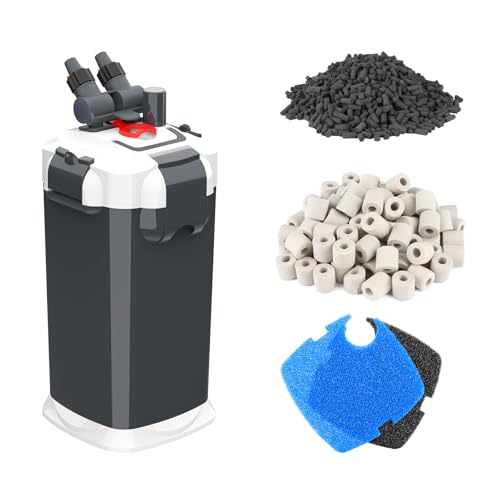

Top 3 picks at a glance
How Much Filtration Does a Heavily Stocked 100-Gallon Actually Need?
For a heavily stocked 100-gallon freshwater tank (cichlids, large community, or goldfish), you need 5x to 6x turnover per hour measured at the tank, not on the box. That means 500 to 600 gallons per hour (GPH) of actual flow after head height, dirty media, and hose length are factored in.
Most manufacturers rate flow with empty baskets and zero head height. Once you add 4 to 5 feet of vertical lift to the tank rim, two 90-degree bends, and fully loaded media, real flow drops 30% to 45%.
Worked Calculation: Rated Flow vs. Real Flow
Use this formula to estimate what you will actually get:
Real Flow = Rated Flow x 0.65 (for loaded media + 4-5 ft head) to 0.70 (for lightly loaded media)
Example for a 100-gallon heavily stocked tank targeting 550 GPH real flow:
- If you choose a filter rated at 700 GPH: 700 x 0.65 = 455 GPH real – too low as a single filter, you will need supplemental flow or a second canister.
- If you choose a filter rated at 925 GPH (Fluval FX6 class): 925 x 0.65 = 601 GPH real – correct for a single-filter solution on a heavily stocked tank.
- If you run two filters rated at 450 GPH each: (450 + 450) x 0.65 = 585 GPH real – ideal because you get redundancy and better circulation.
For heavily stocked tanks, two mid-size canisters almost always outperform one very large canister for circulation, oxygenation, and failsafe biological capacity. If you keep messy fish, plan for the higher end of the range.
Best Canister Filters for 100-Gallon Aquariums Compared
These models are proven in the 100-gallon class and differ significantly in flow, media volume, hose size, and maintenance design.
| Model | Rated Flow (GPH) | Real Flow Estimate (GPH) | Media Capacity | Hose Size (ID) | Power Draw | Best Fit |
|---|---|---|---|---|---|---|
| Fluval FX6 | 925 | 600-645 | 1.58 gal / 5.9 L | 25mm (1 inch) | 43W | Single-filter heavily stocked tanks, large cichlids |
| Fluval FX4 | 700 | 455-490 | 1.0 gal / 3.9 L | 25mm (1 inch) | 30W | Pair with second canister or powerhead on 100 gal |
| OASE BioMaster Thermo 850 | 450 | 292-315 | 1.95 gal / 7.4 L | 16/22mm | 32W + heater | Dual-filter setups, integrated heater, shrimp/planted tanks |
| Eheim Professional 4+ 600 (2275) | 330 | 214-231 | 1.58 gal / 6.0 L | 16/22mm | 16W | Silent operation, energy efficiency, paired setup |
| Eheim Classic 600 (2217) | 264 | 171-185 | 1.58 gal / 6.0 L | 16/22mm | 20W | Budget paired setup, simple design, low bypass |
| Penn-Plax Cascade 1500 | 350 | 227-245 | 1.32 gal / 5.0 L | 22/25mm | 28W | Large media for price, needs pairing on 100 gal |
Rated flow numbers are manufacturer specifications. Real flow estimates use the 0.65-0.70 loaded correction factor described above.
Decision Matrix: Which Setup Fits Your 100-Gallon?
Do not choose by rated GPH alone. Match the filter architecture to your stocking and maintenance style.
| Your Situation | Recommended Configuration | Why |
|---|---|---|
| Heavily stocked African cichlids or large South American cichlids, single filter preferred | 1x Fluval FX6 | Only single canister in this class that delivers 600+ GPH real flow. Large 1-inch hoses resist clogging from waste and handle head pressure well. |
| Heavily stocked community or planted 100-gallon, want best circulation and backup | 2x OASE BioMaster Thermo 850 or 2x Eheim Professional 4+ 600 | Two inlets/outlets eliminate dead spots, and if one filter stalls during cleaning the other preserves bacteria. Thermo models remove in-tank heater clutter. |
| Noise-sensitive room (living room, bedroom) | 2x Eheim Professional 4+ 600 | Eheim’s ceramic shaft and low-watt pump design is consistently the quietest in this size, usually under 35 dB at 3 feet when purged. |
| Budget build but need full biological capacity | 2x Eheim Classic 600 or 2x Cascade 1500 | Lower upfront cost, large media volume, but no self-priming or pre-filter module – you trade convenience for price. |
| Need easiest cleaning access | OASE BioMaster 850 or Fluval FX6 | OASE has a removable pre-filter module you can rinse weekly without opening the canister. FX6 has stackable baskets and purge valve. |
Key Criteria Explained for 100-Gallon Tanks
1. Flow Rate and Head Pressure
A 100-gallon tank is typically 24 to 25 inches tall on a 30 to 36-inch stand. That is 4.5 feet of lift minimum. Filters with 16/22mm hoses lose more flow to friction than 25mm hoses at this head height. If your canister sits inside a closed stand with two bends, expect the lower end of the real-flow estimate. Place the canister as close to directly below the tank as possible and avoid extra hose length.
2. Media Capacity and Bypass
For heavily stocked tanks, media volume matters more than rated flow. Aim for a combined 3.0 to 4.0 gallons of media volume across your filtration. This provides enough surface area for nitrifying bacteria to handle ammonia spikes after feeding.
Look for filters with sealed basket stacks and forced water paths. The Eheim Classic and Fluval FX series have almost zero bypass when baskets are properly seated. Filters with loose trays or thin gaskets allow water to channel around media, which is effectively lost capacity.
A practical media stack for a heavily stocked 100-gallon using an FX6 or similar large canister:
- Bottom basket: coarse mechanical foam + coarse sponge
- Middle basket(s): biological media (sintered glass, ceramic rings) filled to capacity, not in bags that restrict flow
- Top basket: fine filter floss/pad + Purigen or extra biological media if water is already polished
Do not fill every basket with fine floss. It clogs in days on a heavily stocked tank and crashes flow by 30% or more.
3. Hose Size and Plumbing
- 25mm (1 inch) hoses: Found on Fluval FX4/FX6. Higher flow, less clogging with detritus, but stiffer and harder to route. Uses 1-inch ribbed hosing with rubber adapters.
- 16/22mm hoses: Standard on Eheim, OASE, Cascade. Easier to attach spray bars, lily pipes, and inline heaters/UV. More friction loss, clean every 3-4 months to restore flow.
- 22/25mm hoses: Intermediate, found on larger Cascade models. Good compromise but fewer aftermarket parts.
If you plan to run an inline CO2 diffuser, inline heater, or UV sterilizer, 16/22mm is the most compatible size. For raw waste handling on predator tanks, 25mm is superior.
4. Noise
All modern canisters are quiet when fully purged, but differences emerge over months. Eheim Professional and OASE BioMaster are typically the quietest due to lower pump speed and rubber-mounted pump heads. Fluval FX filters move more water and have a deeper hum that is audible in a silent room but masked by tank water surface agitation. Noise almost always comes from trapped air, not the motor. After cleaning, tilt the canister gently and run the priming pump or auto-purge cycle until no air bubbles exit the outlet.
5. Cleaning Access
On a heavily stocked 100-gallon, you will clean mechanical filtration every 2 to 4 weeks. This is where design matters:
- OASE BioMaster: Best-in-class. The pre-filter tube lifts out from the top without disconnecting hoses or opening the main body. Rinse it weekly in tank water in 2 minutes.
- Fluval FX6/FX4: Stackable baskets lift straight out, purge valve drains water without carrying the canister to a sink. Quick-disconnect AquaStop valves do not leak when locked. Heavy when full (over 40 lbs).
- Eheim Professional 4+: Has a pre-filter grid on top and auto-priming button, but baskets are tighter and require more careful seating to avoid bypass.
- Eheim Classic: No priming pump, no quick disconnect without separate taps. You manually siphon to start. Simple and reliable, but the least convenient.
Always use the shut-off taps, drain with the purge valve, and never clean biological media with tap water. Swish it lightly in removed tank water.
Single vs. Dual Canister: What Works Better on 100 Gallons?
A single Fluval FX6 is the only true single-canister solution for a heavily stocked 100-gallon if you want to stay at 5x turnover without additional pumps. It is usually priced in the $300–$400 range and is the simplest plumbing job.
A dual setup (two filters each rated 300-450 GPH) costs more overall, usually $400–$650 for the pair, but gives measurable advantages: better cross-tank flow when inlets/outlets are placed at opposite ends, half the bacterial colony survives any single cleaning mistake, and you can clean one filter at a time on alternating weeks to keep ammonia at zero. For planted or aquascaped 100-gallons where spray bar placement matters, dual is strongly preferred.
Installation Settings for 100-Gallon Heavily Stocked Tanks
- Position inlet and outlet at opposite ends of the tank. Point the outlet slightly downward to create a circular gyre that carries waste to the inlet.
- Set the outlet below the waterline to reduce splashing noise, but add a surface skimmer or point one outlet slightly up to maintain surface agitation for gas exchange. Heavily stocked tanks need visible surface rippling.
- Do not throttle flow with the inlet valve. If you need less current for fish, use the outlet valve or a spray bar to diffuse energy. Restricting the inlet cavitates the pump.
- Prime correctly: fill the canister with dechlorinated water before starting, lock the head, open taps, then prime 5-7 pumps until water fills the hoses. Run for 2 minutes, tilt to release air, then top off tank water.
Frequently Asked Questions
Can I use a filter rated for 100 gallons on a 100-gallon tank?
No, if the tank is heavily stocked. “Rated for 100 gallons” usually assumes light stocking and clean media. You need a filter (or combination) rated for 150 to 250 gallons total, or 600+ GPH real flow as calculated above.
How often should I clean a canister on a heavily stocked 100-gallon?
Rinse mechanical pre-filters every 1 to 2 weeks, and do a full canister rinse every 4 to 8 weeks. If flow drops more than 25% from baseline, clean sooner regardless of schedule.
Are canister filters enough without a hang-on-back or sponge filter?
Yes, if total real flow and media volume meet the targets above. Many keepers add a large sponge filter powered by air as inexpensive biological insurance and to add oxygen, but it is not required if your canisters provide 500+ GPH real flow and 3+ gallons of media.
What hose size do I need for inline equipment?
Most inline heaters, UV sterilizers, and CO2 diffusers are made for 16/22mm hose. If you choose an FX6 with 25mm hose, you will need step-down adapters or a separate 16/22mm loop. Check the equipment specs before buying.