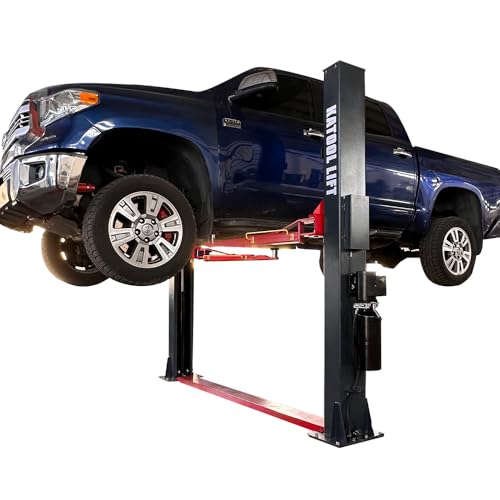
The best two-post car lift for a home garage for most people is the KATOOL 12,000 lb single-point lock release lift. It pairs a 12,000 lb working capacity with a 4.0 HP 220 V power unit — enough for a half-ton pickup, a full-size SUV, or a 3/4-ton diesel with headroom — and it uses a single-point lock release, so one handle disengages the locks on both columns instead of you walking around the bay twice every time you lower the vehicle. It fits the typical home-garage envelope: roughly 12 ft of ceiling, 12 ft of bay width, and a 4-inch reinforced slab.
Not everyone needs 12,000 lb. If your heaviest vehicle is a 3,000–4,000 lb car, a 7,000–10,000 lb lift saves money and installation effort. If your ceiling is under about 11 ft, a baseplate lift beats a clear-floor model. And if your slab is thin, unknown, or unreinforced, the concrete decides your shortlist before the capacity does. The guide below compares capacity, ceiling height, bay width, concrete requirements, arm reach, safety locks, and installation demands across twelve current models so you can match a lift to your building rather than the other way around.
Our Top Picks
 KATOOL 12000 lbs Extra Height 167inch 2 Post112*19*38112 x 18 x 35.4 inches1698 poundsCheck on Amazon


Top 3 picks at a glance

Quick Comparison
Every lift below is a two-post, 220 V-class hoist intended for a home or small-shop bay. Price tiers are relative to the category, not to a specific seller’s daily pricing.
| Lift | Best for | Key specs (per listing) | Price tier |
|---|---|---|---|
| KATOOL 12,000 lb single-point lock release | Heavy-duty value | 12,000 lb capacity, 4.0 HP, 220 V, single-point lock release, adjustable arms | Mid-range |
| Albott 10,000 lb 4 HP hydraulic | Lowest-cost entry into 10,000 lb class | 10,000 lb capacity, 4 HP hydraulic power unit, 2-post truck hoist | Budget |
| WEIZE 11,000 lb double lock release | Lock redundancy on a mid-range budget | 11,000 lb capacity, 220 V 3 HP motor, double safety lock release | Mid-range |
| KATOOL 12,000 lb extra height (167 in) | Shops with 14 ft ceilings | 12,000 lb capacity, 167 in height class, extra-tall columns | Premium |
| KATOOL 11,000 lb 4.0 HP | Budget buyers who still want 4 HP | 11,000 lb capacity, 4.0 HP, home/shop/garage duty | Budget |
| KATOOL clear-floor manual release hoist | Budget clear-floor bays | Clear-floor design, manual safety releases on both sides, capacity figure in the title needs verification | Budget |
| WEIZE 12,000 lb 4 HP single-point | Premium all-rounder | 12,000 lb capacity, 220 V 4 HP, single-point lock release | Premium |
| KATOOL 12,000 lb clear-floor single-point | Clear floor without a baseplate to trip over | 12,000 lb capacity, 4.0 HP, single-point release, clear-floor routing | Premium |
| Albott 10,000 lb hydraulic home-garage lift | Home garages with 10–11 ft ceilings | 10,000 lb capacity, hydraulic power unit, 2-post configuration | Mid-range |
| KATOOL 7,000 lb (8,000 lb structural rating) | Light cars and lower ceilings | 7,000 lb working capacity, higher structural rating, adjustable arms, single-point release | Mid-range |
| XK 11,500 lb truck hoist | Budget high-capacity | 11,500 lb capacity, 220 V power unit, truck hoist class | Budget |
| BILT HARD 11,000 lb double lock release | Mid-range double-lock pick | 11,000 lb capacity, 220 V 3 HP motor, double lock release | Mid-range |
How We Chose
This guide is assembled from published product listings, manufacturer specification documentation, and the standards and conventions that govern two-post lifts in a residential garage. It is not based on physically installing, operating, or dismantling any of these units — the point is to translate spec-sheet language into the numbers that actually decide whether a lift works in your building.
We weighed five things. First, capacity class and how it maps to real curb weights, including whether the lift leaves headroom above your heaviest vehicle. Second, ceiling and floor configuration — clear-floor versus baseplate — because that single choice eliminates more lifts than any other. Third, the lock system: single-point versus dual-point release, and whether the listing documents secondary safety features. Fourth, the power unit: motor horsepower, voltage, and what circuit it implies. Fifth, arm design and adjustment range, since a lift you cannot spot correctly on a unibody car is useless no matter how much it can hold. Crated weight, anchor specification, and hydraulic oil capacity rounded out the assessment, because installation is where most home-garage lift projects go wrong.
1. KATOOL 12,000 lb Single-Point Lock Release Lift – Best for Heavy-Duty Value
As an Amazon Associate we earn from qualifying purchases at no extra cost to you.
This is the pick for someone who owns a half-ton pickup, a full-size SUV, or a 3/4-ton diesel and wants to buy once. A 12,000 lb working capacity covers the great majority of vehicles a homeowner will ever put in a two-car garage, including a crew-cab truck with a toolbox in the bed, and the 4.0 HP power unit raises a loaded lift noticeably faster than the 3 HP units that dominate the mid-range.
The single-point lock release is the headline feature. On a dual-point system you disengage the lock on the left column, walk around, disengage the lock on the right column, then walk back. On a single-point system, one handle or one cable run releases both columns simultaneously. Over the life of the lift that is thousands of unnecessary steps saved, and it makes the lowering sequence easier to do correctly every single time.
- Capacity: 12,000 lb working capacity
- Power unit: 4.0 HP, 220 V single-phase
- Lock system: single-point lock release
- Arms: adjustable arm design for mixed vehicle widths
- Duty: automotive lift and truck hoist class, home/shop use
- Confirm before ordering: whether the model is overhead (clear-floor) or baseplate, and the published maximum lifting height
Where this lift earns its mid-range price is the combination of capacity and motor. A 12,000 lb lift with a 4 HP unit will cycle a loaded truck in the same time a smaller lift cycles a sedan, which matters if you use the bay for real work rather than storage. The adjustable arms also make it easier to reach the factory lift points on unibody cars, where the recommended pickup points can be only a few inches wide and sit inside the pinch weld.
The trade-offs are the ones that come with any 12,000 lb machine. It needs a genuine 220 V circuit — not a shared garage outlet — and the crated unit is heavy enough that you should plan for two or three people plus a way to move it from the driveway to the bay. A 12,000 lb lift also puts more demand on your slab and anchors than a 7,000 lb unit, so the concrete section later in this guide applies to it directly.
Pros
- 12,000 lb capacity covers half-ton and 3/4-ton trucks with margin
- Single-point lock release saves a walk around the bay on every cycle
- 4.0 HP power unit keeps rise times reasonable under load
- Adjustable arms suit both body-on-frame trucks and unibody cars
- 220 V single-phase power is available in most home garages
Cons
- Requires a dedicated 220 V circuit; not a plug-into-any-outlet tool
- Crated weight and column height make solo installation impractical
- The listing does not make the overhead-versus-baseplate configuration obvious, so verify before you buy
- Overkill if your heaviest vehicle is a compact car
Against the WEIZE 12,000 lb single-point model further down this list, the KATOOL is the value play: same capacity class and same lock philosophy, generally positioned a tier below on price. Against the KATOOL 12,000 lb extra-height model, it is the more sensible choice unless you have a genuinely tall ceiling — the extra-height version only pays off if you can use the additional lift height, and most home garages cannot.
2. Albott 10,000 lb 4 HP Hydraulic 2-Post Lift – Best Budget Entry
The Albott 10,000 lb lift is the answer for a homeowner who wants a real two-post hoist without spending mid-range money, and whose garage is used for cars, crossovers, and light trucks rather than heavy diesels. It is a hydraulic 4 HP unit in the 10,000 lb class, which is the traditional sweet spot for a residential two-post: enough for a half-ton pickup with margin, and no more structure than a typical home slab and ceiling can support.
- Capacity: 10,000 lb working capacity
- Power unit: 4 HP hydraulic
- Type: two-post automotive and truck hoist
- Class: budget tier in the home-garage lift market
- Best matched to: cars, crossovers, minivans, and half-ton trucks
The case for this lift is arithmetic. A 10,000 lb rating with a 1.25 safety factor covers vehicles up to about 8,000 lb, which is comfortably above a typical half-ton pickup at 4,000–5,700 lb and a full-size SUV at 5,000–6,200 lb. If you are not lifting a diesel 3/4-ton or a one-ton dually, the extra capacity of a 12,000 lb lift buys you margin you will never use — and it costs more, weighs more to install, and demands more from your slab.
The 4 HP power unit is the other reason this is a sensible budget pick rather than a stripped-down one. Many budget lifts in this class drop to a smaller motor to hit a price point, which shows up as a slow, laboured rise when the arms are loaded. A 4 HP hydraulic unit in a 10,000 lb lift is the right pairing: enough power that the lift does not feel strained at the top of its range.
Pros
- 10,000 lb capacity covers the realistic home-garage vehicle mix
- 4 HP hydraulic power unit keeps cycle times respectable
- Budget price tier makes it the cheapest credible entry into two-post ownership
- Lower capacity class eases demands on ceiling height and slab thickness
Cons
- Not the right choice if a 3/4-ton or one-ton truck is on your shortlist
- Budget tier means fewer documented extras than premium listings
- Arm reach and lock-release style should be confirmed against the specific listing revision
- Still requires a 220 V circuit and a proper anchor installation
Compared with the Albott 10,000 lb hydraulic home-garage model later in this list, this version is the more overtly truck-oriented of the two — same capacity class, but framed as a hoist rather than a home-garage lift. Compared with the KATOOL 7,000 lb unit, it is the better buy for anyone who owns a pickup: 10,000 lb gives you the headroom that 7,000 lb does not.
3. WEIZE 11,000 lb Two-Post Lift with Double Safety Lock Release – Best for Lock Redundancy

The WEIZE 11,000 lb lift is aimed at the buyer who reads the safety section of the manual before the capacity section. It carries an 11,000 lb working capacity — enough for a half-ton truck with margin and for most full-size SUVs — and its distinguishing feature is a double safety lock release rather than the single-point system used on several other lifts in this list.
- Capacity: 11,000 lb working capacity
- Motor: 220 V, 3 HP
- Lock system: double safety lock release
- Type: two-post automotive lift
- Voltage: 220 V single-phase, dedicated circuit
Double lock release means each column’s lock is released independently. It is a slower operating sequence — you handle one side, then the other — but it gives you two separate, visible confirmations that both locks are engaged before you lower the vehicle onto them. For a homeowner working alone, in a garage where nobody is spotting for them, that redundancy has real value.
The 3 HP motor is the honest trade-off. Three horsepower is the most common power unit in this category and it is perfectly adequate: a two-post lift runs an intermittent duty cycle measured in tens of seconds, not continuous duty, so the motor is only working briefly on each rise. What you notice with 3 HP versus 4 HP is rise speed under a loaded vehicle, not reliability. If you lift a truck twice a week, you will notice it. If you lift a car twice a month, you will not.
Eleven thousand pounds is also a smart capacity for a home garage. It sits above the half-ton class with enough margin to cover a loaded truck bed or a heavy SUV, without pushing you into the 12,000 lb class that tends to come with taller columns and heavier crates.
Pros
- Double safety lock release gives independent confirmation on each column
- 11,000 lb capacity handles half-ton trucks and large SUVs comfortably
- 220 V 3 HP motor is a well-proven, easy-to-service configuration
- Mid-range pricing rather than premium
Cons
- 3 HP raises a loaded lift more slowly than a 4 HP unit
- Dual-point release means walking around the bay on every lowering cycle
- Still needs a dedicated 220 V circuit and a proper slab
- Not enough capacity for a one-ton dually at full working load
The nearest alternative is the BILT HARD 11,000 lb double lock release lift later in this list: same capacity class and the same lock philosophy, with a different motor and brand ecosystem. If you specifically want a single-point release instead, the WEIZE 12,000 lb model is the step up — more capacity, more motor, one-hand lock release, and a premium tier price.
4. KATOOL 12,000 lb Extra Height 167 in 2-Post Lift – Best for Tall Shops

This is the specialist in the group. The listing calls out a 167-inch figure — roughly 13 ft 11 in — which places it in the extra-height class of two-post lifts rather than the standard clear-floor class. That is a lift built for a building with 14 ft or more of ceiling, and it exists for one reason: standing room under the vehicle.
Standard clear-floor lifts give you roughly 6 ft of lift height, which is enough to walk under a sedan but often not enough to stand upright under a truck, and almost never enough to stand comfortably under a lifted 4×4. An extra-height lift raises the arms higher so the underside of a tall vehicle sits at working height rather than chest height. If you have ever done a transmission job on your back because the lift ran out of travel, this is the class of machine that fixes it.
- Capacity: 12,000 lb working capacity
- Height class: 167 in, extra-height / tall-column category
- Type: two-post automotive lift and hoist
- Best matched to: garages and shops with 14 ft or more of ceiling
- Verify: whether 167 in refers to overall column height or maximum lift height, and the published overhead clearance
Because the columns are taller, everything about installation gets more demanding. You need a ceiling high enough for the columns plus the crossbar assembly, a door and garage-door track that will not interfere with the top of the columns, and enough bay depth that a raised truck’s bed does not meet the wall behind it. The crated weight is also at the top of the range for this product class.
In exchange, you get the most usable working height in this comparison. The 12,000 lb capacity means the lift is not just tall but strong, so a lifted half-ton on 35-inch tires — the exact vehicle that most often runs out of lift travel — sits at a comfortable height.
Pros
- Extra-height columns give standing room under trucks and lifted vehicles
- 12,000 lb capacity matches the tall-vehicle use case
- Solves the most common complaint about standard clear-floor lifts
- Premium build tier in the KATOOL range
Cons
- Needs roughly 14 ft of ceiling — most home garages are disqualified immediately
- Taller columns mean more demanding installation and more headroom to verify
- Premium price tier for a capability many garages cannot use
- Longer columns can interfere with garage-door tracks and openers
Compare it directly with the standard KATOOL 12,000 lb single-point lift at the top of this list. Same capacity, same brand, same general architecture — the difference is column height and price. Buy the extra-height version only if you have measured your ceiling and confirmed you can use the additional travel. Otherwise you are paying premium money for capability your building will not let you access.
5. KATOOL 11,000 lb 4.0 HP 2-Post Lift – Best Budget Pick with a Real 4 HP Motor

The KATOOL 11,000 lb 4.0 HP lift is the value outlier in this list: budget-tier pricing with a 4.0 HP power unit, which is unusual. Most budget lifts in the 10,000–11,000 lb class pair their capacity with a smaller motor to hit a price point, and you feel that in the rise time. This one keeps the larger motor.
- Capacity: 11,000 lb working capacity
- Motor: 4.0 HP, 220 V single-phase
- Intended use: home, shop, and garage duty
- Type: two-post automotive lift and hoist
- Price tier: budget
Eleven thousand pounds is a good number to shop in. It clears the half-ton pickup class with margin, covers full-size SUVs, and leaves you enough headroom that you are not weighing your vehicle every time you drive into the bay. It also avoids the taller columns and heavier crates that come with the 12,000 lb class, which matters if your ceiling is close to the limit.
The 4.0 HP motor is what separates this from other budget lifts. Because a two-post lift’s power unit runs in short bursts, the practical effect of the extra horsepower is a faster, less laboured rise — the motor sounds like it is doing its job rather than straining. If you plan to lift a truck regularly, that difference is worth more than a handful of cosmetic features.
The trade-off for budget pricing is usually in the details rather than the structure: documentation depth, the finish on the columns and arms, the quality of the hardware kit, and how clearly the listing spells out things like anchor specification and hydraulic oil type. Those are all confirmable before you order, but they require you to ask rather than assume.
Pros
- 4.0 HP motor at a budget price tier
- 11,000 lb capacity covers trucks and large SUVs with margin
- Slightly less demanding on ceiling height than the 12,000 lb class
- Straightforward home/shop/garage positioning
Cons
- Budget tier often means thinner documentation and hardware detail
- Lock-release style should be confirmed before ordering
- Not rated for a one-ton dually at working load
- Still requires a 220 V dedicated circuit and proper anchoring
The closest alternative is the Albott 10,000 lb 4 HP lift. Both are budget-tier with a 4 HP motor; the KATOOL gives you 1,000 lb more capacity for a similar class of spend, which is the more useful upgrade if a pickup is anywhere on your list. Against the WEIZE 11,000 lb 3 HP lift, you are trading a documented double lock release for a larger motor — a genuine either/or, decided by whether you value lock redundancy or rise speed.
6. KATOOL Clear-Floor Hoist with Manual Safety Releases – Best Budget Clear-Floor Option

This is the clear-floor entry in the budget tier. A clear-floor lift routes the equalizing cables and hydraulic lines overhead rather than through a baseplate on the ground, so the bay floor stays completely open — no plate to trip over, no plate to roll a creeper across, and no plate to catch a low car’s undertray when you drive in.
One important caveat on this listing: the product title states a capacity of “1100 lbs,” which is not a plausible working capacity for a two-post vehicle lift. Two-post hoists in this configuration are normally rated in the 9,000–12,000 lb range, and the “1100” is very likely a truncated or mistyped figure. Do not order this lift until you have confirmed the actual working capacity in writing with the seller, and do not assume it is an 11,000 lb unit just because that would be typical. Capacity is the one specification you cannot guess at.
- Design: clear-floor routing — no baseplate across the bay
- Lock system: manual safety releases on both sides
- Type: two-post truck hoist, repair-tool class
- Capacity: title states 1100 lb — verify in writing before purchase
- Price tier: budget
Assuming the capacity confirms in the normal range for this class, the appeal here is the clear floor at a budget price. Clear-floor lifts are usually the more expensive of the two configurations because of the extra structure and cable routing, so finding one at budget pricing is unusual. The manual releases on both sides mean you disengage each column’s lock by hand, which is simple, reliable, and easy to inspect — there is no cable linkage to stretch or adjust.
The counterweight to that simplicity is the operating sequence. Manual dual-side release means walking to each column on every lowering cycle, and it means you have to be disciplined about confirming both locks are fully engaged before you take your hands off the controls. For a home user who lifts a vehicle a few times a month, that discipline is easy to maintain. For someone running a busy shop bay, it becomes friction.
Pros
- Clear floor with no baseplate to trip over or drag equipment across
- Manual releases on both sides are simple and easy to inspect
- Budget price tier for a clear-floor configuration
- Straightforward, mechanical lock system with no cable linkage to adjust
Cons
- Capacity figure in the listing title is implausible and must be verified
- Manual dual-side release means walking the bay on every cycle
- Clear-floor configuration typically demands a higher ceiling than baseplate
- Budget tier — confirm the anchor and hardware kit contents
The natural comparison is the KATOOL 12,000 lb clear-floor single-point lift in the premium tier. That one solves this model’s main operating weakness — you release both locks from one point instead of two — and gives you a documented 12,000 lb capacity. If you want a clear floor and you want to know exactly what you are buying, the premium version is the safer purchase. If your budget is firm and the capacity confirms, this one is the cheaper route to the same open bay floor.
7. WEIZE 12,000 lb 4 HP Single-Point Lock Release Lift – Best Premium All-Rounder

This is the premium all-rounder: 12,000 lb capacity, a 220 V 4 HP motor, and a single-point lock release. It is the specification most home-garage buyers would write down if asked to describe the ideal lift without a budget constraint, and it is the natural step up from the mid-range KATOOL 12,000 lb unit at the top of this list.
- Capacity: 12,000 lb working capacity
- Motor: 220 V, 4 HP
- Lock system: single-point lock release
- Type: two-post automotive car lift
- Price tier: premium
The combination is what justifies the premium tier. Capacity of 12,000 lb means a half-ton or 3/4-ton truck is well within the working range, so you are not doing mental arithmetic every time a friend asks to borrow the bay. The 4 HP motor means the rise is quick even with a loaded truck on the arms. And the single-point release means lowering is a one-position operation — you stand in one place, release both locks, and bring the vehicle down.
Premium pricing in this category usually reflects three things: heavier-gauge steel in the columns and arms, better finishing and hardware, and more complete documentation — anchor specifications, hydraulic oil requirements, torque values, and service intervals spelled out rather than implied. Those are the details that determine whether a lift is still working cleanly in ten years.
It is worth being clear about what premium does