The best hot water pressure washers for 2026 are diesel-fired commercial units in the 3,000-3,500 PSI / 3.5-4.0 GPM class with 115-155°F temperature rise coils, because they clean grease, oil, and heavy equipment far faster than any cold-water or electric hot-water model while staying portable enough for shop and field use.
As an Amazon Associate we earn from qualifying purchases at no extra cost to you.


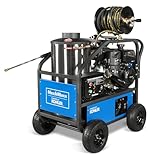
Our Top Picks
 MechMaxx 4000 PSI 4 GPM ZONSEN E-Start EngineZonsen (4 Wheels)39.4 x 30.29 x 53.4 inches450 poundsCheck on Amazon
 MechMaxx 4000 PSI 4 GPM HONDA E-Start EngineHonda (4 Wheels)39.4 x 30.28 x 53.4 Inches450 poundsCheck on Amazon
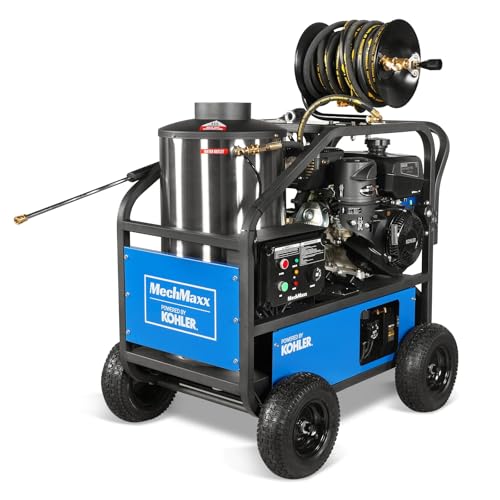 MechMaxx 4000 PSI 4 GPM KOHLER E-Start EngineKohler (4 Wheels)39.4 x 30.3 x 53.4 Inches450 poundsCheck on Amazon

Top 3 picks at a glance
How Heating Methods Change Cleaning Power
Hot water pressure washers don’t just add heat, they cut the time and chemistry needed to break down hydrocarbons. There are three heating approaches, and your fuel access and power supply will decide which one makes sense.
1. Diesel / Kerosene-Fired Burner Coil (Most Common)
This is the standard for commercial hot water units. A fuel burner heats a coiled steel tube that water passes through after the high-pressure pump. Brands like Karcher HDS series, Landa HOT Series, Mi-T-M HSP and HSS Series, and NorthStar skid-mounted units all use this design.
- Heat output: Typically 300,000 to 550,000 BTU/hr
- Temperature rise: 110°F to 150°F above inlet temperature, with outlet temps up to 200-210°F
- Power requirement: Still needs 120V or 240V for the burner ignition, fuel pump, and controls, but far less electrical draw than all-electric heat
- Best for: Shops, farms, construction yards, fleet washing where diesel or kerosene is already on hand
2. Propane / Natural Gas-Fired
Less common, but used where indoor air quality or fuel storage rules prohibit diesel. Heat output is similar to diesel, though propane tanks add logistics and natural gas units are usually stationary.
- Best for: Food processing, indoor wash bays with proper venting, stationary installations
3. Electric Heated
Uses large electric heating elements instead of combustion. Requires a massive electrical service and has slower recovery.
- Heat output: Limited to about 30,000 to 100,000 BTU/hr equivalent (9-30 kW) on common 230V single-phase or 480V three-phase power
- Temperature rise: Often only 40-70°F at 3+ GPM, so outlet temps of 140-155°F max on high-flow models
- Best for: Indoor use with no exhaust venting allowed and where 480V power is available, light degreasing rather than heavy equipment cleaning
If you need true 180-200°F water at 4 GPM for heavy grease, a fuel-fired burner is the only practical choice without industrial electrical service.
What Pressure, Flow, and Temperature Actually Do
Pressure (PSI) breaks the bond between dirt and the surface. Flow (GPM) carries it away. Heat dissolves grease and oil. You need all three in balance.
- 2,000-2,700 PSI / 2.5-3.0 GPM / 140-160°F: Light commercial. Good for vehicles, small shop floors, lawn equipment, and moderate grease. Usually $1,500-$2,800 for diesel-fired models.
- 3,000-3,500 PSI / 3.5-4.0 GPM / 180-200°F: The sweet spot for most buyers. Cleans concrete, heavy equipment, engine bays, dumpsters, and agricultural machinery without damaging surfaces when used with the correct nozzle. Usually $2,800-$5,500.
- 3,500-4,000+ PSI / 4.0-5.5 GPM / 200°F+: Industrial skid and trailer units. For daily fleet washing, oilfield equipment, and parking structures. Often requires belt-drive triplex pumps and 15+ HP engines. Usually $5,500-$11,000+.
Cold water can remove mud and loose dirt, but at 50°F it takes detergent and agitation to cut grease. At 180°F, that same grease emulsifies on contact, which is why a 3 GPM hot water machine will out-clean a 4 GPM cold water machine on oily concrete.
Worked Calculation: How Much Fuel Heat Really Takes
Understanding BTU requirements explains why electric hot water washers are limited and helps you estimate fuel use.
Formula: BTU/hr = GPM x 8.33 (lbs per gallon) x 60 (minutes) x Temperature Rise (°F)
Example: You have 60°F inlet water and want 190°F outlet water at 4.0 GPM.
- Temperature Rise = 190 – 60 = 130°F
- BTU/hr = 4.0 x 8.33 x 60 x 130 = 259,944 BTU/hr of energy transferred to the water
- Burners are about 80-85% efficient, so input required = 259,944 / 0.82 = approximately 317,000 BTU/hr
- Diesel contains about 140,000 BTU per gallon, so fuel use = 317,000 / 140,000 = 2.27 gallons per hour at full fire
In practice, the burner cycles and does not fire continuously, so actual use is often 1.4 to 2.0 GPH for a 4 GPM machine in normal degreasing. A 10-gallon diesel tank therefore gives you roughly 5-7 hours of hot-water operation. An electric unit would need about 76 kW to do the same job continuously (317,000 BTU/hr / 3,412 BTU per kW), which is why it would require a 90A+ 480V three-phase circuit, not a standard wall outlet.
Use this to size your power and fuel: if you only have 120V/20A available, you are limited to about 4,500W or 15,000 BTU/hr of electric heat, which equals less than 15°F rise at 4 GPM. You will need fuel combustion for anything hotter.
Model Classes Compared
| Class | Example Type (Spec Class) | PSI / GPM | Max Temp | Fuel Use (Avg) | Power Needed | Best Surfaces |
|---|---|---|---|---|---|---|
| Compact Electric Hot Water | Mi-T-M 1700 Series / Karcher HDS-E 8/16 | 1,300-1,700 / 2.0-3.0 | 155°F | None (all electric, 22-30 kW) | 480V / 30-45A 3-phase | Indoor floors, food carts, light auto parts |
| Mid-Range Diesel Portable | NorthStar 157302 / Mi-T-M HSP-3004 | 3,000 / 3.5 | 200°F | 1.4-1.7 GPH diesel | 120V / 15A + diesel | Trucks, tractors, concrete with oil film, shop equipment |
| Commercial belt-drive | Landa HOT3-11024D / Karcher HDS 1000 BE | 3,500 / 4.0 | 210°F | 1.8-2.2 GPH diesel | 120V / 20A + diesel | Heavy equipment, concrete, asphalt, dumpsters, fleets |
| High-Flow Skid/Trailer | Landa HOT4-3000 / Hydro Tek SS Series | 3,500-4,000 / 5.0-5.5 | 200°F | 2.5-3.4 GPH diesel | 12V battery + diesel, engine drive | Large lots, oilfield pads, construction fleets |
Decision Matrix: Match Your Situation to the Right Machine
| Your Situation | Buy This Type | Why |
|---|---|---|
| Washing 1-2 vehicles or a small shop floor with occasional grease, have standard 120V outlet | 3,000 PSI / 3-3.5 GPM diesel-fired portable | Lowest cost to get true 180°F+ water without upgraded electrical |
| Indoor wash bay with no exhaust venting allowed | Electric hot water, 1,500 PSI / 3 GPM class | No combustion fumes, but accept lower temp and slower cleaning on heavy grease |
| Cleaning oily concrete, skid steers, or farm equipment weekly | 3,500 PSI / 4.0 GPM belt-drive diesel | Belt-drive pumps last 2-3x longer than direct-drive; 4 GPM rinses 30% faster than 3 GPM |
| Mobile fleet or property maintenance business | Engine-driven skid with 5+ GPM and 10+ gallon fuel tanks | No external power needed; high flow is income – more square feet per hour |
| Strict need to use natural gas / propane only | Stationary propane-fired unit with 200°F coil | Meets fire code where diesel storage is prohibited |
Surface Guide: Temperature and Nozzle Choices
Hot water can damage the wrong surface if you use too much pressure or get too close. Use temperature and nozzle angle together.
- Concrete and Bare Block: 180-200°F, 25-degree nozzle (green), 3,000-3,500 PSI at 12-18 inches. For heavy oil saturation, apply degreaser, dwell 5-10 minutes, then wash at 190°F. Do not use a 0-degree nozzle, it will etch concrete.
- Painted Metal, Trucks, and Equipment: 160-180°F, 25 or 40-degree nozzle (green or white), 1,500-2,500 PSI at 18-24 inches. Keep the burner at 160°F for vehicle paint to avoid softening clear coat, and never hold the wand closer than 12 inches.
- Wood Decks and Fencing: Hot water is rarely needed. If you must remove mildew or old stain, use 140°F max, 40-degree nozzle, and under 1,500 PSI. Hot water raises wood grain faster than cold.
- Asphalt: Keep under 180°F and under 3,000 PSI. Asphalt binder softens with heat and high pressure will strip aggregate.
- Heavy Steel (Frames, Implements, Dumpsters): 200°F, 15-degree nozzle (yellow) at 3,500 PSI is effective. Use a 0-degree only for the initial cut on thick grease piles, then switch to 25-degree to rinse.
Always start with the burner off to wet the surface, then enable heat once the coil is flowing. Running a hot coil without water flow will trip the high-limit and can coke fuel in the coil.
What to Check Before You Buy
- Pump Type: General, Comet, and AR belt-drive triplex pumps with ceramic plungers are the standard for longevity. Direct-drive axial pumps are cheaper but run at engine RPM and wear faster in daily commercial use.
- Coil: Look for schedule 80 steel coil, 1/2-inch or larger diameter, with rust-inhibiting coating and a 5-year warranty. A larger coil holds heat longer and recovers faster.
- Burner Efficiency: A 12V diesel burner with forced-air ignition is more reliable in wind than older transformer ignition. Check for flame sensor and high-limit shutoff.
- Water Supply: Hot water washers still need adequate inlet flow. A 4 GPM machine needs at least 5 GPM from the garden hose or buffer tank to avoid pump cavitation, especially when inlet water is warm.
- Softeners and Scale: If your inlet water is over 7 grains hardness, install a water softener or use a descaling solution quarterly. Scale inside a 200°F coil is the most common cause of lost temperature and coil failure.
- Portability: Empty weight for a 4 GPM diesel portable is typically 350-500 lbs. Ensure your trailer or truck bed and ramp can handle it, and that you have a 10-12 gallon diesel tank for a full day’s work.
FAQ
Can I use a hot water pressure washer with cold water only?
Yes. All fuel-fired hot water machines have a burner on/off switch. Run with the burner off for standard cold-water cleaning on surfaces like wood or vinyl where heat is not needed. Never run the pump without water, even when the burner is off.
Do I need special detergent with hot water?
You need less detergent, not more. Use a high-alkaline degreaser rated for hot water (120-200°F) and for downstream injection if your machine injects after the coil. Many powders rated for cold water will bake onto the coil if injected upstream.
How hot is too hot for vehicle washing?
For modern automotive paint, stay at or below 160-170°F and keep pressure under 2,000 PSI at the surface. Higher temps can soften wax, vinyl wraps, and fresh paint within 90 days of application.
Can I run a diesel hot water washer indoors?
Only with proper exhaust venting and carbon monoxide monitoring. The burner produces exhaust similar to a furnace. Electric hot water units are the alternative for unvented indoor bays.