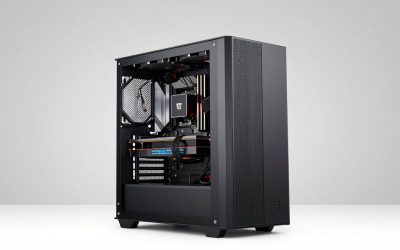
Not every gaming or general-purpose PC needs a discrete graphics card. An APU, a processor with capable integrated graphics built in, lets you build a fully functional PC with no separate GPU at all. That can save money, cut power draw, and shrink the build, but it comes with clear performance ceilings. Understanding what an APU is and where its graphics run out of road helps you decide whether skipping the graphics card is smart or a false economy.
APU basics
APU stands for accelerated processing unit, a term for a CPU that includes a reasonably powerful graphics processor on the same chip. Many standard CPUs also include basic integrated graphics for display output, but true gaming-capable APUs go further, with enough graphics horsepower to play many games at 1080p on lower settings. The trade-off is that integrated graphics share system memory and cannot match a dedicated card with its own fast VRAM.
What an APU can and cannot do
A modern gaming APU handles esports titles, older games, and many current games at 1080p with modest settings, often at very playable frame rates. It struggles with demanding AAA titles at high settings, high resolutions, and heavy ray tracing. For those, a discrete GPU is still essential.
| Workload | APU (no GPU) | Needs discrete GPU? |
|---|---|---|
| Office, web, media | Excellent | No |
| Esports titles 1080p | Very playable | No |
| Modern AAA, low-med 1080p | Often playable | Optional |
| AAA high settings / 1440p+ | Struggles | Yes |
| Heavy ray tracing | Not suitable | Yes |
Why build APU-only
An APU-only build shines as a budget starter PC, a compact living-room machine, a home office box, or a stopgap while GPU prices are high. You get a complete, working system for less, then add a discrete GPU later when budget allows, since most APU platforms have a free PCIe slot waiting. Give the APU fast dual-channel memory, because integrated graphics lean heavily on memory bandwidth, and you will squeeze noticeably more performance out of it.
Getting the most from integrated graphics
An APU rewards a few specific choices that ordinary CPU builds can ignore. Because the graphics share system memory, running a fast dual-channel kit rather than a single stick can lift gaming frame rates substantially, sometimes by double-digit percentages, since bandwidth is the integrated GPU’s tightest constraint. Some platforms also let you allocate more memory to the graphics in firmware, which can help in certain games. And keeping graphics drivers current matters just as much as on a discrete card, because driver updates frequently improve APU game performance.
Settings that keep games playable
To game happily on an APU, aim for 1080p and be willing to use lower or medium presets, plus any built-in upscaling the game offers to render at a lower internal resolution. Turning down the most expensive settings, shadows, reflections, and heavy post-processing, recovers a lot of frames for little visual loss. With sensible settings, an APU turns many titles that look unplayable at ultra into smooth experiences, which is exactly the expectation to set for a graphics-card-free build.
Plan the build to add a GPU later
One of the quiet strengths of an APU system is that it is a complete PC you can upgrade, not a dead end. Choose a motherboard with a full-length PCIe slot and a power supply with a spare PCIe power connector or two, and you can drop in a discrete graphics card whenever the budget or the games demand it. Sizing the PSU with that future card in mind, rather than just the APU’s modest draw, means the upgrade later is a five-minute job instead of a second purchase.
Frequently asked questions
Can you game on an APU without a graphics card?
Yes, within limits. A modern gaming APU plays esports titles and many current games at 1080p on lower settings at playable frame rates. It is not built for AAA games at high settings or higher resolutions, where a discrete GPU becomes necessary.
Does RAM speed matter more with an APU?
Yes, significantly. Integrated graphics share system memory and are bandwidth-limited, so faster dual-channel RAM directly improves APU gaming performance. Running a fast dual-channel kit is one of the easiest ways to get more frames out of an APU-only build.
Bottom line
An APU is a CPU with capable built-in graphics that lets you build a complete PC without a discrete GPU, ideal for budget, compact, or stopgap systems. It handles everyday tasks and 1080p esports well but not demanding AAA gaming. Pair it with fast dual-channel RAM, and keep a PCIe slot free to add a graphics card later.