A new PC that restarts without warning is frustrating, especially when it happens during gaming, Windows setup, or an otherwise light task. The cause is usually not mysterious: unstable power, a loose connection, overheating, memory instability, a driver fault, or a Windows configuration problem are the most common culprits. The key is to avoid changing several things at once. Start by collecting evidence, then test one variable at a time.
For a newly built or newly purchased system in 2026, prioritize hardware seating, BIOS defaults, temperatures, and power delivery before assuming Windows is corrupt. A restart with no blue-screen message often points to power loss, thermal protection, or a low-level hardware instability.
Most Common Causes
| Cause | Symptom | Likelihood |
|---|---|---|
| Loose power cable, RAM, or GPU | Random reboot, failure under movement or load, no consistent error | High on new builds |
| Unstable EXPO/XMP memory profile | Restarts, game crashes, blue screens, errors while installing software | High |
| CPU or GPU overheating | Restart during gaming, rendering, shader compilation, or stress testing | Moderate to high |
| Power supply or wall-power issue | Instant black screen and restart, often when GPU power demand rises | Moderate |
| BIOS, chipset, or graphics driver issue | Restart after sleep, during game launch, or shortly after Windows loads | Moderate |
| Windows automatic restart after a system crash | System reboots too quickly to display a blue-screen stop code | Moderate |
| Faulty component | Problem remains after reseating, default BIOS settings, and clean testing | Lower, but possible |
Diagnose Step by Step
1. Record when the restart happens
Note whether the PC restarts at idle, only in games, during Windows startup, after waking from sleep, or when launching a particular application. A restart under GPU-heavy gaming suggests heat or power delivery. A restart while idle can point to memory, drivers, BIOS settings, or a defective component.
Open Event Viewer with Win + X, then select Event Viewer. Go to Windows Logs > System and look for entries at the restart time. “Kernel-Power” with Event ID 41 confirms Windows detected an unexpected shutdown, but it does not identify the root cause. Also look immediately before it for “WHEA-Logger,” disk errors, driver errors, or BugCheck entries.
2. Stop Windows from hiding blue-screen errors
Press Win + R, type sysdm.cpl, and press Enter. On the Advanced tab, select Settings under Startup and Recovery. Clear Automatically restart, then click OK. If the next failure produces a blue screen, photograph the stop code and any driver filename shown.
3. Check temperatures and fan behavior
Enter BIOS or UEFI by repeatedly pressing Delete or F2 immediately after powering on. Check the CPU temperature on the hardware-monitor page before Windows loads. A steadily rising idle temperature or a CPU temperature already near the CPU’s thermal limit is a cooling installation issue.
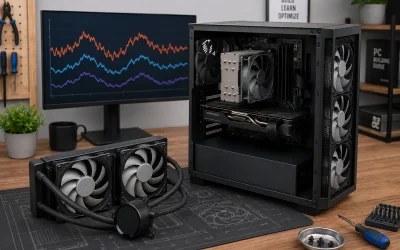
In Windows, verify that CPU cooler and case fans spin normally. Make sure the pump is connected to the correct header if the PC uses liquid cooling. A fan connected to a hub may not report RPM to the motherboard, but the CPU cooler must still receive power.
4. Return BIOS settings to stable defaults
In BIOS, use the option usually named Load Optimized Defaults, Load UEFI Defaults, or Restore Defaults. Save and exit. This disables manual overclocks, undervolts, memory tuning, and aggressive motherboard enhancement settings.
After the system is stable, test the memory profile separately. Do not enable EXPO/XMP, CPU overclocking, GPU overclocking, and custom fan or voltage settings at the same time.
5. Reseat critical hardware with power disconnected
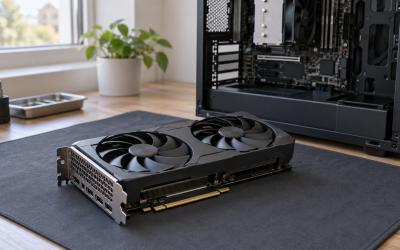
Shut down, switch off the power supply, unplug it, and hold the case power button for 10 seconds. Remove and reinstall the RAM, graphics card, and major power connectors. Check the motherboard’s 24-pin connector, CPU EPS connector near the top of the board, GPU power connector, and both ends of any modular PSU cable.
Use separate PCIe power cables for a power-hungry graphics card when the PSU and GPU documentation call for them. Do not mix modular cables from different power supply brands or models; even similar-looking cables can have different pinouts.
6. Test memory at stock settings
With EXPO/XMP disabled, run the built-in Windows Memory Diagnostic: press Win + R, type mdsched.exe, choose Restart now and check for problems, and let it complete. For intermittent failures, test one RAM module at a time in the motherboard slot recommended for a single stick, commonly labeled A2.
7. Separate software faults from hardware faults
Boot into Safe Mode: hold Shift while selecting Restart, then choose Troubleshoot > Advanced options > Startup Settings > Restart. Press 4 for Safe Mode. If the PC stays stable there but restarts during normal use, drivers, startup software, or Windows files become more likely.
Fixes by Cause
Loose RAM, GPU, or Power Connections
What causes it: Shipping vibration, incomplete installation, or a connector that is not fully latched can interrupt power or data long enough to restart the system.
How to check: Inspect each connector with the PC unplugged. RAM retention clips should be fully engaged. The GPU should sit level in the PCIe slot, and its rear bracket screws should be secure. Look for a visible gap at the GPU power plug or motherboard power plugs.
What to do: Reseat RAM and the graphics card. Firmly reconnect the 24-pin ATX cable, 8-pin or 8+4-pin CPU power cable, and GPU power cable. Confirm the CPU cooler fan is connected to CPU_FAN, or configure the relevant BIOS fan-warning setting only if the board documentation supports a different header.
How to undo: No configuration rollback is needed. If a reseated component makes the problem worse, power down and reinstall it carefully, checking slot alignment and cable routing.
EXPO/XMP Memory Instability
What causes it: EXPO and XMP run memory above default JEDEC settings. A kit listed as compatible can still need a BIOS update, lower memory speed, or different training settings on a particular CPU and motherboard.
How to check: In BIOS, find the memory profile setting, often under Ai Tweaker, OC, Tweaker, Extreme Memory Profile, EXPO, or DRAM Settings. Disable the profile and use the PC normally. If restarts stop, the profile was likely unstable.
What to do: Update the motherboard BIOS using its built-in flash utility, then retry the profile. If instability returns, leave the profile off or choose a lower supported memory speed rather than manually raising voltage. Verify the RAM is installed in the recommended two-stick slots, commonly A2 and B2.
How to undo: Re-enable EXPO/XMP in BIOS and save changes. If the PC fails to boot afterward, clear CMOS using the motherboard’s documented Clear CMOS button, jumper, or battery-removal procedure.
CPU Cooling or Thermal Shutdown
What causes it: A cooler can be mounted unevenly, have insufficient thermal paste contact, retain a protective plastic film, or have a disconnected fan or pump. The CPU may then trigger protective throttling or shutdown behavior.
How to check: Watch CPU temperature in BIOS and verify the CPU fan or pump RPM. Inspect the cooler mount only after the PC has cooled down. Confirm any plastic protective film was removed from the cooler cold plate.
What to do: Reinstall the cooler using the correct mounting hardware and an even cross-pattern when tightening screws. Apply a small, appropriate amount of fresh thermal paste if the cooler was removed. Set the CPU fan header to the correct control mode: PWM for 4-pin PWM fans and DC for 3-pin fans.
How to undo: Restore the original fan curve by loading BIOS defaults or selecting the prior fan profile. Do not remove working thermal paste or cooling hardware unless you are prepared to remount it.
Power Supply, GPU Cable, or Wall-Power Problem
What causes it: A defective PSU, insufficient power capacity, loose GPU power connection, damaged cable, overloaded extension strip, or unstable outlet can cause instantaneous restarts when load changes.
How to check: Determine whether restarts occur during games or graphics-heavy tasks. Inspect cables for scorching, bent pins, or excessive strain. Test the PC directly from a known-good wall outlet, bypassing low-quality power strips and extension cords.
What to do: Reconnect all PSU cables, use only cables supplied with that exact PSU, and ensure the PSU’s rear switch is fully in the on position. If possible, test with a known-good, adequately rated power supply. For prebuilt systems, request warranty support rather than opening a sealed PSU.
How to undo: Return to the original outlet or power strip only after confirming it is not contributing to the problem. Never open the power supply itself; it contains hazardous components.
Driver, BIOS, or Windows Corruption
What causes it: Early driver versions, incomplete Windows updates, firmware bugs, or corrupted system files can trigger crashes that Windows immediately restarts from.
How to check: In Settings > Windows Update > Update history, check whether restarts began after a driver or cumulative update. In Device Manager, accessed through Win + X > Device Manager, look for devices with warning icons. Review Event Viewer for BugCheck or driver-related entries.
What to do: Install motherboard chipset drivers, network drivers, and graphics drivers from the PC or component manufacturer. Update BIOS only when the system is stable and follow the board maker’s exact flash instructions. Run an elevated Command Prompt and enter sfc /scannow, then run DISM /Online /Cleanup-Image /RestoreHealth.
How to undo: Use Settings > Windows Update > Update history > Uninstall updates to remove a recent problematic Windows update. For a driver, open Device Manager, right-click the device, select Properties > Driver > Roll Back Driver when available.
When to Replace or Reinstall
Replace or warranty-claim hardware when the PC still restarts after BIOS defaults, component reseating, a clean power source, and memory testing at stock settings. A PSU is a priority replacement candidate if restarts are sudden, load-related, and persist with different cables or outlets. Replace RAM when one module consistently fails while another works in the same slot. Seek service for a motherboard if multiple known-good components behave inconsistently across slots or ports.
Reinstall Windows only after hardware checks. A clean installation can resolve deeply corrupted drivers or system files, but it cannot repair a loose CPU power cable, overheating cooler, failing PSU, or unstable RAM. Back up personal files first. Create installation media, boot from it, and choose Custom: Install Windows only; delete partitions only when you have confirmed the correct drive is selected and your data is backed up.
FAQ
Why does my new PC restart randomly with no blue screen?
An instant restart without a blue screen commonly indicates power loss, PSU protection, overheating, or hardware instability below the Windows level. Disable Automatically restart in Startup and Recovery so Windows can display a stop code if it is actually crashing.
Can XMP or EXPO cause random restarts?
Yes. Memory profiles are a frequent source of instability on new systems. Disable EXPO/XMP, test at default settings, update BIOS if needed, and only then retry the profile. If it remains unstable, use a lower memory speed or leave the profile disabled.
Is Kernel-Power Event ID 41 the cause of the restart?
No. Event ID 41 means Windows noticed the previous shutdown was unexpected. It is a timestamp and clue, not a diagnosis. Check the events immediately before it and correlate the timing with gaming load, temperatures, sleep, or software changes.
Should I return a new PC that restarts randomly?
If it is a prebuilt system and the problem continues after basic cable checks, Windows updates, and BIOS defaults, use the seller’s return or warranty process. A new PC should not require risky repair work, PSU disassembly, or extensive part swapping to remain stable.